Showing posts with label 1948. Show all posts

Saturday, December 10, 2016

Eleanor Roosevelt’s Triumph—The Universal Declaration of Human Rights

The United Nations General Assembly meeting in Paris on December 10, 1048 adopted the Universal Declaration of Human Rights.


Today is International Human Rights Day which commemorates the adoption by the United Nations General Assembly meeting at the Palais de Chaillot in Paris of the Universal Declaration of Human Rights on December 10, 1948.  The vote was 48 ayes, 0 nays and 8 abstentions.  The abstentions came from the Soviet Union, the Ukrainian and Belorussian S.S.R.s, Yugoslavia and Poland, as well as South Africa, and Saudi Arabia.
The Declaration was an outgrowth of the bitter lessons of World War II and of President Franklin D. Roosevelt’s Four Freedoms which had become the foundation and promise of the alliance against the Axis Powers known at the United Nations.  As the war drew to a close, the United Nations was chartered as new international body to replace the failed League of Nations.  From the beginning codifying international standards for rights was a priority.
Canadian legal scholar John Peters Humphrey, Director of the Division of Human Rights within the United Nations Secretariat, was selected as the principle writer.  He worked closely with a commission chaired by Eleanor Roosevelt, a tireless advocate for a strong declaration.  Members of the commission were selected from a representative cross section of UN members—Australia, Belgium, Byelorussia, Chile, China, Egypt, France, India, Iran, Lebanon, Panama, Philippine, United Kingdom, U.SA, Soviet Union, Uruguay and Yugoslavia.   
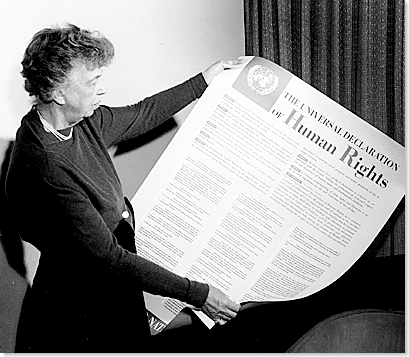
Eleanor Roosevelt admires her handiwork.

Humphrey produced a draft which became the working document with details to be haggled over.  Besides Mrs. Roosevelt,   Jacques Maritain , René Cassin and Stéphane Hessel all of France; and Charles Malik, a Lebanese Christian;  and China’s P. C. Chang played leading roles in working over Humphrey’s texts.
There were numerous struggles in the commission, particularly over objections of Islamic countries over the rights of women, marriage, and the freedom to change religions.  The Soviet Union and its allies and vassal states fought furiously against enshrining individual liberties “at the expense of common necessity.” And conservative Western governments were just as adamantly opposed to including social, economic, and cultural rights.  Mrs. Roosevelt played a key role in patching over differences and coming to a conclusion.
None-the-less, after months of work within the commission the General Assembly debated almost every point and held more than 1,400 votes on virtually every word and clause in the document before it was ready for a final vote of approval.
The Universal Declaration drew heavily on the American Declaration of Independence and Bill of Rights.  In turn this was reflected in the First Principle of the Unitarian Universalsit Association affirming the "Inherent worth and dignity of every person. 

In 1966 the UN General Assembly adopted two detailed additional Covenants on Economic, Social and Cultural Rights, and on Civil and Political Rights, which were ratified by sufficient numbers of member states by 1975 to become international law.  The Universal Declaration of Human rights along with the two covenants are now considered the International Bill of Rights.
The documents, taken together, are important in and of themselves.  But in practice member nations have seldom been willing to challenge the national sovereignty of member states known to be violating the terms of the agreements and perpetrating even the grossest of Human Rights abuses. 
In the midst of a global economic crisis and regional ethnic and religious turmoil, Human Rights are under constant attack.  And the United States, which once proudly proclaimed them, now prefers to cite American exceptionalism for permission to observe them in the breach.  That was the position of the George W. Bush administration for launching the so-called war on terror including acts of kidnapping, summary executions, the use of torture, and indefinite detention without trial.  Although President Barack Obama backed away from some of the excess like the use of torture, he continued and escalated a policy “destroying terrorism anywhere” leading to undeclared war in dozens of countries, targeted assassinations including American citizens, and unrestricted drone warfare resulting in mass civilian casualties.  It has been the shame of his Presidency.
Now comes Donald Trump, an open admirer of “strong leaders” with disastrous human rights records like Russia’s Vladimir Putin and Philippine President Rodrigo Duterte, who has proposed ethnically targeting Muslims and immigrants, revoking citizenship of some protestors—flag burners to start with, and waxed nostalgic for the use of harsh tactics against demonstrators.  His unleashed supporters feel free to harass, intimidate, and threaten anyone who irks him and have physically assaulted Muslims, women, perceived immigrants, LBGT individuals, the homeless, the disabled, liberals and their families.  He has appointed known White nationalist to the highest levels of his administration.  His former campaign manager just announced that “there must be consequences” for those who publicly oppose her boss.  The list goes on and on.  The news gets worse daily.
Human rights are under assault around the world and especially threatened by the rise of Trumpism in the U.S.  The United Nations has never lived up to its obligations to protect individual and groups under attack in member nations.  Clearly the United States government in the hands of the incoming regime not only will offer no protection but will become the oppressor.  Only the people themselves can protect their rights.  Stand up!  Stand united! Join the Resistance!

The fact is that Trump may not only make the Universal Declaration a dead letter, he seems willing to throw the Constitution on the fire as well.
May the ghost of Eleanor Roosevelt haunt the dreams anyone who collaborates in the effort.  The rest of us need to be ready for active resistance.


Sunday, July 14, 2013

The Dixiecrats Take a Hike


Things were tense in the steaming Convention Hall in Philadelphia, Pennsylvania on July 14, 1948 as delegates prepared to vote on the nomination of President Harry S Truman for a full term in his own right.  Delegates from the Solid South were restive and angry.  Earlier the youthful Minneapolis Mayor Hubert Humphrey had roused liberal delegates with a rousing appeal for a strong Civil Rights plank in the Party Platform.  Outraged southerners had booed and cursed.
Harry Truman was considered by many that year as “a gone goose,” in the words of Clair Booth Luce speaking to the Republican Convention in the same city three weeks earlier. The GOP had already captured both Houses of Congress by secure margins for the first time since 1928 in mid-term elections.  The established press and much of the country considered Truman at best an accidental place-holder and a Missouri hick unfit for the demands of the office and the mantle of Franklin D. Roosevelt. 
The Republicans had nominated popular governors Thomas E. Dewey of New York for President and Earl Warren of California as his running mate on a liberal platform.
Moreover Truman was under attack by the left wing of his own party unhappy by his increasingly hostile relations with the former World War II ally the Soviet Union and suspicious of his commitment to Civil Rights and a continuation of New Deal policies.  They were rallying behind popular agronomist and former Vice President and Commerce Secretary Henry Wallace who would bolt the party and run on the independent Progressive Party ticket.
But Truman’s real problem in the Party was in the South.  Traditionally conservative Democrats had generally gone along with the New Deal, using their seniority in Congress to shepherd through much of Roosevelt’s domestic agenda.  In exchange, to the dismay of northern liberals and his wife, Roosevelt had not advanced a Civil Rights program.  But the war changed that.  Moves were made to make pay for Black troops and sailors serving in segregated units to get the same wages as whites and, after Bayard Rustin threatened to lead a war time march on Washington, a guarantee of equal opportunity and pay in defense industries.  Both actions were an anathema to Southerners who also now feared in influx of “cocky” Black veterans ready to challenge the existing order.  Now Truman, with the strong backing of beloved and influential former First Lady Eleanor Roosevelt was supporting strong new Civil Rights legislation.
Truman, hoping to shore up his shaky support on the left and as a signal that he was committed to Civil Rights, was hoping to have the young and very liberal Supreme Court Justice William O. Douglas as his running mate.  But Douglas had turned him down.  Instead Truman turned to old war horse Senator Alben Barkley of Kentucky who had galvanized the convention on opening day with a rousing, chest thumping stem-winder of a Key Note Speech.  Perhaps Barkley presence on the ticket might also re-assure the restive Southerners.
The Agenda was packed on the final day of the convention.  The first order of business was the adoption of a party Platform including Humphrey’s Civil Rights Plank which enjoyed the support of the President. The bitter debate dragged on far past schedule.  When the vote was taken party liberals with the strong support of labor delegates edged the South.  Angrily, Governor Strom Thurman of South Carolina stormed out of the convention trailing 36 delegates including the entire Mississippi delegation and half of Alabama’s.  They met as a rump in a hotel room to watch the rest of the convention unfold on the first televised broadcast.
The remaining Southern delegates put Georgia Senator Richard Russell in nomination.  Although the results were never in doubt, the nominating speeches and long-winded orations excoriating the President and the Convention during the Roll Call of the States kept Truman waiting in his hotel room until well past midnight.
At 2 am on the 15th the President, in a crisp white summer suit, finally took to the podium for his acceptance speech, well after most television viewers had headed to bed.  But Truman electrified the convention with an aggressive speech that set the stage for his famed under-dog campaign.  He vigorously defended the New Deal and pledged to continue its reforms.  He lashed the “Do nothing Congress” and said he would call it into special session and dare the Republican body to enact the provision of their liberal party platform.  “The battle lines of 1948 are the same as they were in 1932,” he declared, “when the nation lay prostrate and helpless as a result of Republican misrule and inaction.”  And he refused to back down on Civil Rights.
If the folks at home only got to see the performance in news reals a few days later, Truman’s performance galvanized most of the rest of the convention delegates who began to believe that he might actually prevail in November.  But those remaining Southerners either left in disgust or sat on their hands.
Shortly after the Convention, Truman defiantly signed the long anticipated Executive Order desegregating the Armed Forces.
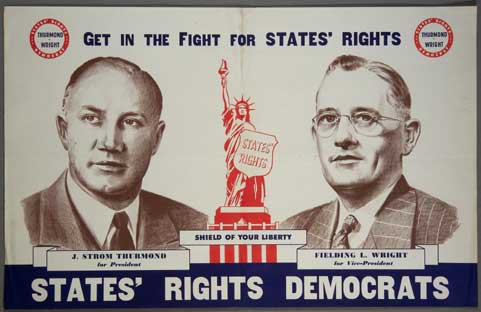
In response, Southerners met at Municipal Auditorium in Birmingham, Alabama, where they nominated Thurmond for President and Governor Fielding L. Wright of Mississippi for Vice president. The new party named itself the States’ Rights Democratic Party but was universally referred to as the Dixiecrats.
A few weeks later at a separate meeting in Oklahoma City, they adopted a platform that made it crystal clear what they stood for.
We stand for the segregation of the races and the racial integrity of each race; the constitutional right to choose one's associates; to accept private employment without governmental interference, and to earn one's living in any lawful way. We oppose the elimination of segregation, the repeal of miscegenation statutes, the control of private employment by Federal bureaucrats called for by the misnamed civil rights program. We favor home-rule, local self-government and a minimum interference with individual rights…. We call upon all Democrats and upon all other loyal Americans who are opposed to totalitarianism at home and abroad to unite with us in ignominiously defeating Harry S. Truman, Thomas E. Dewey and every other candidate for public office who would establish a Police Nation in the United States of America.
The strategy of the Dixiecrats was simple.  They would take over state Democratic Parties where possible and replace Truman with Thurman where possible while running no state or local candidates.  Failing that they would get on the ballot as a third party.  They succeeded in taking over the parties of Alabama, Louisiana, Mississippi, and South Carolina and were on the ballot of the remaining states of the Old Confederacy and in some border states—but not Truman’s Missouri or Barkley’s Kentucky.
As the campaign heated up Wallace and the Progressive party began to flounder, especially when he refused to renounce the public support and endorsement of the Communist Party.  Many liberals, fearing the three-way party split would usher in the Republicans, returned to the Democratic fold, if not entirely enthusiastically. 
In the meantime Wallace’s connections with the Communists re-assured voters tempted to stray to the Republicans that the President was not himself the Red menace painted by the right of the GOP and the Dixiecrats.
Then Truman turned in the greatest campaign in American history, his famed Whistle Stop Tour where he stirred up voters with his famous Give ‘em Hell speeches.  Dewey and Warren ran predictable, dull campaigns making boring speeches to polite partisan crowds in major cities.
Early polling showed the GOP with such a heavy early lead that most news sources decided to suspend polling early to save money.  The press, ensconced in the big cities, hardly noticed the growing enthusiasm for Truman everywhere he appeared.  The pundits unanimously regarded the splintered Democrats as dead in the water.  Almost everyone predicted a Dewey landslide.  The Chicago Tribune confidently printed a headline announcing “Dewey Beat Truman” in their morning edition the day after the voting.
In the end, of course, Truman was the gloating winner.  Despite the multiple parties on the ballot the President almost won an outright majority of the popular vote—49.6%.  He swamped Dewey with 45.1%, Thurman with 2.9%. Wallace was not far behind that. 
The Dixiecrats were able to carry four states—Alabama, Mississippi, North Carolina, and Louisiana plus one Congressional District in Tennessee for a total of 39 Electoral College Votes.  The Republicans carried most of the Northeast except for Massachusetts and Rhode Island as well as two Mid-western states, the Prairie States from Kansas to North Dakota, and Oregon for 189 Electoral vote.  Truman took the rest of the states, including those who had been in the Confederacy, for a whopping 303 Electoral votes.  Although Wallace had run a close fourth in the popular vote, he failed to carry a single state and his utter defeat, along with rising anti-communist hysteria, crushed the far left of the Democratic Party.
After the election the Dixiecrats all returned to the Democratic fold.  Those in Congress, where Democrats had resumed control in the House of Representatives and Senate by comfortable margins, were allowed to retain their senior status, including the Chairmanships of many of the most important committees.  Truman would have to rely on these former foes to advance his agenda, which they generally did, although they blocked his Civil Rights program and his proposal for universal health care insurance.
Segregationist Democrats remained in power across the South, although their voters were more restive each election about the national ticket.  With the adoption of a succession of major Civil Rights bills culminating in the Voting Rights Act of 1965 Southern Democrats began their stampede away from the Democratic Party, just as Lyndon Johnson ruefully predicted.  Many supported arch-segregationist Alabama Governor George Wallace in his 1968 Presidential bid under the American Independent Party banner, and his 1972 run for the Democratic Party nomination which only ended with the attempted assassination that left him gravely injured.
In 1968 Richard Nixon launched his ultimately successful Southern Strategy to lure Wallace and conservative voters to the GOP.  Over the next decades the once Solid South turned increasingly Republican, symbolized by the defection of Senator Strom Thurman himself.
By the early 21st Century the process was completed and the South was such a solid base for the Republicans that it drove the erstwhile party of Lincoln further and further to the right.  Along with the ideologues of the Tea Party the modern GOP is now unrecognizable from its historic roots and is in danger of collapsing into a regional rump party.
And in so many ways this whole landslide of history began with snit and walk-out of the Dixiecrats 65 years ago today.