Showing posts with label Catholics. Show all posts

Saturday, September 26, 2026

The Parthenon is a Ruin but a Grand Survivor of Antiquity


The Parthenon was originally brightly painted.

Sitting on top of the Acropolis, the stony high point of Athens, the Parthenon in all of its ruined glory is one of the most famous structures in the world, an icon of classic antiquity, and for the Greeks, the symbol of their cultural glory.  But its current condition is not just the result of centuries of wear and tear or even of the earthquakes that shake the eastern Mediterranean and Aegean Seas.  Here’s what happened.

The Parthenon we know today was the second—some believe the third—temple structure on that hill.  The first was begun shortly after the Battle of Marathon about 490 BCE.  It was a sanctuary for Athena Parthenos, the Virgin Athena.  It replaced even older temple structures to other gods.  Alas, the structure, sometimes called the proto-Parthenon, did not last long and was not even finished when the Persians sacked the city and razed the Acropolis in 480 BCE. 

Some believe that a second proto-Parthenon was begun around 466 BCE and abandoned before completion, its foundation used in the present structure.  This theory, propounded by German archeologist Wilhelm Dörpfeld around 1890 is not now widely held.

Most believe the site was left vacant for 33 years, some say because of an oath sworn by the Greek allies before the Battle of Plataea in 479 BCE declaring that the sanctuaries destroyed by the Persians would not be rebuilt until Greece was safe from further Persian invasion.  The Peace of Callias between the Greeks and the Persians in 450 BCE supposedly relieved the Athenians of their obligation.  But in fact, decades of war had emptied the city’s coffers.  There was no money for public works on a grand scale.


                                    A bust of Pericles inscribed "Pericles, son of Xanthippus, Athenian." A marble Roman copy after a Greek original from c. 430 BCE.

The great Athenian leader Pericles relocated the seat of the Delian League, the alliance of more than 150 Greek city states which ringed the Aegean and Black Seas and which defeated the Persians, from the island of Delos to Athens and made the Acropolis its de facto headquarters.  Athens was then the preeminent power in that corner of the world, and like many a victor before him, Pericles was determined to show off that power and wealth in stone.  He ordered the crown of the Acropolis leveled and the construction of a new temple to Athena.  Construction lasted from 447 to at least 432 BCE.

We know that the architects of the new building were Ictinos and Callicrates and the sculptor Phidias was both the general artistic supervisor and the creator of the bas relief decoration, incidental sculpture, and the giant statue of Athena Parthenos that was the center piece of the interior.  More on her later.

It was a massive project to build the temple which measured 228.0 x 101.4 feet at the base with 46 out and 23 inner Doric columns supporting a massive roof of marble tiles. The largest single expense in its creation was the transportation of tons of the stone from Mt. Pentelicus, about 10 miles from Athens, to the Acropolis.  The finished work is considered the finest example of Greek architecture ever built and inspired the later Romans and well as the Classical Revival architecture for public buildings that was popular in Europe and America for a century and a half.

Interestingly, although we call the Parthenon a temple, it was evidently not originally a place of worship—it was more of a public monument, a center for civic events, and perhaps more than anything a treasury.  The Cult of Athena Polias, the civic protector of the city, worshiped nearby in the more ancient temple on the northern side of the Acropolis.  Nor were there any know priestesses or rituals associated with the site. 


A reproduction of the Statue of Athena Parthenos by Pheidias, the centerpiece of the Parthenon literally clothed in the treasury of Athens.

Phidias’s famous statue was not an object of veneration which must at all times be ritually attended, cleaned, and preserved.  Which is probably a good thing because the statue was assembled on a wooden core, covered with shaped bronze plates covered in turn with removable gold plates, with the flesh of the goddess’s face and arms made from ivory.  The gold, made from melted coins seized from enemies of Athens, weighed 44 talents—about 2,400 pounds.  Importantly, the plate could be removed.  Essentially, it represented a large portion of the treasury of the Delian League.  The gold plates were removed at least once by Lachares in 296 BCE to pay his troops and were replaced by gilded bronze plates.

The trouble is, no matter how big and heavy you make your treasury by turning it into a monument, eventually someone will conquer you and haul it away.  Which is just what happened.  The Romans carted it off in the 5th Century C.E. It was reported in Constantinople before disappearing entirely.  We know pretty much what the statue looked like, however, from copies, vase paintings, carved gems, coins, and written descriptions.

The Parthenon itself stood and remained dedicated to Athena for nearly 1000 years.  During much of that time it was painted in vivid colors, not at all the austere white that we imagine.  We know that from the contemporary accounts of visitors to Athens and it has been confirmed by the recent archeology which using modern technology has identified tiny residues of paint.  Undoubtedly, it was re-painted after a major fire in the 3rd Century destroyed the roof, which was replaced by wood with clay tiles and pitched more steeply than the original, and damaged the great statue of Athena.

In an act of Christian triumphalism Emperor Theodosius II decreed in 435 AD that all pagan temples in the Byzantine Empire be closed.  The Empire carted off many of the remaining treasures and the Parthenon was left open for further looting. 

After that the building fell into other hands and was converted to other uses.  Around 590 it was converted to an Orthodox Church known at different times as Church of the Parthenos Maria (Virgin Mary), or the Church of the Theotokos (Mother of God).  Many physical alterations and additions had to be made to the building, pagan sculptures that could not be re-interpreted as Christian were removed and many were destroyed, Christian texts were carved into some pillars, and interior walls were painted with icons.  It became one of the four most holy Orthodox pilgrimage places.

The Fourth Crusade conquered Byzantium in 1204 and Athens fell under the sway of the Catholic Church, which tore out Orthodox iconography and renamed the building the Church of Our Lady.  Other physical alterations were made, including the construction of a bell tower at the southwest corner. And so it remained for another 250 years.

Then it was time for the Catholics to exit the stage.  In 1456, Ottoman Turks laid siege to Athens which was defended by a Florentine army which made its last stand on the Acropolis, holding out for two years before surrendering to the Turks. By the turn of the 16th Century, they converted the building to a mosque, scouring it of graven images, both Catholic and pagan, and extending the old church tower into a minaret.

Despite all of these changes of hands, the basic structural integrity of the building was intact and much of the sculptural ornamentation, especially the frieze and pediments were well preserved.  Several Westerners visited the city, wrote detailed descriptions, and made drawings of the venerable building.  Everyone who saw it was struck by its beauty.

In 1687 the Venetians, the dominant naval and military power in the Mediterranean, decided to retake Athens for the greater glory of the Church as part of its wider war against the Ottomans.  Or maybe they just wanted to sack the city.  Hard to tell the difference. 

Francesco Morosini and his subordinate general, the Swede Count Otto Wilhelm Königsmarck laid siege to Athens.  As the Catholics before them had done, the Ottomans fortified the Acropolis—and they made the Parthenon their main arsenal, filling it with hundreds of barrels of powder.  In retrospect it was probably not the wisest idea to make the most visible target in the city into a literal powder keg.

Morosini seems to have been informed of how the Parthenon was being used by a deserter—or perhaps even by a Turkish agent in the belief that the attackers would never target such a historic treasure.  They were wrong.  Morosini pounded the city with artillery from the surrounding hills.  He did not spare the temple.  A mortar round pierced the roof on September 26, 1687 and exploded in the magazine.  


An Italian representation of the bombardment of the Parthenon and attached Mosque by Venetian mortars in 1687 causing the Ottoman powder arsenal inside to blow up almost destroying the ancient temple.

The explosion was tremendous.  Greek architect and archaeologist Kornilia Chatziaslani described the destruction:

. ...three of the sanctuary’s four walls nearly collapsed and three-fifths of the sculptures from the frieze fell. Nothing of the roof apparently remained in place. Six columns from the south side fell, eight from the north, as well as whatever remained from eastern porch, except for one column. The columns brought down with them the enormous marble architraves, triglyphs and metopes.

Three hundred defenders and civilians were killed outright.  Stone fragments rained down like shrapnel over a wide area wounding hundreds more.  Fires were ignited that burned much of the Acropolis and much of the city including many homes.  Of course it finished off Turkish resistance.  Morosini occupied the city in triumph.

Count Königsmarck would later claim that Morosini regretted the “accidental” destruction of the temple, but in his own report back to Venice the commander boasted of his lucky shot.  The next day Morosini ordered the looting of the smoldering wreckage.  His troops tried to remove sculptures of Poseidon and Athena’s horses fell to the ground and smashed as they tried to detach them from the building’s west pediment.  The victor had to content himself with lesser spoils.  21st Century Venetians with their sinking city may be all about preserving “our priceless architectural and cultural heritage”, but clearly in the 17th Century they didn’t give a rat’s ass.

Morosini held the city for less than a year, retreating when the Ottomans assembled a large army to dislodge him.  


A late 18th Century European depiction of the ruined Parthenon and attached mosque.

When the Turks returned, they did not try to rebuild the nearly destroyed building.  They did use some of the stone wreckage as construction material elsewhere in the city and used smaller pieces as land fill.  They also discovered there was a lucrative European market for antiquities and began to loot the ruins for their own profit and to allow visitors to cart off souvenirs which were sometimes hacked from still standing components. 

Thomas Bruce, the 7th Earl of Elgin obtained a controversial permit from government to remove pieces from the Parthenon while serving as the British ambassador to the Ottoman Empire from 1799 to 1803.  Through 1812, Elgin’s agents removed about half of the surviving sculptures of the Parthenon and carted them away to England where they found a prominent home in the British Museum.

A war of independence restored Athens to Greek hands for the first time in centuries in 1832.  For the Greeks the Parthenon was a great cultural symbol.  They quickly leveled the minaret and razed the remaining portions of the mosque.  They cleared the Acropolis of all Latin, medieval and Ottoman buildings.  But they had no money for further restoration or to prevent continued looting by western antiquity collectors and dealers.  


Looted from the Parthenon, the so-called Elgin Marbles are proudly displayed in the British Museum.  Despite decades of appeals and negotiations the Brits refuse to return what they stole.

The Greeks always protested the legitimacy of the Lord Elgin’s questionable deal—indeed the supposed permit documents from the Sultan have never been found.  The Greek government has been demanding a return of their patrimony since 1975 when they began a comprehensive project to restore the Parthenon and the Acropolis.  The British Government has steadfastly refused on the principle that they were stolen fair and square despite decades of rancorous negotiations.


The Parthenon today is threatened by Athens, air pollution and acid rain which eats away at the marble.

There have been several attempts at not so much restoring the Parthenon as cleaning and preserving it in its current state of ruin.  Heavy air pollution and acid rain continue to do damage to the building and some predict may complete what the Venetians started.


Thursday, June 11, 2026

Yankee Fire Brigades vs. Catholics in Boston’s Riot on Broad Street


Generic early 19th Century depiction of rioting/street brawl represents the kind of melee that erupted on Boston's Broad Street in  1837.

It began, as so many unpleasant things do, with a traffic jam of sorts.  It was June 11, 1837 and the place was Boston a/k/a the Hub of the Universe.  After fighting a fire in neighboring Roxbury the volunteer firefighters of Fire Engine Company 2020 stopped at a saloon to wash the smoke out of their throats.  After refreshing themselves they departed to make their way back to the station.  They found their way blocked by a passing Irish funeral parade.  An outraged fireman, named George Fey began cursing at the mourners then took a shove at one of them.  Instantly a melee erupted and quickly escalated as paving stones were hurled and all manner of makeshift weapons, including the brigade’s fire axes, were deployed.

Fire Captain W. W. Miller ordered his men to make a run for the firehouse.  When they got there, Miller sounded an alarm that called out all the city’s fire brigades.  Those heroes rushed to join Company 20 to return to the scene of the initial fight.  By that time the funeral procession had passed but the commotion had attracted a crowd which the firefighters immediately attacked.

It was called the Broad Street Riot and became the greatest street disturbance in the city’s history.  About 1000 people on both sides engaged in a furious street battle.  Fire fighters chased their foes inside some homes which were then systematically smashed up.  Although no one was known to be killed outright, fighting went on for hours.

                                 
                                     Mayor Samuel Atkins Eliot, a prominent Unitarian, called out the Militia to quell the riot.

It was broken up when Mayor Samuel Atkins Eliot—Unitarians will recognize the name as a member of that faith’s most distinguished family—who was on the scene of the original fire, arrived with 10 companies of militia he hastily called out.  The violence was quelled, but not the simmering rage boiling between the immigrant Catholic Irish and Boston’s working class Protestants.  The fine lads of the fire brigades, you see, were all recruited among the city’s Protestant laborers, apprentices, and shop clerks.  No Irish need apply.

Boston, founded by Puritans, had a tradition of rabid anti-Catholicism stretching back well before the American Revolution.  It was then the custom for gangs of apprentices and laborers to gather every year on Guy Fawkes Day—called locally Pope Day—for parades bearing effigies of the Pope to be burned.  Gangs from the North and South sides would customarily run into each other and engage in a semi-ritualistic brawl between them.  All of this in a city virtually bereft of any actual Catholics, except whatever seamen might be lounging around the port. It took a shrewd organizer, Samuel Adams, to transform these street hooligans into the muscle of the Sons of Liberty.

After the Revolution when Boston’s municipal volunteer fire companies were organized, they were drawn from the same pool.


Volunteer fire brigades like this one required a lot of manpower to pull the engine through the streets, handle hoses and bucket brigades, and tear down burning walls.  The men in Boston were recruited among Protestant apprentices, laborers, and street toughs and were idolized in their community.

Boston recovered as a major port and trading center.  By the turn of the 19th Century it was beginning to attract immigrants, especially from Ireland, seeking work.  Most of them were Catholics.  There was plenty of work and whatever resentment the locals might have been kept in check by prosperity.  But President Thomas Jefferson’s embargo on trade with warring European powers and the War of 1812 all but destroyed Boston’s commerce and led to a regional depression.  Tensions mounted between Yankees and Micks.  Street brawls became common.

The first ever public Catholic Mass in Boston was not held until 1788.  In 1803 the Catholics were numerous and prosperous enough to open Holy Cross Church, designed by the same architect—Charles Bulfinch—who was building the city’s impressive churches for the Standing Order.   By 1808 there were enough Catholics—the vast majority of the Irish—to establish the Diocese of Boston. The first Bishop was Jean Cheverus, a refugee from the French Revolution. 

After the War of 1812, commerce resumed, and so did prosperity.  New waves of immigrants arrived.  Catholics began building not only churches but other institutions—a convent and schools.  This rapid rise of Catholics in their midst inflamed the Protestant Clergy as much as job competition inflamed the working class.  Denouncing insidious Popery in thundering terms became common on Sunday mornings and the city’s several religious periodicals could be relied on for more.

No matter how theologically liberal the Boston clergy were—and most of them were very liberal religiously and would soon formally break from the Calvinist Standing Order and become openly Unitarian—few of its members could resist the siren call of anti-Popery.  Rhetoric heated up which seemed to give a sanction to anti-Catholic street violence.


As fire brigades stood by a Protestant mob burned the Ursuline Convent and Girl's Academy.

Things really blew up in 1834 in Charleston—now the Somerville neighborhood of Boston—home to a large population of working class Protestants.  It was also the site of a Convent of Ursuline Nuns, and the academy for girls that they operated.  Since no other equivalently high quality education was available to girls in Boston, many of the city’s Unitarian elite enrolled their daughters there, regardless of warnings from their ministers.  In 1834 the school had 47 students, only six of whom were Catholic.  The neighborhood Protestants resented both Catholics and the haughty Bostonian elite.

Rumors circulated of Protestant girls being “sold” to the convent.  Then in August word began to circulate about a nun who possibly wanted to leave the convent but was prevented from doing so.  Inflamed by a circular calling on the citizenry to intervene to free the mysterious woman, a mob gathered on the evening of August 11.  Early the next morning they rushed the convent with torches and burning tar barrels.  The nuns and students barely had time to escape and hide in the garden while the building was vandalized then set on fire.  Responding fire brigades not only refused to extinguish the flames, but they joined the rioters.  The building burned to the ground in two hours.

The following morning Mayor Theodore Lyman convened a meeting at Faneuil Hall to try to calm the situation and instigate an investigation into the arson.  Bishop Benedict Fenwick called another meeting about the same time at Holy Cross, now officially a cathedral at which he tried to keep the outraged Irish from pouring into the streets to seek revenge.  He was largely successful.

But a new Protestant mob assembled and marched first to Faneuil Hall with the intent of breaking up the Mayor’s meting and then on to the Cathedral.  They were foiled at both points by a Militia guard.  After failing to procure arms from the guarded arsenal they proceeded on to the Convent.  In a frenzy as the Convent itself still smoldered the mob destroyed the gardens and orchards, set bonfires, and pulled down fences before exhausting their fury.

The city’s clergy were divided by the convent riot.  Orthodox ministers including Lyman Beecher, soon to rise to fame as a leading abolitionist either openly cheered the rioters or found excuses for their actions in supposed Catholic immorality and exploitation of pure womanhood.  The city’s Unitarian divines generally decried the violence but refrained from any action or speech which could be considered coming to the defense of Catholics.  The only sympathy came from Bishop Fenwick’s personal friend, the Universalist Hosea Ballou, himself an outcast from the local religious establishment.

The self-confessed ring leader of the riot, John R. Buzzell and a dozen others were charged and brought to trial, but Buzzell boasted:

The testimony against me was point blank and sufficient to have convicted twenty men, but somehow I proved an alibi, and the jury brought in a victory of not guilty, after having been out for twenty-one hours.

In the end only one defendant, a 16-year-old boy seen burning a book after the main arson, was convicted.  The boy had no attorney and not a friend in the world.  He became a safe designated scape goat and was sentenced to life in prison.  That sentence was so manifestly unjust and out of line that Bishop Fenwick and Mother Superior Sister Mary St. George joined 5,000 local citizens petitioning for a commutation of sentence for the boy.  He was eventually released.

Catholic demands for restitution for the failure of authorities to protect their property kept the memory of the Convent Riot alive in both communities as the Boston City Council, Charleston Town Meeting, the County of Middlesex, and the Massachusetts legislature all considered and rejected claims year after year.


Anti-Catholic cartoons like this kept Protestant workers inflamed.

Tensions between Catholics and Protestants remained high.  Then in January of 1836 Awful Disclosures of Maria Monk, or, The Hidden Secrets of a Nun’s Life in a Convent Exposed was published and became an instant best seller.  In fact, it was said to be the mostly widely read American book between Parson Weems’s spurious biography of George Washington and Harriet Beecher Stowe’s Uncle Tom’s Cabin.  The book was a pot boiler novel supposedly written by Maria Monk, a young woman who had escaped from a convent.  It told a hair-raising story of sexual exploitation.  The book, since proven to be almost total fabrication, fueled new waves of anti-Catholicism and led directly to the emergence of the Know Nothings, a rabidly anti-Catholic and anti-immigrant secret society and political party.

Given this kind of history, the Broad Street Riot comes clearly into focus.  Fourteen Irish and four Protestants were brought to trial.  Like the earlier Convent Riot, no Protestants were convicted.  The four Irish were all sentenced to terms in the workhouse.

The riot did cause Mayor Eliot to institute two reforms.  First, he established a paid Fire Department under the authority of the Mayor and Council.  The volunteer brigades were abolished, although almost all of the members of the new professional Department were drawn from their ranks.  Second, he established a Day Police to supplement the existing Night Watch. The two were soon merged into the Boston Police Department.  Recruitment into the new department came mostly from the Irish community.  The Fire and Police Departments remained largely segregated for decades.

Two versions of the riot were told and kept alive in their communities.  The popular version among working class Protestants was that the fire brigade was rushing to a fire when blocked by arrogant Irish mourners who would not let them pass.  In some versions children or whole families perished in the flames.  It was manifestly not true. 

That did not stop it from being believed and the story is retold to this day. The Mighty Mighty Bosstones, a popular Ska and proto-punk band in the 1990’s sang:

The Boston fire-fighting volunteers

 On their way to fight a fire somewhere

Met with a funeral procession

Proceeding way too slow

A brownstone burns out of control

We need to lay to rest this soul

Loggerheads on Broad Street Eye to eye and toe to toe

Broad Street’s just not broad enough

And you just don’t love God enough…

A new wave of immigrants arrived in the 1840’s spurred by the Irish Potato Famine, and the flood gates of Europe opened up after the Civil War.  Catholics gained a majority in the city population and led by Irish politicians seized the City government, a move as bitterly resented by the class of Unitarian Brahmins who were used to running things as by the still large Protestant working class.

Meanwhile the enthusiasm for reform among the intellectual elite of Boston tended to grow in direct proportion to the growing Irish Catholic population.  Early support for moderation in alcohol use was transformed into a temperance movement aimed squarely at the taverns of the scary, rowdy Irish.  Free public education was supported as a counter to the Catholic’s system of parochial schools.  Compulsory public schooling was at first meant to close the Catholic schools and place children into public schools where they would be inoculated with Protestant values.  Crusades for decency and morality in entertainment were aimed at popular amusements.  What Do-gooders saw as reform, the working class Irish recognized as a cultural attack upon them.

Late 19th Century resentments resulted the persistence of the No Irish Need Apply signs still frequently seen in shops and factories.  The politics of Boston and those signs would be bitterly remembered by Joseph P. Kennedy when he became a fabulously rich man married to a daughter of the former Boston Mayor John Francis “Honey Fitz” Fitzgerald.  He inoculated his sons, and by extension their children with a resentment of the WASP elite, and a determination to prove themselves better than any of them.


Members of the almost all Irish Boston Police Department leave a 1919 strike meeting.  WASP governor Calvin Coolidge crushed the strike with National Guard troops and banned the strikers for life from any public employment souring still strong resentments in Boston's Irish Southie community that have lingered to this day.

While Protestant/Catholic relations improved across much of the nation, and as Irish Americans established themselves in politics and the professions, the old strains eased in most places.  But not in Boston.  The Irish found themselves “put in their place” when Governor Calvin Coolidge, a quintessential WASP, crushed the strike by the virtually all Irish Boston Police in 1919, banning every man for life from public service.  Many of those men, unable to find work, would make their close-knit South Boston neighborhood—Southie—a bastion of bank robbers, cartage thieves, and gangsters to this day.

If the Irish in Boston hold resentments to this day, the Protestants have not been shining examples of brotherhood.  The Unitarian’s Beacon Press continued to publish virulent anti-Catholic screeds well into the 1950’s.  Unitarian Universalist ministers generally supported Boston school desegregation in the ‘60s and ‘70s including forced bussing which was voraciously—and occasionally violently—opposed by the Irish of Southie and were often harsh in characterizing the opposition as racist.

More recently conflicts over abortion rights, LGBT rights, and marriage equality, along with the continued clergy sex abuse scandals in the Church, has stoked new criticism of the Church.


A Boston Police sergeant--by the look of him, Irish--guards Black teens boarding school busses in compliance with a court ordered desegregation plan.  They would be greeted by angry crowds and rioting in the same Southie neighborhood where the cop probably lived.  Resentment over "forced busing" and liberal recriminations of racism kept Catholic/Protestant relation inflamed in Boston.

Today in most parts of the country with heavily Catholic populations, large proportions—often majorities—of local Unitarian Universalist congregations—are made up of former Catholics.  But not so much in Boston, and especially not among the Boston Irish.  Disgruntled liberal former Catholics would generally go anywhere to worship before they would set foot in a congregation of those they see as their ancient tribal enemies.

It seems some street brawls never really end.

Saturday, May 24, 2025

The Toleration Act of 1689 as Far as it Went—Which Was Not Very Far at All


King William shown giving his assent to the Act of Toleration.  His wife and co-monarch Queen Mary concurred.

All-in-all it sounded like a much bigger deal than it was when on May 24 William and Mary gave their joint Royal Assent to England’s Act of Toleration of 1689.  The act gave relief from persecution to a narrow set of exclusively Protestant dissenters—including Puritans, Baptists, and some Quakers.  Such largess was not extended to Catholics, Jews, non-Trinitarians, and atheists—a term applied to virtually no one we would recognize as godless today, but to a great many folks with unorthodox religious scruples. 

To even become eligible to stop being subject to arrest, imprisonment, and at least theoretically, execution by being burnt at the stake as heretics, nonconformists had to pledge an Oath of Allegiance to the monarchy and an Oath of Supremacy acknowledging the monarch as Supreme Governor of the Church of England as well as reject the Doctrine of Transubstantiation. This obviously excluded Catholics, but many Protestant dissenters, including most Quakers, eschewed oaths or had other objections.


                                                            The cover for the official publication of the Toleration Act.

Those who signed on the dotted line could cease looking over their shoulders for the sheriff and were even given leave to worship, but not in homes—who knew what kind of heresy might be preached in small gatherings behind the sanctity of the English home?  Their buildings could not be called churches—chapel or meetinghouse were the preferred terms—nor could the building have a bell tower or steeple.  Preachers had to be vetted for orthodox opinions and licensed by the state. 

Moreover, individual adherents of Dissenting sects were still banned from holding any public office, attending universities, and even testifying in certain court cases.  And, of course, they were subject to taxation in support of the established church.


Dissenters' Chapels or Meetinghouses were forbidden to have towers or steeples or most of the characteristics of a church building.  Like this early one in the market town of Devizes, Wiltshire.

The last person actually executed for heresy was the unfortunate dissenting clergyman Edward Wightman way back in 1612.  The Church of England and Protestants had become less concerned with each other than being united in opposition to the Papists who were seen as an existential threat not only to the established Church but to the monarchy.  William and Mary had come to the joint throne earlier the same year from the Netherlands in the Glorious Revolution as Protestant rulers to prevent the return of Catholic Stewarts.  They and Parliament hoped that the symbolic toleration of Protestant dissidents would solidify their rule.

Influential Enlightenment philosopher John Locke had been advocating for just such toleration for years.  But now it was especially politically expedient.


A woodcut portrait of the unfortunate Edinburgh student who was the last person executed for blasphemy in Great Britain in 1697.  His case has inspired poetry, plays, and even a musical. 

Under the Act perhaps some dissenters were safe from the lingering threat of the horrors of the flames and the stake.  But apparently a cheeky schoolboy still had plenty to worry about.  In 1697 Thomas Aikenhead was a 20 year old Edinburgh student who with the swaggering bravado of many a young man, and a tongue likely oiled by the Scottish national beverage, was overheard making shocking statements to his friends. To wit:

…that theology was a rhapsody of ill-invented nonsense, patched up partly of the moral doctrines of philosophers, and partly of poetical fictions and extravagant chimeras: That he ridiculed the holy scriptures, calling the Old Testament Ezra’s fables, in profane allusion to Esop’s Fables; That he railed on Christ, saying, he had learned magick in Egypt, which enabled him to perform those pranks which were called miracles: That he called the New Testament the history of the imposter Christ; That he said Moses was the better artist and the better politician; and he preferred Muhammad to Christ: That the Holy Scriptures were stuffed with such madness, nonsense, and contradictions, that he admired the stupidity of the world in being so long deluded by them: That he rejected the mystery of the Trinity as unworthy of refutation; and scoffed at the incarnation of Christ.

…Or so read the indictment against him for blasphemy drawn up by the zealous Lord Advocate, Sir James Stewart, who demanded the death penalty to set an example to others who might otherwise express such opinions in the future.  The boy refused to recant and a court convicted and sentenced him. 

The case was appealed to the Privy Council where two members of the Court and two prominent ministers begged for mercy on account of the defendant’s tender age.  The Council declined to commute the sentence unless the Church of Scotland interceded on his behalf.  Not only did the church refuse, but its General Assembly also urged “vigorous execution” to curb “the abounding of impiety and profanity in this land.”

At the appointed time the lad was taken from jail where upon he delivered a fine speech that may have been a semi-recantation and was taken to the gallows to be swung.  “the preachers who were the poor boy’s murderers crowded round him at the gallows, and…insulted heaven with prayers more blasphemous than anything he had uttered,” according to Thomas Macaulay’s much later account.

Aikenhead’s death was a testimony to how hollow Toleration could be.  He may have been the last to be sent to the gallows for blasphemy, but plenty more would rot in prison for it.  The last would be John William Gott of the Freethought Socialist League who served the last of several sentences with 9 months at hard labor in 1922.  Yes, you read that right, 1922.  The harsh conditions of his final imprisonment broke his health and he died at the age of 56 shortly after his release.


Boston Puritans were happy to hang young Quaker Mary Dyer and two of her co-religionists.  Illustrator Howard Pyle painted her been marched to her doom in a public spectacle.

But back to the days and years after the Act.  It affected the far off North American Colonies.  Perhaps nowhere more significantly than in New England.  The virtual Puritan theocracy there saw that the act gave some relief to their English cousins.  But they had always vigorously persecuted any deviation from their own Standing Order.  Baptist Roger Williams was driven out to establish Rhode Island.  Anne Hutchinson, her family and allies were banished in 1637 and she had to make a nearly fatal 40 mile trek through virtual wilderness to join Williams.  Mary Dyer and her family were allies of Hutchinson and were also banished.  But Mary returned to England where she met William Fox and became a Quaker preacher.  She boldly returned to Boston, where the pious authorities were glad to hang her and three other Quakers in 1660.

Now, under the Act of Toleration, Protestant dissidents were finally given some measure of freedom in the New England colonies.  Not, however, Catholics who remained in danger.

Naturally Rhode Island and William Penn’s Pennsylvania went further than the Act required and forbad any established religion.  They were joined by neighboring New Jersey and Delaware.  But only Pennsylvania extended toleration to Catholics.  In Maryland, the proprietary colony of Catholic Lord Baltimore, Anglican settlers had swamped his first Catholic settlement and upon gaining the upper hand in the Assembly had promptly disenfranchised the “bloody Papists.”


Virginia Anglicans refused to acknowledge that the Toleration Act applied to the Established Church of the Commonwealth and continued to harass, assault, jail, and fine dissenters.  Here a mob dunks to Baptist Preachers found conducting an open air worship.  As a result Baptists became one of the leading proponents of both religious toleration and strict separation of Church and State.

In Virginia the haughty planters who controlled the government refused to recognize that the Act of Toleration applied to them.  They rallied to the support of the Anglican clergy who demanded the persecution of rapidly spreading dissenting sects, particularly the pesky Baptists.  Baptist preachers were assaulted and arrested, open air meetings were rousted by the militia, homes invaded to prevent private services.  The persecution continued for decades, as did appeals by the Baptists for relief.  Despite numerous attempts and the support of some members of the elite who were schooled in the Scottish Enlightenment, Virginia failed to extend protections to the Baptists and others right up to the American Revolution. 


Thomas Jefferson, shown in an official Presidential portrait years after the fact, considered the Virginia Statute of Religious Freedom in 1777 as one of his greatest achievements.

A sympathetic Thomas Jefferson and his allies would finally rectify matters with the Virginia Statute of Religious Freedom in 1777.  Jefferson’s ally James Madison would ensure that religious liberty and the Separation of Church and State were enshrined in the new Constitution.

Back in the Mother Country a long list of reform acts slowly, excruciatingly slowly, widened what passed for religious freedom.  Here is a list to give you some idea.

The Papists Act of 1778—Allowed some Catholics who would make oaths of loyalty to the Crown and reject claims of Pretenders to hold some public offices, inherit or purchase land.  Perpetual imprisonment for keeping school was abolished and the persecution of Catholic clergy lifted.

Roman Catholic Relief Act 1791—Admitted Catholics to the practice of law, permitted the exercise of their religion, and the existence of their schools.  Chapels, schools, officiating priests, and teachers were to be registered; assemblies with locked doors, as well as steeples and bells to chapels, were forbidden; priests were not to wear their robes or to hold service in the open air; children of Protestants were not to be admitted to their schools; monastic orders and endowments of schools and colleges were prohibited.

Doctrine of the Trinity Act 1813—Extended the protections of the Act of Toleration of 1689 to Unitarians on the same basis as other Protestants.

Roman Catholic Relief Act 1829—Allowed Catholics to be elected to Parliament and most Crown offices.

Roman Catholic Charities Act of 1832—Extended the protection of the Act of Toleration to Catholic schools, places of worship, education, and charities.

Religious Disabilities Act 1846—Ended most remaining restrictions on Catholics for education, charities, and property although Oxford, Cambridge, and Durham Universities were allowed to ban Catholics.


 Jews, once driven from the Kingdom, did not receive protections under the Toleration Act until 1858 during the reign of Queen Victoria.

Jews Relief Act 1858—Extended the protection of the Act of Toleration to Jewish schools, places of worship, education, and charities.

Places of Worship Registration Act 1855—Offered an optional system of registration for non-Anglican places of worship was passed which gave certain legal and fiscal advantages for those that registered, and finally held that “alternative religion was not only lawful, but was often facilitated by the law.”

University Tests Act 1871—Allowed Oxford, Cambridge and Durham Universities to admit Catholics and allow them on their faculties.

Promissory Oaths Act 1871—Repealed most, but not all, of the remaining restrictive clauses of the Act of Toleration.

Statute Law (Repeals) Act 1969—Repealed the final remaining provisions of the Toleration Act.

Criminal Justice and Immigration Act 2008—abolished the common law offenses of blasphemy and blasphemous libel in England and Wales.  Blasphemy remains a criminal offense in Scotland.

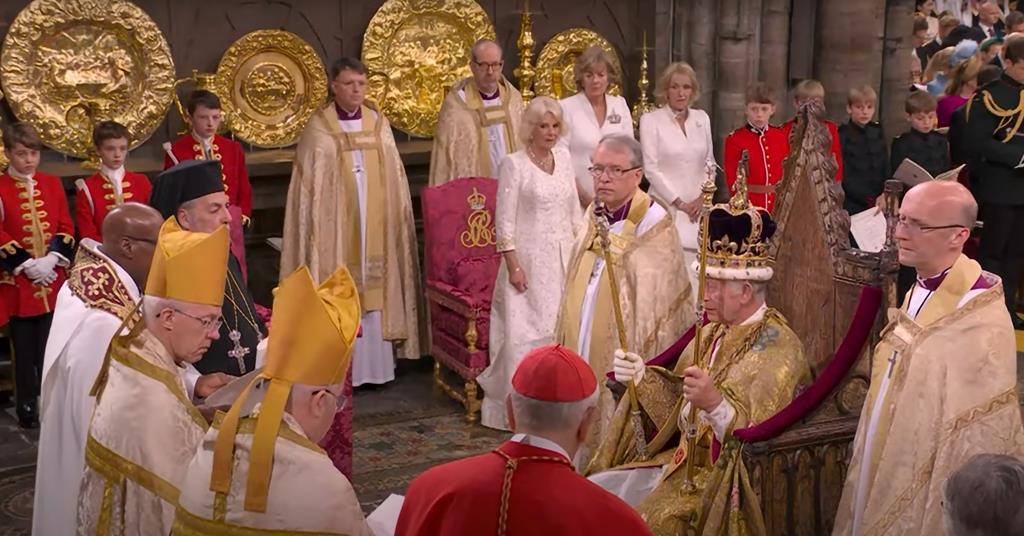
How I prepared to bless King Charles at his coronation' | Real Life |  Premier Christianity

 After his Coronation King Charles III was blessed by Orthodox, Coptic, and Catholic prelates.  Sheiks, Jews, and Imans got their turn to, but not pagans like Wiccans and Modern Druids, or avowedly on the skeptic/agnostic/atheist spectrum.

The Church of Scotland—Presbyterian—is a “National Church but not a State Church.”  The Anglican Church of Ireland was disestablished as a State Church by the Irish Church Act 1869.  The Anglican Church in Wales was disestablished by the Welsh Church Act 1914.  But the Church of England remains the state church there with King Charles III now as its official head who ironically shares his name with a Monarch beheaded for religious reasons.  After being Crowned in Westminster Abby and exiting the chapel and while still ceremonially robed allowed himself to be blessed by Catholic prelates, ministers of dissenting sects, and even Sikhs,  Rabbis, and Imans.