 |
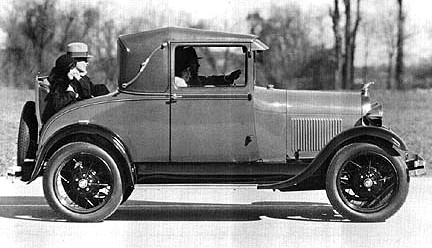
| A Ford Model A cabriolet coupe with the celebrated rumble seat of song and story. |
Henry Ford finally did
it. It was like pulling teeth and the man who once revolutionized an industry and
put Americans behind to wheels of affordable automobiles was dragged
into the wild new world of the Jazz
Age and motorists with money burning holes in their
pockets. On December 2, 1927 Ford
dealers began offering the brand new Model
A replacing at long last 18 years of Model
T production.
The
Tin Lizzie had been the most successful automobile ever sold. Using Ford’s innovative moving assembly line and a simple
design it had been marketed at
prices that any reasonably middle class
American could afford. Autos were no
longer the exclusive plaything of the rich. And as they were produced year
after year, millions of working class and
even poor citizen were made mobile
in second hand Flivers.
Ford
was loath to make changes. He was deep in his heart a stubborn conservative. Moreover, he had peculiar ideas about the morality
of automobile ownership. He regarded
such things as color choices or personalized options offered by competitors as vanities. Of course his any-color-as-long-as-it’s-black philosophy also
streamlined the production process
and kept the per unit price of his cars
low. He considered innovations now
common on competitors like electronic
ignition and cabin heat in
enclosed models as unnecessary
frills.
But
the public was growing tired of breaking
their arms trying to turn over
the Model T engine with a crank. They were also wearing of an engine that by then was under-powered compared to other
brands. It may have been fine with Ford,
who was in no hurry, but customers
were tiring of a vehicle that could be
passed by anything else on wheels on the road including a determined milk wagon.
Sales
of the beloved Model T had been sinking
as competitors, especially Chevrolet,
matched Ford’s production innovations
and added some of their own. Chevy, and
the turncoat former Ford engineers the Dodge Brothers were making their own right-priced mass produced cars and were regularly updating them.
 |
| Henry and Edsel Ford with the new 1928 Model A--Edsel's baby long resisted by his father and sabotaged by him in early production. When it was a huge success the old man took credit. |
Ford’s
Board and his son Edsel finally convinced the old man it
was time for a change. Henry did not
make the transition, mostly overseen by Edsel, easy. He meddled
in production maters—he tried to convert from die stamping body parts from sheet
steel with more expensive drop forge
technology which not only added production costs, but made the cars so heavy that even a new more powerful engine could not produce more speed. The idea
had to be junked at the cost of millions. Edsel supervised the design which was much more
modern and slightly less boxy
than the Model T. It was only after the
new car was a success that Henry pushed his son aside and took the credit for himself.
Edsel
also tinkered with his father’s assembly line process, introducing flexible mass production, which allowed
units on the line to be individualized including the use of four colors plus black and customer-ordered options.
The
car was powered by a new water-cooled L-head 4-cylinder engine that could produce cruising speeds of 65 miles per hour. It also
contained industry innovations including the first use of shatter proof glass.
 |
| Advertisement unveiling the new Model and its body styles. |
Six
body styles could be built on the
basic Model A chassis plus variations of each—a Coupe, a Roadster, a Four Door Sedan,
a Four Door Convertible, a Station wagon or van, and a pick-up
Truck. A simple Roadster could be
had for as little as $385 while a top-of-the-line Town Car with all the options ran to $1,200, not far below the price of luxury
Cadillacs and Packards.
In
the midst of the biggest economic boom
in the country’s history, customers were ready, willing, and able to buy and
spend. By February 1929, one million
Model As had been sold, and by that July, two million. Even with the Wall Street Crash that October and the ensuing plunge into the Great Depression, Ford was able to sell
more than three million units domestically before the car was taken out of
production at the end of the 1932 model year.
In no time at all in its various forms the Model A was the most common sight on the road.
Henry
Ford had learned his lesson. He did not
become too attached to his new baby and replaced it in the 1933 model year with
still more modern Model B with available
with a flathead V-8 engine. And after the mid-30’s the company began offering new models yearly.
 |
| Model As like this Coupe were converted by the thousands into classic hot rods. |
The
model A became, largely because of its widespread
availability, the car on which the original hot rods were built. It
remains a starting point for many classic car restorers and is still
commonly customized. Both historically
accurate restorations and custom
versions are common sights at car shows and in local parades.