Showing posts with label Flag Day. Show all posts

Sunday, June 14, 2026

A Lot Going on When Divided America Observes Flag Day

Sunday promises to be a very busy day.  Americans of all--you should pardon the expression--stripes will claim the national banner as their own in many often conflicting ways.  Not only is it Flag Day, but it falls during Pride Month, the nation's 250th Birthday hoopla, and on the 80th birthday of the man who makes everything about himself.  He is celebrating with a widely mocked UFC fight on the White House grounds under a soaring pavilion--an event which seems to be still unraveling hour by hour.  

Naturally the folks behind the hugely successful No Kings Day protests are offering an alternative. A 90‑minute Rise Up, Sing Out concert at The Town Hall in New York City featuring Bette Midler, Patti Smith, Rufus Wainwright, Sasha Allen, Jane Fonda, and Joy Reid, co‑presented with the Committee for the First Amendment. The event will stream nationwide as local groups host of watch parties. Despite organizers requesting that previously announced local rallies and marches, Indivisible McHenry County is going ahead with its plans for a We the People Rally on Sunday, from 3:00 to 5:00 pm at Rt. 31 and McCullom Lake Road in McHenry.  

  
Marchers in the 2025 Woodstock Pride Fest parade.

It is also LGBTQ+ Pride Month and McHenry County will celebrate at the Woodstock Pride Parade and Festival on the Square from 11 am to 4 pm.  That overlaps with the McHenry roadside rally.  This year there has been organized "push back" from MAGA groups and provocateurs at many local Pride marches and events.

Flag Day might be lost in the shuffle if folks on all sides were not waving it and claiming it for their own.

We’ve been here before as an updated blog post. 

In case you hadn’t noticed today is officially Flag Day, a demi-holiday easily overlooked.  It is celebrated by displaying the American Flag.  Veterans groups often organize solemn flag disposal ceremonies. 

No other country on Earth makes quite the fetish of its flag as does the United States.  The word idolatry comes to mind.  At its worst it elevates the symbol—the Flag—over the substance—the democratic values espoused in the Declaration of Independence and protected by the Constitution.  It is an absolute truism that those who wrap themselves most tightly in the Flag—and these days that is not just a figurative term—are the most disingenuous and dangerousWitness any performance by the Resident of the White House and the seditious mobs that laid siege to the Capitol.

Donald Trump and one of his regular Flag fondling.

On the other hand—especially those who served in the Armed Forces or who were raised in a veteran’s household—have been taught to respect the Flag and “the nation for which it stands.”  I still hang the Flag on my house on patriotic holidays and always place my hat over my heart when it passes by in a parade.  It’s just the way I was raised.

Part of the national devotion to the Flag comes from an odd combination of cultural coincidence and calculated political strategy.  Our National Anthem, not officially adopted until 1931 but widely used on patriotic occasions for more than a century prior, may be the only national song about a flag.  

The Grand Army of the Republic promoted the Flag as a symbol of the Union and a thumb-in-the-eye to former Rebels.

Not widely displayed except at military posts, on Navy ships, and on some Federal buildings prior to the Civil War, the Grand Army of the Republic heavily promoted its use after the war in a spirit of triumphalism of the Union over the vanquished South.  For that reason, display of the national flag was highly unpopular in the South until World War I.

The flag and the Pledge of Allegiance were used to Americanize immigrants, especially children as in this Jacob Riis photo.

The Pledge of Allegiance was penned by Francis Bellamy, a Baptist minister and socialist, for use during celebration the 400th anniversary of the supposed discovery of the New World by Christopher Columbus.  Quickly adopted by schools as part of the daily ritual of beginning classes, the Pledge does not swear allegiance to the government—an inclusive tip-of-the-hat to resentful former Rebels—or even to the Constitution, but to a symbol, the Flag.

By the turn of the 20th Century the Flag was being used as a symbol of assimilation for the waves of emigrants swamping our shores—and as a test of their loyalty.  The most popular composers of the era—the March King John Philip Sousa and Broadways George M. Cohan made literal flag waving as popular as moon-June-spoon ballads.

During World War I, the Woodrow Wilson administration used flag imagery as part of their very sophisticated domestic propaganda operation designed to rouse support of the war effort and raise Liberty Loans.  After the war, the Flag was used to rally support for suppression of the labor movement, radicalism, Socialism, and Communism said to represent sinister alien ideologies.

The flag has often been appropriated to give patriotic cover to hate groups.  Witness this 1925 Ku Klux Klan march in Washington.  But it was also carried by militant unionists at the Lawrence Textile Strike and Chicago Memorial Day Massacre and also by Civil Rights Movement marchers.

Wilson proclaimed the first official Flag Day in 1916.  In 1949, with the country in the grips of yet another Red Scare, Congress made it an official Federal Holiday, although withholding the paid days off for Federal employees standard for other holidays.

June 14 is Flag Day because on this date in 1777 the Continental Congress passed the Flag Act which officially described a new national banner:

Resolved: That the flag of the United States be made of thirteen stripes, alternate red and white; that the union be thirteen stars, white in a blue field, representing a new Constellation.

Betsy Ross almost certainly did not sew the first flag, Washington never viewed it, and the 13 stars in a circle banner may not have never been actually used during the Revolution.  None of that stopped myth makers.

The new official flag—not, by the way, likely first sewn by Philadelphia seamstress Betsy Ross—was based on the unofficial Grand Union flag used by General George Washington during the Siege of Boston.  That flag had the same thirteen alternating red and white stripes but had the English Union Jack in its canton.  Of course, that was before Independence was declared in July of 1776.  It wouldn’t do to keep the reference to the British flag. 

The Act was vague—it did not describe the arrangement of the stars in the field, how the stars should be shaped, or even how large the field should be.  Local flag makers working from the sketchy description produced many variations with five, six, and even twelve-pointed stars; with stars of different sizes; and many variations of arrangement.  Also, the shade of blue used for the field depended largely on what blue cloth the maker might have at hand.

The familiar thirteen stars in a circle was not only not standard, but some historians also doubt if it was used at all during the Revolutionary War.  Others believe that it might have been the flag used at the British surrender at Yorktown.

After Vermont and Kentucky were added to the Union two additional stars and two stripes were added.  That was the Star Spangled Banner observed still flying over Ft. McHenry in Baltimore harbor after an all-night British naval bombardment in 1815.  It became apparent that with more new states, adding stripes would quickly become clumsy. In 1818, after five more states were added, Congress fixed the number of stripes at thirteen with an added star for each new state. 

But it still did not specifically designate an arrangement for the stars.  During the Civil War flags with all manner of arrangements were used.  It was not until the creation of the 48 star flag in 1912 that a specific arrangement was established.  The current 50 star flag has been in use since July 4, 1960 after the admission of Hawaii to the Union.  This year will mark the 66th anniversary of that flag, which has been in service longer than any previous national banner.

Today, the flag is waved by forces on both sides of the great social and political divide even as the nation for which it stood after the perilous on the verge of a second civil war in January 2021.  But many on the left are still chagrined and conflicted about the flag.  Does it represent the on-going lethal threat to which the Black Lives Matter Movement responded?  The ongoing expressions of White supremacy and the continued attacks on basic voting rights?  The attempts to degrade women and attack their bodily autonomy?  The treatment of immigrants and refugees? The continuing militarism and low-grade but bloody war around the world?  Or can the flag be honored as a yet unfulfilled promise? 

The upside-down flag is a traditional sign of distress and has been adopted by Trumpistas, election deniers, and some alt-right militia type groups much to the dismay of many veterans.  Even a Supreme Court Justice--guess who--was caught flying it at both his Washington area home and a Rhode Island summer retreat.

Both sides of the current American social chasm claim to love their country but have seemingly irreconcilable notions about what America is, what it means, and what it should become.

As for me, I will choose hope.  I’ve got my flag out today on the belief that it stands for “Liberty and Justice for All.”  What does your flag mean?


Thursday, June 12, 2025

There Are No Kings Here—Resistance When it Counts


No Kings organized by NE McHenry County IL Indivisible 

This Saturday, June 14, from 11 am to 1 pm hundreds of concerned folks are expected to respond to a call for a No Kings  roadside witness at Route 31 and McCullom Lake Road in McHenry.  The event sponsored locally by Indivisible Mc Henry County is one of more than 1800 Day of Defiance rallies and marches nationwide.  Chicago will hold one beginning with a rally at Daily Plaza at 2 pm.  That will coincide with major Anti-ICE protests.

There is a palpable sense that we are at a tipping point between outright fascism and a successful resistance to oppression.  Here is why…

The Independent - Donald Trump hugged and kissed a flagpole during a  bizarre speech at CPAC in Maryland. "I love you baby," Mr Trump told the flag  as he held tight to 

                                             Trump embracing--or molesting--the Flag.

Saturday is Flag Day, a Federal holiday of such relative obscurity that many folks hardly know exists.  As a regular post here put it:

Flag Day, a demi-holiday easily overlooked is celebrated by displaying the American Flag….No other country on Earth makes quite the fetish of its flag as does the United States.  The word idolatry comes to mind.  At its worst it elevates the symbol—the Flag—over the substance—the democratic values espoused in the Declaration of Independence and protected by the Constitution.  It is an absolute truism that those who wrap themselves most in the Flag—and these day that is not just a figurative term—are the most disingenuous and dangerous.

It is also considered the birth day of the United State Army by the official creation of the Continental Army on June 14, 1775 during the Revolutionary War.  That makes the Army more than a year older than the Independence.  A 250 year anniversary is certainly a notable achievement and worthy of note.  But no other significant milestones were celebrated with much hoopla beyond opening forts and bases to the public and some parade ground drill.

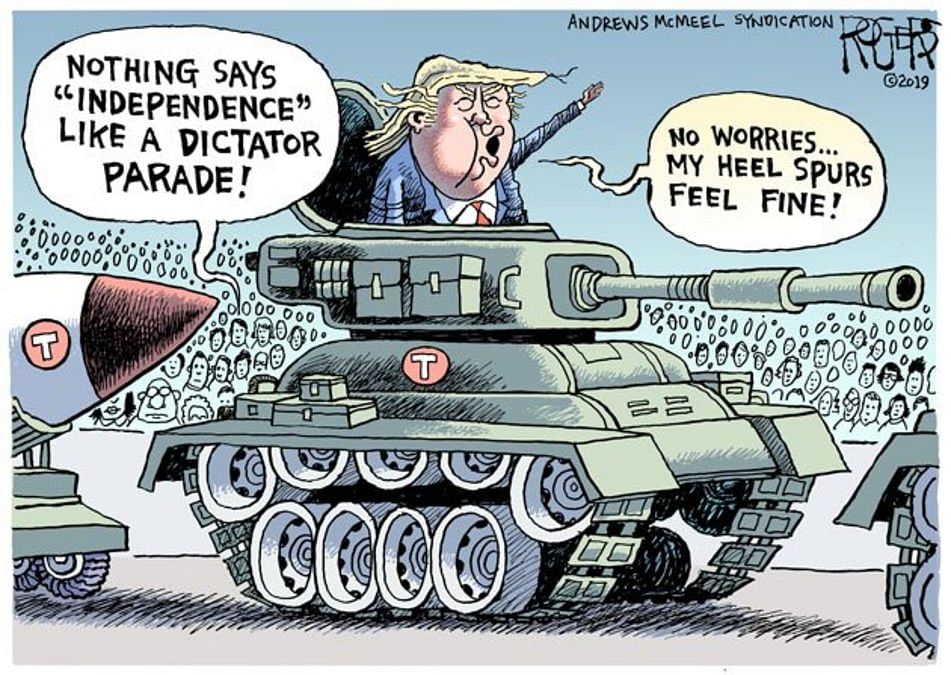
Oh, and little Donny Trump is having a birthday and thinks that a big, exciting, and intimidating grand military parade is better than clowns and balloons for his  party.  He loves parades and when he goes to Europe he gets green eyed with envy for things like Frances Bastille Day hardware display, Moscows May Day marches, and D-Day celebrations.  

Bastille Day: Beleaguered Macron is booed during Paris parade 

                    The French Bastille Day military parade was the porno for Trumps teeny erection  for one of his very own. 

In his first term the Fête Nationale in Paris inspired his desire for Fourth of July spectacular of his own down Pennsylvania Avenue.  But the hubbub in the aftermath of his Capitol insurrection, investigations, impeachment drama, and resistance by the Joint Chiefs of Staff spoiled that dream.  All he got was a delayed Veteran’s Day parade stripped of it heavy armor and missile launchers with few spectators and half-empty reviewing stands.  So disappointing.

His recent European trip inspired him to try again linking the celebration to World War II victory which he says “We won” demeaning the sacrifices of Ally nations  except for noting that the Soviets  lost 55 million people (one of his plucked-from-the-ass exaggerations) but not their Eastern Front victories.  Tying a bigger and better parade to the 80th anniversary was golden opportunity.

The victorious Grand Army of the Republic marches up Pennsylvania Avenue 

 The Grand Review of the Armies in Washington after victory in the Civil War. 

The parade he plans for Saturday is unprecedented.  The Grand Review of the Armies in May of 1865 was an impressive troop procession of victorious armies.  Homecoming parades of American Expeditionary Forces (AEF) in 1919 after the Great War were also victory laps.  But millions under arms scattered across the globe made any such mass grand display logistically impossible.  Troops returning from Korea and Japan were barely acknowledged.

Trump had to dispatch the old Joint Chiefs and most senior commanders to elevate toadies who would not only let him have his precious parade but also be unqueasy about defying Constitutional restraint.


Heavy armored vehicles are already being positioned for Trump military parade this Saturday, 

His big parade is more than just a boondoggle ego trip—it is a declaration of raw power and a threat to any and all who oppose his whims.  He made that clear Tuesday.  Trump told reporters in the Oval Office right after he spoke about sending the National Guard and Marines to Los Angeles to quell protests there. “If any protesters want to come out, they will be met with very big force.”  He pointedly did not make any distinction between peaceful demonstrations  and alleged rioting.

Los Angeles Launches into Fourth Day of Anti-ICE Protest - WSJ 

Repeated images of the same few incidents in Downtown Los Angeles gave the impression the whole city was in flames.  It was not.  Thousands demonstrated peacefully in the city and most residents went about their business unmolested. 

As the timing of that threat makes clear, the danger is in sharper focus than ever in response to resistance to ICE workplace raids and kidnappings in Los Angeles.  Thousands have taken to the streets to protest and to block raids.  The militant, but largely peaceful demonstrations saw some street tussles and a few arrests.  Some clashes did occur in a few block area of downtown LA including rock throwing, window smashing, vandalism, and a couple of car arsons.  Repeated clips of the same incidents of TV and cable news gave the impression that rioting was widespread over the city.  It was not.

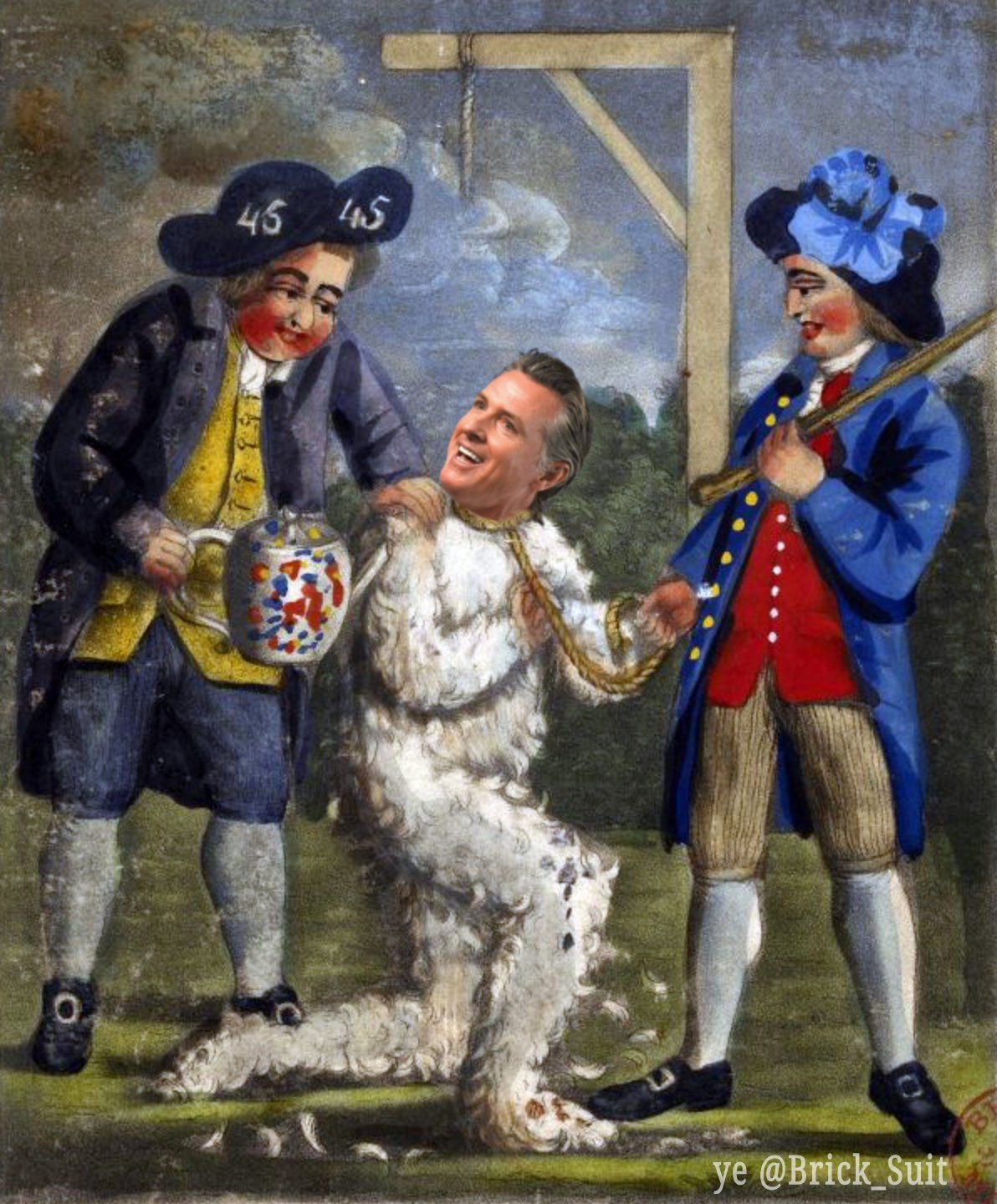
It may have given Trump his Reichstag moment—a phony excuse to usurp dictatorial power.  He first mobilized 2000 California National Guard troops invoking a claim of national emergency over the objections of Governor Gavin Newsome and a Constitutional prohibition of the use of the military against domestic civilians.  Predictably the move inflamed the situation.  Thousands more have taken to the streets.  The Governor and President exchanged insults and threats.  Trump and his lapdog emigration enforcement Czar threatened to arrest him and the Speaker of the House of Representatives suggested the being tarred and feathered was another alternative.

Brick Suit on X: ""Gavin Newsom should be tarred and feathered."  https://t.co/8bwEmgWHk2" / X 

S                                                peaker of the House Mike Johnson suggested the Governor Gavin Newsom be tarred and feathered.

Trump doubled down with more Guard call ups and 700 active duty Marines with combat vehicles and armed with live ammunition.  Clashes in the downtown area escalated with the use of flash bombs, tear gas, and rubber bullets.  Hundreds of arrests have been made mostly by the LAPD.  Most Guardsmen have not been deployed on the streets and Marine officers have admitted that their troops have not been trained in crowd control. 

Trump and Defense Secretary Pete Hegseth have each suggested that similar deployments will be made to other sanctuary cities.  That might be tested after the announcement of special immigration enforcement raids using armored vehicles in five Democratic cities including Chicago on Friday.  Major resistance is expected in all of them.


California National Guard troops stand guard in front of the Federal Building in Los Angeles.

And on Wednesday Hegseth told a Congressional committee that he would not commit to being bound by any court decision against his deployment of Marines.  “What I can say is we should not have local judges determining foreign policy or national security policy for the country.”

The concern is that clashes in those cities could open the door to a Declaration of Insurrection that would suspend Habeas Corpus,  allow mass civilian detentions, override the courts, seize local governments, and possibly even suspend elections.   

Donald the 'dictator' flexes his muscles, and the shroud of secrecy around  the royal baby 

Events are unfolding faster than a mere blogger can keep up with.

Wednesday, June 14, 2023

The History and Emotional Reactions to Flag Day


Note:  We’ve been here before but slightly updated to account

In case you hadn’t noticed today is officially Flag Day, a demi-holiday easily overlookedIt is celebrated by displaying the American FlagVeterans groups often organize solemn flag disposal ceremonies. 

No other country on Earth makes quite the fetish of its flag as does the United States.  The word idolatry comes to mind.  At its worst it elevates the symbol—the Flag—over the substance—the democratic values espoused in the Declaration of Independence and protected by the Constitution.  It is an absolute truism that those who wrap themselves most in the Flag—and these days that is not just a figurative term—are the most disingenuous and dangerous.  Witness any performance by the former Resident of the White House and the seditious mobs that laid siege to the Capitol.

A now Federally indicted scoundrel wrapped himself in the Flag.

On the other hand—especially those who served in the Armed Forces or who were raised in a veteran’s household—have been taught to respect the Flag and “the nation for which it stands.”  I still hang the Flag on my house on patriotic holidays and always place my hat over my heart when it passes by in a parade.  It’s just the way I was raised.

Part of the national devotion to the Flag comes from an odd combination of cultural coincidence and calculated political strategy.  Our National Anthem, not officially adopted until 1931 but widely used on patriotic occasions for more than a century prior, may be the only national song about a flag. 

The Grand Army of the Republic promoted the Flag as a symbol of the Union and a thumb-in-the-eye to former Rebels.

Not widely displayed except at military posts, on Navy ships, and on some Federal buildings prior to the Civil War, the Grand Army of the Republic heavily promoted its use after the war in a spirit of triumphalism of the Union over the vanquished South.  For that reason, display of the national flag was highly unpopular in the South until World War I.

The flag and the Pledge of Allegiance were used to Americanize immigrants, especially children as in this Jacob Riis photo.

The Pledge of Allegiance was penned by Francis Bellamy, a Baptist minister and socialist, for use during celebration the 400th anniversary of the supposed discovery of the New World by Christopher Columbus.  Quickly adopted by schools as part of the daily ritual of beginning classes, the Pledge does not swear allegiance to the government—an inclusive tip-of-the-hat to resentful former Rebels—or even to the Constitution, but to a symbol, the Flag.

By the turn of the 20th Century the Flag was being used as a symbol of assimilation for the waves of emigrants swamping our shores—and as a test of their loyalty.  The most popular composers of the era—the March King John Philip Sousa and Broadways George M. Cohan made literal flag waving as popular as moon-June-spoon ballads.

During World War I, the Woodrow Wilson administration used flag imagery as part of their very sophisticated domestic propaganda operation designed to rouse support of the war effort and raise Liberty Loans.  After the war, the Flag was used to rally support for suppression of the labor movement, radicalism, Socialism, and Communism said to represent sinister alien ideologies.

Wilson proclaimed the first official Flag Day in 1916.  In 1949, with the country in the grips of yet another Red Scare, Congress made it an official Federal Holiday, although withholding the paid days off for Federal employees standard for other holidays.

June 14 is Flag Day because on this date in 1777 the Continental Congress passed the Flag Act which officially described a new national banner:

Resolved: That the flag of the United States be made of thirteen stripes, alternate red and white; that the union be thirteen stars, white in a blue field, representing a new Constellation.


 Betsy Ross almost certainly did not sew the first flag, Washington never viewed it, and the 13 stars in a circle banner may not have never been actually used during the Revolution.  None of that stopped myth makers.

The new official flag—not, by the way, likely first sewn by Philadelphia seamstress Betsy Ross—was based on the unofficial Grand Union flag used by General George Washington during the Siege of Boston.  That flag had the same thirteen alternating red and white stripes but had the British Union flag in its canton.  Of course, that was before Independence was declared in July of 1776.  It wouldn’t do to keep the reference to the British flag. 

The Act was vague—it did not describe the arrangement of the stars in the field, how the stars should be shaped, or even how large the field should be.  Local flag makers working from the sketchy description produced many variations with five, six, and even twelve pointed stars; with stars of different sizes; and many variations of arrangement.  Also, the shade of blue used for the field depended largely on what blue cloth the maker might have at hand.

The familiar thirteen stars in a circle was not only not standard, but some historians also doubt if it was used at all during the Revolutionary War.  Others believe that it might have been the flag used at the British surrender at Yorktown.

After Vermont and Kentucky were added to the Union two additional stars and two stripes were added.  It was this flag that was the Star Spangled Banner observed still flying over Ft. McHenry in Baltimore harbor after an all-night British naval bombardment in 1815.  It became apparent that with more new states, adding stripes would quickly become clumsy. In 1818, after five more states were added, Congress fixed the number of stripes at thirteen with an added star for each new state

But it still did not specifically designate an arrangement for the stars.  During the Civil War flags with all manner of arrangements were used.  It was not until the creation of the 48 star flag in 1912 that a specific arrangement was established.  The current 50 star flag has been in use since July 4, 1960 after the admission of Hawaii to the Union.  This year will mark the 63rd anniversary of that flag, which has been in service longer than any previous national banner.

Today the flag is waved by forces on both sides of the great social and political divide even as the nation for which it stood after the perilous on the verge of a second civil war in January 2021.  But many on the left are still chagrined and conflicted about the flag.  Does it represent the on-going lethal threat to which the Black Lives Matter Movement has responded?  The ongoing expressions of white supremacy and the continued attacks on basic voting rights?  The attempts to degrade women and attack their bodily autonomy?  The treatment of immigrants and refugees? The continuing militarism and low-grade but bloody war around the world?  Or can the flag be honored as a yet unfulfilled promise

McHenry Precinct 31 Democrats are celebrating the Flag this evening at a picnic event at Veteran's Memorial Park featuring County Board Member Kelli Wegener and McHenry County State Board of Education Representative Brian Myers from 5 to 8 pm.

Both sides of the current American social chasm claim to love their country but have seemingly irreconcilable notions about what America is, what it means, and what it should become.

As for me, I will choose hope.  I’ve got my flag out today on the belief that it stands for “Liberty and Justice for All.  What does your flag mean?