|
| Karl Benz, creator of the first modern internal combustion engine automobile. |
On
June 3, 1886 inventor Karl Benz rolled
his latest creation, the Benz
Patent-Motorwagen, a light weight three
wheeled carriage powered by an internal combustion engine of his own
design onto the streets of Manheim for its first public demonstration.
There had been self-propelled road vehicles since
Nicolas-Joseph Cugnot’s lumbering Fardier à vapeur, a heavy cart built to haul artillery for the French
Army was built in 1769. Since then
dozens of steam powered vehicles had
been built and/or proposed. By the 1880’s
Amédée Bollée of Le Mans was producing large, multi-passenger coaches and de Dion & Bouton were turning out
light weight tri and quadricycles. But Benz’s gasoline powered Motorwagan is considered the first modern automobile and the direct ancestor of
all that came that came after.
Benz,
a successful engineer and developer
of stationary engines for industrial applications, was financed by his heiress wife Bertha, a woman
of strong mind and keen intellect in her own right who
would be deeply involved in advising her husband
on business matters. Benz’s German patent dated from his application
on January 29 of that year.
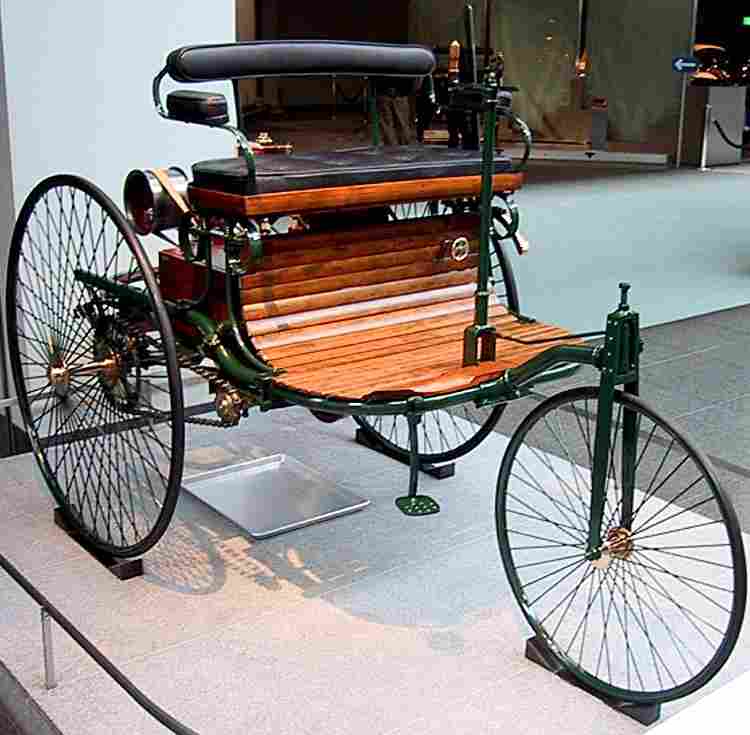 |
| A museum replica of the Patent Moterwagan |
Key
to the tricycle was the light weight
gasoline powered two-stroke piston engine that he had patented back in
1873. The version he mounted on his Moterwagen was a 954 cc single-cylinder four-stroke engine with trembler coil ignition which
produced 2⁄3 horsepower (hp) 250 rpm,
producing about the same power as a modern walk-behind
self-propelled lawnmower engine. But
it was powerful enough to propel the very light vehicle built on a tubular steel frame with thin wood panels. Each of the three wheels, specially designed
by Benz, had wire steel spokes and hard rubber tires. The freely rotating single front wheel was steered by a tiller by a driver seated
in front of the engine.
The
engine drove the two rear wheels
with a chain drive on both sides. A simple belt system served as a single-speed transmission, varying torque between an open disc and drive disc.
A large horizontal flywheel
stabilized the engine power output.
That
first put-putting prototype strikes
us as not quite finished. There was an open crankcase. Into which oil dripped from an open pan on critical
moving parts. Similarly there was
neither a sealed gas tank as we know
it or a carburetor. Gasoline
(or another suitably combustible
fluid) dripped from a small reservoir
into a basin of soaked fibers that supplied a vapor to the cylinder by evaporation. There were also no brakes.
But
Benz was not finished tinkering. Over
the next year he built two more improved models. By the time of his Model 3 Moterwagen, it was powered by a new 2 hp engine
capable of getting the vehicle up to a dizzying 10 miles per hour. It also had a real carburetor, gas tank, and manually operated brakes on the rear
wheels.
All of these prototypes were all well
and good, but perhaps Mrs. Benz was a trifle anxious for her investment to start paying off with sales.
She recognized that the public interest had been piqued, but was far
from convinced that the Moterwagen was a practical means of
transportation. The shrewd and intrepid
Bertha realized something more dramatic need be done.
 |
| Bertha Benz and her sons recreate the beginning of her famous road trip. |
In early August 1888 supposedly without
her husband’s permission—some historians doubt this claim—she gathered up her
two sons, ages 15 and 14 and took the Model 3 out for a spin. A trip actually, all the way from Mannheim to
her mother’s home in Pforzheim, a
trip of about 60 miles which took her through the streets of Heidelberg and Wiesloch. The sight of a
woman and two children zipping through the streets in a noisy, smoky
contraption with no horse naturally attracted considerable attention.
Bertha was not only the driver and navigator, but the mechanic as well. When the
carburetor clogged, she had no problem
clearing it with her hat pin and she
used her garter to insulate an exposed wire. When fuel ran
low and no gasoline was available she purchased ligroin, petroleum ether related
to benzene, at the Wiesloch municipal pharmacy. Later when the wooden block of her brakes wore down, she found a cobbler to nail
strips of leather on them, thus
inventing brake pads on the fly.
Bertha made it safely to her mother’s by
evening and sent husband a famous
telegram explaining her whereabouts and how she got there. The next morning she drove home. She had proved the automobile was a reliable
transportation option and that it could even be operated by an unsupervised
woman. And as she hoped, the trip generated
sales.
Afterwards her husband, at Bertha’s
suggestion made brake pads standard equipment and added a second gear for aid in climbing
hills.
 |
| An early ad for the Moterwagen. |
Over the next few years until 1893 about
25 Moterwagens were built and sold before Benz moved on to more sophisticated
models.
Three years before Karl Benz died in
1929 he merged his Benz & Cie company
with Gottlieb Daimler’s Daimler-Motoren-Gesellschaft
to form what would become Mercedes-Benz.
Bertha Benz’ investment paid off. When she died at age 95 in 1944 she was a
very wealthy woman indeed.
The route she took on her memorable 1888
drive has been named the Bertha Benz Memorial
Route.