Showing posts with label Inuit. Show all posts

Monday, February 28, 2022

Matthew Henson—The Black Face in the Frozen White North

                    Matthew Henson, Polar explorer in his warm Inuit furs in1910.

Matthew Henson at age 21 in 1887 was hired by U.S. Navy Civil Engineer Second Lieutenant Robert E. Peary as a personal valet.  But from the beginning the young Black man was much more than a servant who laid out his master’s clothes in the morning and polished his shoes.  He quickly became an all-around aide and eventually a virtual partner in polar explorations that spanned 23 years. 

Henson was born on August 8, 1866 on his parents farm east of the Potomac River in Charles County, Maryland.  They had been free people of color before the Civil War. The family were victims of attacks by the Ku Klux Klan and other white supremacist groups, who terrorized freedmen and former free people of color after the war.  In 1867 To escape from racial violence in southern Maryland, the Henson family sold the farm and moved to Georgetown, then still an independent town adjacent to the national capitol.

After his father’s early death, he was sent to Washington, D.C. to live with an uncle and had a few years of education a Black public school.  At the age of ten the boy, previously at best an indifferent scholar attended a speech by Frederick Douglass who urges Black youth to vigorously pursue educational opportunities and battle against racial prejudice.

But two years later a keen sense of adventure led him to quit school and sign on as a cabin boy on the merchant ship Katie Hines out of Baltimore and sailed to ports in China, Japan, Africa, and the Russian Arctic seas.  The ship’s Captain Child was impressed by the quick witted lad and not only helped him polish his reading and writing skills but taught him a great deal about sailing and the basics of navigation.

After returning to Washington Henson got more schooling and worked a variety of jobs.  Clerking at the clothing store and outfitters B.H. Stinemetz & Sons was an unusual plum for a young Black.  When Lt. Peary stopped by the store to get a suitable pith helmet for his first trip to Nicaragua to supervise the survey of a canal route he hired the salesman and took him on the trip.  On that tip Peary was much impressed by Henson’s seamanship and his heartiness in enduring the steaming tropical heat of Central America and the diseases that felled many expedition members.

Peary had already made one trip to the Arctic—an 1885 attempt to survey Greenland by dog sled to determine if it was an island or a part of a larger land mass.  Harsh conditions had forced that expedition to turn back but Peary learned much about northern survival skills. He was already thinking about more polar exploration and shared his dreams with Henson who eagerly agreed to accompany him.  While they prepared, Peary taught his servant much of what he learned and practiced his critical skills as a navigator.

In 1891 Henson accompanied Peary back to Greenland on board the seal hunting ship S.S. Kite on a trip backed by the American Geographic Society, Philadelphia Academy of Natural Sciences, and the Brooklyn Institute of Arts and Sciences.  In July sailing in icy waters the ship’s iron tiller suddenly spun around and broke the keel and Peary’s leg.  The expedition established a camp at Red Cliff, at the mouth of MacCormick Fjord at the northwest end of Inglefield Gulf.

During Peary’s six month recovery Henson got to know the local Inuit people and mastered their language.  They called him Mahri-Pahluk and remembered him as the only non-Inuit who became skilled in driving the dog sleds and in training dog teams in the Inuit way.  After Peary recovered and pushed north he proved he was a skilled craftsman, often coming up with solutions for what the team needed in the harsh Arctic conditions and built igloos out of snow instead of using heavy tents for shelter as they traveled. His and Peary’s teams covered thousands of miles in dog sleds and reached the point farthest North of any Arctic expedition yet and established that Greenland was indeed an island.

Henson on board the Peary polar expedition's ship Roosevelt  in 1908 with a sled.  He was an expert dog team driver.

Henson accompanied Peary on six more trips north and was acknowledged at his First Man and de-facto second in command before the 1908-09 drive to be the first to the North Pole.  It was the largest expedition yet and was underwritten by the National Geographic Society and Explorers Club.  Peary used his system of setting up cached supplies along the way. When he and Henson boarded his ship Roosevelt, leaving Greenland on August 18, 1909, they were accompanied by 22 Inuit men, 17 Inuit women, 10 children, 246 dogs, 70 tons (64 metric tons) of whale meat from Labrador, the meat and blubber of 50 walruses, hunting equipment, and tons of coal. In February, Henson and Peary departed their anchored ship at Ellesmere Island’s Cape Sheridan, with the Inuit men and 130 dogs working to lay a trail and supplies along the route to the Pole.

Peary selected Henson and four Inuit as part of the team of six men who would make the final run to the Pole. Before the goal was reached, Peary could no longer continue on foot and rode in a dog sled. He sent Henson ahead as a scout.

In a newspaper interview, Henson later said:

I was in the lead that had overshot the mark a couple of miles. We went back then and I could see that my footprints were the first at the spot.

Matthew Henson, center, and four of his Inuit companions were photographed in front of the presumed North geographic polt marked by a flag of the Explorer's Club.

Henson and his Inuit companions were photographed at the supposed pole.  Subsequent investigation citing navigational errors have cast doubt on the claim of being first to the Pole.  In fact, they were several miles short of that goal.  But when their claim was publicized, Peary was proclaimed a hero and he in turn publicly recognized Henson in his reports to his sponsors.

In 1912 Henson published a memoir of his arctic explorations, A Negro Explorer at the North Pole. In this, he describes himself as a “general assistant, skilled craftsperson, interpreter, and laborer.” He later collaborated with author Bradley Robinson on his 1947 biography, Dark Companion, which told more about his life.

At first although Peary received many honors Henson’s contributions were largely ignored except within 1909 the Black community. Henson spent most of the next 30 years working on staff in the U.S. Customs House in New York, a political appointment by admirer Theodore Roosevelt.

Peary and Henson were co-honored with a Unites States Postal Service stamp on the centennial of their dash to the North Pole.

He later gained renewed attention. In 1937 Henson was admitted as a member to the prestigious Explorers Club in New York City. In 1944 Congress awarded him and five other Peary aides duplicates of the Peary Polar Expedition Medal, a silver medal given to Peary.  Presidents Truman and Eisenhower both honored Henson before he died in 1955.

Henson and his wife Lucy with President Dwight Eisenhower in 1954, a year before his death.

Henson was officially married twice.  He married Eva Flint in 1891, but their marriage did not survive their long periods of separation and they divorced in 1897.  He married Lucy Ross in New York City on September 7, 1907.  That marriage endured the strains of separation until Henson settled into his duties as a Customs official.  They had no children.

But Henson also had an Inuit family in the far North.  His native wife Akatingwah gave him his only child, a son named Anauakaq, born in 1906.  Anauakaq’s children are Henson's only descendants.  After 1909, Henson never saw Akatingwah or his son again but remained in contact through mutual acquaintances and visitors to their village.

In 1986 Anauakaq and an Inuit son of Peary were discovered and brought to Washington as octogenarians where they met American relatives from both families and visited their fathers’ graves.  Anauakaq died a year later.  He and his wife Aviaq had five sons and a daughter, who have children of their own. While some still reside in Greenland, others have moved to Sweden or the United States.

Henson's Inuit descendants in Greenland in 1999.

Actress Taraji P. Henson best known for starring in the cable series Empire and as African-American mathematician Katherine Johnson in Hidden Figures is a decedent of Matthew’s Maryland family of origin.  Joseph Henson born in 1850 was either Matthew’s older brother or his cousin.  That would make her Matthew’s great-great niece or cousin.  She purchased the ancestral Maryland farm and still owns about 25 acres of it.

Henson died on March 9, 1955 in the Bronx.  When he was reinterred in 1986 with his wife Lucy at Arlington National Cemetery members of his Inuit family were in attendance.  

Thursday, June 11, 2020

Fun With Flags—Denmark’s Nordic Cross Set a Trend

The Danish national flag featuring the Nordic Cross--the koffadiflaget.

With a big tip-o’-the-hat to Dr. Sheldon Cooper and his popular cabal access show Fun With Flags, today we share the story of the Nordic Cross and how it got on the flags of all of those folks with blond hair, social democracy, great health care, better sex lives than you or me, and generally the happiest people in the world.  Hey, if the Cross on the flag helps, I’m willing to donate at least the field in the Stars and Stripes.
The Nordic Cross symbolized Christianity, of course, and particularly the Lutheranism that became the state religion of the Nordic Nations.  It has a long horizontal cross bar and the upright was “shifted to the hoist”—the mast or flag pole—leaving the two inner fields as squares and the two outer fields one and half times the width of the inner ones.  Trust me, the design is not as complicated as the written description.  In fact it is simplicity itself as the national flags using it are unadorned by bars, shields,  or other devices.
Blame it all on Denmark which on June 10, 1748 adopted the Koffardiflaget as a civil ensign for use by its merchant ships.  As was the case with other national flags, as opposed to the personal banners of sovereigns, the flag identifying merchant or naval vessels quickly became internationally recognized and a de facto national flag before ultimately being adopted as an official emblem.
The Danish design was simplicity itself—an off-center white cross with narrow arms and upright on a crimson field.

A recreation of the personal banner of William the Conqueror.  Some dispute the early use of the Nordic Cross.
Of course, the Nordic Cross was far older than any national flag.  The personal banner of William the Conqueror, decedent of Vikings, featured the cross on a red field with arms of two lions in the upper left field on a swallow tail pennant.  It also appeared on the arms and banners of various nobles and local rulers not only in Scandinavia, but in the low countries, northern Germany and the Baltic region.  The Teutonic Knights used a black cross on a white background when they held sway from Northern Germany, through Poland and up into Lithuania.
The Scandinavian nations had a complicated history with various parts uniting voluntarily, being forced to unite, sometimes sharing a monarch but not national identity, and at war with one another until the modern independent nations were established when Norway Sweden gained its independence from Sweden in 1905 and Finland split from Russia after the 1917 Revolution.    But with the exception of Finland with its own unique ethnicity and Uralic language, the Scandinavian nations mostly shared a common ethnicNorse—identity, customs, pre-Christian and Christian religious traditions, and related languages.

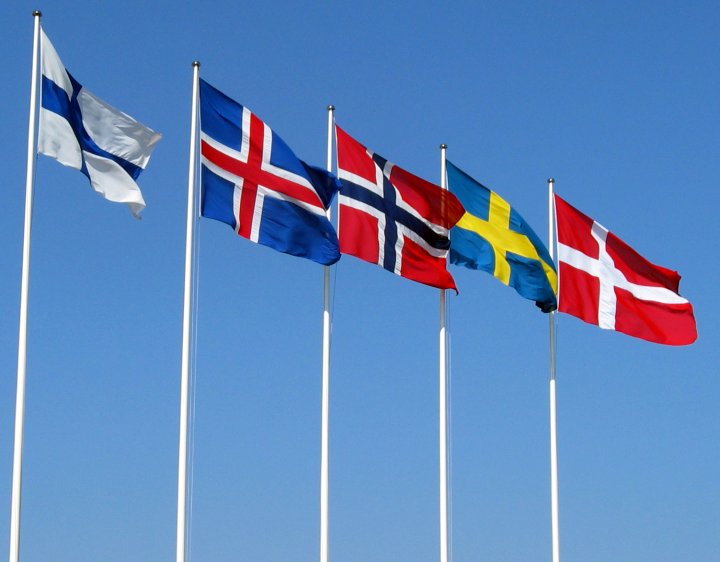
Nordic flags, from left to right: the flags of Finland, Iceland, Norway, Sweden, and Denmark. 
One by one each of the nations adopted national flags featuring the Nordic Cross.
·         Norway in 1821 featuring a blue field with a red cross superimposed over a larger white cross.
·         Sweden in 1906 featuring a light blue field and a gold cross.
·         Iceland although loosely ruled by Norway until 1814 and tied to the Danish Crown from 1380-1945 adopted its flag in 1915 with a red-on-white cross on a blue field.
·         Finland in 1918 featuring blue cross on a white field.

The Inuit majority of Greenland rejected the Norse Cross but maintained the colors of the Danish flag.
The only nation not using the Norse cross is Greenland which gained home rule from Denmark in 1975 and virtual national autonomy in 2009.  It earlier flags were based on the Danish banner.  Unlike the other nations of the region, the ethnic Norse are a minority in Greenland.  The indigenous Inuit  are the majority.  When Virtual independence was achieved a flag with a white cross on a light green background was proposed, an acknowledgement of still being part of the Danish Realm.  But the Inuit preferred a distinctive national banner and a proposal designed by  Thue Christiansen was adopted in 1985.  It features two equal horizontal bands of white (top) and red with a large disk slightly to the hoist side with the top half red, the bottom half white. The red and white colors recall the Koffardiflaget.
Many local flags around the world incorporate the Norse Cross.  In the United Kingdom the Orkney and Shetland Islands in the North Sea off of Scotland both of which were once Norse fifes use the cross on their flag, as does Yorkshire West Riding, once a part of the historic Danelaw.  In the Balkans flags proposed or considered as national banners for Estonia and Latvia incorporated the Cross.

The Nordic Cross was nearly overwhelmed on the War Ensign of Nazi Germany.
Nazi Germany, which often looked at Norse mythology for inspiration incorporated the Cross in its War Ensign, which is now forbidden to be displayed.  A black Iron Cross was displayed in the upper inside field and a large swastika medallion  covered the intersection of the Norse Cross which was black on white on a red field.  Leave it to the Germans to over engineer a simple concept.
For some reason the Nordic Cross shows up, sometimes highly stylized in the flags of several Brazilian states and municipalities despite it being a Portuguese speaking nation and heavily Catholic.  Why is anybody’s guess.

Monday, March 2, 2020

Talking to Whales Cultures Get Science Attention—With Murfin Verse

Tatooed Whale, 2016 by Pim Pitsiulak.
The other day a random Facebook post from the Smithsonian Magazine caught my eye.  It was actually from an article that had originally appeared in Hakai Magazine by Krista Langlois from 2018.  Why Scientists Are Starting to Care About Cultures That Talk to Whales explains that “Arctic people have been communicating with cetaceans for centuries. The rest of the world is finally listening in.”  It’s a fascinating read and I highly recommend it.
An excerpt from the article says:
The advent of whaling changed the North. For the first time, hunters could bring in enough meat to feed an entire village. Permanent settlements began springing up in places like UtqiaÄ¡vik that were reliably visited by bowheads—places still inhabited today. Social organizations shifted as successful whale hunters amassed wealth, became captains, and positioned themselves at the top of a developing social hierarchy. Before long, the whale hunt became the center of cultural, spiritual, and day-to-day life, and whales the cornerstone of many Arctic and subarctic cosmologies.
When agricultural Europeans began visiting and writing about the North in the 10th century, they were mesmerized by Aboriginal peoples’ relationships with whales. Medieval literature depicted the Arctic as a land of malevolent “monstrous fishes” and people who could summon them to shore through magical powers and mumbled spells. Even as explorers and missionaries brought back straightforward accounts of how individual whaling cultures went about hunting, butchering, and sharing a whale, it was hard to shake the sense of mysticism. In 1938, American anthropologist Margaret Lantis analyzed these scattered ethnographic accounts and concluded that Iñupiat, Inuit, and other northern peoples belonged to a circumpolar “whale cult.”
All of which brought to mind a passing mention I found on Facebook noting that on December 10 a Festival for the Souls Dead Whales was observed by the Inuit and other Arctic peoples.   That date coincided with International Human Rights Day which commemorates the adoption of the Universal Declaration of Human Rights.  After a bit on on-line research, as is often the case, the serendipitous calendar coincidence provoked the commission of poetry.

Festival for the Souls of Dead Whales/ International Human Rights Day
December 10, 2016

It says right here on this almanac round up
            that today, December 10, 
            is the Festival for the Souls of Dead Whales.
It’s supposed to be an Alaskan Inuit thing.

Well, maybe.
            Maybe not.
Someone checked it out.

Seems like the people around Barrow—
pardon me UtqiaÄ¡vik now—
never heard of it.

The Inuit living in the traditional way
            take most of their diet 
            from the bowhead whale—
meat, blubber and organs—
and use every damn last scrap
of skin, bone, and sinew.

Each hunter, they say, 
            has his own prayers and rituals           
            of thanks and respect.

Three celebrations each year 
show respect for the souls of the animals, 
bring luck to the hunt,  
to give thanks to the spirits
of the whale who have given themselves
as food for the People.

The men are the hunters,
            but the sea beasts give themselves
            to the women,
            the keepers of the hearth and home,
            who must honor and venerate
            their spirit.

Then the spirits having dwelt 
            in the homes of the People
            return to the sea to tell their brothers
            how they were honored.

But, no, the Inuit of Barrow say,
            we have not heard of
            the Festival for the Souls of Dead Whales.

Perhaps not.

But maybe in remote villages,
            some call a community ritual
            held in the unending night
            when the sea is frozen thick,
            the wind howls, 
and the bowheads
are safe from the rifles and harpoons
of the hunters,
by this particular name.

Perhaps some anthropologist
            with notebook in hand
            simply gave the name 
            to a nameless, timeless
            thanksgiving.

Whatever.

Like another celebration 
            marked on today’s calendar
            the Festival for the Souls of Dead Whales
            is a mere rumor
            honored mostly in the breach.

           —Patrick Murfin


Sunday, June 11, 2017

Denmark Starts Trend for Nordic Cross National Flags

The Danish national flag featuring the Nordic Cross--the koffadiflaget.


With a big tip-o’-the-hat to Dr. Sheldon Cooper and his popular cable access show Fun With Flags, today we share the story of the Nordic Cross and how it got on the flags of all of those folks with blond hair, social democracy, great health care, better sex lives than you or me,  and generally the happiest people in the world.  Hey, if the Cross on the flag helps, I’m willing to donate at least the field in the current Stars and Stripes.
The Nordic Cross symbolized Christianity, of course, and particularly the Lutheranism that became the state religion of the Nordic Nations.  It has a long horizontal cross bar and the upright was “shifted to the hoist”—the mast or flag pole—leaving the two inner fields as squares and the two outer fields one and half times the width of the inner ones.  Trust me, the design is not as complicated as the written description.  In fact it is simplicity itself as the national flags using it are unadorned by bars, shields,  or other devices.
Blame it all on Denmark which on June 10, 1748 adopted the Koffardiflaget as a civil ensign for use by its merchant ships.  As was the case with other national flags, as opposed to the personal banners of sovereigns, the flag identifying merchant or naval vessels quickly became internationally recognized and a de facto national flag before ultimately being adopted as an official emblem.
The Danish design was simplicity itself—an off-center white cross with narrow arms and upright on a crimson field.

A recreation of the personal banner of William the Conqueror.  Some dispute the early use of the Nordic Cross.
Of course, the Nordic Cross was far older than any national flag.  The personal banner of William the Conqueror, decedent of Vikings, featured the cross on a red field with arms of two lions in the upper left field on a swallow tail pennant.  It also appeared on the arms and banners of various nobles and local rulers not only in Scandinavia, but in the low countries, northern Germany and the Baltic region.  The Teutonic Knights used a black cross on a white background when they held sway from Northern Germany, through Poland and up into Lithuania.
The Scandinavian nations had a complicated history with various parts uniting voluntarily, being forced to unite, sometimes sharing a monarch but not national identity, and at war with one another until the modern independent nations were established when Sweden gained its independence from Norway in 1905 and Finland split from Russia after the 1917 Revolution.    But with the exception of Finland with its own unique ethnicity and Uralic language, the Scandinavian nations mostly shared a common ethnicNorse—identity, customs, pre-Christian and Christian religious traditions, and related languages.

Nordic flags, from left to right: the flags of Finland, Iceland, Norway, Sweden, and Denmark.
One by one each of the nations adopted national flags featuring the Nordic Cross.
·       Norway in 1821 featuring a blue field with a red cross superimposed over a larger white cross.
·       Sweden in 1906 featuring a light blue field and a gold cross.
·       Iceland although loosely ruled by Norway until 1814 and tied to the Danish Crown from 1380-1945 adopted its flag in 1915 with a red-on-white cross on a blue field.
·       Finland in 1918 featuring blue cross on a white field.

The Inuit majority of Greenland rejected the Norse Cross but maintained the colors of the Danish flag.
The only nation not using the Norse cross is Greenland which gained home rule from Denmark in 1975 a virtual national autonomy in 2009.  It earlier flags were based on the Danish banner.  Unlike the other nations of the region, the ethnic Norse are a minority in Greenland.  The indigenous Inuit  are the majority.  When Virtual independence was achieved a flag with a white cross on a light green background was proposed, an acknowledgement of still being part of the Danish Realm.  But the Inuit preferred a distinctive national banner and a proposal designed by  Thue Christiansen was adopted in 1985.  It features two equal horizontal bands of white (top) and red with a large disk slightly to the hoist side with the top half red, the bottom half white. The red and white colors recall the Koffardiflaget.
The Nordic cross can be found in many local flags around the incorporate the Norse Cross.  In the United Kingdom the Orkney and Shetland Islands in the North Sea off of Scotland both of which were once Norse fifes use the cross on their flag, as does Yorkshire West Riding, once a part of the historic Danelaw.  In the Balkans flags proposed or considered as national banners for Estonia and Latvia incorporated the Cross.

The Nordic Cross was nearly overwhelmed on the War Ensign of Nazi Germany.
Nazi Germany, which often looked at Norse mythology for inspiration incorporated the Cross in its War Ensign, which is now forbidden to be displayed.  A black Iron Cross was displayed in the upper inside field and a large swastika medallion  covered the intersection of the Norse Cross which was black on white on a red field.  Leave it to the Germans to over engineer a simple concept.
For some reason the Nordic Cross shows up, sometimes highly stylized in the flags of several Brazilian states and municipalities despite it being a Portuguese speaking nation and heavily Catholic.  Why is anybody’s guess.