Showing posts with label Massachusetts Bay. Show all posts

Wednesday, June 24, 2026

King Phillips War--When Tribes Almost Drove Out Settler Colonists


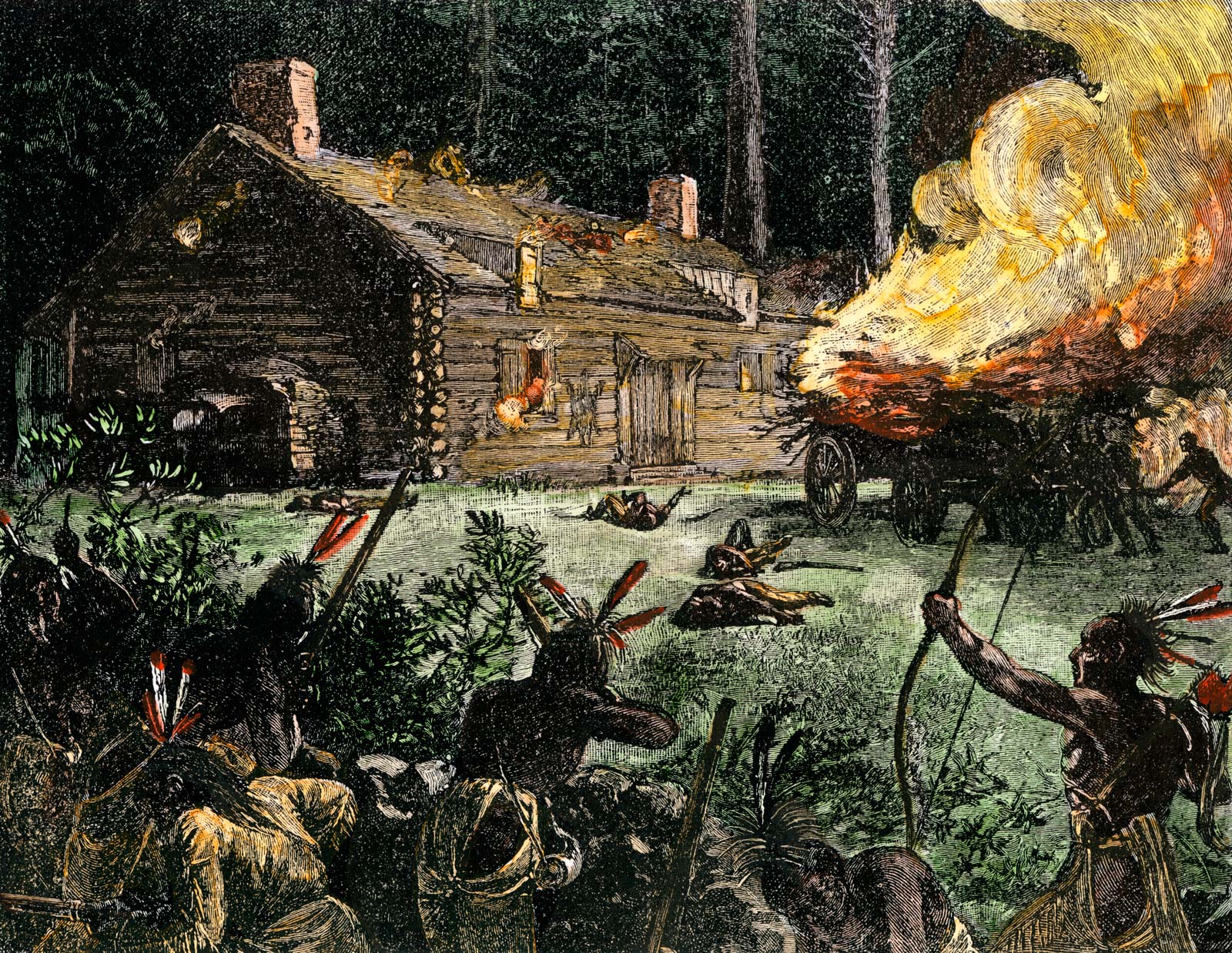
Attacking a homestead during King Philip's War.

On June 24, 1675 King Philip’s War erupted in New England with the sudden attack on isolated farmsteads in the Town of Swansea in Plymouth Colony by a band of Pokanoket.  The raiders lay siege to the town for five days before capturing and burning it with several settlers killed, including some from other towns who had attempted to raise the siege.

Alarm spread across the colonies.  Forces of Plymouth and Boston responded by raiding and burning a Wampanoag town at Mt. Hope (modern Bristol, Rhode Island).  The war quickly spread across the region with the Wampanoag, Pokanoket, Nipmunk, Podunk, Narragansett, and Nashaway peoples rising up against the colonists and their native allies the Mohegan and Pequoit.

It was the bloodiest conflict between settlers and natives in the early colonial period and per-capita on both sides the bloodiest war ever fought in North America.  Out of a total English population of about 56,000 more than 800 were killed, about 1.5% of the total.  Nearly half of all New England towns were attacked and more remote areas were swept of settlers.

Losses were even worse for native tribes.  Out of about 20,000 people in the various tribes, 3,000 or so were killed outright—about 15% of the population—and many more were injured.  Smaller tribes were nearly destroyed, and many fled their homes to an uncertain fate in the territory of hostile tribes further inland.

What stunned the settlers was that the war erupted after 50 years of general peace and was led by the Wampanoag, long-time allies and trading partners.  The original peace had been made by Massasoit, Sachem of the tribe and Plymouth leaders shortly after their 1620 landing.  It was Massasoit and his band that had helped the struggling colony survive the first brutal winter, taught them how to grow corn, and were the guests at the semi-mythical First Thanksgiving.  The Wampanoag prospered trading pelts, meat, and crafts with the colonists for knives, pots, and other desired iron goods.  And the alliance protected them from their enemies including the Iroquoian Mohegans.

But tensions had gradually been rising as Plymouth and the Massachusetts Bay colony centered at Boston spread inland, north and south along the coast, and up the Connecticut River stabbing deep into tribal hunting grounds.  The rapid population growth of Colonists put pressure on game populations.  And an economic crisis of sorts arose as the friendly tribes began running out of trade goods and turned to bartering for land—often land that they shared with other tribes.

Attempts to Christianize the tribes was also resented by most, although a few hundred did convert and moved to Praying Towns where they studied the Gospel and learned English crafts and trades.  These Praying Indians were resented by traditionalists, and, when push came to shove, distrusted by their White protectors.

After the elderly Massasoit, who crafted the alliance died in 1661, relations rapidly deteriorated.  His eldest son Wamsutta became Grand Sachem of the Wampanoag Confederacy.  Wamsutta himself died suddenly, and somewhat mysteriously, while visiting Plymouth Governor Josiah Winslows home for negotiations.  He was succeeded as Sachem by his younger brother Metacom, who would become known among the colonists as King Philip


                                                Paul Revere imagined this is what Metacom looked like in  this engraving for the book The Entertaining History of King Philip's War.

In council Metacom had long advocated resistance to the English.  Now he circulated among the tribes, both members of the Wampanoag Confederacy and ancient tribal enemies urging them to unite and rise up.  An advisor to Metacom, Praying Indian John Sassamon and the first native educated at Harvard, became alarmed and warned Plymouth officials of a possible uprising.  His mutilated body was soon found frozen in a pond, likely assassinated by Metacom’s supporters.

Plymouth authorities, acting on tips from other Praying Indians, arrested three warriors, tried them before a jury that included some natives, and hanged them on June 8.  Two weeks later war broke out. 


Early in the war the natives were triumphant. During the summer the towns of Middleborough, Dartmouth, Mendon, Brookfield, and Lancaster were attacked, and survivors fled. In early September they attacked Deerfield, Hadley, and Northfield


100 Militia and unarmed farmers sent to reap harvests abandoned by panicked settlers were ambushed and nearly massacred at Battle of Bloody Bank.

The New England Confederation consisting of the colonies of Plymouth, Massachusetts Bay, Connecticut, and New Haven, declared war on September 9 and began organizing a common defense.  Their first action was a disaster.  A column of about 100 militia and farmers was dispatched to the burned over areas to try to reap abandoned harvests and retrieve other supplies for the coming winter.  They were ambushed near Hadley and nearly massacred at the Battle of Bloody Bank.  More raids against the frontier towns of Springfield and Hatfield continued in the early Fall


Plymouth Governor Josiah Winslow was the main New England leader in King Philip's War.  The death of Wampanoag Grand Sachem Wamsutta at his home while visiting for negotiations may have been an assassination or an accident, but it set of the war.  He would order the attack on the neutral Narragansett Praying Indians was not only an atrocity, it spread the war.

Led by Plymouth Governor Winslow the Colonists elected not to strike west into the Wamponoag heartland, but south against the Narragansett, who tried to remain neutral in the war.  Winslow suspected them of harboring Wamponoag women and children and feared that they might join the general uprising.  With friendly Indians for guides the force moved into Rhode Island, not a member of the New England Confederacy and generally friendly to the tribe.  In December they found and destroyed several villages then located the Narragansett stronghold palisade fort near modern South Kingston.  Winslow attacked with about a thousand men across a frozen bog.  The Great Swamp Fight ended with the fort and most of the tribe’s winter provisions burned.  The Narragansett lost at least 300 and the remnants of the tribe were forced away from their homes where many died of exposure or starvation and the surviving warriors joined the general uprising.

The colonists also lost heavily in the fight with 70 killed, including many of their most experienced officers, and 150 wounded. 


The Great Swamp Fight.

Over the Winter the tribal offensive intensified.  Twenty-three towns and villages were attacked.  And in reprisal for the Narragansett raid the Jireh Bull Garrison House near the site of the Great Swamp Fight was attacked, burned to the ground, and its 15-man garrison massacred.  It was a rare instance of a well-fortified colonial post being taken by assault.

Things got even worse that Spring.  Plymouth Plantation itself, deep in the most settled and well defended area, was attacked on March 12.  Although the attack was repulsed it demoralized the colonists.  Three more towns were attacked within two weeks.  A sizable company of Massachusetts Militia under a Captain Pierce was ambushed between Pawtucket and Blackstones settlement.  Most were killed outright and those taken captive were tortured and killed.

The Rhode Island capitol of Providence had to be abandoned and was later burned.  Across the region colonists were forced back on their most populous towns which were fortified to withstand repeated attacks.  Rhode Islanders were forced into a small defensive perimeter around Newport.

But despite battlefield victories, the Indian offensive began to grind to a halt for lack of provisions.  The war had left their own crops neglected and a hunting season was lost to battle.  Hoped for aid from the English enemy the French in Canada did not materialize except for some arms and ammunition used in the northernmost battleground—Massachusetts’s colonies in what is now Maine.

The Wampanoag’s traditional enemies the Pequot and Mohegans joined the colonists in greater numbers and began raiding Wamponoag villages and burning crops.  They played a big role in defending Connecticut from the kind of destruction faced elsewhere.

Desperately Metacom traveled to the lands of his traditional enemies the Mohawks to secure an alliance but instead they launched attacks on his exposed villages and fields.  Hungry bands began leaving the area for safety in Maine, New Hampshire, New York, and even Canada.

In April 1676 the remnants of the Narragansett under Canonchet were defeated and the chief killed.  The next month Massachusetts Militia under Captain William Turner fell upon a large group of natives in a fishing camp at Peskeopscut on the Falls of the Connecticut River killing nearly 200 and forcing many survivors to jump into the river where they likely drown.  It was an expensive victory.  Turner and 40 of his men were also killed.

Battles near Hadley and Marlborough scattered native survivors.  Colonial authorities offered an amnesty to those who would come in to surrender and who could show that they had not been combatants.  Hungry bands began to straggle in.  By early July over 400 had surrendered.

Metacom went into hiding in the Assowamset Swamp near Providence and near where the war started.  He was hunted by mixed teams of settlers and native allies.  He was found and killed by Praying Indian John Alderman.  He was beheaded, drawn and quartered. 


                                            Victorious militia troops march into Plymouth with Metacom's head on a pike.

The severed head of “King Philip” was on display at Plymouth for the next twenty years.  Fighting in northern Maine dragged on another year, but the New England heartland was secure.

Many of the tribes were essentially eliminated as organized bands or pushed beyond the frontier.  Hundreds of native captives were tried and executed or sold as slaves in Bermuda, where many residents today trace their lineage to exiled Indians.

Although Plymouth and other colonies had gone deeply in debt and much capital was destroyed, the amazing population growth of the colonies recouped losses within a few years.  Western settlement was delayed by lingering fears of Indian attacks and by the growing threat of the French but that allowed the core settlements to grow into real cities and encouraged a move away from subsistence farming to trade and manufacture.  By the end of the century the per capita income and standard of living in New England exceeded that of Mother England.

Friday, March 20, 2026

Puritan Goodwife Anne Bradstreet was Colonial America's First Published Poet


No authentic portrait of Anne Bradshaw exists.  Puritan women were generally not considered important enough for the expense of a painting.  She is usually depicted as a generic Puritan woman of her era.  We know that she was dark haired, small, and plagued by ill health and the toll of eight childbirths.  Her attractive face was scarred by small pox. 

It is easy to identify the essential founder of American literature if you put preconceived notions aside.  Despite a near glut of over educated clergy and highly literate laymen, the first poetic voice to emerge from the struggling colonies in New England and first published poet to rise from the stony soil was a sickly young woman, the mother of eight, who was discouraged in every way from expressing herself.

Anne Dudley was born in North HamptonshireEngland on or about March 20 by the old Julian Calendar in 1612.  Her father Thomas was a Puritan leader and her mother Dorothy Yorke was the well-read daughter of a noble family. Her parents took Simon Bradstreet, the son of a minister, into their household when his father died when she was 16 and he was 25.  Anne married the man who had been a virtual brother to her.

Bradstreet was commemorated by this stained-glass window in the dissenter's chapel in her English hometown.

Young Bradstreet became a junior officer of the Massachusetts Bay Company and her father an investor and supporter.  In 1630 the whole extended family boarded the Arabella, the flagship of the Winthrop Fleet of 11 vessels that brought the first large wave of the great Puritan Migration to re-enforce the tiny, struggling colonies planted two years earlier.

Thomas Dudley soon became Governor John Winthrop’s Deputy and Bradstreet took the third ranking post of administrator.  Frail young Anne had suffered on the arduous sea voyage and found the primitive life of a frontier village hard.  She suffered from a variety of ailments, including smallpox which scarred her face, and a joint condition, probably rheumatoid arthritis.  Both her husband and father frequently traveled to other Puritan villages in their duties.  She passed these times when she was bedridden by studying her father’s extensive library.  She mastered not only the Bible, as expected, but dense theological texts and works in LatinFrench, and German She also read and adored poetry and began to compose verse of her own which she shared privately with her family.


Simon Bradshaw in middle age.  Anne's husband was a member of the Puritan governing elite.

Despite her frail health and scholarly bent, Anne was a devoted wife.  She gave birth to eight children who she doted on.

As the Colony prospered, so did her family’s prospects.  They helped establish the new principal city of Boston and in a few years moved across the Charles River to New Town, soon to be renamed Cambridge.  In 1636 both her husband and father became founders of Harvard University, from which two of her sons would later graduate.

Anne Bradstreet was close friend of Anne Hutchinson and shared many of her religious opinions.  She witnessed Hutchinson's persecution, exile, and eventual hanging at the hands of Governor Winthrop, her husband's mentor and closest associate. 

The following year Anne received a strong lesson on the perils of being caught making public expressions when her close friend, Anne Hutchinson, with whom she privately shared many views, was brought to trial before Governor Winthrop and sentenced to exile from the colony, expected to be a death sentence by starvation among the “savages” and eventually execution by hanging for heresy.

The family moved twice more, first to Ipswich and finally to North Andover in 1640.


The title page of the English first edition of Bradstreet's poem.  Note the publisher's address.

It was with some consternation that Anne learned that her brother-in-law the Rev. John Woodbridge had secretly copied her poems and taken them to London where they were published in 1650 under the title, The Tenth Muse Lately Sprung Up in America, by a Gentlewoman of those Parts.  None-the-less, she was proud of the accomplishment, and the laudatory interest with which it was received. 

Anne continued to write, although not for publication.  Here themes were as wide ranging as her reading—by this time she had amassed a personal library of perhaps 800 books, perhaps the greatest depository in the colony.  She touched on religious themes, but also closely observed nature, politics, and domestic life.  She wrote both short pieces and long, almost epic verse dense with allusion.  She composed a series of devotions for her family’s private use,

Increasingly crippled and bed-ridden more frequently, Anne suffered the loss of a beloved daughter and other relatives and a devastating 1666 house fire that destroyed virtually everything the family owned, including Anne’s precious library.  Despite these reversals she continued to passionately embrace life and thank God.

Bradstreet's last house in North Andover.  It still stands and is marked as the "Governor Bradstreet House."  

Due to her family’s prominence, they were able to rebuild a comfortable home.  Anne died there in on September 16, 1672 at the age of 60. 

An expanded American edition of The Tenth Muse including several unpublished poems was published posthumously in 1678 in Boston as Several Poems Compiled with Great Wit and Learning.  Despite the lingering Puritan disdain for expression by women, no less an august personage than Cotton Mather himself admired the work.

In the mid-19th Century, the religious poems she composed for her family were published as Contemplations and brought about renewed interest in her as a poet.  By the early 1900’s, however, her work was dismissed as a historical curiosity rather than as a substantial contribution to literature.


Bradstreet's worn and broken tombstone was replaced by a modern marker.

The rise in Womens Studies set off a re-assessment of her work, which is now regarded as both highly original in many respects and well-constructed within the poetic disciplines of her time.

Anne Bradstreet made other contributions to American letters, culture, and public life through her many descendants who include Ralph Waldo Emerson, the Rev. William Ellery Channing, Henry Wadsworth Longfellow, Oliver Wendell Holmes Sr. and Jr., Richard Henry Dana, abolitionist Wendell PhillipsSarah Orne JewettHerbert Hoover, Justice David Sauter, and actors John Lithgow and Sarah Jessica Parker 

Sometime after the London publication of The Tenth Muse Anne wrote her thoughts of mingled shame and pride in a poem, naturally.

The Author to Her Book


Thou ill-formed offspring of my feeble brain,

Who after birth didst by my side remain,

Till snatched from thence by friends, less wise than true,

Who thee abroad, exposed to public view,

Made thee in rags, halting to th’ press to trudge,

Where errors were not lessened (all may judge).

At thy return my blushing was not small,

My rambling brat (in print) should mother call,

I cast thee by as one unfit for light,

The visage was so irksome in my sight;

Yet being mine own, at length affection would

Thy blemishes amend, if so I could.

I washed thy face, but more defects I saw,

And rubbing off a spot still made a flaw.

I stretched thy joints to make thee even feet,

Yet still thou run’st more hobbling than is meet;

In better dress to trim thee was my mind,

But nought save homespun cloth I’ th house I find.

In this array ‘mongst vulgars may’st thou roam.

In critic’s hands beware thou dost not come,

And take thy way where yet thou art not known;

If for thy father asked, say thou hadst none;

And for thy mother, she alas is poor,

Which caused her thus to send thee out of door.


—Anne Bradstreet


Monday, October 28, 2024

It’s Harvard’s Birthday Like It or Not


Two years after its founding as The College at New Town, John Harvard, a young Puritan minister died and left a tidy fortune and a 400 book library to the school which was shortly re-named in his honor.  No reliable portrait of Harvard exists, but the College erected a statue anyway.  Note the hand rubbing his toe--a good luck tradition among students that leaves that toe preternaturally bright and shiny.

Flags at half staff at Fox News and Make America Great Again prayer breakfasts.  On October 28, 1636 the greatest bastion of “cultural elitism” in American history came into being and despite stiff competition, it remains a force with tendrils deep into the highest echelons of government, law, business, and the arts.    

It was on this day that the College at New Towne was created by an act of the Great and General Court of the Massachusetts Bay Colony.  New Towne was just up the Charles River from Boston would soon be named Cambridge, in honor of the English university where many leading citizens had received their education.  A fitting name for the home of the very first institution of higher learning in North America.

This was only 16 years after Separatist dissenters, known to us as the Pilgrims, established a tiny colony at Plymouth and eight years since the dour Puritans had established themselves.  Despite a steadily growing population due to new arrivals from England and extraordinary fertility, settlements still clung close to the coast and not many miles inland was still a “howling wilderness” populated by Native tribes and confederacies.  The urgent mission of the school was to train new Puritan divines to fill the pulpits of the town churches that the members of the General Court were sure would be built.  The school began with one Master, Nathaniel Eaton, and nine students

After just two years of existence and without graduating a single student the struggling College received a startling and totally unexpected windfallJohn Harvard was a young Puritan minister who had arrived in the New World in 1637 and was settled as minister in Charlestown.  He was the son of a butcher and tavern keeper who rose in the world. In 1625, his father, a stepsister, and two brothers died of the plague.  Only his mother and one brother survived.  His mother remarried and was widowed twice more by men of substance.  She was able to send her son to the Puritan hot bed of Emmanuel College, Cambridge from which he graduated in 1632.  

His mother died in 1635 and his brother in 1737 leaving John the unexpected heir of a small fortune.  Unfortunately the minister contracted the dreaded consumption (tuberculosis) and was dead within a year.  Among Harvard’s closest friends was Eaton, the Master of the New School.  In his will Harvard donated his impressive library of more than 400 volumes to the school in addition to £779 17s 2d, half of the cash value of his estate.  Eaton was entrusted with using it for the benefit of the school.

Eaton put the money to work right away.  He saw to the erection of a fine frame two story building with a stone foundation and a cellar.   The building could supposedly house the Master and up to 30 students with a parlor for instruction. The property included its own apple orchard, barn, and garden plot.  Eaton was glad to rename the school Harvard College on March 13, 1639.

The wood frame Old College was built in 1638 largely with John Harvard's bequest and stood until it burned down in 1670.
 

Eaton was not to enjoy his stewardship of the college for long.  He and his family ran afoul of  notoriously high handed Governor John Winthrop.  Eaton was fired and brought up on charges that he had “whipped too harshly” two of his students and that his wife had served others hasty pudding contaminated with goat feces—an event which inspired the name for a much later college humor society.  After being convicted, Eaton fled to Virginia and was later accused by the Governor of absconding with £100 of the Harvard bequest—an allegation that dogged the man until his dying day in an English debtor’s prison.

Eaton was succeeded in 1640 by Henry Dunster, the first man to hold the title President.  The first students graduated in 1642. During his tenure, in 1650 Harvard College received its official Charter. Dunster remained in his post until 1654 when he too ran afoul of Puritan authorities in a dispute over infant baptism.

Harvard was never officially affiliated with the church.  It didn’t need to be.  The authorities of Massachusetts Bay assumed that all institutions would be subject to “instruction” by a virtual theocracy.  A 1643 pamphlet summarized the mission of the college, “To advance Learning and perpetuate it to Posterity; dreading to leave an illiterate Ministery to the Churche.”

In the early years there periodic eruptions of campus misbehavior and scandal—even Puritan boys away from home for the first time were apt to go a bit wild, drinking, gambling, whoring, insulting good townsfolk, and occasionally openly rebelling against bad food, inept instruction, and capricious discipline.  These instances were usually met with canings, expulsions, prosecution by local authorities, and—once in a while—the dismissal of faculty members for being too lax or too harsh.

Despite this, the College was succeeding in supplying new ministers—plenty of them, even more than there were pulpits to fill.   Its classic education, drawn from the colleges of Cambridge in the Mother Country, however, was a suitable preparation for other professions as well.  Soon the college produced lawyers in as great abundance as divines, followed by medical doctors.  Even failed students who did not succeed in a profession could fall back upon the calling of the desperate gentlemanschool mastering.  Others found their way into business, particularly maritime trade, where a good education in figures stood them well.

In 1664 the College building burned to the ground taking with it all but one of John Harvard’s library books.  It was quickly replaced with grander accommodations.

Concerned with both rowdyism on campus and creeping infidelity, Increase Mather, the powerful pastor of Boston’s North Church, was named Acting President in 1685, named Rector following year, and made permanent President in 1692.  Although not in residence on campus, and seldom even a visitor, Mather instituted sweeping changes in curriculum and discipline.  He purged classic, but heathen Latin writers from the curriculum, instituted study of Greek and Hebrew and emphasized Biblical text and commentaries by Christian writers.  To reign in the unruly students, he enforced rules that they must live and dine on campus.  Mather held sway at Harvard until 1701.

Despite the turmoil and the rigidity of Puritanism, Harvard had done its job well.  At the dawn of 18th Century New England had the highest concentration of college graduates in the world, the most literate general population, and quite likely the highest standard of living.  Although the society had a rigid social structure, it was not a hierarchy of unbreakable class or caste distinction.  The sons of farmers and tradesmen, could, and often did, acquire an advanced education and rise to prominence.  A profusion of ministers, lawyers, teachers and merchants trained at Harvard provided a core of educated civic leadership that was unmatched.

However much Mather and his Puritan peers might have wished it, however, an education inevitably caused inconvenient questioning of authority and received wisdom.  Mather’s successor as President was John Leverett, the first non-minister to serve.  He quietly began distancing the college from control by the Boston clergy.  In the next century the ideas of the Enlightenment would begin to percolate through the school, as well as a growing restiveness with Calvinist rigidity.

Harvard Yard in 1740, soon educating a generation that would spark a Revolution.

Graduates of Harvard like Samuel and John Adams were to become leaders of the drive for Independence.  When the notions of Harvard cross fertilized with Virginian aristocrats who had been schooled by tutors and at institutions like the College of William and Mary where the radical notions of the Scottish Enlightenment held sway, there was revolution in political thought as well as simply politics.

The earliest known official reference to Harvard as a university occurred in the new Massachusetts Constitution of 1780.  Undergraduates still attended Harvard College, with the University offering graduate education in many fields.

Through the last half of the 1700s, Harvard and the ministers it was still producing became more and more unorthodox.  Rival Yale, founded the same year as Mather left the helm of Harvard, was soon seen as an orthodox bastion against Harvard liberalism.  In 1805 the Harvard Board of Overseers filled the Hollis Chair of Religion with liberal Henry Ware, Sr. a move that would eventually lead to the rupture of the New England Standing Order and would leave Unitarians firmly in control of the College, and over most of the congregations of Eastern Massachusetts.  The orthodox Congregationalists responded by founding Andover Theological Seminary in 1808 to train reliable clergy.

Henry Ware, Sr. whose appointment to the Holis Chair of Religion set off the Unitarian Controversy eventually leading to a schism in the New England Standing Order and established Unitarian dominance over the Harvard for the next 150 years.

Over the next fifty years a Unitarian establishment came to dominate the College.  Early on  Unitarians and High Federalists instituted a series of societies and institutions on campus meant to shore up their authority against possible challenges by orthodox Congregationalists.  Ironically, the religious liberals instituted an illiberal regime that was constantly being challenged.  And the challenge was not only from the orthodox. 

By the 1840 Unitarians of Ware’s sort were seen as enforces of their own orthodoxy and were the subject of rebellion by a new wave of philosophyTranscendentalism exemplified by Ralph Waldo Emerson who shocked sensibilities with his Divinity School Address.  Many Harvard graduates became leading members of the New England Renaissance, a cultural phenomenon that gave the nation its first full throated literary voice.

Harvard Presidents--Unitarians all--spanning 1829-1862.  From right to left in order of their service--Josiah Qunincy III, scion of a distinguished Massachusetts family;  famed orator Edward Everett;  Jared Sparks whose ordination was the occasion of William Ellery Channing's Baltimore Sermon which was the a virtual Unitarian declaration of a unique identity; James Walker, and Cornelius Conway. 

By the Civil War, Harvard had become the firm foundation of the rule of Boston and Massachusetts by an insular elite—the Boston Brahmins.  The management by a succession of stodgy Unitarian Presidents nearly killed the college by the Civil War, however.  Wealthy Bostonians were becoming reluctant to entrust their young men to religious indoctrination and not practical training for the business world.

To the rescue came yet another Unitarian, Charles William Eliot who became president in 1869.  He was a trained scientist and had attended the advanced polytechnic universities of Europe.  He was also a Transcendentalist who determined to secularize the college in order to free the minds of the students.  

Under his long leadership he instituted the New Education meant to enable students to make intelligent choices, but did not attempt to provide specialized vocational or technical training.  He radically reformed and expanded the curriculum, supplementing the traditional Classics education with a broader sampling of the humanities including modern language and literature as well as a firm grounding in science and mathematics.  He instituted an elective system that let students participate in building their own education.  He reformed graduate schools and added new ones, emphasizing original research as well as instruction.  

An administrative reformer as well, Elliot reorganized the faculty into schools and departments and replaced recitations with lectures and seminars. He encouraged both private and public secondary schools to change their curricula to prepare for college admission, thus almost single handily inventing the modern High School.  He instituted admission to the school by standardized testing


Long time Harvard President Charles William Eliot transformed Harvard into a modern research university and the most prestigious school in the United States.

A tireless fundraiser, he solicited the generous support of the very wealthy to create a huge endowment and build the many new structures his expanding university required.  In doing so he tied Harvard closely to the emerging plutocracy of Gilded Age America.  Although a noted progressive and liberal—he insisted on educating Blacks and admitting Jews, for instance, he displayed class loyalty by fierce opposition to unionism and the labor movement and encouraging Harvard students to actively become strike breakers. By the time Eliot’s tenure ended in 1909 Harvard had been transformed into a world class research university.

Over the rest of the 20th Century Harvard evolved away from being a de facto Unitarian fiefdom.  They ceased to dominate the Corporation.  Presidents came from other religions and traditions.  The very Brahmin elite that had empowered Unitarian domination was dispersing and drifting away from the New England tribal faith to more conservative, conventional, and less controversial faiths.  While Harvard Divinity School remained an important and prestigious training ground for Unitarian Universalist ministers—indeed bright pink Harvard doctoral robes are still a passport to the most prestigious pulpits, and leadership positions within the Unitarian Universalist Association—most students and graduates are now not UUs.  Indeed for several years there were no active Unitarian or Universalist professors at all on the faculty until the endowment of the Ralph Waldo Emerson Unitarian Universalist Association Chair of Divinity and the appointment of its first professor in 2008.

Jews and Catholics, previously admitted on a strict quota basis, began being admitted in large numbers beginning in the 1960’s.  Black and other minority students became actively recruited and supported as the 20th Century closed.  Harvard absorbed Radcliffe College, founded in 1879 as the Harvard Annex for Women in 1977 making it fully co-educational.  Women now are a majority in the College and are enrolled in large numbers in all graduate schools.  .

Today Harvard remains the most prestigious American University with 2,000 faculty to teach and advise approximately 6,700 undergraduate and 13,600 graduate and professional students in 12 degree-granting Schools and the Radcliffe Institute for Advanced Study.  The Harvard University Library is the largest academic library in the United States, and the second largest library in the country.  

Harvard President Claudine Gay being grilled by a Congressional hearing.

Harvard displayed it’s institutional commitment to diversity of it student body, faculty, and leadership in 2023 when Claudine Gay was named the 30th President amid much hoopla.  She was a political scientist, academic administrator, and  the Wilbur A. Cowett Professor of Government and of African and African-American Studies whose research addressed American political behavior, including voter turnout and politics of race and identity.  Her appoint was seen as a slap to the long campaign of conservatives to overturn consideration of race in admission policies and sniping at every work-around the University came up with to still insure full and equitable participation by racial, ethnic, and religious minorities.  She had also been prominent in supporting Black Lives Matter protests both on and off campus.  

But after just a year in office Gay was forced to resign after she defended the right to protest by War in Gaza activists  and campus organizations who were charged with being Anti-Semitic in their attacks on Israel and Jews in general.  She was grilled and humiliated by a Republican-led Congressional investigation and many Democrats with historic ties to Israel and major Jewish American organizations  chimed in.  Along with two other University Presidents she was forced to resign for failing to use maximum police force to clear their campuses of tent cities and daily protests.   

Harvard is—by a wide margin—also the wealthiest school in the world.  In June 2009 the University had an endowment of $25.7 billion despite having lost maybe as much of half of its value in the economic crisis of 2008.  The losses have resulted in some major finger pointing—largely at former President Lawrence Summers who departed a controversy wracked tenure to become President Barak Obamas top economic advisor.  The losses caused some belt tightening, the delay of a capital project or two and a review of a previously announced policy that would make undergraduate admission free to needy students.  But the Stock Market has recovered its losses and regularly flirts with record highs.   Even with calls to boycott contributions from wealthy Jews and other donors,  no one is going to have to hold a bake sale for Harvard any time soon.

Most universities like to list a handful of distinguished alumni in their brochures.  It would take a phone book for Harvard with 8 Presidents of the United States including both George W. Bush and Barak Obama and 21 Supreme Court Justices.

The school, even with a far more diversified student body than in the past, continues to pump its graduates into all of the elite institutions in the nation.  Since most of them can read, write, and formulate independent informed opinion, this continues to depress and outrages the Right.
 

Wednesday, March 20, 2024

Anne Bradstreet Was Puritan Goodwife and Colonial America’s First Published Poet

No authentic portrait of Anne Bradshaw exists.  Puritan women were generally not considered important enough for the expense of a painting.  She is usually depicted as a generic Puritan woman of her era.  We know that she was dark haired, small, and plagued by ill health and the toll of eight childbirths.  Her attractive face was scarred by small pox. 

It is easy to identify the essential founder of American literature if you put preconceived notions aside.  Despite a near glut of over educated clergy and highly literate laymen, the first poetic voice to emerge from the struggling colonies in New England and first published poet to rise from the stony soil was a sickly young woman, the mother of eight, who was discouraged in every way from expressing herself.

Anne Dudley was born in North Hamptonshire, England on or about March 20 by the old Julian Calendar in 1612.  Her father Thomas was a Puritan leader and her mother Dorothy Yorke was the well-read daughter of a noble family. Her parents took Simon Bradstreet, the son of a minister, into their household when his father died when she was 16 and he was 25.  Anne married the man who had been a virtual brother to her.


Bradstreet was commemorated by this stained glass window in the dissenter's chapel in her English hometown.

Young Bradstreet became a junior officer of the Massachusetts Bay Company and her father an investor and supporter.  In 1630 the whole extended family boarded the Arabella, the flagship of the Winthrop Fleet of 11 vessels that brought the first large wave of the great Puritan Migration to re-enforce the tiny, struggling colonies planted two years earlier.

Thomas Dudley soon became Governor John Winthrops Deputy and Bradstreet took the third ranking post of administrator.  Frail young Anne had suffered on the arduous sea voyage and found the primitive life of a frontier village hard.  She suffered from a variety of ailments, including smallpox which scarred her face, and a joint condition, probably rheumatoid arthritis.  Both her husband and father frequently traveled to other Puritan villages in their duties.  She passed these times when she was bed ridden by studying her father’s extensive library.  She mastered not only the Bible, as expected, but dense theological texts and works in Latin, French, and German.  She also read and adored poetry and began to compose verse of her own which she shared privately with her family.


Simon Bradshaw in middle age.  Anne's husband was a member of the Puritan governing elite.

Despite her frail health and scholarly bent, Anne was a devoted wife.  She gave birth to eight children who she doted on.

As the Colony prospered, so did her family’s prospects.  They helped establish the new principal city of Boston and in a few years moved across the Charles River to New Town, soon to be renamed Cambridge.  In 1636 both her husband and father became founders of Harvard University, from which two of her sons would later graduate.

Anne Bradtreet was close friend of Anne Hutchinson and shared many of her religious opinions.  She witnessed Hutchinson's persecution, exile, and eventual hanging at the hands of Governor Winthrop, her husband's mentor and closest associate. 

The following year Anne received a strong lesson on the perils of being caught making public expressions when her close friend, Anne Hutchinson, with whom she privately shared many opinions, was brought to trial before Governor Winthrop and sentenced to exile from the colony, expected to be a death sentence by starvation among the “savages” and eventually execution by hanging for heresy.

The family moved twice more, first to Ipswich and finally to North Andover in 1640.


The title page of the English first edition of Bradstreet's poem.  Note the publisher's address.

It was with some consternation that Anne learned that her brother-in-law the Rev. John Woodbridge had secretly copied her poems and taken them to London where they were published in 1650 under the title, The Tenth Muse Lately Sprung Up in America, by a Gentlewoman of those Parts.  None-the-less, she was proud of the accomplishment, and the laudatory interest with which it was received. 

Anne continued to write, although not for publication.  Here themes were as wide ranging as her reading—by this time she had amassed a personal library of perhaps 800 books, perhaps the greatest depository in the colony.  She touched on religious themes, but also closely observed nature, politics, and domestic life.  She wrote both short pieces and long, almost epic verse dense with allusion.  She composed a series of devotions for her family’s private use,

Increasingly crippled and bed ridden more frequently, Anne suffered the loss of a beloved daughter and other relatives and a devastating 1666 house fire that destroyed virtually everything the family owned, including Anne’s precious library.  Despite these reversals she continued to passionately embrace life and thank God.

Bradstreet's last house in North Andover.  It still stands and is marked as the "Governor Bradstreet House."  

Due to her family’s prominence, they were able to rebuild a comfortable home.  Anne died there in on September 16, 1672 at the age of 60. 

An expanded American edition of The Tenth Muse including several unpublished poems was published posthumously in 1678 in Boston as Several Poems Compiled with Great Wit and Learning.  Despite the lingering Puritan disdain for expression by women, no less an august personage than Cotton Mather himself admired the work.

In the mid-19th Century, the religious poems she composed for her family were published as Contemplations and brought about renewed interest in her as a poet.  By the early 1900’s, however, her work was dismissed as a historical curiosity rather than as a substantial contribution to literature.


Bradstreet's last house in North Andover.  It still stands and is marked as the "Governor Bradstreet House." 

The rise in womens studies set off a re-assessment of her work, which is now regarded as both highly original in many respects and well constructed within the poetic disciplines of her time.


Anne Bradstreet made other contributions to American letters, culture, and public life through her many descendents who include Ralph Waldo Emerson, the Rev. William Ellery Channing, Henry Wadsworth Longfellow, Oliver Wendell Holmes Sr. and Jr., Richard Henry Dana, abolitionist Wendell Phillips, Sarah Orne Jewett, Herbert Hoover, Justice David Sauter, and actors John Lithgow and Sarah Jessica Parker.  


Sometime after the London publication of The Tenth Muse Anne wrote her thoughts of mingled shame and pride in a poem, naturally.


The Author to Her Book


Thou ill-formed offspring of my feeble brain,

Who after birth didst by my side remain,

Till snatched from thence by friends, less wise than true,

Who thee abroad, exposed to public view,

Made thee in rags, halting to th’ press to trudge,

Where errors were not lessened (all may judge).

At thy return my blushing was not small,

My rambling brat (in print) should mother call,

I cast thee by as one unfit for light,

The visage was so irksome in my sight;

Yet being mine own, at length affection would

Thy blemishes amend, if so I could.

I washed thy face, but more defects I saw,

And rubbing off a spot still made a flaw.

I stretched thy joints to make thee even feet,

Yet still thou run’st more hobbling than is meet;

In better dress to trim thee was my mind,

But nought save homespun cloth I’ th house I find.

In this array ‘mongst vulgars may’st thou roam.

In critic’s hands beware thou dost not come,

And take thy way where yet thou art not known;

If for thy father asked, say thou hadst none;

And for thy mother, she alas is poor,

Which caused her thus to send thee out of door.


—Anne Bradstreet