Showing posts with label Medal of Honor. Show all posts

Wednesday, July 1, 2026

Buffalo Soldiers Did the Heavy Lifting But Teddy Roosevelt Got the Glory


This Landmark book for young adults and a Classic Comic Book both fired my boyhood hero worship of Theodore Roosevelt.  The cover illustration turned out to be inaccurate.  Roosevelt was wearing his blue field shirt not his khaki officer's tunic and completed the charge on foot after he lost his horse.  But it did show one Black trooper in the lower right of the picture--more credit than Buffalo Soldiers usually got.

When I was a kid, Theodore Roosevelt was my hero.  I know, incredibly dorky.  But Teddy was a fat, bookish kid with glasses, sort of like me, who grew up to have an exciting life.  For a couple of years or so in my pre-teens I took to pinning the brim of my cowboy hat to the crown on one side with a U.S. Army insignia swiped from my Dad’s World War II uniform. I led an entirely imaginary “Junior Rough Riders” outfit in elaborate games of defending Cheyenne from foreign menace. I assure you that I could not get any of the other kids in the neighborhood to join me in this oddball fantasy.

In school, much to the confusion and irritation of my teachers, I insisted on dating all of my papers 1905, the first year of Roosevelt’s second term as President.  Much of Roosevelt’s appeal to me was his famous Charge on San Juan Hill.  In later years I discovered that while T.R. did, indeed, perform ably and bravely that day and that his Rough Riders fought well, it was not the whole story. 

On July 1, 1898 the heaviest land combat of the Spanish American War took place in the Battle for San Juan Heights during the American drive to take the city of Santiago, Cuba.

With the outbreak of the War Roosevelt, a hyperkinetic New York politician who was serving ably as Assistant Secretary of the Navy—a post in which he had played a key role in building the Great White Fleet which made the U.S. Navy among the most modern in the world—yearned for military action on the ground. 


                             Col. Theodore Roosevelt 1st Volunteer Cavalry after his brevet from Lt. Col.

He was not encouraged by President William McKinley in his first attempt to volunteer to raise a cavalry regiment for the conflict.  He convinced his close friend Col. Leonard Wood, one of the most respected officers in the Regular Army and a medical doctor serving as an advisor to the President, to offer to lead a volunteer unit with Roosevelt as his second in command and in charge of recruitment.  McKinley, needing to raise a large army quickly, reluctantly agreed. 

Roosevelt famously recruited a unit that mixed cowboys who he was familiar with from his days as a South Dakota rancher, Harvard pals, and polo playing New York socialites.  


Legendary Arizona lawman Bucky O'Neill was captain of a troop of Rough Riders raised in the West and including cowboys and veteran Indian fighters.

Among the Volunteers were a legendary western lawman, Bucky ONiell, Captain of a troop raised in Arizona and at least one of the criminals he had once locked up serving under an assumed name.  Like O’Niell, a former militia officer, many men were veterans of the Indian wars and provided leadership as junior officers and non-commissioned officers that was rare in Volunteer units.  There were also swells like Hamilton Fish, grandson of the New York Governor and Senator of the same name. 

Roosevelt used his considerable influence, and some of his own wealth, to make sure that the men were armed with the same modern Krag-Jorgensen carbines used by the regular cavalry and generally had the most up-to-date equipment and the finest horse stock available.  The unit was trained to the highest standards and the men, mostly expert horsemen, were soon considered the equal of regular troops. 


300-pound Regular Army Major General William Shafter was the commander of V Corps in the drive to capture Santiago.  He was an indifferent to incompetent senior officer.

Designated the First Volunteer Cavalry (1st U.S.V.C), the unit arrived by train with their horses, mules, and baggage at Tampa, Florida for disembarkation on May 29.  They found a tangle of confusion and a shortage of ships.  After days of dithering while troops fell ill with heat stroke and tropical infections, Major General William Shafter, a 300 lb. veteran regular army officer who turned out to be an indifferent bordering on incompetent commander of the V Corps for the campaign against Santiago, under pressure from Washington to move quickly ordered the Volunteers to board available ships without their horses, mules, and most of their equipment. 

There was only room for eight of twelve companies.  With yellow fever and malaria already rampant a fourth of the men mustered and trained were unavailable by the time the ships landed in east of Santiago on June 21 and 22 the men were also demoralized by the loss of their horses and equipment. 

Once on shore they became part of the cavalry division commanded by Major General of Volunteers Joseph Wheeler, a storied Confederate cavalry commander and longtime Democratic Representative from Alabama.  McKinley had accepted Wheeler’s offer to serve and placed him in high command in the hopes that common wartime service would heal lingering sectional divisions.  And in fact, that was one of the results.  Blue uniformed Federal troops were cheered as they moved through the South to disembarkation points instead of stoned as some Yankees had feared. 

Wheeler’s division also included the 9th and 10th Cavalry Regiments, Buffalo Soldier Black troops and tough as nails veteran Indian fighters from Ft. Leavenworth.   Along with the Rough Riders and other regular army cavalry units, they had arrived without horses and baggage. 


An Unreconstructed former Confederate, Major General of Volunteers Joseph Wheeler (left) was in command of the cavalry in the Santiago campaign.  Seen here with Lenard Wood who was brevetted to Brigadier General of the 2nd Brigade, and Col. Roosevelt of the Rough Riders.

Wheeler was only a barely reconstructed Rebel.  He hated Yankees and disdained the Colored troops under his command.  But he was an aggressive officer.  Two after days of landing Shafer dispatched Wheeler on a dismounted cavalry reconnaissance of enemy lines in support of Cuban irregulars to find where the enemy might be dug in.  He was under orders to hold the bulk of his troops to cover continuing landing operations.  Instead, Wheeler, acting on his own authority moved his men aggressively forward with the Rough Riders and 10th cavalry in the lead and provoked a pitched battle with the Spanish rearguard at Las Guasimas. 

The troops were weakened by heat and disease and issued four days of rations and what ammunition they could carry.  They had no baggage, logistical support, and had only two small field guns.  Only officers were mounted.  None of the men were trained as infantry or accustomed to long marches, especially in the stifling heat.  For two hours the Spanish infantry, which enjoyed artillery support, mauled and stymied the American advance until the Spanish commander Major General Antero RubĂ­n called for an orderly retreat to more defensible lines. 

During the battle a confused and excited Wheeler was heard rallying his troops with exhortations to “Get those damned Yankees!”  War correspondents covering the battle reported a glorious victory.  On the ground it was recognized as the near disaster it was. 

The Spanish fell back on a well defended line of trenches and block houses including commanding positions on two hills of the San Juan Heights.  After waiting for the rest of V Corps to land, Shafter ordered a general offensive against the Santiago defensive line on July 1.  Wheeler fell ill with malaria and was replaced by his subordinate Brigadier General Samuel S. Sumner and Wood was brevetted to Brigadier to take command of Sumner’s 2nd Brigade.  Roosevelt in turn was brevetted full Colonel in command of the Rough Riders. 

Shafter had three divisions.  He ordered the infantry of the 1st and 2nd Divisions, which included two other Black regiments, the 23rd and 24th Infantry (Colored), to the north to take the fortified stronghold at El Caney.  This was to take no more than two hours then the divisions were expected to move up to support an attack by the dismounted cavalry on the heights. 

But the 2nd Division under General Henry W. Lawton was held off by stiff Spanish resistance at El Caney for more than twelve hours.  Brigades of the 1st Division came under withering fire when they emerged from a tree line at the base of the heights.  The commander of the 3rd Brigade was mortally wounded the second he stepped from the tree line and two more officers assuming command were quickly wounded and had to be evacuated.  The whole division was pinned down under intense fire in what became known as Hells Pocket while they waited for Lawton to come up. 

The cavalry on the right of the line came up and also took heavy fire.  With his men pinned in shallow trenches Capt. O’Niell of the Rough Riders exposed himself to enemy fire to calm his troops and was shot through the throat shortly after assuring a worried subordinate that “a Spanish bullet hasn’t been made that can kill me.” 

Distressed, Roosevelt determined that their position was untenable and he must either withdraw or attack.  He took a vague order to support the pinned down infantry on his left as an excuse to attack.  Ahead of him was the smaller of two hills commanding the heights, dubbed Kettle Hill because a cauldron for boiling sugar cane was found near the base.  Roosevelt formed his regiment under fire and moved out.  He was the only officer mounted because he feared he might succumb to an asthma attack in the heat trying to climb the hill. 


 Tough veteran Buffalo Soldier cavalrymen in Cuba.

Seeing the Rough Riders moving unilaterally, other units of Woods’ 2nd Brigade, including elements of the 10th and the white Volunteers of the 3rd Cavalry joined in the assault at the urging of 1st Lt. Jules G. Ord of the 10th.  Further left the Black troops of the 23rd and 24th Infantry from the 2nd Division began moving without orders when they observed the advance... 

Men started dropping of heat prostration on the climb.  Others were riddled by heavy fire.  Roosevelt lost his horse and sustained a light wound on the wrist but pressed forward.  The dismounted cavalry, units now thoroughly mixed, pressed the frontal attack with some of the 10th joining the Black infantry regiments on the left slope. 

After sustaining heavy casualties, the troops, Roosevelt near the van, took the summit sending the defenders to the protection of the fortifications and block house atop San Juan Hill itself.  The first colors on the summit were the 3rd and the 10th Cavalry with the Rough Rider banner soon following.  In fact, troops of all units plus elements of the Black infantry took Kettle Hill, although Roosevelt and the Rough Riders would receive almost all of the credit in press accounts.  


Charge of the 24th and 25th Colored Infantry, in the Battle of San Juan Hill. 1899 lithograph by Chicago printers Kurz and Allison

Meanwhile, the men on top of Kettle hill were taking heavy fire from San Juan.  General Wheeler, rising from his sick bed at the sound of battle, arrived on the scene to take operational command since Shafter was ill at his headquarters well behind the lines. He ordered the whole 1st Division under the command of Brigadier General Jacob Ford Kent forward and then re-took personal command of the cavalry. 

Kent’s Colored Infantry and elements of the 10th Cavalry were already advancing up the slope.  Other units closed in support.  Meanwhile the Cavalry at the top of Kettle Hill began an advance down the “saddle” between it and San Juan Hill and up the second.  Young Ord was killed breasting the summit of the Hill his Black troops on his heels.  The troops pressed on, taking the shell pocked block house in furious hand to hand combat. 

Roosevelt led a last charge of the cavalry up to the top of the hill, sweeping it of Spanish and uniting with the exhausted black troops.  
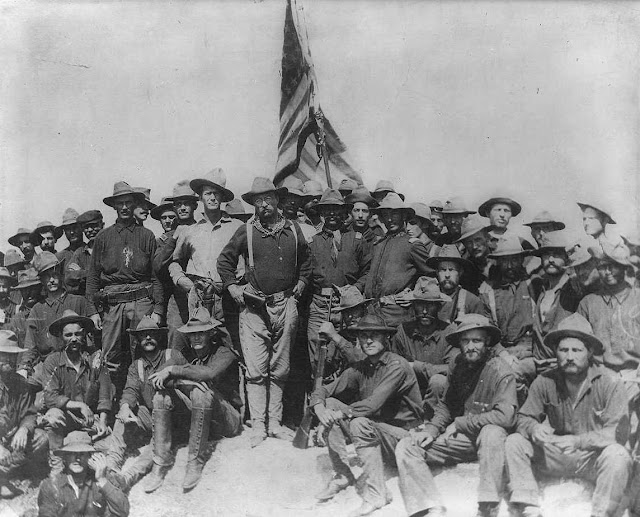

Shortly after the battle, Roosevelt posed with his Rough Riders atop San Juan Hill.  The Buffalo Soldiers who had fought with them were notably not included.

Meanwhile other units of the cavalry’s 1st Brigade secured a smaller knoll on the Spanish right flank.  The heights had been cleared, but fearing a counterattack, Wheeler ordered the exhausted men to throw up breastworks facing the city of Santiago, a mile or so in the distance. 

Roosevelt’s men did repulse one weak counterattack.  But back at his headquarters in the rear Shafter feared a general counterattack and ordered a retreat to the original positions in the trenches as the bottoms of the hills.  Unable to convince his superior to countermand the order, Wheeler on the scene simply ignored it and continued fortifying his position over night. 

Lawton’s Division, badly roughed up at El Caney, finally arrived around noon on July 2.  The position was now secure, and artillery was brought up to the heights to threaten the city and a squadron of Spanish cruisers in the harbor.  The cruisers were forced to flee the guns and ran into a waiting superior American Navy taskforce which destroyed them. 

After a siege by combined American and Cuban nationalist forces, the Spanish surrendered Santiago on July 17.  That completed major land operations in Cuba. 

Troops who survived the shot, shell, and heat stroke of the Battle for San Juan Heights were ravaged by yellow fever and malaria.  General Shafter petitioned Washington for a rapid withdrawal of V Corps calling it an “army of convalescents.”  Concerned that the President would ignore the bumbling Shafter, a group of senior officers prevailed upon the politically well-connected Roosevelt to send a similar appeal on their behalf. 

American evacuation began on August 7.  Troops of the 9th Infantry (Colored) were left behind as an occupation force under the theory that their race and Southern origin would protect them from illness.  It didn’t.  By the time they, too, finally went home almost a tenth of their number came down with yellow fever. 

Roosevelt returned aa a national hero, the Rough Riders were celebrated as folk heroes.  On the strength of his celebrity Roosevelt won the spot as McKinley’s running mate in 1900 and ascended to the Presidency upon his assassination. 

The Buffalo Soldiers, cavalry and infantry alike, who had fought so well received virtually no notice.  Even their White officers, including the heroic Lt. Ord, the son of an active duty General, were denied decorations.  Roosevelt got his Medal of Honor, arguably well deserved.  But so did Schafer who was ineffective as a commander and never came under hostile fire. 

And, oh yes, the U.S. won the war, obtained an empire, and was recognized as a first-rate world power for the first time.


Wednesday, June 10, 2026

Planting the Stars and Stripes in Asia--The Korean War They Didn't Teach You


A Korean map of the Hermit Kingdom.  The Han is the second major river from the south pictured on the map, the water way to the capital Hanyang (modern Seoul.)

A fat book could be made of forgotten and neglected American foreign wars or interventions. Take the war in Korea, for instance.  No, not the one when Harry Truman sent American forces to try to repel an invasion of the South by the Communist North in 1950, although I know veterans of that conflict have taken to calling it a forgotten war.  No, I have in mind an action nearly 80 years earlier.  Never heard of it?  Well pull up a stool and I will tell you all about it.

In American military and naval annals, it is listed, mostly as a footnote, as the United States Expedition to Korea of 1871.  It is best remembered as the first foreign conflict in which Medals of Honor were awarded.  The Koreans, who have a keener memory of such things, call it the Shinmiyangyo.

Korea in the late 19th Century was one of the most isolated nations on earth.  The history of this peninsular nation in northern Asia was a tragic one of repeated invasions or attempted invasions by neighboring China, Japan, and Manchuria.  The response of the ruling Joseon Dynasty which came to power in 1392 and had ruled and shaped the nation as a Confusion culture and state, was extreme isolationism—a virtual exclusion of all contact and trade with the rest of the world.  That policy was being tested again by pressure from Japan, the introduction of Catholicism by missionaries in the late 18th Century, and demands of European powers for concessions and trade privileges.  


In 1866 after eight fruitless week of battle a French expeditionary force failed to capture the citadel of Gsnghwua and was forced into a humiliating withdrawa
l.

In 1866 the French launched a punitive expedition against Korea in retaliation for a massacre of Catholics that included French Priests and to demand trade concessions.  A sizable French force landed on the fortress island of Ganghwa which guarded the approach to the capital of Hanyang, modern day Seoul.  After six weeks of fighting, the French were ignominiously forced to withdraw.  The ruling Joseon Dynasty, previously weakened by internal dissent was strengthened and but also deluded about its military capacity.  It re-affirmed its isolation and in the West became known as the Hermit Kingdom.

As for the United States, having spanned its own continent and emerged united from the Civil War, the country continued to look westward to the Pacific all the way to the shores of Asia to expand its influence and to secure free and equal access to the trade of all Asian ports.  Spurred on by the Navy, a force in search of a mission to keep it afloat in peace time, the government followed a policy to open trade relations with all nations and to check the growing power of its greatest rival the British Empire with its strong presence in China and naval superiority.

The first catalyst of the U.S action against Korea was the fate of the General Sherman, an American side wheel commercial steamer that was hired by an English firm in China to try to open trade with Korea in 1866, the same year as the French adventure.  The belligerent American captain of the ship would not take a refusal to allow it to dock and captured Korean officials sent to inform him of the government policy.  He then tried to move upriver firing cannons as he went.  The Koreans rallied and after several days of fighting and the loss of several junks, the General Sherman was destroyed and her surviving crew taken captive—and were likely executed.

Also of official concern was the possible fate of Americans who were shipwrecked in Korean waters, although in the one confirmed case, the survivors were well treated and sent to China from where they could be repatriated.  Finally, the U.S. sought to open Korean ports and sign a trade agreement.


The iron hulled and screw propelled steam frigate the USS Colorado was the flagship of the American squadron on the 1871 Korean expedition.

Early April 1871 what might be called a heavily muscular diplomatic mission set sail for Korea.  In Command was Rear Admiral John Rogers on board the USS Colorado, the flagship of the Navy’s Asiatic Squadron.  It was an iron-hulled three masted steam screw frigate which had seen service in the Civil War.  On board to handle negotiations was Frederick F. Low, the United States Ambassador to China.  Also in the squadron were four other warships—the sloop of war USS Alaska, the armed tug USS Palos, the side-wheel gunboat USS Monocacy, and the screw sloop USS Benicia

Admiral Rogers might be forgiven if he envisioned having the success and glory the Commodore Mathew Perry found in opening trade with Japan in 1854.


"Men in white" were encountered by Admiral Roger's crew.  These Korean officials later taken captive were photographed on the deck of the Colorado in their traditional attire.

On June 1st Rogers arrived in Korean waters and successfully put men ashore to attempt to contact authorities.  The crew reported encountering “men in white” who were reluctant to talk to him or take any message to the Emperor in his capital of Hanyang.  Rogers’s men ashore reportedly politely told the Koreans that they would be exploring the area and “meant no harm.”

The Admiral then led his ships to the entry of the Han River leading to the capital—where foreign ships were explicitly forbidden to go.  The flotilla came under ineffective cannon fire from fortresses on Ganghwa.  The ships were not badly damaged, due “to the bad gunnery of the Coreans, whose fire, although very hot for the fifteen minutes in which they maintained it, was ill-directed, and consequently without effect.”

Rogers hotly demanded an official apology for the “unprovoked attack” and gave the Koreans a ten-day deadline to reply.  When those days lapsed, he quickly swung into action with a punitive raid on Ganghwa Island.

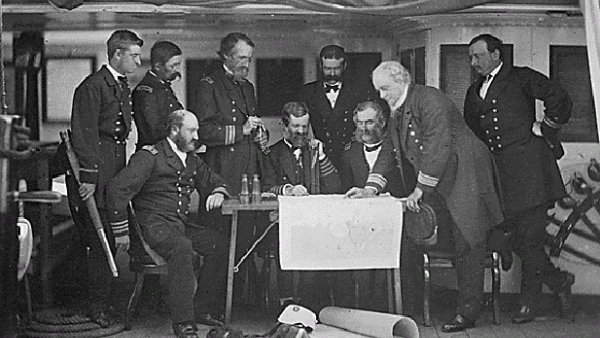
A council of war on board the USS Colorado.  Admiral John Rodgers is the one leaning over the chart.

On June 10 hostilities began with an attack on the lightly defended Choji Garrison on the Salee River.  The Koreans, members of the Tiger Hunters led by General Eo Jae-yeon were crudely armed with matchlock muskets which had been obsolete for nearly a hundred years in the West.

A force of 546 sailors and 105 Marines were put ashore to move on other objectives supported by 12-pound howitzers and guns from the flotilla.  They quickly moved on and captured Deokjin Garrison, and Deokjin Fort, which they found abandoned.  The Koreans fell back and regrouped at the well-fortified citadel of the Gwangseong Garrison.  As the Americans advanced on the fort an attempt to flank it was repulsed.

American forces established strong artillery batteries on two hills overlooking the fort which was pounded by extensive shelling abetted by fire from the USS Monocacy operating close to shore in shallow Han River waters.  


U.S. Sailors stormed the citadel of Gwangseong in heavy hand to hand fighting.

Navy Lt. Hugh McKee led a charge on the damaged fort.  The Korean defenders with their slow loading matchlocks were hardly able to get off a single volley of fire before McKee reached the top of the wall leading his troops. He was felled by a ball immediately.  Right behind him Commander Winfield Scott Schley personally shot the Korean who had wounded McKee.  Several seamen rushed to the aid of McKee, fatally wounded in the groin.  Meanwhile two Marines, Corporal Charles Brown of the USS Colorados guard and Private Hugh Purvis of the USS Alaska’s guard captured the personal flag of Eo Jae-yĹŹn and Private James Dougherty shot and killed the General.  Carpenter Cyrus Hayden, a sailor from the USS Colorado planted the American Flag on the ramparts under heavy fire.


Korean dead in the breached citadel.

The whole battle for the fortress lasted 15 minutes from the breach of the walls.  The surviving garrison, including the deputy commander, was taken prisoner.  In all of the action that day the Koreans lost 243 dead and 20 captured, most of them wounded.  American losses were three dead, including McKee, and ten wounded.

It was a brilliant military victory, especially considering that the Americans accomplished in a single day what the French had failed to do in six weeks.

Despite the military glory, the diplomatic mission ended in abject failure.  Rogers tried to use his prisoners as bargaining chips to demand negotiations with the Koreans.  The Koreans, for their part, flatly refused to negotiate, or even to take back the prisoners, who they considered traitors for surrendering.  The squadron stood off Korean waters until July 1 fruitlessly waiting to begin talks.  Frustrated and with fuel for his ships running low, Rogers had to break off contact and return with his primary objectives unmet.  In the end Rogers left as empty handed as the French.


Korean Headquarters Flag captured  by Marines Private Hugh Purvis, Corporal Charles Brown, and Captain McLain Tilton on board the USS Colorado after the battle.

The U.S. was unable to establish relations with Korea until 1886, after the Japanese forcibly opened trade there and the British had extracted concessions.

Nine sailors and six Marines including McKee, Brown, Purvis, Dougherty, Hayden, and three sailors who came to the aid of McKee were awarded the Medal of Honor.  Admiral Rogers never found the fame and glory of Commodore Perry and faded into historical obscurity.


North Koreans re-enact the Shinmiyangyo annually and celebrate the defenders as national martyrs and heroes.

For the Koreans, especially, in the Communist North, which now so closely resembles the Hermit Kingdom, the whole experience of 19th Century contact with the Americans is celebrated.  A story was invented making an ancestor of Kim Il Sung, the founder of the Peoples Republic of Korea and of the dynasty that has ruled ever since, the local commander who sank the General Sherman.  The American spy ship the USS Pueblo which was captured by the North Koreans in 1968 is now anchored at the site of the destruction of the General Sherman.  And the fallen garrison of Gwangseong are celebrated as martyr/heroes like the Texicans at the Alamo.

Which is why you probably never heard of America’s first Korean War.


Wednesday, August 9, 2023

How the Purple Heart Became the Medal Soldiers Don’t Want


My father never wanted a Purple Heart and dodged attempts to pin one on him.  W.M. Murfin served as an Army Medical Corps officer in the Pacific during World War II.  That service included three amphibious landings under fire and front-line service with forward battalion aid stations.  While never seriously wounded he was injured three times including being cut up crawling over barbed wire and scrapes and abrasions rescuing seriously wounded soldiers under fire.  On one day of such rescues when his unit was cut off by the Japanese on Leyte in the Philippines he dragged several men to safety under machine gun fire.  That earned him the Bronze Star.  He was glad to receive that medal and after the War kept it in its presentation case along with another award he treasured—his Eagle Scout medal.

                                First Lieutenant W.M. Murfin, U.S. Army Medical Corps on Leyte in the Philippines in 1943.

But he dodged the Purple Heart despite repeated attempts to give him one.  He knew what they represented and what they were worth—as a Medical Corps officer he had handed out scores of them to the maimed men his unit treated.  He felt that his own minor bleeding did not match the suffering of those in his care.  He also felt, sometimes at least, that the medal was a trinket that was inadequate recompense for the pain and suffering.

The Purple Heart is said to be the oldest U.S, combat decoration which it is, sort of, but then again isn’t.  Let me explain.

During the Revolutionary War the Continental Army did not have formal awards for bravery.  This was due partly to concern for republican virtue—a rejection of the titles and decorations of European royalty and their military, and partly because no one knew exactly who could or should authorize such awards, Congress, the Commanding General, or even the states.  Besides, everyone was concerned by more pressing matters.

But in 1782 with the war slowly winding down after the defeat of Cornwallis army at Yorktown and as peace negotiations dragged on in Paris George Washington was faced with a restless—and mostly unpaid—army in his camp at Newberg, New York.

The only formal recognition of bravery or distinguished service was mention in official reports on engagements.  Most frequently officers were cited, non-commissioned officers and private soldiers only rarely.  Some time the citations were read aloud to units in assembly but even that was often overlooked. 

Just once, in 1780, Congress authorized the striking of a special medal designated at the Fidelity Medallion to honor three soldiers who were conspicuous in the capture of Major John AndrĂ©, the man who received Benedict Arnolds traitorous offer to deliver West Point to the British.  But the three men, Privates John Paulding, David Williams, and Isaac Van Wart were New York militiamen not troops of the Continental Line.  The Fidelity Medallion was never awarded again and is thus considered a commemorative award rather than a regular military decoration.

George Washington's Revolutionary War cloth Badge of Military Merritt.

General Washington designed a cloth purple heart shaped patch that could be sewn on a uniform.  On August 7, 1782 he signed an order authorizing the award of a Badge of Military Merritt to specifically award the “common soldier” and was meant to recognize those who gave “loyal military service.” Washington personally cited three men—sergeants William Brown, Elijah Churchill, and Daniel Bissel who served as a spy.  All three were from Connecticut. Other commanders were authorized to make the award as well, but it is unclear if any did, or how many may have been granted before the Continental Army officially disbanded. Any records of such awards would have been kept in an Orderly Book which has never been found.

After the war the Badge of Military Merritt was never again awarded, although the honor was not officially abolished.  It simply was forgotten.  None-the-less, the boosters of the modern Purple Heart medal claim that it directly traces its origins to Washington’s 1782 order.  The claim is tenuous at best, but those who lobbied for the creation of the current medal identified it with the Badge and its design was based on the purple heart shape with a cameo of Washington added to bolster the connection.

Through the War of 1812, the Mexican War, and several Indian campaigns, the Army had no decoration for bravery.  With the coming of the Civil War there was a clamor for an award for heroism.  No one seemed to have thought of reviving the Badge of Merritt.  At the outset of the war Commanding General Winfield Scott opposed the creation of a medal as an un-republican symbol of aristocracy and privilege.  After Scott retired late in 1861 Navy Secretary Gideon Wells requested authorization of a medal from Congress.  By 1862 separate legislation authorized a Medal of Honor for each service.

With no other awards available the Medal of Honor was soon handed out nearly wholesale.  In the Civil War alone 1,523 were awarded and before World War I another 767 were handed out for conflicts big, small, and obscure including the Indian Wars, Spanish-American War, Philippine Rebellion, Boxer Rebellion, and the occupation of Veracruz. 

By 1916 the Army became convinced that the Medal of Honor had become devalued by capricious awards.  After a report of a special Medal of Honor Review Board the Army rescinded 911 of the awards in 1917.  During World War I far fewer were awarded, but new medals were authorized for bravery below the level of “conspicuous gallantry and intrepidity at the risk of life above and beyond the call of duty.”  A number of new decorations were created for heroism in combat below the Medal of Honor including the Distinguished Service and Navy Crosses, Silver Star, and Bronze Star.  But the Badge of Merritt was not among them.

However nearly ten years after the war ended Army brass had second thoughts about being relatively stingy with medals during the Great War.  Army Chief of Staff General Charles Pelot Summerall proposed reviving the long defunct Badge of Merritt in 1928 but it died in Congress.  His successor General Douglas MacArthur with the support of private lobbying groups confidentially reopened work on a new design, involving the Washington Commission of Fine Arts and Elizabeth Will, an Army heraldic specialist in the Office of the Quartermaster General.  By Executive Order of President Herbert Hoover in one of his final acts the award was revived on the 200th Anniversary of George Washington’s birth, amid considerable hoopla by War Department General Order No. 3, dated February 22, 1932.

The criteria for the new Purple Heart medal were broad—and retroactive.  Servicemen from April 5, 1917, the day before the U.S. entered the war were eligible upon their request if they had the Meritorious Service Citation Certificate, Army Wound Ribbon, or were authorized to wear Wound Chevrons on their uniforms.  The Service Citation was given for “meritorious performance of duty” which could include combat but also other exceptional service.  Civilians serving with the military—Red Cross and YMCA volunteers for example were also eligible.

The first non-retroactive Purple Heart was awarded to General MacArthur not for wounds, but for his meritorious service during the defense of the Philippines.


In World War II many G.I.s were given their Purple Hearts by the staff of military hospitals.  This soldier seems happy to get his--perhaps because he received a "ticket home" wound.

Until early in World War II the same criteria were used for new awards.  By executive order in December 1942 the practice of awarding the Purple Heart for meritorious service was discontinued and the award limited to wounds suffered in combat.  Eligibility was extended to all armed services. 

During World War II, 1,506,000 Purple Heart medals were manufactured, many in anticipation of the estimated casualties resulting from the planned Allied invasion of Japan. By the end of the war, even accounting for medals lost, stolen or wasted, nearly 500,000 remained. More than 70 years later that cache of medals is still being used.  In 2000 more than 120,000 were in stock—plenty for new conflicts from Desert Storm to the wars in Iraq and Afghanistan.  As in previous wars there were plenty on hand with combat units for immediate award to the wounded. 

Since World War II there have been several adjustments to eligibility including allowing for posthumous awards; excluding previously eligible civilians; including those wounded in terrorist attacks, or while serving as part of a peacekeeping force, and to former prisoners of war wounded after April 25, 1962.

U.S. Army Major General Carla G. Hawley-Bowland pins a Purple Heart medal on U.S. Army Medical Corps Sergeant Juan Roldan-Jaramillo during a ceremony at Walter Reed Medical Center in 2008. The Sergeant lost both of his legs from an improvised explosive device (IED) attack in Iraq.

An accurate total of Purple Hearts awarded is impossible since a great many were presented without ceremony or documentation in war zones when the wounded were treated for their injuries.  In 2009 National Geographic estimated the following totals of Purple Hearts awarded by conflict. 

    World War I—320,518

    World War II—1,076,245

    Korean War—118,650

    Vietnam War—351,794

    Persian Gulf War—607

    Afghanistan War—7,027 (as of June 5, 2010)

    Iraq War—35,321 (as of June 5, 2010)

Additional decorations have been awarded in numerous other operations among them the bombing of a Marine barracks in Lebanon in 1983; the invasions of Granada and Panama; peace keeping activities in Mogadishu, Somalia in 1993; the NATO campaign against Yugoslavia during the Kosovo War in 1999, and the Benghazi attack in Libya in 2012.

The Military Order of the Purple Heart has helped place scores of monuments like this one on the Square in Woodstock, Illinois.

The Military Order of the Purple Heart (MOPH) was chartered by Congress in 1932 and is restricted to veterans who have received the medal.  It currently has approximately 45,300 members.  The Order annually promotes Purple Heart Day on August 7, helps place Purple Heart monuments in many locations including Woodstock, Illinois, and assists returning lost medals to the recipients or their families. 

All honor to those who have received the Purple Heart.  But as Dad knew, it’s the medal no one wants to earn.