Phineas T. Barnum's Roman Hippodrome. Note tent covering the open roof.
When William Kissam
Vanderbilt finally got control of a chunk of grandpa Cornelius
Vanderbilt’s estate in 1879, he knew just what he wanted to do with
one of the assets. The old Commodore owned the property
where a half-derelict hulk of a building sat on prime Manhattan
real estate.
The large structure had originally
been the New York & Harlem Railroad depot, which the Commodore
bought and incorporated into what became the New York Central. In
1871 station operations moved to the shiny new Grand Central Depot.
Phineas T. Barnum then stepped in and leased the
building. He took the roof off, gutted it, and converted it into
an oval arena 270 feet long, with tiers of seats and benches.
It was rechristened first as the Great Roman Hippodrome then even
more grandly Barnum’s Monster Classical and Geological
Hippodrome. The bombastic showman experienced great success
staging his famous circus and other spectacular exhibitions
including chariot racing there.
In 1876 Barnum gave up his lease
to concentrate on his increasingly lucrative touring circus. Irish-born
band leader Patrick Gilmore, composer of When Johnny Comes Marching
Home and other famous marches, then took over the building
re-dubbing it Gilmore’s Garden. When he was not presenting
his own concerts there, Gilmore rented the space to promoters of flower
shows, beauty contests, temperance and revival meetings,
walking marathons. and in 1877 the first Westminster Kennel Club Dog
Show then called the New York Bench Show. He also presented boxing
matches at a time when prize fights were illegal in the Empire
State by passing them off as exhibitions and even as demonstrations
accompanying lectures on the manly arts of self-defense.
The promoter of the Dog Show briefly
took over the building but kept Gilmore's name on it. He added genteel tennis
matches and installed an ice skating rink for use during the frigid winter
months.
Vanderbilt's renovated and renamed Madison Square Garden.
It
was undoubtedly the boxing which attracted the younger Vanderbilt. He
considered himself something of a sporting man and owned a very
successful horse racing stable in France. Later he was a co-owner
of the yacht Defender, which won the 1895 America’s Cup.
He took over the building and with a minor facelift re-opened it on May
31, 1879 as Madison Square Garden.
Vanderbilt
booked boxing exhibitions featuring Police Gazette heroes like Heavyweight
Champion John L. Sullivan. Other sports attractions
presented to crowds of up to 10,000 patrons included track and field meets
and bicycle racing—maybe the most popular spectator sport in the
country—on his specially built banked velodrome track. The
National Horse Show joined the dog show as an annual attraction and Barnum
came back to exhibit his prize elephant Jumbo. Buffalo Bill
Cody’s Wild West Show became a national sensation there
during a long run in 1886. The place also hosted national conventions
of the Elks and other organizations.
The old building established itself as the Big Apple’s prime multi-purpose
venue for big events. But it was in deteriorating condition
and uncomfortable or unusable much of the year—stiffing hot in the summer
and freezing cold and dark during the long winter months.
Harper’s Weekly described it as a “patched-up grumy,
drafty combustible, old shell.”
After
11 years Vanderbilt grew tired of his toy while civic leaders clamored
for its replacement, an expensive project he had no interest in
underwriting. Enter a consortium the richest men in the city and
country—J.P. Morgan, Andrew Carnegie, William
Waldorf Astor, and others plus showman Barnum—who bought the building and
land, tore it down, and erected an impressive replacement also called Madison
Square Garden.
 |
| Vanderbilt's renovated and renamed Madison Square Garden. |
The
second Garden was designed by famed architect Stanford White and opened
in 1890 at the staggering cost of $3 million. The grand new edifice
did have a roof making it the largest indoor arena/exhibition space
in the country. In fact, the famed Roof Garden Restaurant became a
place to be seen for the city elite and a venue for late night
entertainment after the Broadway shows were done for the
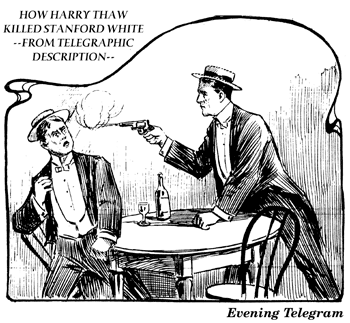
evening. White was famously shot and killed by the husband
of his lover, Gibson Girl model and actress Evelyn Nesbit
there in 1906.
The
second Garden became the annual home for the touring Barnum and Ringling
Brothers circuses and eventually their combined show. It
continued to be the venue of choice for top prize fights and in 1902 and ‘03
the indoor games of the professional World Series of Football.
It also hosted important national events like the 1924 Democratic National
Convention which nominated John W. Davis after 103 ballots.
Despite
the cultural importance of the building, it was not a financial
success and in 1925 the mortgage holder, New York Life Insurance,
foreclosed, tore it down. then erected their skyscraper
headquarters on the site.
A
third Madison Square Garden was built away from Madison Square on Eighth
Avenue between 49th and 50th Streets where trolley barns once stood. The new
structure was owned by Tex Rickard whose New York Rangers of the National
Hockey League (NHL) made it home from 1926.
The third Garden shown on a 1941 picture postcard.
Basketball was represented
in a series of collegiate double headers every week featuring top local
and national teams as well as the National Invitation Tournament
(NIT) beginning in 1938 and hosted seven NCAA Men’s Basketball
Championship finals between 1943 and 1950. The New York Nicks
of the National Basketball Association (NBA) began their residency
in 1949.
Although
this incarnation did not host any national political conventions, Franklin
Roosevelt used it to stir up support for his first Presidential campaign
with a mammoth rally in 1932. Thirty years later the Garden
was packed for a birthday celebration for John F. Kennedy at
which Marylin Monroe famously crooned him “Happy Birthday, Mr.
President” in a slinky silver sequined gown that she had to be sewn
into.
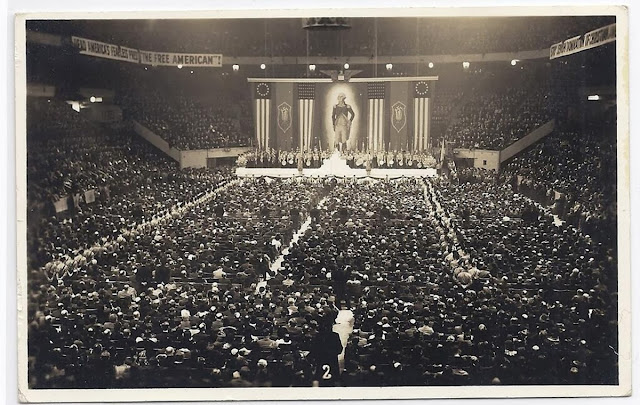 |
| A large portrait of George Washington loomed over a huge German American Bund pro-Nazi rally at the Garden in 1939. |
Garden
III
was available to anyone with pockets deep enough to pay the rent so
was often the site of events for diametrically opposed groups. The American
Jewish Congress and the Jewish Labor Committee held a Boycott
Nazi Germany rally there in 1937 but in 1939 the German American Bund
staged an even larger event in support of isolationists trying to keep
the U.S. from entering World War II on the side of the British
and French.
Billy
Graham
conducted a 16 week revival Crusade there in 1957.
In
the 1960s ownership and management was taken over by the new Madison
Square Garden Company under the leadership of impresario Irving
Feld of Ringling Bros. The company laid plans for yet another
incarnation, this time built over Pennsylvania Station between Seventh
and Eighth Avenues from 31st to 33rd Streets. After
the new building was opened in 1968, the old Garden III was torn down.
The original plan was to erect a new world’s tallest building at
the old site but that was squelched by massive neighborhood
opposition resulting in strict height limits for new construction
in the area. It remained underused as a parking lot until
1989 when the Worldwide Plaza opened on the site.
Today's Madison Square Garden IV is round.
The
newest Garden increasingly became a venue for big pop concert
events in addition to its traditional diet of sports. These famously
included a 1971 rock-and-roll revival concert immortalized by Ricky
Nelson’s song Garden Party, Elvis Presley, George
Harrison’s Concert for Bangladesh, and the Concert for New York
City following the September 11 attacks. Artists like Elton
John, Billy Joel, Parliament-Funkadelic, and U2
have all played there many times with Joel having the record of more than 60
appearances.
The
Garden was also the launching pad for the re-introduction of professional
wrestling into mainstream pop culture as the venue for the inaugural
WrestleMania presented by the World Wrestling Federation (WWF)
in 1985 and many subsequent marquee events.
The
Democrats held their convention at the Garden in 1976, 1980, and 1992.
Madison
Square Garden's $1 billion second renovation took place mainly over three off-seasons.
It was set to begin after the 2009–10 hockey/basketball seasons but was delayed
until after the 2010–11 seasons. Renovation was done in phases with the
majority of the work done in the summer months to minimize disruptions to the
NHL and NBA seasons.
Despite
a billion dollar renovation in 2011-‘13, the Garden lost long time
tenants the Ringling Bros. Circus and Disney on Ice
to the new Barclays Center in Brooklyn.
The City
of New York wants to expand Penn Station underneath the Garden which
would require that it be torn down and relocated. This has been a major
issue in the city for years with the MSG company resisting the move. In
2013 they were granted a ten year extension of their air rights
permit after which time they will either have to move or begin a new, and
risky, application for another extension. Then, in January 2016, New York
Governor Andrew Cuomo announced a redevelopment plan for Penn
Station that would involve the removal of The Theater at Madison Square Garden
but would otherwise leave the arena intact.

.jpg)


