Showing posts with label Portland Oregon. Show all posts

Tuesday, August 20, 2019

Proud Boys, White Nationalists and Antifa—One of These Things is Not Like the Other—With Murfin Verse

Proud Boys and Neo-Nazi allies marching in Portland.
The Proud Boys, allegedly White Nationalist litewestern chauvinists” descended on Portland, Oregon over the weekend for what was billed as a “End Domestic Terrorism” march and the largest such demonstration yet of the neo-fascist right.  The frat boys of the so-called alt-right were joined by the harder edged Three Percenters, a patriot movement militia, the American Guard, and assorted officially unaffiliated loners and losers scraped up in neo-Nazi chat rooms on the dark web.  The Domestic Terrorism that they were protesting was not that which has left scores dead in multiple recent mass murder shootings, but the Antifa who have done such despicable things as throwing a milk shake at rabid right Republican Congressman Matt Gaetz, punching alt-right spokesman Richard Spencer, and demonstrating at speaking events.
Portland, a city that The Guardian described as having “a liberal laid-back hippy vibe” was the target of the march for two reasons.  First, it is the home of the largest groupings of the amorphous Antifa which sprang up from a robust local anarchist scene and the Black Block street fighters that first came to prominence in the 1999 World Trade Organization (WTO) protests up the coast in Seattle.  Secondly, it is convenient the compounds, bunkers, and training camps of the Patriot Militias, White supremacists, and anti-government radicals that dot eastern Oregon and Washington, Idaho, and Montana
The two sides have faced off in Portland before.  As the city prepared for what was expected to be the largest confrontation ever, Donald Trump stirred the pot.  Of course he did.  The Resident Tweeted, “Major consideration is being given to naming ANTIFA an ‘ORGANIZATION OF TERROR.  Portland is being watched very closely. Hopefully the Mayor will be able to properly do his job!”
Not only did the Cheeto-in-Charge not mention or condemn the White Nationalist with a proven history of violence—the Proud Boys were prominent in in the Charlottesville clashes two years ago that left anti-Nazi protestor Heather Heyer dead—but he explicitly endorsed their stated cause much to the delight of organizers Joe Biggs and Enrique Tarrio of the planned non-permitted march.

Proud Boy spokes bigot Enrique Tarrio was the most visible leader to actually make the march.
Predictably much of the American mass media, trained like Pavlov’s dog to spout on-the-one-hand/on-the-other-hand equivalency in the name of journalistic neutrality, treated the Proud Boys and the Antifa equally “dangerous extremists of the far right and far left.”
In the end Portland Police kept the two sides mostly separated preventing violent clashes.  But the march leaders mostly failed to show up to their own event fearing arrest and left their followers with no plans or support.  They were forced to march back and forth across the long Morrison Bridge over the Willamette and then were steered to a riverfront industrial area where cement barricades police in full riot gear kept them separated from the Antifa who were also largely neutralized except for shouting back and forth.

In one of many street theater performances counter protestors proclaimed "White Flour," "Wife Power," and dressed as hot dogs to mock the white nationalist marchers.
But that doesn’t mean that the marchers were unopposed.  Large numbers of creative and non-violent Portlandians got ahead of both the police and marchers preemptively occupying most of the squares and public places in the downtown area where the marchers could gather with dancing unicorns, clowns, jugglers, puppets and derisive signs.  The counter protests also featured Buddhist and Jewish prayers, speeches, a poop emoji costume parade organized by the PopMob group, and music.  Their mood was joyful and triumphant. Meanwhile the leaderless marchers were steered through hostile minority neighborhoods where they were frequently given wrong directions and where local businesses refused to sell them water or food or allow them to use restrooms.  When they finally found a place to gather the planned three hour rally was cut to half an hour as speakers were drowned out by counter protestors’ jeers, chants, and songs.
The exhausted marchers had to retrace their steps under humiliating police protection and were left where they had to walk additional miles to return to the busses and cars that brought them.  Over the entire day a handful on each side had been arrested, mostly in isolated incidents after the main march broke up.

A lone Black Antifa marched alongside the massive police presence that separated the two sides.
The local press depicted the day as a humiliating defeat for the White Nationalists.  But Proud Boy leaders declared victory anyway and vowed to return to the city with new marches every month with the stated aim of bankrupting the city until the Mayor and Council “cracked down and eliminated the Antifa.”  Blackmail by attrition if you will.
With calls for suppression not of White Nationalists or Neo-Nazis on the rise including legislation in Congress to declare the Antifa as terrorists, comes the difficult question of defining just who Antifa are and who are other opponents of the Right.  Are the Black Block and the Antifa on the streets of Charlottesville, Portland, New York, Boston, the Bay Area, and other places really identical?  Clearly there is some overlap and the cosmetics are similar—the use of black clothing, banners, and sometimes masks.  But the Antifa are clearly much broader and focused more directly on community self-defense and direct confrontation with racist thugs than on mindless rampage.  The Industrial Workers of the World (IWW), my old radical labor union and its General Defense Committee (GDC) which have been among the most cohesive and visible elements of the Antifa movement has clearly made that distinction.  Many of those now joining the Antifa movement have no ties at all to the Black Block. 

A typical red and black Antifa flag carried in many actions.
Two years ago in Charlottesville the Antifa were a very visible presence in the protests organized to protest the planned removal of a monument to Robert E. Lee.  They were pointedly not included in Trumps famous declaration that there were “good people on both sides.”  But the Antifa famously came to the defense of religious leaders including Unitarian Universalist Association (UUA) President Rev. Susan Frederick-Gray and several other UUs who linked arms around the perimeter of the block where the Lee statue stood to prevent the Neo-Nazis from rallying there.  The ministers came under attack and feared for their lives.  They were rescued and protected with masked Antifa including IWW members.  One participant, famed Black scholar Cornel West said frankly.  “The antifascists, and then, crucially, the anarchists…saved our lives, actually. We would have been completely crushed, and I’ll never forget that.”

Antifa including members of the IWW--note flag to the right--to the rescue shielding besieged ministers and religious leaders in Charlottesville two years ago.
A few days later we held a vigil on the grounds of the Tree of Life Unitarian Universalist Congregation in McHenry, Illinois.  A couple of hundred folks showed up on short notice.  As the crowd formed a solemn circle before moving to line Bull Valley Road with lighted candles I spoke.
After remembering the blood sacrifice of 32 year old anti-fascist hero Heather Heyer and the needless deaths of Virginia State Police Lt. H. Jay Cullon and Trooper Pilot Berk M.M. Bates in a helicopter crash responding to the violent chaos unleashed by the organized forces of bigotry, I said that it fell to me to be the voice of anger and outrage.  I was not there to lead a chorus of Kumbaya.  I noted West’s appreciation of the Antifa--the same anti-fascists that Trump and far too much of the media held to be equally guilty for the violence.  And I was moved to recall others who had confronted Nazism.  The poem I wrote and read at the time may have made some gathered that evening uncomfortable.  But it had to be said.

Communists and Brown Shirts brawling in a Munich beer hall in 1932.  No one else physically stood up against growing Nazi power.
Munich and Charlottesville
August 13, 2017

So is this how it felt on the streets of Munich
            when the strutting Brown Shirts 
            in their polished jackboots,
            Sam Browne belts, and scarlet arm bands
            faced the scruffy Commies 
            in their cloth caps
            and shirtsleeves rolled up 
            and battled in the beerhalls,
            parks and streets.

All of the good people, the nice people
            cowered behind closed doors
            and wished it would go away—
                        all of the liberals, the Catholics,
                        the new-bred pacifists of the Great War,
                        the professors and doctors,
                        editors and intellectuals,
                        the Social Democrats,
                        even—my God!—Jews 
                        who had not gone Red—
            a pox on both your houses they solemnly intoned.

Hey, buddy, in retrospect those damn Bolshies
            look pretty good,
            like heroes even.

Things look a little different in Charlottesville,
            in brilliant color not grainy black and white
            and the Fascists can’t agree on a
            Boy Scout uniform and array themselves
            golf shirts and khakis, rainbow Klan hoods,
            biker black and studs and strutting camo.

But the smell, you know, that stench,
            is just the same.

The question is—do you dare be a Red today
            or will you close your doors
            and go back to your game consoles
            and cat videos.

Which will it be, buddy?

—Patrick Murfin

Sunday, August 9, 2015

The Original One and Only Rebel Girl—Part 2

Elizabeth Gurly Flynn in Portland, late '20'.


Note:  Well, this story is too compelling, and encompasses such a sweep of American labor and radical history that it keeps getting away from me.  Instead of the promised two installments, it will stretch to three. We left the story of Elizabeth Gurley Flynn in 1920 when she was just 30 years old.  She was doing defense work on behalf of the IWW leadership which had been tried, convicted, and sentenced to long terms following post-World War I Red Scare raids.  If you missed the tumultuous first part of her story, you can catch up here .
For almost 10 years much of Elizabeth Gurley Flynn’s work for and with the Industrial Workers of the World (IWW) had by necessity concentrated on legal defense campaigns, many of them centered on issues around the rights of free speech, free press, and free assembly.  And it was deeply personal given her own experience fighting off charges of violating the Espionage Act during World War I.  Then came the post-War Red Scare and Palmer Raids which ushered in the most viciously repressive era in American History.  Not only was the entire leadership of the IWW prosecuted and persecuted—101 including Big Bill Haywood and 40 in Leavenworth, Kansas—but Socialist Party leader and three-time presidential candidate Eugene V. Debs and other prominent Socialists and anarchists were victims.
In 1920, at the height of the repression Roger Baldwin moved to reorganize the three year old National Civil Liberties Bureau which had been formed to protect war-time freedom of speech and defend the rights of conscientious objectors into a broader and more aggressive organization.  Flynn was on board as a founding member of the new American Civil Liberties Union (ACLU) along with lawyer, feminist, and pacifist Crystal Eastman; law professor Walter Nelles; Southern born Jewish lawyer Morris Ernst; wealthy and well connected attorney Albert DeSilver who personally funded over half of the organization’s early budgets; Arthur Garfield Hays, the organization’s General Counsel and top court room lawyer; Socialist and Wobbly Helen Keller; Chicago reformer and pioneer social worker Jane Addams; and Felix Frankfurter, a future Supreme Court Justice.  It was impressive company for a high school dropout.
Flynn remained on the ACLU Board for twenty years and dedicated much of her time to the organization, frequently speaking on its behalf, explaining its often controversial aims and objectives, and highlighting specific cases.  She also worked with ad hoc committees formed to support specific cases and joined the International Labor Defense (ILD), which supported civil rights causes all over the world.  The ILD was similar in form, mission, and structure to the IWW’s General Defense Committee, with whom she had worked on the Palmer Raid cases, but it was broader not only geographically, but in terms of those who it defended.  Communists were active in, but did not necessarily dominate the ILD.  Flynn was international chair of the organization for three years.

An IWW continent at a mass Saco and Vanzetti rally.  Flynn helped organize and spoke at scores of such rallys and meetings across the country.


All three of these roles—ACLU, ad hoc committees, and the ILD came together with the Saco and Vanzetti case which would dominate Flynn’s attention for much of the 1920’s.   Nicola Sacco and Bartolomeo Vanzetti were two poor Italian anarchists, famously a shoe maker and a fish peddler, who were charged with murdering a security guard and the paymaster of the Morrill Shoe Company in South Braintree, Massachusetts during a payroll robbery on April 15, 1920.  From the beginning evidence against the pair was sketchy, at best.  Italian immigrant groups, anarchists and the left in general, and much of the labor movement quickly came to believe that two innocent men were being railroaded for their political beliefs. 
The case dragged on through a sensational trial, lengthy appeals handled by her ACLU colleague Arthur Garfield Hays, and pardon and clemency international petition drives.  Flynn barnstormed the country speaking to Free Saco and Vanzetti rallies, fund raising, and writing articles.  Through the ILD she helped organize massive street demonstrations in Rome, Paris, London, Moscow, and across Latin America.  Even the Pope pled for clemency.  But despite her best efforts the men were executed on August 27, 1927.

During the ‘20’s when she was not consumed by her work with the ACLU and with the Saco and Vanzetti case, Flynn supported herself as a lecturer and platform speaker.  Increasingly she focused on women’s issues in her talks supporting birth control and women’s suffrage then encouraging women to use their new-found power at the ballot box to promote social justice and peace. She was also particularly critical trade union leadership for being male-dominated and not serving the needs of women.
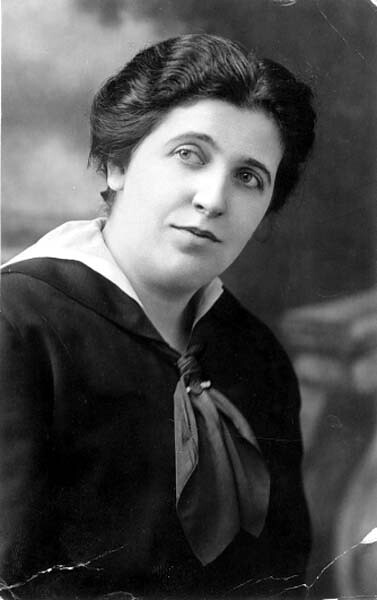
As the Saco and Vanzetti case was winding down, Flynn was emotionally and physically exhausted.  In 1926 she accepted the offer of Dr. Marie Equi to share her Portland, Oregon home.  It was the first real, permanent home Flynn had in years of near constant travel as an organizer and speaker.  And Equi was her first long term stable relationship since her marriage ended.

Dr. Marie Equi.

Equi was also a long time committed radical.  Born in 1872 to an Irish mother and Italian father, both working class immigrants, she worked in the New Bedford textile mills until heading out to Oregon with a high school girlfriend to attempt homesteading.  She lived with Bessie Holcomb on the Dales homestead for ten years until 1897 when the couple moved to San Francisco so that Equi could attend medical school.  In 1901, leaving Holcomb behind, she moved to Portland to continue her studies at University of Oregon earning her medical degree in 1903. 
She established a general practice in Portland in 1905 with an emphasis on women and children, including clandestinely providing birth control advice and performing abortions.  She gained fame when she volunteered to join a group of doctors and nurses who provided medical care to San Francisco after the earthquake and fire winning an official commendation from the U.S. Army for her work.  Back in Portland Equi became a leader in progressive causes and was a local leader of the Birth Control League.  She hosted Margaret Sanger and was arrested for distributing her pro-birth control pamphlets, although she was never prosecuted for actually providing the services.  During Sanger’s visit the two apparently had a physical relationship and Equi subsequently wrote love letters to Sanger.
In 1913 Equi was radicalized when she came out in support of the mostly women workers of the Portland Canning Company along with local members of the IWW and Socialist Party.  She was clubbed and severely injured on the picket line.  She joined the IWW and declared herself to be an anarchist.  She joined in IWW campaigns among the unemployed, in Free Speech Fights, and in support of its drives among timber workers.  Flynn and Equi’s paths may have first crossed.
Like Flynn, her opposition to World War I let Equi to be indicted under the Espionage Act.  Unlike Flynn, she was convicted and sentenced to ten years in prison.  Woodrow Wilson commuted her sentence to a year and a day.  She served her time in harsh conditions in the crowded women’s section of San Quentin Prison and was released for good behavior after 10 months in ill health.  Following release she returned to her medical practice and resumed her radical activities, including support for Sacco and Vanzetti.
Back in 1915 Equi and her partner Harriet Speckart, an heiress to the Olympia Brewing Company family had adopted a daughter, May, becoming one of the first open lesbian couples to raise a family together.  When Speckart died in 1926, Equi invited Flynn to share her home and the care of young May.
Flynn may not have intended to stay so long with Equi, viewing her time there at first as respite.  She needed it.  She was in worse shape than she thought.  Instead of helping care for May, mother and daughter Equi ended up tending Flynn.  She kept up with her ACLU work mostly by correspondence and made a few regional appearances.  But here time in Portland offered her an opportunity to re-connect with many old Wobbly ties, and perhaps to mend fences with those who shared Haywood’s condemnation of her behavior in the Iron Range case.  There was a fairly steady stream of them visiting Equi, who was a much beloved figure,
Then in 1930 Equi suffered a heart attack, and had to sell her medical practice.  It was Flynn’s turn to be a caretaker.

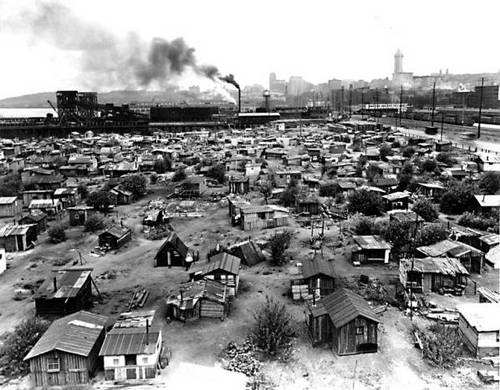
Hoovervilles like this sprang up in major cities and near small towns where the dispossessed homeless squatted in shacks on vacant land.

The severity, depth, and length of the Great Depression shocked even Flynn who could recall the sharp panics that punctuated the late 19th Century and the pre-World War I year.  Now huge roaming armies of the unemployed, sprawling Hoovervilles, soup and breadlines, and aggressive attacks on what gains labor had been able to make in the last thirty or so years were the reality of the day.   Worse, other than generally attacking the capitalist greed which produced the crisis, the left and labor movements seemed as flummoxed as everyone else on how to respond.  Traditionally during panics unions fought usually loosing battles against wage cuts and anarchists had responded with hunger marches.  New job organizing was considered nearly impossible as those who kept their jobs were loath to take any risk of losing them and the huge armies of the unemployed seemed a bottomless reservoir of potential scabs.  Many Socialists could only wring their hands and advance rather timid emergency relief programs.
Flynn had never been a doctrinaire socialist.  Like Haywood and other Wobblies and labor figures, she had supported the left wing of the Socialist Party represented by the International Socialist Review over more moderate, electoral oriented social democrats sometimes derided as sewer socialists.  Her associations with Tresca, the Saco and Vanzetti campaign and Equi had drawn her closer to the anarchists and anarcho-syndicalist oriented Wobblies.  But as the Depression entered its third and fourth years, she saw that the Communists were emerging with an aggressive, creative, an effective response to the crisis that included organizing the unemployed, aggressive union organizing, and emphasizing working class solidarity across traditional divisions of ethnicity, language, race, and gender.  She also worked more with Communists through the ACLU.
On the other hand, many of her old Wobbly friends were hostile to the Communists due to conflicts with them like in the Southern Illinois coal fields where promising IWW inroads were ruined when the Communists set up their own union, the Progressive Miners of America setting up a potential miners’ civil war between the IWW, PMW, and the United Mine Workers.  The IWW eventually withdrew from the field to prevent that disaster from happening.
The turning point for Flynn came with the 1934 West Coast Longshoremen’s Strike.   The strike broke out on May 9, 1934 in San Francisco West coast dissidents known as the Albion Hall Group bucked the conservative leadership of the  East Coast based International Longshoremen’s Association (ILA) to demand  a closed shop, a coast wide contract, and a union hiring hall.  The leaders included Australian Harry Bridges and several other Communists, but also members of the old IWW Marine Transport Workers who had made a strong run at dominating the west coast maritime trades in the ‘20’s and early ‘30’s.  After the shipping companies deployed strike breakers and armed thugs against port pickets, west coast sailors joined the walk out and it spread to all major west coast ports, including Portland.

The 1934 West Coast Maritime Strike spread from the Bay Area to all western ports.  Here mass picketing closes down a Seattle pier.  Flynn threw herself into work in support of the strike.


Flynn offered her services in support of the strike and was soon a common sight on the Portland docks rallying longshoremen and sailors with her fiery rhetoric.  Violence against the striker spread.  On May 15 Strikers attacked the stockade housing strikebreakers in San Pedro on May 15 and two strikers were shot and killed by the employer hired guns.  Street battles broke out in San Francisco, Oakland, Portland, and Seattle.  As Teamsters honored picket lines against the wished of their conservative president Dave Beck, almost nothing moved from the ports.
On Bloody Thursday, July 5, employers backed by goons and massed police tried to force open the Port of San Francisco.  Mounted police charged strikers and melees broke out all around the port.  Three men were shot by police outside the union’s strike kitchen and two of them died.  Fighting continued all day, including an armed assault on union headquarters.  That night the Governor of California mobilized the National Guard and the War Department authorized the deployment of Federal Troops to “restore order.”  Under such overwhelming force scabs, including cadres of organized businessmen began moving goods out of the port by Truck.
Bridges appealed to the San Francisco Labor Council and the Alameda County (Oakland) Central Labor Council for a General Strike in support of waterfront workers.  Rank and file Teamsters again defied Beck to vote to strike as did most of the unions of both bodies.  Mass funerals for the dead strikers with processions of thousands mobilized support for a General Strike across both cities.  The strike officially began on July 1 and effectively shut down the cities.  Strike marshals kept things orderly.  Food, milk, and a handful of necessities including medicine and medical supplies were exempt from the strike and allowed to move.  Ports further north, including Portland, threated to join and create a cost-wide General Strike.  President Roosevelt, on the advice of Labor Secretary Francis Perkins, declined to redirect the heavy cruiser USS Houston on which he was sailing to Hawaii, to enter San Francisco Bay and shell strike headquarters and mass pickets with its heavy guns.
The General Strike lasted four days until the Labor Council ordered a vote by strikers on whether to accept a boss’s offer of arbitration.  Although Bridges opposed it, ILA members in all ports except Everett, Washington voted to accept arbitration.  The International Seamen’s Union (ISU) were not offered the same deal by their employers who refused to recognize the union without an election in the Fleet, leaving them behind as the Longshoremen began to return to work.
Not content with the victory they apparently had won, employers and authorities launched a full scale military style attack on union facilities on July 15.  Guardsmen with machine guns were deployed to bottle up workers on the water front and to provide cover for swarms of vigilantes escorted by the San Francisco Police Department attacked the headquarters of the nearly moribund Marine Workers’ Industrial Union, and the ILA soup kitchen, the Workers’ Ex-Servicemen’s League’s headquarters the Workers’ Open Forum, and the Western Worker that contained a bookstore and the main offices of the Communist Party.  Hundreds of arrests were made and several of the buildings were completely destroyed.   The employers believed that they had smashed the strike.
But ILA members forced back to work resorted to regular wildcat walkouts with the winking approval of Bridges that were able to win many concessions in working conditions and prevent black balling of union militants.  Then in November the arbiter handed the union its essential victory—a union run hiring hall system.  Bridges and his ILA soon had control of all of the West Coast ports and the ISA independently won its own hiring system.
Flynn was thrilled.  A general strike, job control by direct action—these were dreams of old Wobblies.  Over the next few years she worked closely with the maritime unions and with the Communists coming to increasingly know and trust them.  She still had to overcome nagging doubts and the strong opposition of most of her Wobbly friends, but in late 1936 she officially joined the Communist Party, subjecting herself for the first time to party discipline.  She never looked back.
Flynn flung herself into work for the Party with all of the single-minded devotion with which she had once served the IWW.  It brought the deep seated institutionalist in her out in force.  She was soon contributing a regular column to the Daily Worker and hitting speaker’s platforms around the country orating on a wide range of issues propagated by the Party.  Her public embrace of the Party was prestigious for the organization which was eager to exploit her legendary status.  She was also seen as a major voice for women within the Party and a recruiting tool to reach them.
Perhaps her new affiliation placed a strain on her relationship with Equi, who remained loyal to her Wobbly and anarchist roots.  Or perhaps she just found herself re-invigorated with fresh purpose and wanted to return to the center of American radicalism, New York City.  At any rate not long after joining the Party, Flynn left Equi in 1937 and moved back to the Big Apple. 
To be continued….