Showing posts with label President. Show all posts

Tuesday, February 20, 2018

Presidents Day Hangover—The Often Hungover Franklin Pierce

Franklin Pierce has been called the most handsome President.  After that the accolades taper of dramatically


Yesterday, as noted was the Presidents Day  Holiday.  You might have hoped to have escaped the ordeal for another year.   No such luck.  Today we are taking one of the lesser lights of the White House for a spin.  Franklin Pierce usually shows up in the lowest third of best to worst Chief Executives lists, but usually misses the absolute bottom tier out of a combination of obscurity—and likely pity.

Franklin who, you might ask.  Why the 14th President of the United States, that’s who.  The noble son of New Hampshire who was certainly the handsomest man ever elected to that office.

Although born in a log cabin in 1804, Pierce came from reputable Yankee stock.  His father was a Revolutionary War hero and two time Democratic-Republican governor of the Granite State.
 
Pierce's greatest service to the nation may have been giving cushy patronage jobs to his equally handsome college pal Nathaniel Hawthorne which gave the aspiring author plenty of time to write.  Hawthorne posed for this portrait in 1852, the year in which Pierce's election assured him of the sinecure. 
He was educated at Philips Exeter Academy and then attended Bowdoin College in Maine where he became the lifelong friend of Nathaniel Hawthorne.  In fact one of Pierce’s most notable accomplishments as President was keeping Hawthorne employed in plumb political appointments thus saving his family from virtual starvation.

After graduation, Pierce studied law in Massachusetts the returned to Concord, New Hampshire to start practicing in 1824.  Gregarious and charming, Pierce won friends and clients and was soon highly successful as a lawyer and rising in Democratic politics.  He served in the New Hampshire House of Representatives from 1828 to ’33 while his father was Governor and served as Speaker for the last two years.  Then he was elected to the U.S. Congress and at 27 years old was the youngest serving Representative.

During this time he married the beautiful but shy and frail daughter of the former President of Bowdoin College.  He was devoted to the former Federal.  Highly religious, she abhorred her husband’s political career—and his heavy drinking.  She became an outspoken teetotaler.  Despite their differences, they made a striking couple and had three children together.  Their first son, named for his father, died in infancy and their second survived only four years before falling victim to a typhoid epidemic.  Jane regarded these tragedies as punishment for her husband’s political career.

In 1836 the New Hampshire General Court elected Pierce to the U.S. Senate.  He served as a Democrat without much distinction until he gave into his wife’s pleas and resigned in 1842.  He returned to a lucrative private law practice in Concord, and then was appointed Federal Attorney from 1845-47.
Pierce still cut a dashing figure when he posed in his Mexican War Brigadier uniform in 1852.

With the outbreak of the Mexican War, generally unpopular in New England, Pierce enlisted as a Colonel of Volunteers.  Once in Mexico, he was promoted through political clout with the Polk Administration as Brigadier of 1st Brigade, 3rd Division and joined Winfield Scott’s army in time for the Battle of Contreras where he was seriously wounded in the leg in a fall from his horse.  The next day while leading his troops in the Battle of Churubusco he fainted from pain and had to be carried off the field.  After recovery, he resumed command for the rest of the campaign and returned to Concord a middling war hero.

In 1852 the Democrats meeting in Baltimore were deadlocked between four candidates for President—Stephen A. Douglas, William L. Marcy, James Buchanan and Lewis Cass each with significant regional support.  The party was split on the expansion of slavery, but tied to place itself above “agitation” on the issue.  The platform called for support of the controversial Kansas-Nebraska Act. None of the candidates could win a majority.  On the 35th ballot Pierce’s name was put up as a possible compromise—a Northern man with Southern sympathies and a record as a war hero.  He finally the won nomination on the 49th ballot, probably the most obscure man ever to win a major party nomination.
 
A Democratic Party poster for the 1852 campaign with Vice Presidential nominee Rufus King of Alabama who would die just a month after the Inauguration.
If the Democrats were in disarray that year, the Whigs were busy dying after the disastrous accidental presidency of John Tyler.  Their great men—Daniel Webster and Henry Clay—refused to get out of each other’s way.  Instead the party nominated war hero Winfield Scott.  But Scott was a pompous campaigner and as an anti-slavery Virginian lost the support of the south.  

In the General Election Old Fuss and Feathers was humiliated at the hand of his former subordinate.  Pierce won the Electoral votes 27 of the 31 states, including Scott’s home state of Virginia.

He was, at 48 years old, then the youngest man ever elected to the office.

But tragedy struck before his inauguration.  On his way to Washington the train carrying the President Elect and his family derailed.  His wife was injured and his last surviving son, 11 year old Benjamin was decapitated before his eyes.  The tragedy unhinged both Pierce and his wife, who blamed the death on her husband’s career.

Pierce was devoted to his lovely,  shy, and deeply religous wife Jane who hated her husband's career and his sole surviving son Benjamin.

Once in Washington Jane withdrew from her husband and official duties as hostess.  Pierce spent most of the first year in office alone in a darkened room drinking himself insensible.  When his Vice President, former Alabama Senator Rufus King died just thirty days after inauguration , Pierce’s Party fearing for his sanity and ability to serve his term fretted that he had no clear successor.

Pierce eventually recovered enough to perform his duties, although he continued to drink heavily.  He steadfastly supported the Kansas Nebraska Act, including the hated provisions of the Fugitive Slave Act and generally pursued a policy of conciliation with the South while decrying the “agitation” of Northern Abolitionists.  His closest adviser and political supporter was his Secretary of War, Jefferson Davis.  

As President Pierce relied heavily on his Secretary of War Jeffeson Davis of Mississippi.  The two men cooresponded privately during the Civil War in lettrers some historians say bordered on treason.  Luckily for Pierce they were not discovered until after his death.

His policies led to a decade of virtual civil war in Bloody Kansas between slave state settlers and their Missouri Border Ruffian allies, and Northern Free Soil settlers supported by Abolitionists.
At every juncture where there was sectional conflict, Pierce sided with the South on the justification that it was necessary to preserve the Union.

By the end of his four year presidency his Party was splintered sectionaly.  Noone wanted a second Pierce term.  The party finally settled on his Secretary of State James Buchanan, another Doughface Democrat—a Northerner with Southern principles.

Pierce retired to New Hampshire to try and win back the affection of his alienated wife.  They traveled abroad.  When they returned home, Pierce began speaking publicly against “abolitionist agitation.”  He was briefly considered for re-nomination in 1860 but declined and the Democrats split among three sectional candidates.

During the war he was an outspoken opponent and critic of the Lincoln Administration and the President’s war aims.  When Secretary of State William Seward accused him of being a member of the seditious secret Knights of the Golden Circle—a militant Copperhead group flirting with allying themselves with the Confederacy in armed rebellion in Ohio and border states.  Pierce demanded he present proof in what became an embarrassing scandal for both men.

At the end of the war when Jefferson Davis’s  papers were captured, very friendly letters from Pierce to the Confederate President were found—so friendly many thought they verged on treason.

Pierce’s wife Jane had died in 1863.  And now his reputation was in tatters.  He was drinking more than ever.  On October 8, 1869 he died in Concord of cirrhosis of the liver.

With no close heirs save a nephew, he divided his estate with generous gifts to several friends, including a provision for the children of old pal Nathaniel Hawthorne.


Tuesday, October 27, 2015

Idolizing Teddy—A Ten Year Old’s Obsession


Note:  I am still researching and working on an epic post saluting the recently departed Maureen O’Hara, so I am resurrecting one of those memoir posts of my Cheyenne boyhood to fill the space today.  And this one may help explain some of my oddness.  Some things never change.
Brilliant. Bombastic. Explosively energetic.  Arrogant.  Innovative.  Egomaniacal.  Heroic.  Perpetually manic.  Self-inventing.  Those are some of the words and phrases the immediately spring to mind when contemplating the life of Theodore Roosevelt, the man who, among other things, reinvented the Presidency for the 20th Century.  The man who was born into a wealthy and influential old Knickerbocker Dutch family on October 27, 1858 continues to fascinate 96 years after his death in 1919 at the age of 60. 
In recent years he was the subject of widely hailed three volume biography by Edmund Morris and several other books examining various parts of his multi-faceted life, studied in Doris Kearns Goodwin’s close examination of the Progressive era in The Bully Pulpit, portrayed by Tom Berenger in the TV miniseries Rough Riders, and last year was one of the three main characters profiled in Ken Burns’ epic 5 night PBS documentary series The Roosevelts.
But 40 years after Roosevelt’s death, he also grabbed the idolizing attention of a 10 year old nerd from Cheyenne, Wyoming.  I was already in the grips of fascination with history as a bespectacled, bookish kid with no friends when I first encountered passing notice of him in my entirely inadequate elementary school social studies text.  From there I checked him out in the illustrated Presidential biography books that I had already collected.  And my folks had taken me to the Black Hills where I had seen Roosevelt’s visage squeezed in between Jefferson and Lincoln on Mount Rushmore.  So I knew he was a big deal.

My inspiration.
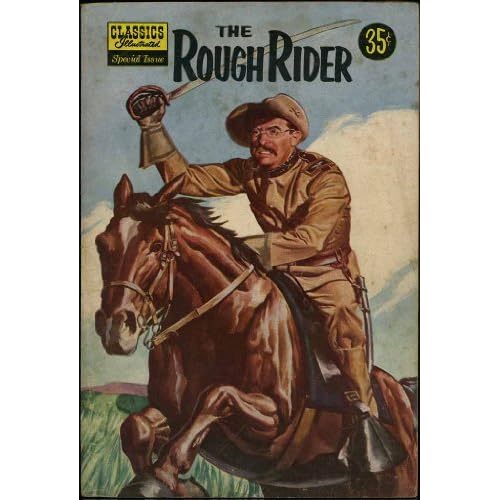
But what turned Roosevelt from a passing interest into an obsession was a Classics Illustrated   comic book The Roughrider.  The comic told the story of how young Theodore, the weakling asthmatic who was bullied and mocked for his myopia and thick glasses but who by dint of sheer grit and determination transformed himself into a Harvard boxer, South Dakota rancher, New York City Police Commissioner, war hero, and eventually President.  A particularly satisfying panel in the book depicted Roosevelt knocking out with one mighty blow a cowboy who mocked him as four eyes.  The boy Teddy reminded me a lot of me, likewise the brunt of ridicule and abuse.  The adult hero held out promise that it did not always have to be that way.
It was a short step from hero worship to nutty obsession.  How so?  Let me count the ways.
The first thing was appearance.  The mustache stubbornly refused to rise on from the fine blonde down on my upper lip.  Halloween costume fakes were all jet black, lacked the distinctive inward curl around the sides of the mouth, and, well, looked like crap.  And I discovered that pince-nez glasses were not available at my local optician’s.  I was stuck with the clunky plastic faux tortoise shell frames fit for a middle aged accountant.  But I could get the hat right.
I started with a cheap gray felt hat I bought at a souvenir stand at Cheyenne Frontier Days.  It was supposed to be a Confederate hat and had a paper Stars and Bars Flag sticker on the front.  I was a loyal Union man and spent hours trying to get all vestiges of that peeled off.  The hat did have a satisfyingly military looking gold cord band with end tassels.  I pinned up one side with a brass US collar insignia from my Dad’s World War II uniform.  It made a satisfying reproduction of Col. Roosevelt’s famous Rough Rider campaign hat.
At first I decorated it with a long pheasant tail feather, but discarded that when I realized that no photo showed my beloved Teddy sporting such a plume.  I wore that increasingly battered hat every single day from the moment I got out of bed to the time I turned in at night—except when required to remove it at school or church—for almost three years until it practically disintegrated and my head got too big.  Needless to say, I attracted a lot of gaping stares.  And the bullies were unimpressed by its martial appearance.
The hat was useful in the back yard fantasy games I played largely by myself.  None of the other neighborhood kids, least of all twin brother Tim who was running with a faster older crowd and already smoking cigarettes in their fort/club house, were interested in daily charges up San Juan Hill or whatever other adventures I could conjure.  My red and white Firestone coaster brake bicycle with the plastic streamers on the hand grips had to be my noble steed.
Alas, there are no extant photos of me in my Rough Rider hat, although I know that several were snapped on our old Kodak Brownie Box Camera.  My mom, likely out of shame and embarrassment, left them out of her meticulously maintained photo albums and they can’t even be located in the unsorted shoe boxes of old photos. 
School was a place where my obsession played out with a bit of drama.  I started handing in my homework, busy work Ditto activity sheets, quizzes, and tests with the correct day of the month underneath my name but instead of 1959 listing the year as 1905, the year after Roosevelt’s election to a full term on his own.

What an idyllic vision of American life in the era of Teddy Roosevelt was represented in the old movies that I adored like Meet Me in St. Louis.
I picked the year because the old movies I watched on TV when I got home from school painted that era as sunny, pleasant, and free from looming nuclear annihilation—something that was constantly on our minds in Cheyenne where the Air Force was beginning to build the nation’s first ICBM missile base and which, the civic boast proclaimed, would be a top target for Commie obliteration.  The movies, mostly musicals and comedies like Meet Me in St. Louis or Life With Father were all made in the ‘30’ and ‘40’s when many ticket buyers were of an age to recall those days with wistful nostalgia.  Most depicted the comfortable middle class in large homes with live-in servants.  It seemed to me that Teddy Roosevelt ruled over an ideal time to be alive.
So I decided that, come hell or high water, I would live then.  Neither my teachers, nor the Principal at Eastridge Elementary where I was routinely sent for an attitude adjustment, were amused by this quirk.  They demanded that I use the correct date and used every punishment in their arsenal to compel my acquiescence.  For a while I was given an F (actually a 5 because Cheyenne Public Schools were then using an odd numerical grading system) on every paper I turned in with the wrong year.  But I was a student reading at the level of a senior in high School and in subjects like social studies and science showed every evidence of complete mastery of the lessons.  Of course my spelling was atrocious, my hand writing cramped and nearly illegible, and I was too bored by arithmetic to bother with accurate computations and, it would be discovered much later, was mildly dyslexic compounding that problem.  Despite my wildly uneven academic performance, eventually it was decided that it was hopeless the hold the date thing against my grades.  Besides, if the teachers kept it up, I would be held back for another year and they would be stuck with me again.
So they tried keeping me in for recess.  Hardly a punishment as it kept me from getting beat up on the playground and while the others were running around and screaming, I was happily alone in the class room partaking of my favorite activity—reading.  Keeping me after school was no skin off my nose either.  Things were not all that rosy at home where my Mom was battling mental health and rage issues and I was the number 1 object of her wrath and dissatisfaction with the hand life had dealt her.  Of course that also meant that when the school sent home notes complaining about my stubborn misdating, she took it as purposeful disgrace to the family—the gravest of all possible offenses.  Then out would come the wire handle of the fly swatter, down would drop my jeans and underwear and my ass got whipped to hamburger.
None of it mattered.  I just kept entering that date, and dreaming of the time and place where nothing like that happened. 
The whole thing lasted almost three years until I entered Junior High School and just let it all slide for new dreams and obsessions, every bit as weird perhaps, but not as apt to draw notice. 
Then in a few more years I would discover the underside of 1905 and the Roosevelt utopia—the world of vicious capitalist exploitation of working people, their resistance and rebellion, of open class war, Jim Crow, lynchings, and of nasty little imperialist war.
But that’s another story….