Showing posts with label Samuel Gompers. Show all posts

Friday, May 1, 2026

Why May Day Still Matters


A French May Day poster from around the turn of the 20th Century.

Chicago was a-boil with labor turmoil in 1886.  The burgeoning city became a major manufacturing center and tens of thousands of immigrants poured into the city since the Civil War to join displaced American born farmers and former independent craftsmen in giant factories.  Hours were long, working conditions hard and dangerous, bosses harsh, and pay cuts frequent. 

Since the Great Railroad Strike of 1877 tensions had been building.  And so had a labor movement—craft unions loosely organized under a city central labor body, and the Knights of Labor, officially a benevolent society whose national leadership was opposed to strikes.  But unlike the craft unions, the Knights would enroll all workers—skilled and unskilled alike.  In addition, immigrant communities had their own radical leadership and press.  None was as vigorous or developed as the Germans, who were not only the largest immigrant community in the city but had a highly educated leadership steeped in European radicalism.  Many of these leaders identified with the growing international anarchist movement.

There were several major strikes in the city that spring.  The largest was at the giant McCormick Harvesting Machine plant where strikers had been replaced by scabs under police protection and daily clashes were occurring at the factory gates. 

On May 1st workers responded to a call for a General Strike for an 8 Hour Day was issued nationally by the Federation of Organized Trades and Labor Unions (ancestor of the American Federation of Labor.)   In Chicago the International Working Peoples Association (IWPA) organized a march by 8,000 workers led by Albert and Lucy Parsons, the main English language figures in the anarchist labor movement.  The General Strike got so much support that even half of the scabs at McCormick laid down their tools to join.

Employers were in a panic at the turn of events.  They met with city officials demanding suppression of strikes and demonstrations and agreed among themselves to redouble their own efforts to violently suppress strikes through the use of the Pinkerton Agency and bands of thugs and criminals hired off the streets.  


                                        Chicago  Police attack pickets at the McCormick works on May 3 inspiring a protest rally at the Haymarket the next evening.

On May 3 a rally in support of striking McCormick workers was addressed by German anarchist leader August Spies.  When strikers confronted scabs emerging from the plant after the 4 pm end of shift, police opened fire killing six workers and wounding scores.  Outraged, Spies rushed to the North Side where his daily newspaper, Arbeiter-Zeitung was published.  He and his associates decided to call a protest meeting at the Haymarket just west of downtown for the next day.  Flyers in German and English were hastily printed and rushed into distribution.  Spies noticed that the flyers contained the words “Workingmen Arm Yourselves and Appear in Full Force!”  He ordered the copies destroyed and new ones printed without those words.  Spies had consistently counseled non-violence.  Most of the thousands of flyers distributed omitted the words, but a few hundred of the first run were circulated before they could be recalled.

The evening of May 4, a huge crowd gathered at the Haymarket in a drizzling rain to hear speakers orate from the back of a wagon.  Mayor Carter Harrison stopped by and observed that the crowd was orderly and peaceful.  He ordered police already massed near-by not to intervene.  The last scheduled speaker of the evening, English-born Samuel Fielden, a Methodist lay preacher as well as a labor activist, was addressing a thinning crowd when the police officer in charge, Inspector John Bonfield, who was getting “supplemental” income and support from a coalition of major employers, decided to act. He ordered a phalanx of 175 officers to advance through the crowd from the rear.  Captain William Ward addressing Fielden on the wagon ordered the crowd to disperse.  Fielden protested that the assembly was peaceful and he was nearly finished anyway.  Ward issued a second warning.  Fielden said, “All right.”

Then someone—it has never been certainly determined who—threw a bomb from a side ally into the massed police.  Five officers were killed and others injured.  Police responded by firing wildly, wounding many of their own.  About 60 officers were wounded—mostly by friendly fire, but so were dozens of workers, including Fielden.

The crowd ran and Fielden limped away.

The press went, predictably, berserk.  The offices of the Arbeiter-Zeitung and regular meeting places and haunts of anarchists and unionists were raided.  Police quickly rounded up much of the German leadership. 

A warrant was out for Albert Parsons, who had spoken at the rally earlier but was gone when the attack occurred.  Parsons disguised himself and fled to Wisconsin.  He later decided to turn himself in and stand trial in solidarity with his German comrades.  


The men charged in the Haymarket case and the poster that called workers to the rally
.

In addition to Spies, Parsons and Fielden authorities charged Adolph FischerGeorge EngelsLouis LinggMichael Schwab, and Oscar Neebe.  Some of the defendants had not been at the Haymarket that night at all, and Neebe was out of town.  21-year-old Lingg was known to be an advocate of propaganda of the deed and had written a provocative article in the Arbeiter-Zeitung advocating the use of dynamite.  But he was not at the rally.

The trial began on June 21 and was presided over by Judge Joseph Gary who made no attempt to conceal his animus to the defendants.  Although no evidence could be brought forward linking any defendant to the bomb, prosecutors argued that they were in a conspiracy and that the defendants were guilty because they had not actively discouraged the unknown bomber.  All eight men were convicted by the jury.  Seven were sentenced to death and Neebe to 15 years in prison.

Before sentence could be carried out, Lingg committed suicide in his cell by biting a blasting cap. 

After appeals were exhausted, Illinois Governor Richard James Oglesby commuted Fielden’s and Schwab’s sentences to life in prison on November 10, 1887.  The next day, November 11, the four remaining condemned men were led to a scaffold in a courtyard of Cook County Jail and hung.  Their execution drew outrage and protest from the labor movement around the world.


                                    Illinois Governor John Peter Alteld, a pro-labor Democrat defied public opinion to pardon the surviving Haymarket defendants.

In 1893, Governor John Peter Altgeld, a liberal Democrat, signed pardons for Fielden, Neebe, and Schwab and concluded all eight defendants were innocent. The pardons and his opposition to calling in Federal troops to intervene in the Pullman Strike ended his political career.

In 1898 Samuel Gompers, head of the newly reorganized AFL petitioned the First Congress of the Second International (socialist) to designate May 1 to commemorate the Martyrs of Chicago and support a new general strike call for an 8-hour day scheduled for May 1, 1890.  The International enthusiastically agreed calling for “a great international demonstration” on that date.  Huge crowds responded around the world including a march by tens of thousands in New York City.  The event was so successful that it was made annual the next year and has been celebrated globally ever since.

But in the United States, where May Day was born, the holiday was officially abandoned within a few years.  Samuel Gompers stuck his historic deal with the employer’s organization, the Civic Federation, which gave craft unionists a “place at the table.”  Part of that deal was the abandonment of May Day, now associated with Socialism in exchange for recognition of a non-ideological Labor Day in September around the time of a local New York City building trades celebration.


A May Day rally in New York's Union Square in 1913.

Industrial and militant unions like the Industrial Workers of the World (IWW) kept May Day, as did socialists of all stripes.  Large celebrations persisted in many cities until the post World War II anti-Communist hysteria when the press successfully identified May Day with military parades in the Kremlin.


The Old Man at the Haymarket Memorial when it was still located on the original site after preaching a May Day sermon at a small Unitarian Universalist congregation

Begining in the last years of the 20th Century, even conservative unions helped revive the May Day tradition.  The Chicago Federation of Labor funded a new Haymarket Memorial featuring a speaker on a wagon near the exact location of the original and held annual commemorations there until the monument was relocated to Union Park on the outer fringes of Downtown.  Hispanic and immigration activists staged huge marches for immigration reform and to protest deportations on May Day, increasingly with the support of the labor movement.


This year those protests and labor observation will be part of a nation-wide No Work/No School/No Shopping Day action called for by a broad coalition of leading Resistance groups and organizations who have already mobilized millions to action against the Trump/MAGA regime. 

Sounds like a General Strike, doesn't it.


Saturday, November 8, 2025

The New Orleans General Strike of 1892 Surprised the Deep South With Interracial Solidarity


A year before the strike dockworkers loading and unloading goods--mostly bales of cotton--on a New Orleans wharf.

New Orleans was always an anomaly in the South, hell it was unique in all the United States for many reasons.  It was a cosmopolitan city ruled by the French or Spanish for most of its history and had a part of the US for only 89 years in 1892 when a multi-racial General Strike hit the city on November 8.

Many inhabitants were Creole, a term which originally had simply meant Europeans born in the New World, but in New Orleans had also come to infer those of mixed racial heritage.  The city was long the home not only of slaves, but of a large, and sometimes quite prosperous, Free Black population.  Free Blacks, slaves and their descendants mixed with the European population.  In addition, New Orleans was unique among southern cities in attracting large numbers of European immigrants in the late 19th Century in the same way that industrial cities of the North did.  These included large numbers of Irish, Germans, Italians, and Sicilians.  The result was a unique cultural stew and a mixing of races and ethnicities in ways unheard of elsewhere in the South.

New Orleans was also the second busiest port city in the country after New York. Through it passed the agricultural production of the heartland—wheat, corn, and livestock from the great drainages of the Ohio, Mississippi, and Missouri—plus raw materials like lumber from the North Woods and coal from the fields of Tennessee, Kentucky, and Illinois.  Most importantly of all, cotton by the bale for the hungry mills of the world and other bulk Southern crops, sugar and rice.  In the other direction, disgorged from steam and sailing ships of the world was a stream of manufactured goods, luxury imports, and tropical produce.


River boats line up to disgorge cotton.  The docks were the critical pinch-point to strangle the city's commerce and unions of the Triple Alliance successfully resisted all efforts to divide them by race, 

In this atmosphere, despite the steadfast opposition of employers and government, labor unions took root and flourished.  Workers maintained strong lodges of the Knights of Labor and, particularly in the labor intensive industries serving trade where White and Black workers often labored side by side, had a tradition of solidarity.  The Knights with their old lodges faded away, but the fledgling American Federation of Labor (AFL) and its craft unions were quick to take their place by the early 1890s. 

Early in 1892 Streetcar Conductors won unprecedented gains, including an 8 hour day and a closed union shop.  The later was regarded as particularly important because it prevented employers from squeezing union workers out by replacing them with scabs.  That victory spurred a frenzy of organization around the city.  By late summer 30 newly charted craft unions joined existing ones to form the 49 union-strong Workingmens Amalgamated Council that represented more than 20,000 workers.

Three of the largest unions—and those most essential to keeping goods and trade moving—were integrated.  These included the Teamsters, Scalesmen, and Packers.  Together they formed the Triple Alliance at the heart of the movement. 

On October 24, with the support of the full Amalgamated Council, the Triple Alliance walked out demanding a 10 hour day, overtime pay, and the closed shop. Commerce in the city ground to a halt.


                                             Black workers, especially from the  Teamsters, were key to the strike. 

Employers banded together under the leadership of the Board of Trade to try to break the strike.  They had the support of major railroads serving the city as well as river and ocean going shippers.  A large sum of money was raised to beat the strike and the Board of Trade appealed to the Governor to call out the Militia to intervene. 

The local press, solidly behind the owners, flooded the city with lurid accounts of roving bands of marauding Blacks threatening and insulting women and children.  Every effort was made to divide the strikers by race.  They also charged wide-spread violence.


Leafleting in support of the Strike. 

But the strikers were well disciplined.  They maintained picket lines but allowed no violence.  And they refused to be divided by race.

Then the Board of Trade tried offering to negotiate with the Scalesmen and Packers, who were white-led, while refusing to deal with the Teamsters, dominated by Blacks.  The Packers and Scalesmen both met and passed resolutions vowing to stay out until the Teamsters got a settlement on an equal basis with them.


                                Workers milling around strike headquarters was the most a local newspaper could show despite claims of violence.

As the strike dragged on into its second week other member unions of the Amalgamated Council demanded a General Strike in support of the Triple Alliance.  A committee made up of the leaders of the Cotton Screwmen, Cotton Yardmen, Printers, Boiler Makers, and Cab Drivers began to plan for a strike. 

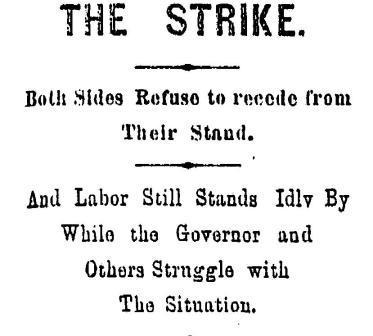
Just the possibility of a strike encouraged many independent and smaller employers to appeal to the Board of Trade to open serious negotiations with the strikers.  In fact, a tentative agreement was announced, but hard liners on the Board sank the pact.  On November 8, just as they had threatened, all member unions of the Amalgamated Council went out on strike.  They were even joined by unorganized workers.  Utility workers, newly organized, joined the strike with their own demands and soon the gas plant was closed down, plunging the city into darkness.  Without Streetcars retail clerks and office workers could not get to their jobs.  Food deliveries ended and within a day or two most shops were without supplies.

The Board of Trade and newspapers doubled down on racial scare stories and lurid accounts of violence and rioting in the streets.  But New Orleans residents could observe for themselves that the city was peaceful and calm, if at a commercial standstill.  Even special agents of the Board, roaming the streets to identify and document violence, could not find any. A call for “special deputies” to be used as strike breakers resulted in only 59 volunteers, hardly enough to force thousands back to work.  Employers then began arming and training their clerks and foremen and offered to pay the State for the cost of raising the Militia.


A headline reflected the frustration of the local power structure. 

The Mayor declared martial law but could not enforce his orders.  On November 10 Democratic Governor Murphy J. Foster did call out the Militia.  But when officers arrived and reported no riot or disturbance, the governor had to rescind the order the next day.

As banking activity dropped to less than half of its pre-strike levels, a sure sign of the effectiveness of the strike, the Board of Trade reluctantly agreed to accept binding arbitration. They even had to agree to face-to-face meetings with union leaders both white and Black.

After 48 hours of grueling negotiations, the Board agreed to the 10 hour day and overtime, but not to recognition of the union shop for the Triple Alliance unions.  Most other unions got comparable concessions. 

The unions reluctantly agreed, feeling that they had proved their power and could enforce the agreements at will, even without official recognition.

Workers were barely back on the job when the Board of Trade sought an investigation and prosecution of the union by Federal Authorities for allegedly violating the Sherman Anti-Trust act by uniting “in restraint of trade.”  A Federal judge ordered an injunction against the unions, which was moot because their members were already back on the job.  None-the-less AFL leaders appealed the decision.  After several years of legal wrangling, the Justice Department quietly withdrew the suit.


In many ways it was one of the most successful General Strikes in American history.  Not only did the united power of the unions force win many key demands, but they also remained strong enough to make sure that the terms of the settlement were adhered to long after the strike ended.  And the model of the power of labor solidarity across racial lines was powerful.  Also key was the unity of skilled tradesmen with the semi-skilled and unskilled laborers of the Teamsters and Packers.  Unfortunately, it would be all too often forgotten in the next decades.

But national AFL leaders like Samuel Gompers considered the strike a failure because it did not secure formal union recognition—in their eyes by far the most important objective of the strike.  Some labor historians trace the resistance of the AFL to most future calls for a general strike to this failure.  In fact, in the next few years, the AFL largely tried to retreat from strike action of any kind unless as an absolute final resort and instead pursued a strategy of accommodation with employers through the Civic Federation.


Monday, September 1, 2025

Labor Day—A Consolation Prize Working Class Holiday But the Movement Joins the Resistance This Year


Classic American Labor Day image with a twist representing the Black laborers that were often erased from the history of the American Labor movement.

Note—This is an updated version of an almost annual holiday blog post.  This year Labor Day has new urgency inspiring nation-wide protests sponsored by the AFL-CIO, Indivisible, and other progressive organizations.  Chicago, which is bracing for possibly imminent mass ICE enforcement action and the deployment of Federalized National Guard troops—recall how well that has historically gone for working people and the Labor Movement—will have one of the largest in the country.  Here in McHenry County there will be an action in Crystal Lake but the main action will be the Workers Over Billionaires road side rally in McHenry from 11 am-2pm sponsored by Indivisible McHenry County

Today is officially Labor Day in the United States, a Federal Holiday celebrated on the first Monday of September since 1894.  For most people it is just the last hurrah of summer, an occasion for one last cookout and the gateway to Fall and football season.  In most cities and towns, the labor movement is not even perfunctorily acknowledged.  The press mostly uses the occasion to annually either write the obituary of unions or to denounce them as powerful and greedy bullies, depending on the political inclination of the outlet.


While most of working schlumps are grateful for the day off (if we get one), I for one, wish I could officially celebrate Labor Day with virtually the whole rest of the world on May 1.  International Labor Day was proclaimed by the Second International in honor of the memory of Chicagos Haymarket Martyrs at the suggestion of none other than American Federation of Labor (AFL) chief Samuel Gompers himself and which quickly spread around the world.  American unions celebrated it too.

But within just a few years Gompers was at the heart of a deal that substituted the September observance for May Day, a few crumbs from the Boss’s table, and a pat on the head by the Civic Federation in exchange for a promise to oppose labor radicalism and the growth of industrial style unionism in rapidly expanding basic heavy and the extractive industries—mining, forestry, agriculture, etc.

It is true that a September Labor Day observance pre-dated the 1886 Haymarket Affair.  In 1882 the New York Central Labor Union, made up of skilled craft unions belonging to a prototype of the AFL and lodges of the rival Knights of Labor cooperated in a call for a giant parade followed by picnics, games and amusements, and educational talks.  It was designed to showcase the pride and power of the labor movement and also to press for the chief demand of labor reformers—the Eight Hour Day—the same cause that would be marked by an attempted nationwide General Strike on May 1, 1886, an event that led up the attack by police on a workers rally in Chicagos Haymarket on May 4 and the bomb blast blamed on the mostly German and anarchist leaders of the local labor movement.


The Eight Hour Day was the main demand of both the New York 1882 parade and the mass strikes of 1886 that led to the establishment of May First as International Labor Day.  But the demand was much older as shown in this photo of what is believed to have been the first Eight Hour banner by working men in 1856.  

New York City officials, eager to appease workers after a number of local strikes were suppressed with violence, gave their official approval to the parade.  On September 5, 1882 an estimated 30,000 workers marched in military order behind elaborate banners representing local unions of all the trades, job shops, and Knights of Labor lodges.  It was an impressive display, but despite later claims by the AFL that observance of Labor Day spread quickly, only a few other cities, mostly in New York, began holding September celebrations.  


The official U.S. labor movement points to this massive 1882 New York City parade as the origin for celebrating Labor Day in September. 

In the meantime, huge May Day parades and rallies spread across the country.  But the late 1880s and early 1890s were the beginning of a nearly 40 year period of virtual open class warfare with strikes being violently suppressed by local, state, and Federal authorities, and armies of private goons and strikebreakers.  And workers often fought back with equal violence.  Episodes like the Homestead Steel Strike with its running gun battles between Pinkertons and workers, the nationwide Pullman Strike of 1882, and virtually continuous battles in the coal fields and hard rock mine districts nationwide, made many fear for revolution or civil war.

Democratic President Grover Cleveland, who ordered the Army to crush the Pullman Strike, wanted a symbolic peace offering to Labor without actually granting the movement any of its demands. 

Republican king pin Ohio Senator Marc Hanna, soon to anoint William McKinley as the next President, was even more ambitious—he proposed a pact of cooperation between capital and “responsible labor.”  He offered Gompers, the Cigar Rollers Union chief who headed the AFL, a seat in his new Civic Federation alongside the robber barons and captains of industry.  Hanna did not make the same offer to Grand Master Workman Terrance V. Powderly of the Knights of Labor, who personally opposed strikes and advocated arbitration of disputes, because the members of Knights lodges included unskilled workers clamoring for recognition in heavy industry.  Gompers’s AFL would be allowed to pursue organizing skilled workers strictly by trade but not organize the great mass of unskilled, largely immigrant workers.  Gompers would also be called on to use his unions to oppose labor radicalism, and even to break strikes led by unions outside the grand agreement.


                                                             Early Labor Day celebrations were rife with patriotic imagery..

With Gompers in his pocket, Hanna engineered enough Republican support in Congress to get Cleveland’s official Labor Day proposal passed.  Cleveland signed it in to law just six days after Eugene V. Debss industrial union of railroad workers was smashed to the end of the Pullman Strike. 

Within a few years all states either aligned their existing Labor celebrations with the Federal holiday or enacted state proclamations echoing the U.S. call. 

Meanwhile authorities everywhere tried to suppress May Day observances, which continued to be supported by militant unionists and radicals of every sort—social democrats, anarchists, and Marxists.  The Knights of Labor withered away, but aggressive industrial unions, especially in the mining industry, continued to fight both the bosses and the AFL’s attempt to divide the aristocracy of labor from the mass rank and file.  In little more than a decade the radical Industrial Workers of the World (IWW) would be formed to intensify that battle.


Butchers march in a 1914 Labor Day Parade in Valparaiso,  Indiana. 

During the Depression and the presidency of Franklin D. Roosevelt Democrats became the party of labor.   Labor Day became the official kick-off of Democratic election campaigns. Labor Day parades and rallies often seemed more platforms to launch candidacies than a labor union celebration.

Even that faded as the percentage of Americans in unions continued to shrink year after year after a high tide in the early ‘60s.  By the Clinton era, Democrats continued to get support from labor, but seemed to try to disassociate themselves from it, shunning identification as the party for of labor in favor of being seen as the champion of the Middle Class.


A 2014 cartoon summed up the plight of American workers on Labor Day.  It has gotten worse. 

As half-assed a holiday as Labor Day is, I hope we all will take a moment to thank the American Labor movement for largely creating that Middle Class.

Of late the organized labor movement has bestirred itself led by aggressive drives in the service industries including hospitality, fast food, and retail spurred by demands for a living minimum wage.  Public employees especially teachers and healthcare workers have also been militant and are extending their union representation.  Labor shortages in the wake of the Coronavirus pandemic gave unions leverage not seen in decades.  


Women workers were at the heart of the union renaissance in jobs in education, healthcare, public employment, hospitality, and retail.  They are also growing among the ranks of traditionally male dominated construction, skilled trades, and industry.  

Now, under the Trump Redux regime working people and the labor movement are under attack across the board as the Orange Menace settles old scores, pays off his oligarch backers, subverts the Constitution, and tries to seize dictatorial powers.  Nationwide demonstrations today commit workers and the labor movement to an even broader Resistance.  Courage is required.