Showing posts with label Settler colonialism. Show all posts

Sunday, March 8, 2026

Settler Colonialism or Land Reform that Populated the Breadbasket


This map shows Land Districts and Offices in charge of selling Western land--a primary income source for the Federal government which helped keep taxes and tariffs low.  Some land agents, however, were corrupt and scandals common.  Individual speculators and organized stock companies borrowed money to buy vast tracts of land in the hopes of selling at inflated prices to settlers.  But most settlers could not afford the asking prices, the speculators and companies often could not pay their loans.  The result was financial failure and instability on one hand and a huge pent-up demand for cheaper land.  The Land Act of 1820 was meant to address both problems.

The Land Act of 1820 is a nearly forgotten piece of legislation passed by Congress which opened the Old Northwest Territory and Missouri to an avalanche of new settlement.  It was a byproduct of the Missouri Compromise. 

Population growth in the West was stymied by the almost constant bloody Indian warfare in the region from the end of the Revolution through the War of 1812 and by the high land prices and large minimum parcels required by the Land Ordinance of 1785

When a financial panic swept the nation in 1819 it became impossible for most would-be settlers to borrow the money needed to legally buy the land.  To escape high land prices mostly Scotch-Irish pioneers often pushed out ahead of land surveyors and squatted on land.  When the government caught up with them they argued that their improvements on the land should be subtracted from the cost.  They were often displaced and pushed further west. 


A deed to land in Indiana sold to James Benton McMurry in 1831 under the terms of the Land Act of 1820.  Note the document is attested to and initialed by President Andrew Jackson (or by a designee in the Executive Mansion under his authority) which was required by law for all sale of Federal land.  An example of the administrative minutia early Presidents were saddled with.

To make settlement more affordable and thus to reduce squatting, the new act reduced the minimum tract from 160 to 80 acres, a manageable family farm in the generally rich soil of the West. 

Buying land exclusively on creditas was common among land speculators—was eliminated.  The price was reduced from $1.65 (set in 1804) to $1.25 per acre with a relatively affordable $100 down payment.  The very poorest, who probably could not even afford the necessary tools and equipment to bring the land into production, were excluded, but the cost was low enough to be manageable by many. 

Although speculators could still form land companies and buy large blocks of tracts, the recurring financial panics over the next few years drove many to bankruptcy while owner-operated farms could endure hard times on a subsistence basis 


New Salem in Illinois was first settled in 1828 and was typical of the communities that sprang up across the West with liberalized land sale policies.  Even there not everyone could afford land.  Newcomer Abraham Lincoln from Indiana had to hire out as a wood cutter, river boatman, and store clerk.

In the end most of the farmland in the region sold at, or not much above the Federal price.  The success of the policy was astounding.  Illinois, for instance, had a population of about 55,000 in 1820.  Over the next 40 years the population doubled every ten years to almost 900,000 in 1860.  

Land sales were vigorous enough that even at the reduced price enough revenue was generated to operate the nearly skeletal Federal government. In fact, they provided enough income that they were largely responsible for the Federal Debt being completely paid off and retired—if only briefly—during the administration of Andrew Jackson.

Such a rapid explosion for population also had a dramatic effect on government as new Congressional seats were allotted with every new Census giving the West considerable regional clout.  By the eve of the Civil War the states covered by the act were no longer on the frontier.  They were well settled, prosperous, and with the advantages of easy access to markets via the great river systems and the new railroads, became the breadbasket to the nation. 

Thursday, November 18, 2021

A Land Acknowledgement for Tree of Life UU Congregation in McHenry

November is Native American Heritage Month in the United States.  The designation was inspired by the false narrative of the First Thanksgiving myth and in recognition of the true history of the genocidal displacement of aboriginal peoples and nations by the European settler invasion and conquest.

The Unitarian Universalist Association, like many progressive religious bodies has been moved to acknowledge that history.

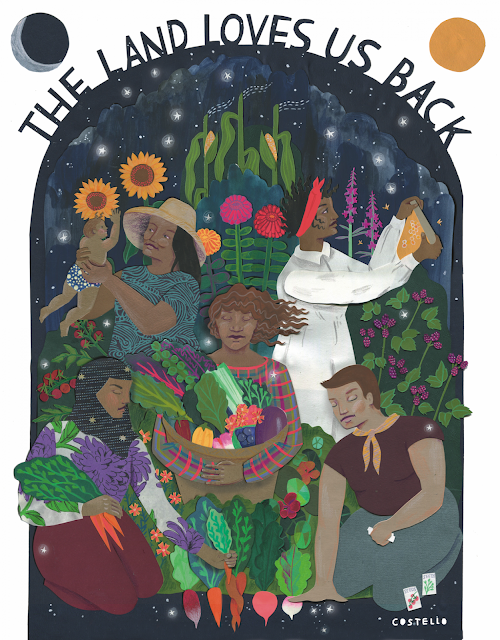
                                We are all sustained by the earth, waters, and air.  Illustration by Molly Costello.

The enormous wealth of the United States is based on the theft of Indigenous land and the enslavement of people of African descent. In order to maximize wealth, the colonizers sought to eliminate or minimize the number of people who could claim their Indigenous rights to land, natural resources and sovereignty. These attempts are ongoing and have included genocide, forced removal, forced assimilation and the more contemporary systemic erasure of Native people through invisibility in education, media and pop culture.

Millions of Indigenous people and hundreds of Indigenous nations have resiliently survived 400 + years of systemic and violent attempts to eliminate them, only to be rendered invisible by white supremacy culture and institutions which pretend they no longer exist. They continue to assert their sovereignty, and their rights and relationship to their homelands, natural resources, culture and spiritual practices. They continue to lead efforts across this country to protect life itself, which depends upon the protection of the land, the water and the air. Indigenous people are still here and their lands are still occupied.

Part of our response if encouraging the use of Land Acknowledgement statements at the beginning of gatherings, meetings, and Congregational worship.  In that spirit I created an Acknowledgement prayer that we used as a Chalice Lighting last night at a meeting of the Tree of Life Social Justice Team.  I adapted material from the fine resources provided by the UUA.  Our near neighbors at Countryside Church Unitarian Universalist in Palatine who created a litany of the peoples who lived on or used the land in our area.  Note that just prior to European settlement in Northeastern Illinois native tribes had few permanent villages in the area, but it was widely used as a hunting and trading area by many.

Tree of Life's building in McHenry and the lovely acreage it occupies was stolen from the Native peoples who found sustenance here after the Black Hawk War of 1832.

Tree of Life Land Acknowledgement Prayer

As we begin, we take this moment to acknowledge that Tree of Life occupies land in what was the unceded territory of indigenous peoples.  As community and church members, we continue to benefit from the seizure and occupation of this land. We also want to affirm that this is not simply performative but is deeply felt and is a commitment toward action.

We acknowledge the Lakota Sioux, Ho Chunk Winnebago, Illini, Shawnee, joined later by the Ottawa, Lenape/Delaware, Kickapoo, Potawatomi, Sac, Fox, and Wyandot.

We also acknowledge the plants, animals, water, and the very earth itself that sustained them and ourselves.

We are grateful for our undeserved grace and affirm our duty to be restorative.

Amen.