Showing posts with label TV news. Show all posts

Tuesday, September 3, 2024

Walter Cronkite Staged a News Coup at CBS

Walter Cronkite prided himself on not only being the anchor of The CBS Evening News but the program's Managing Editor broadcasting from a working newsroom in the mid-1960s.

He had only been on the job a little more than a year when Walter Cronkite finally got his wish. Over the fierce objections of local affiliates who resented losing profitable time for local or syndicated programming to the network, his program, re-named the CBS Evening News, expanded from 15 to 30 minutes every night on September 2, 1963.

A week later NBCs Huntley-Brinkley Report, the ratings leader among the three network news programs by a wide margin, reluctantly followed suit.  ABCs lightly regarded and little watched new program then anchored by the entirely forgotten Ron Cochran didn’t even bother.  It wasn’t until two years later during Peter Jennings rocky first tenure in the anchor chair that ABC joined the trend.

At first many critics and the public weren’t sure that there would “be enough news” to fill a half hour.  The early years were still dominated by the anchors reading the news.  Network correspondents in New York and Washington could get on the air easily.  But live feeds from other locations were difficult and expensive.  On-the-spot coverage was shot on film, which had to be rushed to network headquarters, developed, printed, and edited which could mean delays in seeing events from a few hours to days for stories filed by correspondents half a world away.

But Cronkite was right.  The Sixties were exploding with news.  Just a week before his premier the March on Washington for Jobs and Freedom featuring Martin Luther Kings dramatic speech had captured the attention of the nation.  The Civil Rights Movement and grainy film footage of cops beating demonstrators would be a staple of the expanded broadcasts.  So would rising Cold War tensions symbolized by yet another Berlin Crisis.  In Washington a photogenic President and a glamorous First Lady drove news cycles, as they were coming be known.

It must have been a very hot news night when this show was aired on CBS's still un-air conditioned set in New York City.

In November the assassination of John F. Kennedy and its aftermath would more than fill the nightly broadcasts.  Still ahead were the great Space Race, a rapidly escalating War in Vietnam and the protest movement against it, a whole counter cultural movement, and, as always politics, politics, and more politics.

By the end of the decade, having vanquished NBC’s once insurmountable lead in viewers and having established himself as “The most trusted man in America” Cronkite would be clamoring to expand his program to a full hour.  The affiliates, preferring to expand their local news operations instead blocked his ambition.  

Nora O'Donnell, the only woman among the three network anchors will be replaced after the Election by a pair of men.

In its current configuration as The CBS Evening News With Nora ODonnell it remains a 30 minute program. When she leaves the anchor chair after the November elections she will be replaced by a male tag-team of John Dickerson, political editor for CBS News and Maurice DuBois, a local news anchor on New York station WCBS.  Shades of Huntley and Brinkly that they hope will jump start ratings for the now perennial bottom dweller. The program will be moved back to its former home at the CBS Broadcast Center in New York.  David Muir at ABC leads the ratings competition among the Big Three heritage networks and Lester Holt still helms NBC Nightly news.

None have the influence of Cronkite to generations who get most of their news on the phones from a plethora of platforms, many of them driven by ideological bias.   


Thursday, September 3, 2020

Walter Cronkite’s CBS News Coup

Walter Cronkite prided himself on not only being the anchor of The CBS Evening News but the program's Managing Editor broadcasting from a working newsroom in the mid-1960s.

He had only been on the job a little more than a year when Walter Cronkite finally got his wish. Over the fierce objections of local affiliates who resented loosing profitable time for local or syndicated programming to the network, his program, re-named the CBS Evening News, expanded from 15 to 30 minutes every night on September 2, 1963.

From Sept. 2, 1992, here is a CBS "Up to the Minute" segment on Walter Cronkite's very first "CBS Evening News" from 1963.  The lead story that night was about Alabama Governor George Wallace and his stand in the University of Alabama doorway to block a Federal Judge's desegregation order.  It turned out there was plenty of news to fill his new half hour time slot.
A week later NBC’s Huntley-Brinkley Report, the ratings leader among the three network news programs by a wide margin, reluctantly followed suit.  ABC’s lightly regarded and little watched new program then anchored by the entirely forgotten Ron Cochran didn’t even bother.  It wasn’t until two years later during Peter Jennings’ rocky first tenure in the anchor chair that ABC joined the trend.
At first many critics and the public weren’t sure that there would “be enough news” to fill a half hour.  The early years were still dominated by the anchors reading the news.  Network correspondents in New York and Washington could get on the air easily.  But live feeds from other locations were difficult and expensive.  On-the-spot coverage was shot on film, which had to be rushed to network headquarters, developed, printed, and edited which could mean delays in seeing events from a few hours to days for stories filed by correspondents half a world away.
But Cronkite was right.  The Sixties were exploding with news.  Just a week before his premier the March on Washington for Jobs and Freedom featuring Martin Luther King’s dramatic speech had captured the attention of the nation.  The Civil Rights Movement and grainy film footage of cops beating demonstrators would be a staple of the expanded broadcasts.  So would rising Cold War tensions symbolized by yet another Berlin Crisis.  In Washington a photogenic President and a glamorous First Lady drove news cycles, as they were coming be known.
In November the assassination of John F. Kennedy and its aftermath would more than fill the nightly broadcasts.  Still ahead were the great Space Race, a rapidly escalating War in Vietnam and the protest movement against it, a whole counter cultural movement, and, as always politics, politics, and more politics.

It must have been a very hot news night when this show was aired on CBS's still un-air conditioned set in New York City.
 By the end of the decade, having vanquished NBC’s once insurmountable lead in viewers and having established himself as “The most trusted man in America” Cronkite would be clamoring to expand his program to a full hour.  The affiliates, preferring to expand their local news operations instead blocked his ambition.  In its current configuration as The CBS Evening News With Nora O’Donnell it remains a 30 minute program and has slipped to a distant third place among the shrinking audience for the over-the-air Big Three television networks.


Tuesday, September 2, 2014

Cronkite’s Coup—More Evening News


He had only been on the job a little more than a year when Walter Cronkite finally got his wish. Over the fierce objection of local affiliates who resented loosing profitable time for local or syndicated programming to the network, his program, re-named the CBS Evening News, expanded from 15 to 30 minutes every night on September 2, 1963.
A week later NBC’s Huntley-Brinkley Report, the ratings leader among the three network news programs by a wide margin, reluctantly followed suit.  ABC’s lightly regarded and little watch new program then anchored by the entirely forgotten Ron Cochran didn’t even bother.  It wasn’t until two years later during Peter Jennings’ rocky first tenure in the anchor chair that ABC joined the trend.
At first many critics and the public weren’t sure that there would “be enough news” to fill a half hour.  The early years were still dominated by the anchors reading the news.  Network correspondents in New York and Washington could get on the air easily.  But live feeds from other locations were difficult and expensive.  On-the-spot coverage was shot on film, which had to be rushed to network headquarters, developed, printed and edited which could mean delays in seeing events from a few hours to days for stories filed by correspondents half a world away.
But Cronkite was right.  The Sixties were exploding with news.  Just a week before his premier the March on Washington for Jobs and Justice featuring Martin Luther King’s dramatic speech had captured the attention of the nation.  The Civil Rights Movement and grainy film footage of cops beating demonstrators would be a staple of the expanded broadcasts.  So would rising Cold War tensions symbolized by yet another Berlin Crisis.  In Washington a photogenic President and a glamorous First Lady drove news cycles, as they were coming be known.
In November the assassination of John F. Kennedy and its aftermath would more than fill the nightly broadcasts.  Still ahead were the great Space Race, a rapidly escalating War in Vietnam and the protest movement against it, a whole counter cultural movement, and, as always politics, politics, and more politics.
By the end of the decade, having vanquished NBC’s once insurmountable lead in viewers and having established himself as “The most trusted man in America” Cronkite would be clamoring to expand his program to a full hour.  The affiliates, preferring to expand their local news operations instead blocked his ambition.


Friday, May 9, 2014

Announcing the Vast Wasteland


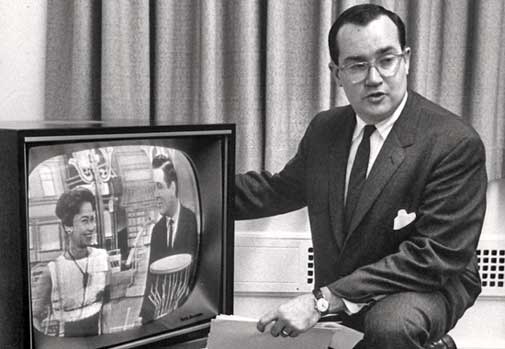
Some count it as one of the most important American speeches of the second half of the 20th Century right up there with Eisenhower’s Farwell Address, Kennedy’s Inaugural Address, and the most famous orations by Martin Luther King.  But it was not delivered by a towering political figure or a game changing visionary.  It was spoken by a semi-obscure bureaucrat.  It was not given before cheering thousands, before Congress, or broadcast to millions.  It was delivered in a hotel ballroom to a roomful of conventioneers at a trade association gathering.  The demeanor of the speaker was more professorial than oratorical.  But man, did it shake things up.
The speaker was Newton Minow a bespectacled 35 year old lawyer and liberal Democratic Party activist who had just been named by President John F. Kennedy to be the Chairman of the Federal Communications Commission.  The venue was the convention of the National Association of Broadcasters on May 9, 1961 in Washington, D.C.  The convention program announced the title of the address as Television and the Public Interest.  But it is remembered and quoted from to this day as the Vast Wasteland speech.
Minnow scolded the squirming broadcasters like a petulant school marm:
When television is good, nothing — not the theater, not the magazines or newspapers — nothing is better.  But when television is bad, nothing is worse. I invite each of you to sit down in front of your own television set when your station goes on the air and stay there, for a day, without a book, without a magazine, without a newspaper, without a profit and loss sheet or a rating book to distract you. Keep your eyes glued to that set until the station signs off. I can assure you that what you will observe is a vast wasteland.  You will see a procession of game shows, formula comedies about totally unbelievable families, blood and thunder, mayhem, violence, sadism, murder, western bad men, western good men, private eyes, gangsters, more violence, and cartoons. And endlessly commercials — many screaming, cajoling, and offending. And most of all, boredom. True, you'll see a few things you will enjoy. But they will be very, very few. And if you think I exaggerate, I only ask you to try it…
Television and all who participate in it are jointly accountable to the American public for respect for the special needs of children, for community responsibility, for the advancement of education and culture, for the acceptability of the program materials chosen, for decency and decorum in production, and for propriety in advertising. This responsibility cannot be discharged by any given group of programs, but can be discharged only through the highest standards of respect for the American home, applied to every moment of every program presented by television.  Program materials should enlarge the horizons of the viewer, provide him with wholesome entertainment, afford helpful stimulation, and remind him of the responsibilities which the citizen has toward his society.
It was a scolding that went the equivalent of viral in those quaint days.  Gleeful print editors splashed reports all over front pages of newspapers and magazines including highly influential and widely read Time.  The editorial pages from the New York Times to the Weekly Podunk Hay Seed clucked and shook their gravest heads.  Preachers thundered from Sunday pulpits.  PTAs and women’s clubs met and passed resolutions demanding action.  Academics scrambled to find ways to fund new research to further prove how depraved TV was making American culture. 
Now days we tend to look back on those innocent times of just three broadcast networks and some usually down-at-the heels local independent stations which ran mostly very old movies, re-runs, cheap syndications like Whirly Birds or Highway Patrol, wrestling and roller derby, and shabby kiddy shows with moth-eaten cartoons through the rosy lenses of nostalgia.  We remember a handful of favorite westerns and sit coms and extoll the era for its “innocence.”  Some even consider the early ‘60’s as the tail end of the so-called Golden Age of Television.
But it didn’t look like that back then.
In the long term, the speech hardly put a dent in crass, mindless, and violent television.  But in the short term certain reforms and gains were made.  Broadcasters responded with a beefed up Code of Practices for Television Broadcasters which had been first introduced amid earlier cultural criticism in 1951.  The companies crossed their hearts and hoped to die if they weren’t responsible and moral.  And they awarded themselves the Seal of Good Practice, displayed during closing credits on most shows.  Other than rigid controls of curse words, any kind of reference to sex, and the insistence that married couples could only be shown in the bedroom in twin beds, the Code was toothless.  It did little to discourage violence and nothing at all about the routine depiction of minorities in degrading ways.
More significantly the news divisions of the three networks hyped the speech almost as much as their print critics.  At CBS Fred Friendly, Edward R. Murrow, and Walter Cronkite used it as leverage to win a long cherished expansion of the evening news broadcast from 15 minutes to half an hour and to increase a commitment to regular documentary programs.  Other networks followed and two years after the speech more than 400 documentaries were aired on the three networks.  NBC beefed up the hard news component of its Today program.  The Sunday morning news interview programs were also expanded to half an hour.  There was expanded news coverage generally of things like United Nations sessions and large numbers of reporters were assigned across the globe for international coverage.
The speech also helped spur the development of local educational television stations, which were encouraged by the FCC.  By the mid ‘60’s some stations were expanding beyond the strictly instructional programing of their early years and adding some cultural, news, and public affairs programing in the evenings.  By 1970 the Corporation for Public Broadcasting replaced the old National Education Television and modest amounts of federal dollars began to flow to affiliates for the creation of programing.
In the 53 years since the speech television options have exploded—the explosion of UHF stations, more networks, cable and satellite services, and now alternative options via the internet and smartphone applications.  Although it can be argued that there is more high quality drama and smartly written comedy than ever—largely due to the relaxation of censorship rules that restricted adult themes and language—a quick survey of television option quickly reveals that the waste land is vaster than ever.  Stultifying reality shows.  A channel that once called itself the Arts and Entertainment Network which is now devoted to shows that simultaneously mock and exult redneck life style.  Its once distinguished cousin the History Channel is full of UFO, conspiracy theories, and religious claptrap.  A major cable “news” channel that is a fulltime propaganda machine for the far right and routine peddlers of actual fraud.  More judge and courtroom shows than you can shake a gavel at plus a whole program dedicated to paternity tests.  Endless re-runs not only of classic programs but any show that managed to survive for three seasons—enough to syndicate.  Shopping channels.  Infomercials.  More sports channels than there are sports.  You get the picture.
As for Newton, after his term at the FCC ended, he came back to Chicago where he lucratively still practices law.  He was a member of the Board of Governors of PBS and its predecessor, NET serving from 1973–1980 and serving as its Chairman from 1978 to 1980. He is past-president of the Carnegie Corporation, an influential PBS sponsor, and the original funder of Sesame Street. He co-chaired the 1976 and 1980 presidential debates and is a vice-chairman of the Commission on Presidential Debates. He is also the Walter Annenberg professor emeritus at Northwestern University and has authored of four books and numerous professional journal and magazine articles.  He and his wife also serve on numerous charitable boards.  In other words, he is a pillar of the liberal establishment.
Ever since his big moment in the sun back in 1961 the press returns to speak with him about the current state of television.  On the 50 anniversary of that speech, he gave another one on the same topic at Harvard.  Although not as well publisized, he assessments were equally harsh, especially in the area of dumbed down and biased news.
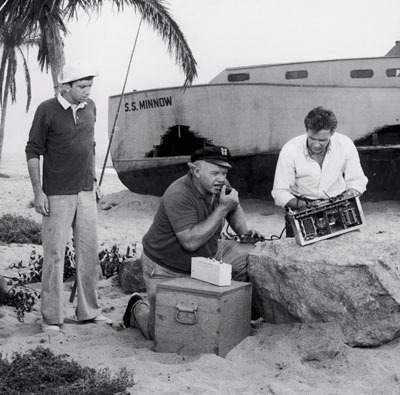
Despite all of the praise, he received for his original speech, he had his detractors who charged him with being a dreaded egg head and elitist.  The producers of the perinially popular Gilligan’s Island, just the kind of programing that drew his disdain, thumbed their nose at him.  The S.S. Minnow, the tour boat that wrecked on a desert island, was named after the FCC chairman, not the fish.