Showing posts with label Wobbly. Show all posts

Sunday, August 13, 2023

Rebel Worker and Icon Carlos Cortez—My Presentation at the National Museum of Mexican Art Program in His Honor

Note—Here is the text of my remarks about Carlos Cortez a today’s book launch and exhibit opening at the National Museum of Mexican Art in Chicago.

My name is Patrick Murfin. I was Carlos Cortez’s close friend and Fellow Worker in the Industrial Workers of the World (IWW) from 1968.  We collaborated in the Chicago Branch, at General Headquarters and on the Industrial Worker, lived together twice, and worked at the same trade school as custodians.  I am an amateur historian who co-authored The IWW:  It’s First Seventy Years 1905-1975 with Fred W. Thompson.  I have continued as a life-long social justice activist, is an obscure poet, and maintain a daily blog Heretic, Rebel, a Thing to Flout—An Eclectic Journal of Opinion, History, Poetry and General Bloviating.

Carlos might not we well known to the general public, but he is a revered figure in the labor movement, especially with the Industrial Workers of the World (IWW) and in the Latinx and Native American arts communities.  He was perhaps best known for his lino and woodcut posters and illustrations. For him art of all types was inseparable from social activism and was meant to be easily accessible to ordinary people.  He could have made a fortune and been far more widely recognized as a fine artist if he sold his posters in signed and numbered editions.  Instead, he printed them himself in unlimited numbers by silk screening on whatever paper stock he could scrounge and were sold for a few dollars or more likely given away.  In fact, if he discovered there was a commercial market for his prints that were being re-sold by dealers and galleries, he would print more just to keep the price down.  Much of his work has been archived, preserved, and displayed here at the National Museum of Mexican Art, which he helped nurture.

The National Mexican of Mexican Art launches a new retrospective exhibit today, Carlos Cortez 100 AƱos.

But he is being recognized now as a writer.  He was also a roll-up-his-sleeves, plain spoken poet who published three collections in his lifetime and who shared his work at poetry readings and slams around the city avoiding the establishment to find venues where the excluded and outcast could be included.  He performed his pieces at union meetings and on picket lines, at rallies and benefits, and for those who gathered in the informal salon he kept open in the former Northwest Side neighborhood storefront where he made a home with his beloved wife Marianna. 

Most of his work first saw print in the Industrial Worker with which he was associated for more than 40 years. 

Born in Milwaukee on August 13, 1923 to a German Socialist mother and a Mexican indio/mestizo IWW member Father.  He was steeped from the beginning in working class culture and revolutionary values.  He took seriously the old Socialist admonitions not to allow governments to divide workers and turn them against each other in imperialist wars.  During World War II he refused induction into the Army and spent nearly three years in the Federal Prison at Sandstone, Minnesota—ironically the same prison where I was held for the same offense for draft resistance during the Vietnam War. 

After the war he worked at record store where he cultivated his taste for jazz, folk, and international music.  He also immersed himself in the emerging Beat culture.  He was most often seen in a jaunty beret.

In the late 1950’s he decided to come down to Chicago to become more involved with the IWW where there was both an active general membership branch and the union’s General Headquarters.  He volunteered his time helping out at GHQ where Fred W. Thompson then the Editor of the Industrial Worker began to use his contributions of both illustrations and writings.

Soon he was contributing several pieces each issue—articles, essays, folksy polemics, and occasional verse.   Short musings, observations, and yarns were printed as a regular feature column The Left Side.  Other pieces appeared signed as CAC, C.C. Redcloud, Koyokuikatl, and his IWW membership card number X321826.

Carlos and I at the 1970 IWW General Convention in Chicago with elder Hungarian Wobbly militants.

When he first came down he was still known as Karl Cortez as his mother called him, but has he immersed himself in the city and connected to the Mexican and Chicano communities, he became Carlos and adopted the big hats, and flowing mustache and sometimes goatee which became his trademark.

By the late 60’s Carlos took over as editor of the paper and in 1970 I began my regular contributions to its pages.  Later we reorganized the staff as a collective and eventually I assumed the editorship while Carlos continued his contributions.  When we lost office space to do the layout and production, we did it at a table in Carlos and Marianna’s apartment.  When that place was remodeled by their landlord they stayed with me and then Secretary Treasurer Kathleen Taylor in our near-by fourth floor walk-up apartment in the building dubbed Wobbly Towers for a few months.

Meanwhile Carlos and I both worked as custodians at Coyne American Institute, a trade school on Fullerton Avenue.  A few years later when I was homeless Carlos returned the favor and I stayed with them for some time enjoying Marianna’s strong espresso in the morning and hanging with Carlos over Wild Turkey in the evenings in the large gallery-like front room that served as his workshop and gathering spot.   Almost every evening was an education.

This 1963 illustration from the Industrial Worker illustrated the brutality of attacks on Southern Civil Rights demonstrators.

It is really a tribute to the Industrial Worker as a working class institution that Carlos is being honored for the work that largely first appeared there.

During those years Carlos became a founding member of the Movemento Aristico Chicano (MARCH)—the first organization of Latino artists in the city.  With his close friend Carlos CumpiĆ”n and others meeting in the comfortable front room, he built an organization which mentored many young artists, spread “the culture”, and helped foster the re-birth of the muralist movement in the city.  He also became an early supporter of the Mexican Fine Arts Center now known as the National Museum of Mexican Arts which became the repository of many of his works and has the largest collection of his extensive production in the world.  He was also active with the Chicago Mural Group, Mexican Taller del Grabado (Mexican Graphic Workshop), Casa de la Cultura Mestizarte, and the Native Men’s Song Circle, a Native American group out of the American Indian Center.  Through that association, he came to mentor and encourage young Indian artists with the same passion he dedicated to the Chicanos.  In fact, there was no artist or poet of any race who was not welcome in that home, as long as they were ready and eager to serve the people’s needs and not “art for art’s sake,” a notion he found repugnant and elitist.

Perhaps Carlos's most famous posters were his images of Wobbly songwriter and martyr Joe Hill.  He did several different versions in at least three languages--English, Spanish, and Swedish.

A lifelong bachelor, in the early 60’s a Greek friend told him that he should meet his sister.  The trouble was that she was still in Greece.  The two corresponded through her brother for a while.  Carlos saved his money, quit his job, and crossed the ocean as a passenger on a freighter.  He met Marianna Drogitis, a lovely young woman who was, however, by the standards of her culture, a spinster having rejected several suitors.  The two fell in love despite not speaking a word of each other’s language.  They communicated by gesture and the few words of German they had in common—she had learned the language in occupied Greece where members of her family were active in the Resistance.  They returned to the U.S. on another freighter, married, and settled into the happiest marriage I have ever seen in a Chicago apartment in 1965.  

                                The love of Carlos's life--his Greek wife Marianna.

When I proposed to Kathy Brady-Larsen in the early 80’s, Carlos was pleased to make a drawing of the two of us with her daughters Carolynne and Heather for the invitations I designed.  He and Marianna danced happily at our wedding party at Lilly’s on Lincoln Avenue.

By 1981 Carlos’s heart forced him to retire from wage slavery.  It gave him more time to dedicate to his artwork, poetry and causes.  Unfortunately, it also put a strain on Marianna who took extra work to make up for the lost income.  Despite sometimes working twelve hours at two jobs, she always had a smile for any of Carlos’s many guests, and a pat on the cheek for the old man.

The original Charles H. Kerr & Co. edition of Crystal-Gazing the Amber Fluit & Other Wobbly Poems.

Carlos, although best known as a graphic artist and for his work on the Industrial Worker, was also a poet.  He would do occasional readings at an old haunt, the College of Complexes, in coffee houses, at radical bookstores, and wherever his friends gathered.  He wrote three books of poetry, including De Kansas a Califas & Back to Chicago, published by March/Abrazo Press, and Crystal-Gazing the Amber Fluid & Other Wobbly Poems, published by the old Socialist publisher Charles H. Kerr & Company.  Carlos was President of the Kerr Board for 20 years, a title he detested.  He also edited, wrote the introduction to, or contributed to several other books.

Carlos was devastated when his beloved Marianna died in 2001.  I last saw him at her memorial.

His health deteriorated rapidly after that, and he was often confined to a wheelchair.  He continued to greet a steady parade of visitors and admirers to his studio home and participated in the planning of new exhibitions of his work, including one in Madrid sponsored by the anarcho-syndicalists of the Confederacion National de Trabajo (CNT.)   He suffered a massive heart attack and was confined to his bed for the last 18 months of his life.

                                        Carlos was inducted into the Chicago Literary Hall of Fame.

On January 17, 2005 Carlos died, surrounded by friends and “listening to the music of the Texas Tornados.”


Thursday, October 27, 2016

Hooked on Voting

As a small child I clung to my father's pants leg as he did something mysterious and holy behind the curtain of a booth.
Back when I was a young Wobbly hanging around at the anarchist Solidarity Bookstore in Chicago, the byword among my friends and fellow workers around election time was, “Don’t vote, it only encourages them.”  I would laugh along with the line and nod my head.  After all, I had punched my ticket as radical and would hardly do anything to jeopardize that standing.  Then Election Day would roll around and I would look over my shoulder and make sure no one was looking and skulk over to a polling place in some school gym or Legion Hall, pull that sideways lever behind me closing the red, white, and blue striped curtain, and start flipping switches on the voting machine.  I couldn’t help myself.
I blame it on my parents.  Just like drunks lacing the apple juice with whiskey to “help the baby sleep” or junkies skin popping their toddlers.  Yeah, just like that.  I have memories of them hauling me and my twin brother Tim to the polls at some ridiculously early age.  Actually, I best remember standing by my Dad’s long legs, holding on to his wool suit pants while he did something mysterious and holy or going with my Mom and clinging to her official Jane Wyatt flaring skirts.  We didn’t do it often, but when we did it was apparent that it was really, really important.  So I caught the habit like I did standing up and putting my hat over my heart every single time an American Flag passed in a parade.  I still do that, too.  Yeah, I’m that hopeless.
I learned eventually that although both of the folks went to vote, they didn’t vote the same way.  Dad was a Republican of the Eisenhower stripe.  Mom with all of the fervor a young woman who had gone hungry in the Great Depression voted Democrat.  Despite the fact that I emulated my father with all of the slavish devotion of hero worship in most things, I ended up in my Mom’s political party. That was probably John F. Kennedy’s fault.  Yeah, that’s the guy.  
It was this guy's fault.  Yea, this guy.

As a nerdy kid, I already had more than a healthy interest in politics.  I remember being fascinated by coverage of the national political conventions four years earlier when I was only 7—watching Walter Cronkite in a little box in one corner of the screen with his headphones on as grainy pictures of ecstatic delegates parading with signs and banners wavered across the screen.
And that year, 1960, I had sent away to Mad Magazine for the official Alfred E. Newman for President kit—posters, buttons, bumper stickers, and a plastic boater hat with a red, white, and blue ribbon—and actually campaigned door to door in my neighborhood as if it were a real campaign. 
But as the election drew near, I became more drawn to the charismatic young Democrat.  I bought and read his paperback campaign biography and then found a young reader’s edition of Profiles in Courage.  I watched the famous debate and thought Nixon looked like one of the shifty gamblers in a two reel western that the good guy shoots when he pulls a derringer out of his sleeve.  My Dad told me that Nixon was the grown up and Kennedy was just “a spoiled rich man’s son.”  I would have none of it.  Oh, how I yearned to go to the polls and be part of the history that I was sure would change the world.   Election night I stayed up well after midnight glued to the returns until it was called in the hours right before dawn.
On a windy day in late September 1963 I actually got to see the President as he flew in for a brief stop at the Cheyenne, Wyoming airport to make a quick speech and fulfill a foolishly made promise to visit all 50 states.  I pressed up against the chain link fence when he bolted from his security detail to touch hands with those along that fence to see him.  He passed right before me, his flesh missing mine by inches.  Less than two months later he was dead.  That day was the most traumatic of my life.  But that’s another tale.
I turned 21 and finally eligible to vote in 1970.  I was already a veteran anti-war activist and blooming radical.  I had “voted” in the streets against the Vietnam War during the 1968 Democratic Convention.  Now I was a resident of Mayor Richard J. Daley’s Chicago living in the rundown, gang infested part of the old 43rd Ward—the epicenter of Lakefront Liberalism further east.  But where I lived on Howe Street, west of Old Town and the urban removal wreckage of Larrabee Avenue the Hillbillies, Puerto Ricans, and old Germans hung on desperately resisting displacement. 
I slipped away downtown one day in March right after my birthday and registered to vote at the County Clerk’s office.   I cast my first vote at the Fire House on Armitage just a block from my house.  It was a thrill which I could feel tingling in every part of my body.  I voted for Adlai Stevenson III for Senator.
By 1972 I was living on Webster Avenue right across from the old DePaul University gymnasium.  That was also my polling place.  It was my first presidential election.  I intended to write in Benjamin Spock, the nominee of the Peace and Freedom Party who was not on the ballot in Illinois, or very many other places outside of California.  But at the last moment I pulled for George McGovern.  I could not bring myself to waste my vote on a protest candidate.
The next year I was a guest of the government serving a sentence for draft resistance.  When I got out, there was some fear that I would be ineligible to vote.  But Illinois is one of the states that does not bar felons from voting and later I would also be covered by Jimmy Carter’s blanket pardon of Draft offenders.  Over the next decade I moved around the city multiple times, but always made sure I was correctly registered at my new addresses by the time of any election—special, primary, or general.
After a brief departure for Madison, Wisconsin I returned to Chicago just in time for the infamous Blizzard of ’79 and as the snow slowly melted got involved in my first electoral campaign as a low level volunteer for radical Helen Schiller’s early unsuccessful run for Alderman in the Uptown centered 48th Ward. Four years later I was living on Albany Street near Diversey in Dick Mell’s 33rd Ward, and volunteered for Harold Washington in the Democratic Primary for Mayor.  In the General Election I was a de facto Washington precinct captain since the party regulars were supporting Republican Bernard Epton.  
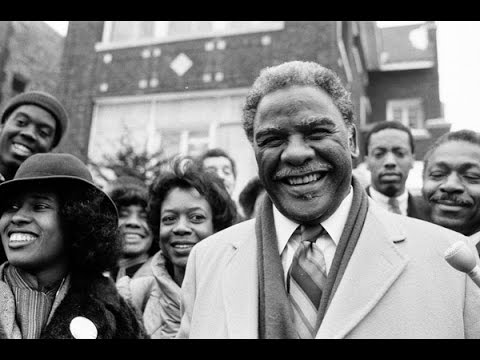
I not only voted for Harold Washington for Mayor, I rang doorbells in Dick Mell's hostile ward for him.

We voted at an American Legion Post.  For the first time I was able to bring my new daughters by marriage, Carolynne and Heather with me as I voted, just as my parents brought me.  I was determined to pass on the infection.
By the next round of election the whole family was relocated to Crystal Lake in the wilds of McHenry County where Republicans strutted unchallenged and lowly Democrats cringed and hid.  I didn’t care for that.  So I signed up to run for Democratic Precinct Committeeman and on the primary ballot.  I was elected by the score or so intrepid Democrats in the neighborhood.
I walked the blocks and rang doorbells for nearly 28 years. It got to be a habit.  Found a few Democrats.  Encouraged others.  Not once did I carry that precinct, or even come close.  But I’d be damned if I would just give it to the bastards.
We first voted at a Dodge dealership just a block up the road from the house.  Voting booths set up amid the shiny new cars.  I brought Maureen, a three year old toddler holding my hand wondering what it was all about.  Later the polling place moved a bit further away, to the offices of Flowerwood Nursery around the corner on Rt. 14.  Then it was at North Middle School until the hysterics decided that voters were likely to be sex predators or terrorists and could not be allowed in the same building with their little darlings.  Those self-same darlings lost the regular awareness that voting was a part of life.  Congratulations for a job well done on that.
Finally they moved our polling place out of the precinct over to the basement of the Salvation Army several blocks away where we shared the space with another precinct.  It’s been there for years now. 
Over the years I helped on a lot of campaigns, local, state, and national.  I got elected a McHenry County Central Committee officer—Vice Chair and Secretary.  Even served a few months as County Chair after Bob McGary suddenly died.  I did the Party’s publicity and tried to make myself useful.  We made small inroads.  Even won a little victory here and there occasionally.  But mostly we lost elections.  A lot of ‘em.  And I voted in every one of them.
Clip board with walk lists and lit in hand, the candidate for Nunda Township trustee canvassed door to door.

I even ran for office myself.  I got past a cavalry charge of an open, non-partisan primary for Crystal Lake City Council one year when the whole town was mad at the incumbents, but got my ass handed to me in the Municipal elections.  Not smart enough to know better, I tried again running as a Democrat for County Board and a few years later for the lowly post of Nunda Township Trustee.  A dead skunk would have polled as well.
One year the County Party even gave me a plaque with my name engraved on it, a pat on the head, and let me ramble for a few moments at the annual Thomas Jefferson Dinner fund raiser.  That was nice.  No one ever gave me an award before and none are ever likely to again.  It looks semi-impressive on my study wall.
Having no one better that year McHenry County  Democrats even gave me a shiney plaque at the 2008 Thomas Jefferson Dinner.
There were high points.  In 2008 we carried McHenry County for Barack Obama and the whole statewide ticket.  Turns out that there really are Democrats out here, but they are generally too discouraged, too fearful of the opinions of their Republican neighbors, and too damned lazy to get out and vote most years.  That election and celebrating at the Old Courthouse in Woodstock was one of the best moments of my life.  Four years later we managed just not to lose the country too badly, which was better than anyone expected.


Some folks wondered if I am disappointed in Obama.  Not really.  There is lots of stuff I disagree with him about—especially his continuing reliance on the blunt instrument of military power—and I have not been shy about calling him out about it or protesting.  And I wish he could have done more—moved universal single payer health insurance—instead of the half-loaf of so-called Obama Care.  But at least it is a half loaf and a lot of folks won’t go hungry because of it.  On the whole he has done about as well as anyone could expect against the raging and united opposition of a political party gone mad and an assertive not-to-be-denied oligarchy. Increasingly in his second term he has stood up strong and proud for the rights of minorities, immigrants, women, and the LBGT communities. 
In 2013 I finally hung up my clipboard as a committee person.  It was someone else’s turn.  I have taken a pass on meetings and rallies, phone banking and worse, fundraising.  I’m an armchair politician now.  A sideline cheerleader.  And it the itch gets irresistible, I can always rant and bloviate on politics here on this blog and post snarky comments on Facebook.
But it will be Election Day soon.  The alarm bell will go off.  The old fire horse is up for another run.  It looks good for Democrats this year.  We’ll carry Hillary Clinton in McHenry County and our down ballot candidates stand a fighting chance against a self-destructive and demoralized Republican Party.
I will get up on November 8 and put on my Election Day tie—the one with the cowboys on horseback and big American Flags.  I can’t say it’s a luck tie, because it has seen mostly lost elections.  But I wear it because the Republicans think they own the flag and it literally drives the worst of them into a frothing rage to see it worn by a commie/pinko/babykiller/fag/democrat.
After work I will take the PACE bus home from Woodstock as usual but instead of getting off at my house, I’ll ride a few blocks more to where I can walk to the Salvation Army.  I’ll go down the stairs and sign in, chatting with some of the Election Judges who have served nearly 30 years.  I’ll ask about turn out.  Then I’ll take my cardboard ballot to the flimsy little privacy stand, carefully fill in the little ovals with a felt marker and feed it through the optical scanner that I don’t entirely trust.  When I turn in the protective privacy shield, a judge will peel of an oval sticker with an American flag on it and the words I voted.  I’ll put it on my lapel and exit the building for the fairly long walk home in the gathering gloaming.
And I will feel good.  Damned good.  I’ll have had my fix.