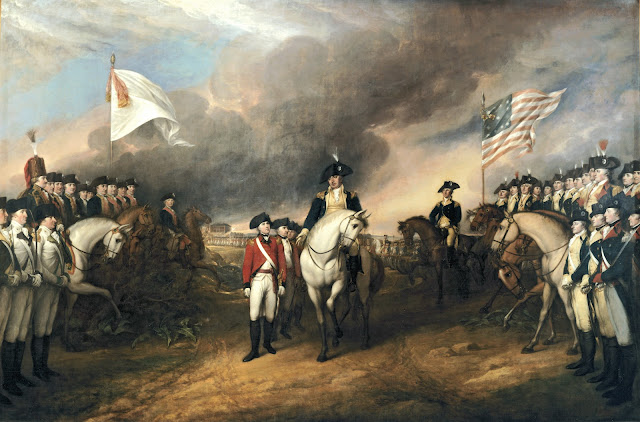
As Washington looks on General Benjamin Lincoln accepts the sword of
surrender offered by British General Charles O'Hara on behalf of Lord
Cornwallis at Yorktown ending major combat between armies in North
America during the Revolution--but not ending the war itself.
Note—Yesterday we left George
Washington in winter quarters in January 1777 at the end of a little more than
a year and a half of eventful active command of the Continental Army. .
The British musicians had it right when
they played The World Turned Upside Down on October 19, 1781. On that day British forces commanded by Lieutenant General Lord Cornwallis marched out of their fortifications at Yorktown, Virginia
between ranks of Continental Army and French troops. Cornwallis, feigning
illness, dispatched Irish born Brigadier General Charles O’Hara to do the distasteful duty. O’Hara attempted to
offer the sword of surrender to the senior
French officer, the Comte de Rochambeau who declined pointing to General George Washington. Washington, irked at Cornwallis’s breach of
decorum, likewise refused to accept the sword from an inferior officer. He chose
his subordinate, General Benjamin
Lincoln, who had been humiliated
at the surrender of Savannah, Georgia, to accept
the sword. 7,087 British and German mercenary officers and enlisted
men and 840 sailors from the British
fleet in the York River lay down their
arms.
Modern historians accurately
emphasize that the victory at
Yorktown would have been impossible
except for the large French Army under Rochambeau and the presence of the French Fleet under the Comte de Grasse at sea. After the patriotic
hagiography of Washington in the 19th Century, it has become fashionable
to decry the Continental commander’s generalship, particularly in
light of his long string of battlefield losses to the
British—especially the disastrous Long Island campaign. But Washington was masterfully in command
of the operation from the time the allies reached agreement
in Newport, Rhode
Island.
Since the moral boosting but small
victories at Trenton and Princeton, Washington’s main
achievement had been just keeping his army
in the field against a far
superior force through terrible deprivation and brutal winters at
Valley Forge and Morristown, with poor material support from
a Congress with no power to levy taxes in to pay for the
war.
On the battlefield in personal command,
Washington’s record was at best mixed. In 1777 he lost the Battle of
Brandywine allowing Major General Lord William Howe, Commander in
Chief of His Majesty’s Forces in North America, to capture Philadelphia and also lost an
attempt to go on the offensive at Germantown. He was able to deter the always slow and
timid Howe from marching his army up the Hudson to join up with Gentleman
Johnny Burgoyne’s invasion force from Canada. A northern
Army under Horatio Gates with the notable assistance of Benedict
Arnold was able to destroy Burgoyne’s army in battles around Saratoga—a
turning point in the war
which encouraged the French to enter
the conflict. But because he was not on the scene,
Washington would get scant credit in his role as over-all Commander
in Chief.

The Battle of Monmouth in June of 1778,
one of the largest field battles of the war, ended up at tactical tie
after the early stages of the Continental attack against an army under new
British commander Sir Henry Clinton were bungled by Washington’s old
rival for command, General Charles Lee who he angrily relieved
in the field. Washington rallied
his fleeing troops and snatched a stalemate from the jaws of defeat. Despite not being beaten in the field,
however, Clinton was discouraged and retreated to New York achieving
Washington’s more important strategic mission—keeping the Continental
Army in intact to fight another day.
In 1779 Clinton moved up the Hudson but was checked
by a counter-offensive by outnumbered Continental units under General
Mad Anthony Wayne. Skirmishes at Verplanck’s Point and at Stony Point showed that the Continental infantry had become formidable
and were an enormous boost to morale. With the Continental also still in possession
of key fortifications on the Hudson,
Clinton was forced to turn back again.
While Washington
went into another brutal winter encampment a Morristown, New Jersey, Clinton
and much of his Army sailed south
where they took Savannah from troops
under General Benjamin Lincoln. As much
of the fighting shifted south, Washington’s influence in Congress was at its low point and he could not get his choice of Nathaniel Greene
to take command there approved. Instead,
they appointed the official victor
of Saratoga, Horatio Gates, who had been involved in plots to replace Washington in over-all command. Gates failed
badly and was finally replaced by Green who initiated a Fabian strategy of hit-and-run attacks and engaging in bloody battles which the
British technically won but
sustained heavy losses. The British, now under Cornwallis after
Clinton returned to New York, were forced to retreat north into Virginia where
the Marquis de Lafayette,
Washington’s young favorite, was
playing cat and mouse with British raiders under Tory Col. Banastre
Tarleton and turncoat
Benedict Arnold.
The winter of
1780-81 instead of concentrating the army in one encampment as in the past,
Washington dispersed his regiments to towns around New York,
New Jersey, and Pennsylvania in order to supplement inadequate rations from Congress with foraging opportunities. On New Year’s Day, 1781 veteran troops of the Pennsylvania Line, some of the finest
troops in the Army under the command of Anthony Wayne, mutinied. They
had not been paid by Pennsylvania since enlistment. In fact, the only money most had ever seen was
a paltry $20 enlistment bonus,
far less than that paid by other states.
They had enlisted for “three years or the duration of the war”
and figured that their enlistments expired on the First. They resolved to march on Philadelphia to
demand back pay. One officer was
killed trying to prevent it. A committee of sergeants was elected to present
their petition and negotiate. They organized themselves into units and set off on an orderly march.

When Clinton heard
of the mutiny, he offered the men immunity
and parole plus enrolment bonuses and standard Regular
Army pay if they would switch
sides. But the men refused and
declared their loyalty to the new nation.
Washington and Wayne were sympathetic to the men and wrote in their
behalf to both Congress and the government of Pennsylvania. Eventually the crisis was averted due to loans arranged by financier Robert Morris. Pennsylvanian
agreed to discharge the three year men who did not accept a
new, more generous, re-enlistment bonus.
Approximately 1,250 infantrymen and 67 artillerymen were discharged. Some later returned to the service for new
bonuses. Only 1,050 remained on the
rolls. Some regiments were disbanded and
their remaining officers and men transferred
to other units. Almost everyone was
given a furlough to go home with
instructions to assemble with their new regiments which were each posted to
different towns. Almost all came
back. By spring Wayne was able to
take command and march his men out for another campaign season.
The close thing, which had sent Congress
into a panic, was indicative of Washington’s struggle keeping his army
together and effective.
The years of effective stalemate between Washington’s main army and Clinton in New York
was the background when Rochambeau arrived at Newport,
Rhode Island along with a formidable French fleet under Admiral François Joseph Paul de Grasse, and $20,000 in coin for the cash strapped
Continental Army. Together Washington
and the French hashed out the plan to move
swiftly to trap Cornwallis’s
army in Virginia before Clinton could re-enforce it. The audacious
details of moving two entire armies—4,000 Continentals and 5,000 French—by
a combination of forced march and
sail all the way from Newport to Virginia were mostly the work of Washington
himself.
The result was that
the trap was successfully sprung, a text
book siege and gallant final assault,
plus the French fleet fighting off the Royal
Navy and preventing
re-enforcements. The world was indeed
turned upside down. But the war was not over.
Clinton still had a large Army in New York and fighting on the western Frontier continued with ever
greater cruelty and brutality on both sides.
But the American Revolution
was now another world war, an extension of a long series of European and
colonial conflicts between the
British and the French. The interests of both nations in the Caribbean, Africa, and India were now
in play in addition to the fate of American
Independence. The treasuries of both countries were being
bled dry and their military and
naval forces stretched to the limit. In Paris
Benjamin Franklin and John Adams now had leverage to open negotiations to end the war with recognition
of U.S. Independence. But the process
would take time.
Under the
circumstances neither Washington nor Clinton wanted to risk their armies
wastefully. They went into a long period
of wary, watchful waiting.
But the Continental Army was idle and hungry. An idle, hungry army
is a very dangerous thing.
The aftermath of other revolutions won by rebel armies after protracted
wars would come to similar cross
roads. It almost never ended well. Usually the victorious General would
place himself at the head of his troops
and overthrow what civil revolutionary authority there was,
declaring himself President, Dictator,
or Monarch and consolidating his
power by lavishing the spoils of war
on his officers and men.
Other times revolutions devolved
into bitter civil war. Almost never did
it end with civil government intact
and hardly a shot fired in anger.
One man, General Washington
himself, prevented calamity in one
of the most important acts of his
distinguished career and one that is little remembered today. This is what happened.
The bulk of the Army had been
encamped at Newburgh,
New York to keep the British Army under
close surveillance and bottled up in
New York City since March of
1782. As another winter approached, all
eyes turned to Congress where proposals to provide pensions when the Army was inevitably
disbanded were being debated.
In 1780, to squelch earlier
discontent among the troops, Congress had pledged
to, on the model of the British,
put all officers on half-pay for the
rest of their lives. Now the treasury, such as it was, was empty and with no power to compel the states to fund the government under the new Articles of Confederation, there was no way to make good on
that promise. Worse, in January Superintendent of Finance Robert Morris announced
that the coffers were empty and that
he was suspending paying the Army.
Previously Morris, a financier and one of the wealthiest men in the new nation, had
met such emergencies by personally
guaranteeing notes—and buying many
of them himself. That he refused to do
so at this juncture was part a plan of
a faction of Congress known as the Nationalists to put pressure on the new government to assert limited powers of taxation, notably the ability to levy an import duty or impost. This was bitterly opposed by a larger block of Congress and many states had passed instructions to their delegates forbidding them to vote in favor of
payments of pensions fearing that it would force the adoption of taxation.
The Nationalists, who included
Morris, Gouverneur Morris of New
York, James Madison, and Alexander Hamilton who had left the
Army to take a seat in Congress from New York, backed
the impost plan not only to meet obligations to the Army, but to pay the many debts Congress amassed during the Revolution.
They hoped that a possible crisis involving the Army might force
Congress to move. They were in more or
less confidential communication with
officers in the Army, including some senior
commanders.
Among those was one of
Washington’s favorite officers, General
Henry Knox who was encouraged to draft
a memorial to Congress signed by other senior officers of
such impressive stature that they
could not be dismissed as mere malcontents. After expressing dissatisfaction with the
suspension of pay, the memorial offered a
compromise on the pension issue.
Instead of half pay for a life time, they indicated the Army would be
satisfied with a lump sum payment. It concluded with a not very veiled threat that “that any further
experiments on their [the army’s] patience may have fatal effects.” Private messages were also sent to Secretary of War Benjamin Lincoln,
himself recently out of the Army and the officer delegated by Washington to
receive the surrender of the British at Yorktown,
that made clear the dangerous state of
moral in the Army.
The memorial was delivered to
Congress by General Alexander McDougall
and Colonels John Brooks and Matthias Ogden in late December 1782. McDougall and Brooks lingered in Philadelphia
to lobby Congress and monitor the situation. They met
with a special committee in early
January to explain the seriousness of the situation. That committee reported to the whole body on
January 22 at which time Robert Morris shocked Congress by announcing his resignation
in despair of the body acting. The
nationalists twice tried to pass legislation calling for pensions at full pay
to end on a specific date as an alternative to the original lifetime half pay
or the Army’s immediate lump sum. On
February 4 Congress rejected the proposal for the second time.
.jpg)
Brooks hastened back to
Newburgh to rally the officer corps for more decisive action. McDougall
wrote Knox under the significant pseudonym
Brutus suggested that the Army refuse to disband when peace
was announced until their demands were met.
That action would be virtual mutiny in the face of an order from Congress to demobilize. Knox was sympathetic
but non-committal.
Meanwhile other dissenting
forces in the Army became involved. That
included the staff of Washington’s chief rival General Horatio Gates, the
victor at Saratoga and a clique of younger officers long
dissatisfied with Washington’s leadership and outside the thrall of the cult of personal
loyalty to him. Nationalists in
Congress may have believed that these officers might be the core of a coup d’état should it
become necessary.
By mid-February rumors that a peace treaty was at hand
swirled around both the capital in Philadelphia and the camp in Newburgh, bring
the situation closer to crisis. Hamilton
wrote privately to Washington, his patron
in the Army and who was said to regard him, like the Marquis de Lafayette
as a son. Taking advantage of the relationship,
Hamilton warned the General of the dangers in his camp and urged him to “take
the direction” of the army’s anger—in
other words be ready to assume
command of a coup against Congress.
Shocked, Washington wrote back that he sympathized with the plights
of both the Army and of Congress but flatly said that he would be no part of a plan to use the Army as a threat to the civil government in contradiction to the republican
principles on which the war had been conducted.
On February 21 Knox dashed the hopes of Congressional
Nationalists that he would lend his prestige to a threat not to disband the
Army undoubtedly after consultation
with Washington. In letters he expressed
again sympathy for the Army’s plight but declared he would not participate in
any mutiny or revolt and expressed the hope that the Army would only be used
“against the Enemies of the Liberties in America.”
Without the support of
Washington and Knox—indeed with their declared opposition—the Nationalists
turned their attention to Gates as their best
bet for a man on a white horse. They sent Gates a signal of their support
should he decide to move with Pennsylvania
Colonel Walter Stewart, returning to duty after an illness. He arrived in camp on March 8 and met with
Gates. Rumors about an impending
demonstration of some kind swirled through the camp.
On March 10 an unsigned letter, later attributed to Major John Armstrong, Jr. who was an aide to Gates, began circulating in camp calling for a meeting of field grade officers the next day,
March 11 at 11 am.
As soon as Washington got wind
of it he denounced the
“disorderly... and irregular nature” of the anonymously called meeting in his general orders of the day on the
morning of the 11th. Without explicitly banning the meeting, he proposed his
own meeting of officers on March 15. The
letter was carefully worded to give
the impression that Washington
himself would not attend. Instead, he directed the meeting to be chaired by the “senior officer present” knowing full well that would be Gates.
The next day a second
anonymous letter appeared claiming that Washington’s endorsement of a meeting
on the 15th was a signal the General would support a threat in force to
Congress. Washington was furious.
For the next three days the
camp was awash in rumors and whispered plot.
On the appointed time on
Saturday, March 15 the officers assembled in the New Building or Temple
which had just been constructed and was the largest facility in camp capable of hold such a meeting. As expected, Gates took the chair. Shortly after he called the meeting to order,
Washington suddenly and unexpectedly appeared
and asked permission to address
the assembly.
His sudden appearance caused
quite a stir—and for one of the few times in his experience in the Army the greeting was not unanimously
adulatory. Younger officers and those who had not personally served close
to him hooted and jeered. Gates must have been none to glad to see
his commander, but had no choice but
to allow him to speak.
Washington came to the front
of the room and turned to face his officers.
He gave a short speech with unusual heat and passion, a departure from
his carefully cultivated image of lofty probity. He had carefully drafted the statement, but
gave it without notes as if extemporaneously. He called upon the assembly to oppose anyone “who wickedly attempts to
open the floodgates of civil discord and deluge our rising empire in blood.”
"I have grown not only gray, but nearly blind in the service of my
country" Washington told his brother officers at Newburgh bringing many
to tears and diffusing a potential mutiny or coup against Congress.
Then he drew sheets of paper folded in half
length-wise from inside his coat. It
was a letter from a member of Congress, he said. He fumbled
with the paper and seemed to have
difficulty reading it. He then drew
from another pocket a new pair of spectacles. Almost no one
except his closest aides had yet seen him wear them. He slowly unfolded them and perched
them unsteadily on his nose.
“Gentlemen, you will permit me
to put on my spectacles, for I have not only grown gray but almost blind in the
service of my country.” Many of the
officers wept. The sympathy
and sentiment of the room swung
immediately to Washington. After reading
the letter, which really added little to the issue at hand, the General bowed and left the building without waiting
for a response. He didn’t have to
wait. The conspiracy or potential coup
or whatever had been afoot collapsed.
A motion was made to denounce the anonymous letters. It passed virtually unanimously with only Colonel Timothy Pickering protesting. Other motions affirmed the loyalty of the Army. A committee consisting of General Knox and
Colonel Brooks was appointed to draft a final resolution which expressed the “utmost confidence” of the Army in
Congress and the “disdain and abhorrence”
for the irregular proposals circulated earlier.
How much of the proceedings
that morning were carefully stage-managed
in advance by Washington and Knox and how much was happy accident is hotly
debated by historians. I am in the
camp that recognizes Washington as a brilliant
tactician. The old fox knew exactly what he was doing.
General
Washington accompanied by his slave is pictured with the rolled up
speech delivered before his officers at Newburgh. Painting by John
Trumbull.
The speech went down in
history as the Newburgh Address,
but it was a bit of stage business that
carried the day.
Meanwhile Washington sent
copies of both the anonymous letters and his address to Congress which was
debating, yet again, the pension issue.
Even steadfast opponents now realized how narrowly disaster had been averted. The Nationalist now saw an opportunity. They advised the creation of a committee to study the intelligence and
come up with a solution. Shrewdly, they stacked the committee with steadfast opponents of any pension
plan. But presented with mounting
evidence of deep dissatisfaction in the Army and the prospect that in the
future Washington might not be able to so deftly turn aside open rebellion, one
anti-pension delegate, Eliphalet Dyer
of Connecticut, now came forward with a proposal for
a lump-sum payment, including arrears
pay.
As finally approved, the
pension plan called for half-pay for
five years, mirroring the solution proposed by Knox and twice rejected
before. The payment was not in cash, but in government bonds, highly speculative
securities many thought would be worthless. Many officers sold their bonds to speculators for pennies on the dollar. But those who held onto the bonds
were made whole. Thanks to the adoption of the Constitution, the new ability of the
nation to levy import duties and all of the taxes, and Secretary of the Treasury Alexander Hamilton’s determination to
fully pay off Revolutionary War debt,
the bonds were redeemed by the
government at full value in 1790.
But Congress was not yet out
of the woods. Discontent spread to the still
uncompensated non-commissioned officers and there was some minor rioting in camp and talk of marching on Philadelphia to claim
their back pay. Once again the specter
of the Army refusing to disband was raised.
On April 19, eight years to
the day since the Battles of Lexington and
Concord, with news of a final Peace Treaty confirmed, Washington declared the war over. Congress
quickly ordered him to disband the Army and voted each enlisted man and non-commissioned officer three months’ pay.
Since there were still no funds in the treasury, Robert Morris stepped
up $800,000 in notes on his personal
accounts to the troops. Many
soldiers, in need of cash just to get home, sold their notes to speculators at
deep discounts. The notes, whether
retained by the soldiers or by the speculators were also paid off by Hamilton.
Soldiers left camp over the
next few months either on a furlough from
which they never expected to be recalled or outright discharged. The notes were given them upon their
separation. This caused difficulties
when a Pennsylvania regiment was
swept by rumors that they would be discharged before getting their notes. They departed camp and marched on
Philadelphia in June, sending Congress scurrying to Princeton, New Jersey. There is evidence that some supporters of the
Newburgh plot also had a hand in this dangerous mini-uprising including Walter Stewart, John Armstrong, and
Gouverneur Morris.
The crisis passed. The Army was formally disbanded in November except
for small garrisons at West Point and on the frontier.
But Washington had one last
appearance before his officers which was also critical in staving off the hopes of some that they could become a hereditary class of American aristocrats.
Washington entered New York City to wild cheers after seeing the signal that the last British ship had taken sail in 1783.
It was only nine days after
the English under Sir Guy Carlson, Commander-in-Chief of all
British Forces in North America, sailed out of New York Harbor. On the way
out an enraged gunner on one of the
ships let go one final round on Patriot crowds jeering on Staten Island. The ball plunked pitifully in the water
well short of its target. Barring some
skirmishing by Native allies on the
frontier that was the last shot of
the war. The American Revolution was
essentially over and to the world’s surprise the upstart Colonies were the victors.
Washington was hovering
outside the city with many of his staff officers and top commanders waiting to take control of the last bastion of
British power in the fledgling states.
Although Carlson had received
orders from London to evacuate in
August, he informed the President of
Congress in a letter that it would take weeks to complete the task because
he would also be taking with him all
of the Tory refugees who could reach
the city—eventually 29,000 of them—and slaves
who had escaped into British
lines after they were promised freedom. By the treaty ending the war, the slaves
were supposed to be returned to
their “rightful owners” but despite
the objections of Southern members of Congress, the new
government was eager enough to see the Red
Coat army gone that they were willing to wink at this breach of
the treaty.
With the refugees and former
slaves safely aboard, Carlton finally loaded his garrisons and set sail on
November 27.
Washington refused to enter
the city until his scouts confirmed
that all the troops were gone and an
English ensign flying from a high pole on the Battery Park was hauled down and replaced by American colors. That was hard
because the British had greased the
pole. Numerous attempts were made before the flag was finally hauled down and
the Stars and Stripes were nailed to the pole.
Immediately upon spying the
new flag, Washington entered the city at the head of his troops and paraded down Broadway to the Battery.
Washington did not plan to
stay long in New York after securing the
city. Like all soldiers, he was
eager to return home. But he had a few loose ends to wrap up first.
In the more than two years
since the last major battle, the defeat of Cornwallis’s
army at Yorktown, Washington had
to keep his army together and in the field until a treaty could be concluded
and the British left. But with the
immediate military threat removed, Congress had been even more reluctant than
usual to support the troops with supplies, provisions, and pay. With victory at hand actual privation stalked
the Army as it had in the bleakest days of the war.
Moral not only suffered, but
mutiny brewed. Although many veterans
had been mustered out, fresh levies
had taken their place. A band of Pennsylvania troops stationed at Lancaster moved to march on the capital
at Philadelphia. They entered the city unobstructed and
were joined by members of the local
garrison who trapped Congress in
the State House.
Although the mutiny was quelled and the emergency passed, Washington was mortified. He was also
concerned by similar sentiments being voiced even among his closest circle of brother officers. Many wanted their beloved commander to seize the government and rule
as either a dictator—or even a king—who would dispense favors and honors
among them.
Virtually unique in all history, Washington, the victorious
commander, would have none of it. He
sincerely believed in civilian government and civilian authority over the
military, even though it caused him no end of vexations.
He decided to call his
officers together for a “final farewell”
before departing the city. He chose the Frauncis Tavern, one of the few meeting places with food and drink in
the city large enough for the gathering.
The tavern on Pearl Street
had been built as the elegant mansion
for a wealthy merchant but had been a popular
gathering point since before the Revolution.
Washington's Farewell to his officers set an example of modest retirement.
At noon on December 4, 1782,
the day designated by Congress for the disbandment of the Continental Army, General Washington entered the Long Room of the tavern where 80 of his
officers, including most of those to whom he was personally connected, were
assembled. It was an emotional
scene. It was described in 1830 in a memoir
by Colonel Benjamin Tallmadge. Although some historians doubt the accuracy of such
recollections long after the fact, most believe that something very like the
scene he described actually took place:
At 12 o’clock the
officers repaired to Fraunces Tavern in Pearl Street where General Washington
had appointed to meet them and to take his final leave of them. We had been
assembled but a few moments when his excellence entered the room. His emotions
were too strong to be concealed which seemed to be reciprocated by every
officer present. After partaking of a slight refreshment in almost breathless
silence the General filled his glass with wine and turning to the officers
said, “With a heart full of love and gratitude I now take leave of you. I most
devoutly wish that your latter days may be as prosperous and happy as your
former ones have been glorious and honorable.”
After the officers
had taken a glass of wine General Washington said “I cannot come to each of you
but shall feel obliged if each of you will come and take me by the hand.”
General Knox being nearest to him turned to the Commander-in-chief who,
suffused in tears, was incapable of utterance but grasped his hand when they
embraced each other in silence. In the same affectionate manner every officer
in the room marched up and parted with his general in chief. Such a scene of
sorrow and weeping I had never before witnessed and fondly hope I may never be
called to witness again.
Then, without much further ceremony or the need for pointed commentary, the offers rose to
escort their commander to a barge
that took him to New Jersey. From there he rode to Annapolis, Maryland where Congress was sitting
after the mutiny scare in Philadelphia.
There he submitted a final report
and tendered his resignation. Then on to retirement at Mount Vernon.
These final displays were the example to his officers and troops. There would be no military coup, no
dictatorship, no new American royalty and aristocracy.
It was an act more profound in many ways than any
battlefield victory.
Tomorrow—First in Peace.


.jpg)


