Showing posts with label red scare. Show all posts

Tuesday, November 11, 2025

Ellis Island—Immigrants Were Once Welcomed Roughly But Mostly Admitted


Ellis Island around the turn of the 20th Century. 

A guy who should have been a joke became the leading contender for the Republican Presidential nomination in 2016.  He got elected largely on his promise to build a high tech version of the Great Wall of China across our Southern boarders at a cost of billions of dollars, to round up and deport 11 million so called illegal aliens, and even to revoke the citizenship of millions born in the U.S. to immigrant parents.  In addition to casting Latino immigrants as criminals and rapists, he targeted Muslims and African immigrants.  His policies resulted in the infamous separation of children from their families and a vast network of internment facilities for immigrants and asylum seekers.  The translation of all of this is that America would be made White again.  He tapped into a deep reservoir of nativism and xenophobia that has surfaced repeatedly in American history in various ugly guises.

The wall turned out to be an expensive and ineffective boondoggle covering less than 100 miles of the long Southern border.  But in his second term Donald Trump has unleashed a massive kidnapping and deportation initiative employing ICE and Border Patrol agents and masked police from agencies across the Federal Government.  He has deployed National Guard and regular troops to “sanctuary cities” across the country and brought the whole nation to the brink of civil war.

In comparison and contrast take the great symbol of immigration and the doorway to millions.  Many of the decedents of the wretched refuse who entered that doorway and who were despised, abused, and exploited now believe that they are White Real Americans and cheer on the billionaire who holds them in as much contempt as the Mexicans he disparages.

Ellis Island, the main Port of Entry into the United States for immigrants arriving from across the Atlantic Ocean for sixty-two years closed on November 12, 1954.  Since 1898 over 12 million people  entered the country through the immigration processing center on the island.  About 100 million people, one third of all Americans alive today either came through the Island themselves or have at least one ancestor who did.

The local native tribes called it Kiosk (Gull Island) for the birds that gathered on the stony 3.2 acre outcropping off the New Jersey coast of New York Harbor.  The Dutch and English settlers named it after the abundant oysters that attracted the gulls.  Nearby is even smaller Bedloe’s Island on which Ft. Wood was built, a harbor defense 11 point star fort completed in 1801.  When that instillation was abandoned as obsolete after the Civil War, the fort’s thick stone walls supported the base and pedestal for the Statue of Liberty, which was unveiled there in 1886.

Ellis Island, which the Federal Government purchased in 1808, was also part of the harbor defense system, featuring a parapet with three circular levels of gun platforms named Fort Gibson.  Like its neighbor, the fortification was abandoned after the Civil War.


In the late 19th Century the State of New York employed Castle Garden as an immigrant receiving station. 

By the time that big statue was erected next door, millions of emigrants had already poured through the harbor.  At the time there was no Federal screening or regulation of immigration.  If it was done at all, such screening was left to the states.  For decades New York funneled immigrants off the ships to Castle Garden in the Battery. From 1855 to 1890 an approximately eight million immigrants, mostly from Northern and Western Europe, passed through its doors.

The first great wave of European immigrants, especially the huge numbers of Catholic Irish set off a wave of nativism that culminated in the Know Nothing Party.  The continuing need for massive numbers of workers to for the huge construction projectscanals, railroads, turnpikes, harbor dredging—as well as in mining and the growing industrial sector, made absorption of the growing numbers easier.  And the Civil War both diverted the country’s attention from immigration issues and used plenty of off-the-boat immigrants as cannon fodder.

By the 1870’s, however, economic depression in Europe, famines, political instability, and a rising wave of anti-Semitism brought a new wave of immigrants from Southern and Eastern Europe, especially Italy, Poland, and portions of the Russian, Austro-Hungarian, and Ottoman Empires which was resented by “Americans” and earlier immigrants alike.  The Labor Movement, struggling to maintain craft unions and high wages in the skilled trades, and to establish any kind of unionism among the semi-skilled and unskilled laborers of the humming new factories, mills and mines, was fearful that a surplus of cheap labor would drive wages down and that “ignorant” immigrants would be used as scabs.   The Protestant middle class was aghast at swarthy new hordes of Papists and worse, Jews.

Pressure was growing on the Federal government to step in and regulate immigration uniformly.  The Federal government assumed responsibility in 1890.  It immediately recognized that New York’s Castle Garden facility would be unable to handle the huge numbers that seemed to increase yearly.  Work to convert abandoned Ellis Island to a receiving station began almost immediately.

On January 1, 1892 the Ellis Island receiving station opened under the auspices of the new Bureau of Emigration.  Fifteen year old Anne Moore and her two brothers from Cork, Ireland, were the first to be processed.   They would be far from the last. 

The first reception center burned down within 5 years.  In December 1900 the impressive main hall which still stands was opened and processed 2,251 immigrants on the first day.  Over the years the facility was greatly expanded as was the island itself.  From 1890 onward fill from unloaded ship ballast and from construction projects in the City, especially from the Subway system, was used to expand the island.  Eventually it covered more than 27 total acres with the bulk of the land in two large sections on either side of a ferry slip connected by a narrow strip of land.  Numerous buildings dotted both sides of the island.


Immigrants arriving at Ellis Island carried all of their possessions with them. 

Most people believe that all immigrants arriving by ship in New York passed through the island.  That is not quite true.  First and second class passengers were cursorily interviewed on board ship and generally passed directly through to land in New York unless they showed signs of illness.  It was presumed that those who could afford such passage had sufficient assets to prevent them from becoming “burdens on society.”  But the vast majority of immigrants were booked third class and steerage.  Steerage passengers were treated as virtual cargo, held in cramped conditions below deck and not allowed to mingle in any way with their betters.  These were the millions that were funneled through Ellis Island’s screening process.

These passengers were transported by ferry from the docks to the island and entered the Great Hall to begin the process of evaluation.  If all went smoothly, this could take a little as two hours.  Most spent the better part of the day on the island.  But if anything went amiss, or if medical inspection detected an illness, passengers could be detained for weeks.  Besides medical screening, which typically looked out for infectious disease, blindness and other disabilities, chronic illness, infirmity, and insanity, immigrants were asked 29 questions including name, occupation, and the amount of money carried.  About 2% were sent back for various causes including having a criminal background, illness, insanity, and a total lack of funds and skills which might lead them to become a burden.  Children who arrived without a parent or guardian also were frequently rejected. 


Women and children inspected for eye disease.  

Upon approval immigrants were released to welcoming family, if they had any, or to the arms of labor agents prowling the docks.  Many settled in New York, others were whisked away by rail to points all across the country, often dispatched to factories and mines by the labor agents.  These agents frequently shook down the immigrants for cash in addition to getting paid by potential employers.  Some were total frauds and immigrants found themselves trapped in towns far from the coast or supportive communities with no money and no job.

The peak year for Ellis Island was 1907, with 1,004,756 immigrants processed including an all-time daily high on April 17, 1907, when 11,747 arrived. 

A deep recession in America slowed immigration somewhat, and World War I disrupted immigration patterns.  But the country braced for a huge new wave of immigrants and refugees after the war just as the great Red Scare was identifying immigrants as likely Communists and subversives.

In fact the War and the Red Scare combined to give the Island a new use as a detention facility and a debarkation point for deportation.  During the war thousands of enemy aliens were detained there and during the Red Scare many more thousands rounded up in the infamous Palmer Raids were held there for deportation.  While the Island was being used for these purposes the greatly reduced flow of regular immigrants was screened on board ship.

In 1920, Ellis Island reopened as an immigration receiving station and a greatly reduced 225,206 immigrants were processed that year.

The clamor to restrain immigration, especially from those pesky Southern and Eastern European areas—and by Asians on the West Coast—led to increasingly restrictive immigration laws.  The 1921 Quota Law was refined by the 1924 National Origins Act.  Together they sought to maintain the balance of “real Americans” and earlier immigrants of Western and Northern European extraction by imposing strict quotas based on national origin that would allow new immigrants from any nation in proportion to their representation in the current American population and the total for all immigration was capped at a figure much lower than pre-war levels. 

After 1924 potential immigrants were supposed to apply for and be screened by American embassies around the world.  Those approved were given papers that would allow them to land directly in the country after clearing normal customs.  From 1924 onward only a trickle of immigrants claiming refugee status were processed through the island.  The bulk of the facilities continued to be used for detention of one sort or another.

During World War II the island again became a detention center for enemy aliens.  More than 7,000—mostly Germans and Italians, but some Japanese and some from Axis allied or occupied countries—were held on the island.  It also housed a large Coast Guard training facility.

In the post war years another Red Scare caused some suspected Communists to be held there as well.  In 1952 changes in the law dropped the number of detainees from a post-war peak of 1,500 to just 30.  In fact the last were not released until 1954.   The same year the last of a trickle of immigrants was also processed—Norwegian sailor Arne Peterssen.  With the days of the trans-oceanic passenger ships drawing to a close and the arrival of more and more immigrants by air, the giant old facility was simply an expensive dinosaur when it was closed by the Eisenhower Administration the same year.


The Great Hall as restored reflects a certain architectural grandeur, but seems curiously devoid of the teaming, chaotic life that filled it in the peak immigration years. 

The facilities on the island were allowed to deteriorate.  But in the 1960’s public interest in re-discovering ethnic roots began to pick up as the children and grandchildren of immigrants reached the middle class.   In 1965, President Lyndon Johnson declared Ellis Island part of the Statue of Liberty National Monument. The deteriorating buildings were opened to the public on a limited basis between 1976 and 1984 when a major restoration, the largest historic restoration in U.S. history, got under way. The $160 million dollar project was funded by donations made to the Statue of Liberty—Ellis Island Foundation in partnership with the National Park Service. The Main Building was reopened to the public on September 10, 1990 as the Ellis Island Immigration Museum. The museum now receives almost 2 million visitors annually.


Friday, May 23, 2025

Canadian Mounties as a National Symbol are Ready to Face Off Against a Real U.S. Threat


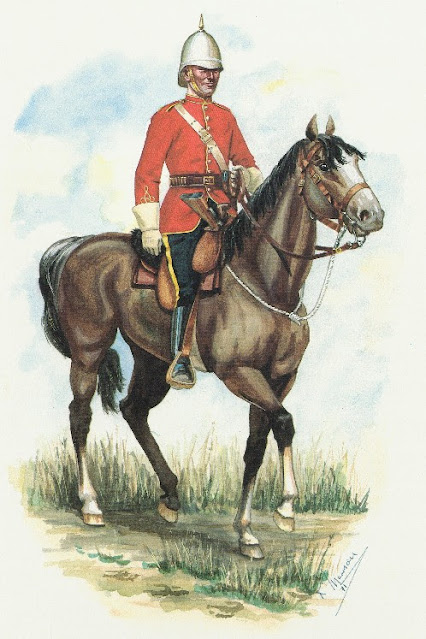
                                                         A Northwest Canadian Mounted Police Constable in 1876.

On May 23, 1873 acting on the advice of Canadian Prime Minister John A. Macdonald Queen Victoria gave her personal approval to the establishment of the North West Mounted Police.  Macdonald was keen on extending authority over the vast, lightly populated Northwest Territories, discouraging the ever expansionist United States from moving into the vacuum, and preventing the kind of full scale Indian warfare that characterized the American frontier.

The unit was originally conceived of as an army cavalry unit to be called the Northwest Rifles modeled after the Indian Armys famed Khyber Rifles.  But Macdonald feared that the military form might antagonize the native peoples and the United States and possibly lead to conflict.  Instead, he decided to turn to the civilian, paramilitary police Royal Irish Constabulary as his model.  Rank and file members were designated as Constables.  But it was organized as a lancer cavalry unit and outfitted in standard Imperial red tunics and colonial white pith helmets. 

The first force under Commissioner Arthur French was trained and assembled at Fort Dufferin in Manitoba and was dispatched on its first deployment on July 8, 1874, the Long March  to Fort Whoop-Up  in what is now southern Alberta.  Fort Whoop-up was a trading post established by Americans operating from near-by Montana Territory.  Its trading staples included plenty of fire water and the purpose of the expedition of 22 officers and 287 constables and sub-constables was to stamp out the trade.  Of more real concern may have been reports that the traders were flying the American flag over the fort.  


Officers and Constables in garrison uniforms including the jaunty pillbox caps that they much preffered to pith helmets and often wore on patrol at Ft. March in 1878.

Word of the advancing force was enough to cause the Americans to abandon the fort and French established his first frontier post, Ft. MacLeod nearby.  The force clearly established Canada’s claim to the west and made possible a southern route for the trans-Canadian railway. 

The NWMP early duties include continued suppression of the whiskey trade, keeping peace among native tribes, and general law enforcement.  Each post commander was sworn in as a Justice of the Peace so that the force had judicial as well as police power and over vast areas was the only form of organized government.  Because the force gained a reputation for treating native people fairly, even in disputes with Whites, peace was generally kept.  When Sitting Bull and thousands of Sioux crossed the border in 1876 after the Battle of the Little Big Horn seeking the protection of the Great White Mother (Victoria), NWMP under James Morrow Walsh maintained order at the Sioux settlement at Wood Mountain and the presence of a large armed force dissuaded the American Cavalry from any cross border adventures.  


 The Mounted police engaged as soldiers in the Métis Rebellion alongside Army troops like the Middlands Regiment which made a bayonet charge at the Battle of Batoche in 1885.

In 1885 the NWMP saw their first, and only, widespread domestic use as a military force in suppressing the Métis (a distinct culture of mixed native and European, mostly French, dissent) under the leadership of Louis Riel.  Simultaneously there was an uprising of dissident Cree which the government tied to the Métis. After the rebels enjoyed some early successes, Riel was defeated in a bloody three day Battle of Batoche on May 9.  On June 9 the last significant band of Cree were routed and dispersed at Loon Lake.  Riel and the Cree chief Poundmaker surrendered in June.  Other leaders escaped into the United States.  Poundmaker and other Cree leaders were sentenced to prison while eight natives were hung for crimes.  Riel was hung, causing controversy and protests by French speaking Canadians who ever after regarded the NWMP as an instrument of Anglo domination.  The remaining Cree and other native allies were pacified with increased rations.  Peace was secured on the frontier and the Canadian Pacific spurred to completion. 

The NWMP began to enter international folklore with the Klondike Gold Rush of 1896.  With prospecting intensifying in the Yukon Territory and a growing presence of American miners and whiskey traders in the region—which always set off alarm sovereignty bells in Ottawa—NWMP authority was extended to the Yukon and an initial force of twenty officers were dispatched to the region to keep order and enforce customs duties on Americans pouring in over the border from Skagway, Alaska.  In fact a brief attempt was made to assert Canadian control over Skagway, but the force settled for a customs port at the top of the pass leading to Dawson and the heart of the mining district.  


Mounties like these at Dawson in the Yukon gold fields were already using broad brimmed Stetsons in 1899 five years before they were officially incorporated into the dress uniform of the Northwest Mounted Police.

The RCMP rigidly enforced minimum grubstake requirements to prevent starvation, which had occurred during the first season of the rush.  Miners without sufficient supplies were turned back.  And there were thousands because word of the Rush came in the midst of one of the worst of the periodic economic Panics in America sending many desperate men north to find their fortunes. 

The police also worked to keep out handguns, an American favorite, as a way to reduce crime and tried to control gambling and prostitution as well.  Known criminals were quickly deported.  The presence of the police in the gold field prevented the violence and claim jumping that was typical of most gold rush areas.  When observers retuned from the fields they unanimously remarked on the contrast between the mayhem and anarchy on the Alaskan side of the border and the relative peace kept by the force that earned a new nickname—the Mounties.  Soon they were heroes of dime novels, melodramas, and early silent pictures in the U.S. and Canada. 

In 1904 the NWMP adopted the flat brimmed Stetson hat with a high four-pinch crown as the official headgear of the unit, replacing the detested white pith helmets, which were entirely unsuited for use in the north.  Many units had unofficially been using the hats for years on patrol, wearing the helmets only on Parade or ceremonial occasions. 

The same year King Edward VII bestowed the title Royal to the name in recognition of service of Police members who volunteered in the Canadian Rifles and other regiments during the Boer War.  

Royal North West Mounted Police found their jurisdiction growing.  The Arctic and Yukon had already been added, and soon the newly organized provinces of Alberta, Saskatchewan, and Manitoba in the years leading to the First World War. 

The war brought a new role—“border patrols, surveillance of enemy aliens, and enforcement of national security regulations.”  This new national security role would lead the force in controversial new directions, including massive surveillance and monitoring of many labor unions, socialist organizations, ethnic associations, and of French Canadians who were constantly suspected of separatist intentions. 

In 1918 RNWMP was dispatched to help occupy the Russian port of Vladivostok as part of the Canadian Expeditionary Force sent to join the Allied effort aiding White forces in the Russian Civil War.  

Mounties charge workers during the Winnipeg General Strike of 1919.  The force was increasingly used against labor unions, Socialists, and Communists often abetting private strike breaking thugs.  To this day the Canadian labor movement regards the RCMP with suspicion and contempt.

The following year they were called in to quell the Winnipeg General Strike and opened fire on the strikers killing 4 and injuring 30.  They frequently intervened in labor disputes for the next thirty years and began to be considered strike breakers and scab herders by working people. 

In 1920 the Dominion Police were merged into the force under the new name Royal Canadian Mounted Police (RCMP) which was given expanded authority as a national police force with authority to enforce Federal Law in all Provinces and Territories and officially adding counterintelligence operations to its national security portfolio. Among regular targets of the RCMP were the Communist Party of Canada, the One Big Union (Canadian counterpart of the Industrial Workers of the World), and minority ethnic and cultural groups.  Ukrainians who were arriving in the Prairie Provinces in large numbers to escape the bloody civil war at home, were particularly targeted because they included both Red and White sympathizers.  Chinese were also targeted, and two percent of all Chinese immigrants were deported by the RCMP for alleged violation of the Opium laws.  Special squads were organized for strike breaking and a semi-secret Legion of Frontiersmen united sworn officers with right wing civilian vigilantes.  

 The official badge of the Royal Canadian Mounted Police since 1920.

During the ‘30s more duties were added as the RCMP absorbed the Preventative Services, National Revenue creating the new RCMP Marine Section, a naval arm with duties analogous the American Coast Guard.  The RCMP schooner St. Roch became the first ship to ever cross the Northwest Passage from west to east and later the first vessel to make the crossing in one season. 

With Canada’s entry into World War II with the rest of the British Commonwealth, security functions were reorganized as the RCMP Security Service. 

In 1949 Newfoundland became a full member of the Canadian Federation and the RCMP absorbed its former police unit, the Newfoundland Rangers. 

The Red Scare of the 1950’s was as intense north of the border as south and the RCMP was empowered to “screen out subversive elements from the public sector.”  The witch hunt of public servants was extensive and was soon broadened to include investigations of alleged homosexuals on the grounds that their “aberrant sexual behavior” made them susceptible to black mail and extortion.  The RCMP even devised a Fruit Machine meant to discover secret homosexuals by monitoring pupil dilation when viewing beefcake pictures.  Hundreds of civil servants lost their jobs before the program was finally discontinued. 

The rise of the separatist Parti Québécois in the 70’s resulted in widespread abuse by the RCMP and led to a special commission which finally recommended the RCMP be stripped of intelligence duties and a new Canadian Security Intelligence Service (CSIS) be created. 


On day-to-day duty Constables wear fairly standard police uniforms including protective vests.  Only the badge on their caps and the yellow stripe on their pants are distinctive.  

Beginning in 1974 women were included in the force.  Today the RCPM is a force of almost 19,000 sworn officers and another 9,700 unsworn support personnel.  It is the national police force and provides policing to all Provinces and Territories except Ontario and Quebec, which maintain their own provincial forces.  They also contract as local law enforcement in many small cities and towns.  They also provide border and customs services and maintain a security function, including expanded anti-terrorist authority

Mounties charge on their matching black horses as part of a performance of the Musical Ride. 

The familiar red tunics with Sam Browne belts, Stetson hats, blue jodhpurs with yellow stripe, and high boots remain the dress uniform and a nation symbol of Canada.  Daily uniforms are usually blue or grey, standard police style.  The RCMP fulfills many ceremonial guard functions at state occasions and maintains the famous Musical Ride, a mounted unit with matching black horses that performs elaborate drills, including a full charge with leveled lances, to musical accompaniment. 

During the Vancouver Winter Olympic Games of 2010, the RCMP was featured as a national symbol in both the opening and closing ceremonies including the whimsical and humorous closing program, but also in the formal raising and lowering of the Olympic Flag.  It seemed like the Mounties and the Maple Leaf Flag were the two things that Canadians wanted the world to remember about them.  


The opening ceremony at the Vancouver Winter Olympics in 2010 included giant Mountie pulled along on wheels and a Busby Berkley style dance number on a birthday cake.

Today with Trumps bluster and blather about a 51st State, punishing tariffs, and open lust for Canadian national resources, the RCMP is hearkening back to it’s original mission of defending sovereignty and checking American overreach and expansionism.  As Canada rallies defiance, the Mounties are both a symbol of defiance and, along with  small but tough and highly trained Armed forces, an active deterrent to aggression.

The Mounties are watching you, Donald.  And you know what they say—They always get their man.