Friday, January 30, 2015

Mahatma Gandhi—The Father of the Nation is No More

The body of Mahatma Gandhi, his fatal wounds clearly visible, lays on the funeral beir transporting it to his cremation.


On January 30, 1948 Mohandas Karamchand Gandhi was shot and killed while on a nightly public walk in Delhi by Nathuram Godse, a Hindu nationalist enraged that the Mahatma had promoted communal peace between India and Muslim Pakistan by fasting until the Indian government made a 550 million Rupee payment to Pakistan and paid reparations to Indian Muslims whose homes had been destroyed in the civil unrest following Independence and Partition.  It was the last great non-violent protest of Gandhi’s long life. 
One would think that the accomplishments of a man who since returning to India in triumph following campaigns on behalf of Indian laborers in South Africa, had worked tirelessly for independence since joining the Indian Congress Party in 1915 and whose famous Salt March in 1930 was the opening of a long campaign of non-violent struggle and passive resistance which led ultimately to independence in 1947 would have been honored by nationalists.  You would, of course, be wrong.  Fanaticism, particularly that inflamed by religious righteousness, is incapable of gratitude and intolerant of the slightest perceived attempt to bridge divisions.
And Gandhi had been doing that his whole life.  In the 1920’s he reached out to Indian Muslims becoming the first Indian leader to be truly national rather than sectarian.  He had opposed outbreaks of inter-communal violence, and had repeatedly reached out to Muslim victims of Hindu rioters.  When the British Raj finally agreed to independence based on a partition into two states—India and Muslim Pakistan, Gandhi personally rejected the terms and refused to either celebrate Independence or recognize it on those terms.  He refused to take any official part in the new Indian government which his leadership of the Congress Party would have entitled him to.
Upon Partition horrific inter-communal violence broke out across the Indian Sub-Continent, particularly in the Punjab and Bengal.  As many as half a million people were killed and 12 million Hindus, Muslims, and Sikhs were displaced from their homes creating waves of refugees and abject misery.
Gandhi launched a series of “fasts unto death” to protest the Partition and violence and to try and bring about peace and reconciliation between Hindus and Muslims who he considered to be one Indian people.  The last of these fasts was launched on January 12, 1948 and lasted until the 27th which was three days after the Indian Parliament had reversed a previous stand and released the money to Pakistan promised in a division of the former colony’s assets and the recompense to Muslim victims of the sectarian violence.
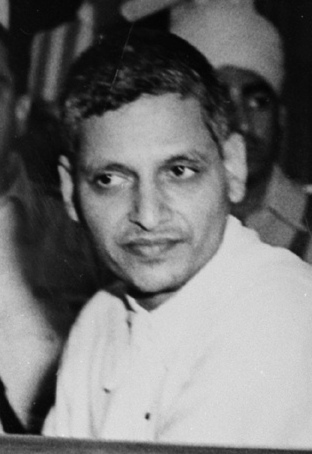
Gandhi's assassin Nathuram Godse at his trial.
The assassin, Nathuram Godse, was no lone wolf.  He was a member of the extremist Hindu Mahasabha and had several collaborators and accomplices.  And Godse’s hatred to Gandhi went far back—he was involved in the last four of five previous assassination attempts dating back to the 1930’s.  Just days before on January 20 Godse and his group had bungled an attempt at Birla House in Delhi that involved a bomb which exploded at a podium from which Gandhi was scheduled to speak.
Godse and another of the plotters Narayan Apte escaped to Godse’s native Pune via Bombay by rail.  Determined to make another attempt Godse obtained a Beretta 38 caliber semi-automatic pistol with the assistance of other members of the group.  Godse and Apte returned to Delhi on January 29 and checked into a room at the Delhi Railway Station. 
On the evening of the 30th Gandhi was walking in the garden toward Birla House to take part in a prayer meeting.  As usual he was unaccompanied by any security.  Escorting him were young women including his nieces.  At 78 years of age the Mahatma was still recovering from his fast and somewhat feeble. 
At 5:17 that evening Godse approached Gandhi and bowed.  The old leader paused to acknowledge the greeting, as was his custom.  One of the young women with him, Abha Chattopadhyay, tugged at his arm and told Godse, “Brother, Bapu is already late,” but the assassin shoved her aside, raised his pistol and pumped three shots into Gandhi’s chest at close range.
Gandhi reportedly cried out Hey Rama!—O Lord!—as he collapsed.  The phrase became a rallying cry for remembering the martyred leader in the days and weeks following his death.
Godse himself called out—“Police! Police!” and waited to be arrested.  He was ready—eager to be a martyr for his cause.  He later told investigators that he knew he would be hated for his act in the short run but that eventually his “removal of Gandhi from Indian politics” would prove such a blessing that he would be honored for his “sacrifice.”
Gandhi was taken to a hospital where he was officially pronounced dead two hours later.  In fact, he had probably died at the scene but the time allowed government and Congress Party leaders time to be informed and prepare for the public reaction that was sure to follow.
Later that evening Prime Minister Jawaharlal Nehru, one of Gandhi’s oldest and closest associate from whom he had become estranged for agreeing to form a Congress Party government on the basis of Partition, addressed the nation by radio:
Friends and comrades, the light has gone out of our lives, and there is darkness everywhere, and I do not quite know what to tell you or how to say it. Our beloved leader, Bapu as we called him, the father of the nation, is no more. Perhaps I am wrong to say that; nevertheless, we will not see him again, as we have seen him for these many years, we will not run to him for advice or seek solace from him, and that is a terrible blow, not only for me, but for millions and millions in this country.
The shocked nation went into deep mourning.  Communal violence once again broke out until the Government assured the nation that it had arrested the murderer and his associates and that they were not Muslim.  The Mahasabha and other Indian religious parties, Hindu, Muslim, and Sikh were outlawed upward of 20,000 secularist militants were taken into custody.  The Congress Party draped itself in the memory of Gandhi and built loyalty across India from the poor who had little previous allegiance to the new government.  Nehru was, for the time being, able to still calls for an invasion of Pakistan.
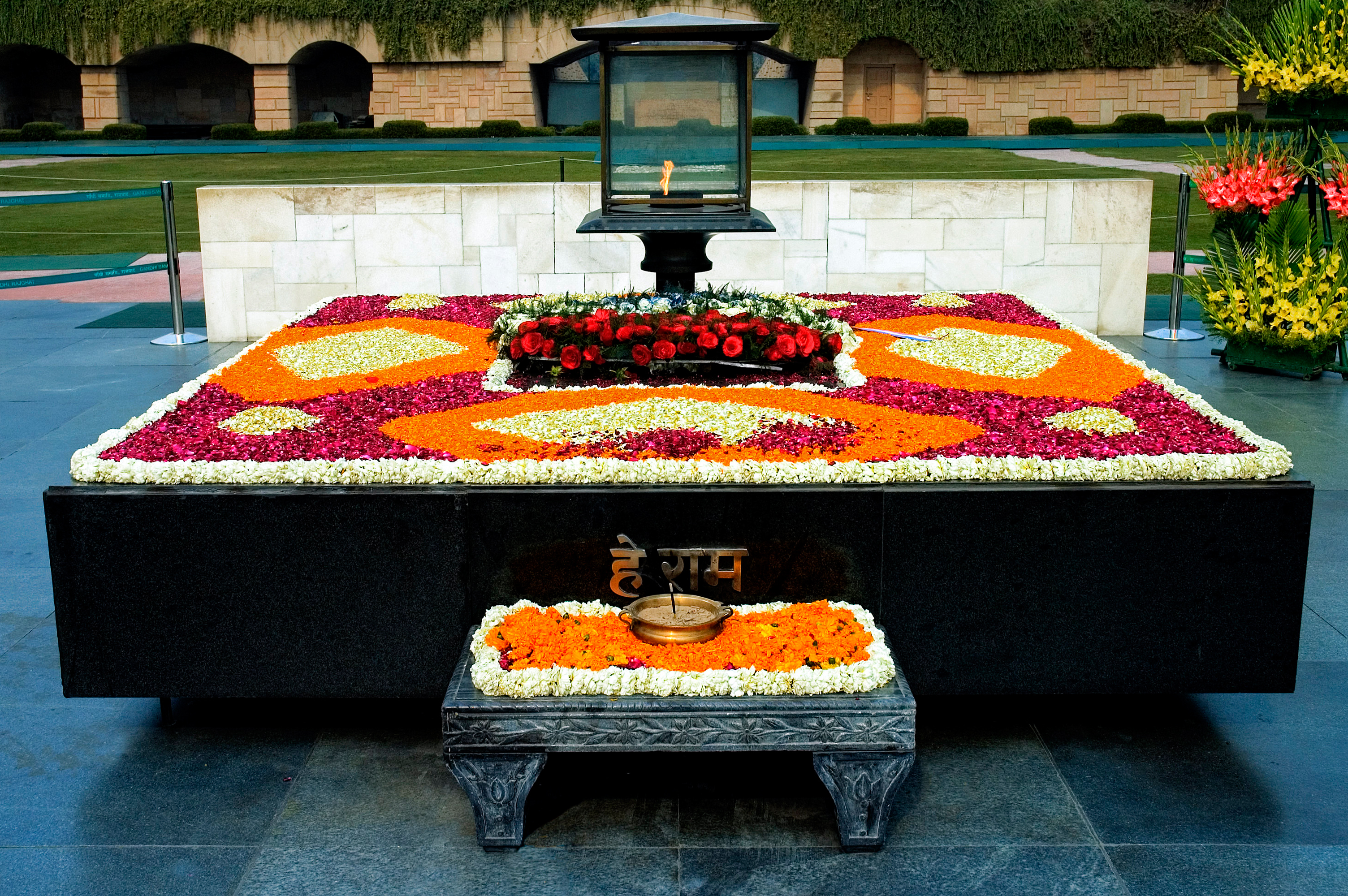

The Memorial at the Raj Ghat cremation site.

Over two million people joined the five-mile long funeral procession that took over five hours to reach Raj Ghat on the banks of the Yamuna River in Delhi from Birla House.  Gandhi’s body was elevated on platform atop an artillery caisson pulled through the streets by fifty men.  At the site overlooking the river, his body was cremated on an open pyre.  Some of the ashes were scattered immediately in the river.  The rest were divided and placed in small urn distributed across India to be scattered in local rivers and bodies of water to unite the country in participation of the final Hindu ritual.  Some of those urns were misplaced or for other reasons not immediately scattered.  Over the last 25 years or so a few have been discovered and ashes scattered at other Indian holy sites, the Headwaters of the Nile, and even near the Los Angeles Self-Realization Fellowship Lake Shrine.  The cremation site at Raj Ghat is now a national memorial and still attracts hundreds of thousands of pilgrims every year.

Godse, Apte, and six others were tried for participation in the assassination plot.  After an eight month trial all but Vinayak Damodar Savarkar, a leading political figure in the Hindu nationalist movement, were convicted on at least some charges.  Dattatraya Parchure, a medical doctor and intellectual later had his conviction overturned by the High Court of Punjab.  Godse and Apte were sentenced to death by hanging.  The remaining defendants received life in prison for conspiracy to commit murder or violating the Explosive Substances Act in connection with the January 20 failed bomb attempt.

Despite appeals by the Gandhi family and Prime Minister Nehru to spare the lives of the assassins in the spirit of Gandhi’s non-violence, Godse and Apte were hung on November 15, 1949 at Ambala Jail.


Thursday, January 29, 2015

The Mantra-Rock Dance—Hippies, Hare Krishna, and the Haight


There were a lot of threads to the youth culture being woven on the streets of San Francisco—the older, now established Beats finding new followers for their expressions of alienation, spiritual quest, and rebellion through art and poetry; a ramped-up music scene revolving around a bunch of local bands inventing a new American rock and roll sound; a quasi-anarchic radicalism spreading from the Anti-Vietnam War movement and near-by college campuses; the introduction of cheap, free, and then legal LSD and other hallucinogens plus wide spread availability of Mexican marijuana; the sexual revolution made possible by the pill; a flood of teenage runaways and throwaways living on the streets often engaging in virtual or real prostitution to survive; the large Hells Angels motor cycle club with their sometimes violent culture; and a community of spiritual seekers drawn to a range of mostly Eastern Religions and cults.
All of these threads seemed to come together on January 29, 1967 for an event at the Avalon Ballroom called The Mantra-Rock Dance.  In retrospect it is remembered as “the ultimate high” and as “the major spiritual event of the San Francisco hippie era.”  All of the threads came together for one intense, cathartic night that participants thought opened a door to a new future. 
It started simply enough as just another local benefit.  All sorts of local San Francisco organizations and causes raised money and awareness with benefit concerts held at various halls and venues, often ballrooms built to accommodate big bands.  Local rock bands had been building followings for years starting out at benefit shows.  Some had gone on to play at Bill Graham’s Fillmore West for cash money, had signed recording contracts with major labels, and were now national acts verging on super stardom.  But these same big acts remained living in the community and feeling connected to it.  Even the biggest could be lured back to a benefit show for a good cause in front of the fans that first boosted their careers.
So it was not without hope that Mukunda Goswami, the former Michael Grant and a Reed College graduate and jazz musician, decided to have a concert to raise funds and publicize the new International Society for Krishna Consciousness (ISKCON) West Coast Center and Temple in the heart of the Haight-Ashbury counter cultural community.
 
Swami Prabhupada annointing an American devotee.


A. C. Bhaktivedanta Swami Prabhupada, usually referred to as simply Prabhupada, was a guru in a school of Vaishnavite Hinduism which was one of the many strains of the traditional Indian religion and which took the Bhagavata Purana as a central scripture and veneration of the god Krishna as central.  He was pious, scholarly, and respected by Western religious scholars like Harvey Cox.  He took it as his mission to bring this traditional form of Hinduism to the West, founding ISKCON and his first temple in New York City in 1965.
Prabhupada took advantage of rising interest in Eastern religions fostered by both the Beat movement and liberal theologians.  Interest in Hinduism in this country dates back to Ralph Waldo Emerson who studied early translations of the Bhagavad Gita and adapted from it many of the more mystical aspects of his Transcendentalism including his central notion of an Over soul. 
In 1893 Swami Vivekananda created a sensation at the World Parliament of Religions held in conjunction with the Columbian Exposition in Chicago introducing yoga to this country.  His books became best sellers and the practice of yoga spread across the country, especially in enclaves of the highly educated.  Yoga was widely practiced by many of the Beats.  But it was viewed largely as a system of meditation and most religious content from Hinduism and Buddhism had been stripped away.  By the 1960s many were ready to dig deeper into the roots of meditative spiritual practices, the Hindu Vedas or holy books and ritual practices.
Prabhupada’s New York temple catered to that interest and was quickly successful.  Within two years the Swami had trained a core group of American born followers who he initiated as disciples.  From this group he selected Mukunda Das to lead a team with half a dozen others to establish the San Francisco temple in late 1966.
The group quickly attracted attention and followers with their yellow robes, shaved heads, street dancing and chanting, classes at the center, and free feeds for the community of brown rice and vegetables.   To gain more followers and to raise money to support the Temple Mukunda Das and his team quickly decided to tap into the local tradition of rock benefits and to invite Prabhupada for his first West Coast visit to participate in the event.
The idea was controversial among the Swami’s New York followers.  The movement demanded abstention from drugs and alcohol and chastity or monogamous marriage among disciples.  The San Francisco scene was already notorious for its drug and free sex life style.  Poet Allen Ginsberg, who had adopted Hare Krishna chanting in his own spiritual practice and who was friendly with Prabhupada although not an acolyte, convinced the guru that there was a spiritual hunger that he could fill.  Many, like Ginsberg himself, would adopt at least some of the practices leaving the life style restrictions to full-fledged initiates.  The Swami agreed to attend on that basis and Ginsberg signed on to introduce him in California and participate in public chanting.
With that in place Mukunda Das and his team turned to lining up talent.  Through connections they quickly signed up two of the top San Francisco bands—The Grateful Dead and Big Brother and the Holding Company with its lead singer Janis Joplin.  Both bands agreed to perform for the Musician’s Union minimum of $250.  Team  member Malati Dasi happened to hear Moby Grape, a relatively obscure band just establishing themselves, and added them to the program—which would catapult them to fame and a record deal.
The Fillmore was considered as a venue, but Bill Graham, an old school Humanist and secular Jew, was skeptical of the new group.  Instead organizers turned to the Avalon Ballroom managed by Family Dog impresario and manager of Big Brother and the Holding Company Chet Helms.  Helms was supportive, if somewhat skeptical that the event would draw a crowd.  He also agreed to provide the state of the art light show for the event.
Artist Harvey Cohen, one of the first ISKCON followers, designed a psychedelic poster in the style of Stanly Mouse which featured Prabhupada seemingly floating in a purple bubble and an invitation to “bring cushions, drums, bells, cymbals.”  The posters were soon dotting the Haight and were up at Bay Area college campuses.

More than ten days before the event on January 17 Prabhupada arrived at the San Francisco Airport and was greeted by Ginsberg and more than fifty dancing and chanting acolytes and hippies.  The Swami settled down to teaching at the temple and to giving occasional interviews.  His presence in the city helped build excitement, especially after the San Francisco Chronicle published a lengthy interview in which he was pointedly asked if all of those drug crazed hippies were welcome to his temple and he replied, “Hippies or anyone—I make no distinctions. Everyone is welcome."

Allen Ginsberg welcoms Prabhupada at the San Francisco Airport on Jaunary 17, 1975.

The week before the show, Prabhupada and the program were given an enthusiastic full page treatment in The Oracle, the city’s underground newspaper in an article headed The New Science.
Despite the growing hoopla both the organizers and Helms worried about attendance on a Sunday night.  Even in any-thing-goes San Francisco Sunday was not a usual night out.
But thousands showed up the evening of the 29th ready to plunk down the $2.50 at the door only admission.  Despite warnings about bring drugs, marihuana hung heavily in the air.  Acid guru Timothy Leary and his pal Owsley Stanley III, the manufacture of famously high quality, powerful LSD.  As was Owsley’s custom he brought hundreds of hits with him and freely distributed them.  Leary would later be up on the stage with Ginsberg and the Swami.
3000 people filled the auditorium to its capacity and hundreds waited outside.  Despite the crowding and the disappointment of those who could not get in, the mood of the night was uniformly mellow.  Prabhupada's biographer Satsvarupa Dasa Goswami later described the scene:
Almost everyone who came wore bright or unusual costumes: tribal robes, Mexican ponchos, Indian kurtas, “God’s-eyes,” feathers, and beads. Some hippies brought their own flutes, lutes, gourds, drums, rattles, horns, and guitars. The Hell’s Angels, dirty-haired, wearing jeans, boots, and denim jackets and accompanied by their women, made their entrance, carrying chains, smoking cigarettes, and displaying their regalia of German helmets, emblazoned emblems, and so on—everything but their motorcycles, which they had parked outside.
The crowd was fed Prasadsanctified food—including orange slices as Helms’s light show was projected on walls accompanied by pictures of Prabhupada and Hindu deities.  The program began with a parade of disciples chanting Hare Krishna to an Indian raga.  Moby Grape opened the music program.
Around 10 Prabhupada entered the auditorium from the rear.  “He looked like a Vedic sage, exalted and otherworldly. As he advanced towards the stage, the crowd parted and made way for him, like the surfer riding a wave. He glided onto the stage, sat down and began playing the kartals [ritual finger cymbals],” his biographer recalled. 
Ginsberg welcomed the Swami to the stage in a rambling introduction that included a recommendation that chanting was a good way to come down from LSD and “stabilize their consciousness upon reentry.”  Prabhupada gave a short speech of welcome then Ginsberg led the crowed in the Hare Krishna chant.  After several minutes Prabhupada arose and began dancing to the chant.  Others joined him on stage, including the members of all of the bands many of whom played along with their instruments.  The crowd joined in elated dancing and with their own drums and bells.
Afterward Joplin and then the Dead played on into the early morning hours.
Reactions to the event were ecstatic.  $2,000 was raise, but more importantly so was community consciousness.  Attendance at the temple swelled.  Publicity from the event helped propel Prabhupada into the national spot light and he soon embarked on long speaking tours and established many other temples.
Mukunda Das and other members of the San Francisco team were sent to London to establish a temple there and established a famous relationship with George Harrison who embraced Krishna worship for the rest of his life and not only created his own devotional music—My Sweet Lordbut produced an album of temple chanting that became a charted hit in England and Europe.

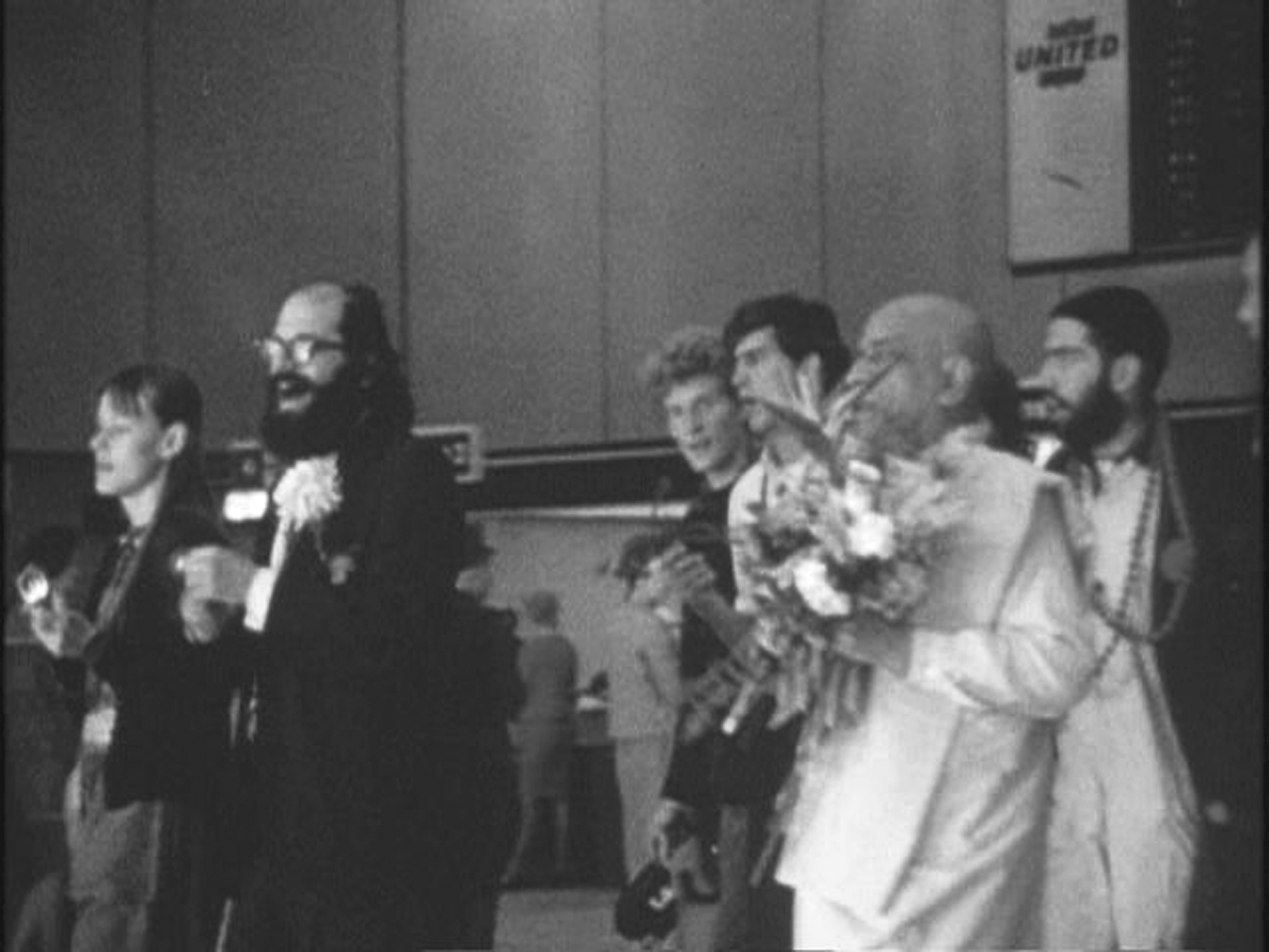
Hare Krishnas chanting and dancing in an airport.
By the early ‘70’s the Hare Krishnas, as they were popularly called, were a familiar sight on the streets of many American cities, and especially at airports where they engaged in chanting, ritual begging, and the sale of flowers.  There was also a backlash.  ISKCON was accused of operating as cult and brainwashing its young acolytes to keep the isolated at temples and rural communes or ashrams.  This took the characteristics of a social panic as parents hired so-called deprogrammers to essentially kidnap their children, hold them against their will, and subject them to intensive “therapy” that was itself a form a brainwashing all with the usual approval and acquiescence of law enforcement.
Eventually religious scholars came to the defense of the Hare Krishnas as a genuine religious movement with deep ties to traditional Indian Hinduism and the organization lowered its public profile somewhat. 
The movement grew and spread, despite the controversies.  It was also one of the few Western seeds of eastern religions that retained, and even grew significantly, a presence in its home country. 
By the time that Prabhupada died in 1977 at the age of 81 he left behind 108 temples across the globe, plus numerous farm communes, and study institutes.  His publishing house, Bhaktivedanta Book Trust was and remains the world’s largest publisher of ancient Hindu religious texts as well as modern commentaries and has translated key texts into dozen of language.   Despite internal squabbles over leadership succession that continue to this day, the movement has continued to grow and counted over 400 temples worldwide in 2012 plus many home centers serving small clusters in places remote from temples. 
As for the dreams of the San Francisco Hippies for a new beginning,  well, that is another story.