Showing posts with label Al Smith. Show all posts

Friday, March 4, 2022

Reformer Frances Perkins Stepped Up for Labor

                            Frances Perkins--Madam Secretary.

On March 4, 1932 Franklin D. Roosevelt, the day of his first inauguration, nominated Frances Perkins as Secretary of Labor.  She was the first woman elevated to cabinet rank.  If anyone was expecting a docile figurehead, they were in for a big surprise.  Not only was she a key player in the New Deal and a key backer of a wide range of labor reforms, she held down the job for twelve years through FDR’s first three terms despite efforts to unseat her.

Born into a respectable Republican and Congregationalist New England family in 1880, she was radicalized by exposure to the yawning class divide while attending Mt. Holyoke College where she read Jacob Riis’s expose of slum conditions and attended lectures by leading reformers and labor advocates, especially Florence Kelley of the National Consumer’s League.  Graduating in 1902 she tried her hand at teaching science in urban schools while volunteering at settlement houses.

                          Perkins as a student at Mt. Holyoke.

But by 1909 she was ready to give up teaching for a career in social services and advocacy.  She moved to New York City to pursue a master’s degree in economics and sociology from Columbia University then joined her mentor Florence Kelley by serving as Secretary for the New York State Consumer’s League where she successfully led lobbing efforts to get the Legislature to limit the work week for women and children to 54 hours.  She also took up active support of the Suffrage movement.

In 1911 she personally witnessed women leaping to their deaths from the upper floors of the building at the Triangle Shirtwaist Fire, an event that would steel her determination to guarantee safe working conditions.  Where she had previously relied on legislation alone, she increasingly saw the need for workers to organize in their own defense and supported the work of Ladies Garment Workers leader Rose Schneiderman and others.  She even joined the Socialist Party, though she advocated gradual reform rather than revolutionary action.

                                    The young reformer and New York civil servant.

In 1912 she supported Woodrow Wilson over Eugene V. Debs believing that the Democrat would more effectively advance labor’s cause.  She was wrong, but in the long run was one of the people most responsible for seeing that the planks of the 1912 Socialist platform were finally enacted under another Democrat.

She briefly retired from public life to marry economist Paul Wilson and to give birth to a daughter.  But Wilson suffered a breakdown and Perkins returned to work as the family breadwinner.

In 1919 she joined the administration of New York Governor Al Smith as the first woman on the state Industrial Commission.  By 1926 she was Chair of the Commission.  In 1929 Governor Roosevelt appointed her to head the state Labor Department.  She pushed through another round of reduction of hours for women and children to 48, stepped up factory safety inspection, and lobbied for minimum wage and unemployment insurance laws.

Roosevelt took her with him to Washington.  As Labor Secretary she helped craft and get the Wagner Act through Congress, which finally guaranteed workers the right to organize into labor unions on the job and engage in collective bargaining.

Perkins, one of the chief architects, witnessed FDR sign the Social Security Act into law.

The Fair Labor Standards Act embodied her long cherished dreams for a minimum wage and a standard 40 hour work week for women and men.  She chaired the administration’s Committee on Economic Security which drafted the legislation embodied in the Social Security Act of 1935.

As the labor battles for representation in the basic industries intensified through the Depression, Perkins stood relentlessly on the side of working people to organize and resisted traditional calls to use Federal force and troops to suppress strikes.  She held firm against intervention in the 1934 San Francisco General Strike.

Conservatives and business interests put her in their cross hairs and in 1939 the House Un-American Activities Committee drew up a bill of impeachment against her for refusing to deport Harry Bridges, the Australian born West Coast Longshoremen’s leader who had been a key figure in the General Strike.  The impeachment attempt fizzled from lack of evidence and Perkins continued to serve until 1945 when she resigned to head the U.S. delegation to the International Labor Organization (ILO) conference in Paris.

                                              The Secretary of Labor on a coal mine safety inspection.

She concluded her public service when President Harry Truman appointed her to the Civil Service Commission.  With the return of Republicans to power in 1953 she took a professorship at Cornel University’s School of Industrial and Labor Relations.

Perkins died at age 85 in her beloved New York City in 1965.

Although revered by labor and feminists Perkins remains a reviled figure on the right.  In 2011 hyper reactionary Maine Governor Paul LePage tried to have a labor mural featuring Frances Perkins (center panel) from the State Department of Labor because it is too pro-labor and offended some business owners.

The Labor Department Building war re-named for Perkins on April 10, 1980—the 100th anniversary of her birth with President Jimmy Carter presiding over the ceremony.  On the same day the Postal Service issued a new 15-cent stamp bearing her likeness


Monday, March 4, 2019

Frances Perkins Stepped Up for Labor

Frances Perkins--Madam Secretary.

On March 4, 1932 Franklin D. Roosevelt, the day of his first inauguration, nominated Frances Perkins as Secretary of Labor.  She was the first woman elevated to cabinet rank.  If anyone was expecting a docile figurehead, they were in for a big surprise.  Not only was she a key player in the New Deal and a key backer of a wide range of labor reforms, she held down the job for twelve years through FDR’s first three terms despite efforts to unseat her.
Born into a respectable Republican and Congregationalist New England family in 1880, she was radicalized by exposure to the yawning class divide while attending Mt. Holyoke College where she read Jacob Riis’s expose of slum conditions and attended lectures by leading reformers and labor advocates, especially Florence Kelley of the National Consumer’s League.  Graduating in 1902 she tried her hand at teaching science in urban schools while volunteering at settlement houses.

As a student at Mt.Holyoke.
But by 1909 she was ready to give up teaching for a career in social services and advocacy.  She moved to New York City to pursue a master’s degree in economics and sociology from Columbia University then joined her mentor Florence Kelley by serving as Secretary for the New York State Consumer’s League where she successfully lead lobbing efforts to get the Legislature to limit the work week for women and children to 54 hours.  She also took up active support of the Suffrage movement.
In 1911 she personally witnessed women leaping to their deaths from the upper floors of the building at the Triangle Shirtwaist Fire, an event that would steel her determination to guarantee safe working conditions.  Where she had previously relied on legislation alone, she increasingly saw the need for workers to organize in their own defense and supported the work of Ladies Garment Workers leader Rose Schneiderman and others.  She even joined the Socialist Party, though she advocated gradual reform rather than revolutionary action

The young reformer and New York civil servant.
In 1912 she supported Woodrow Wilson over Eugene V. Debs believing that the Democrat would more effectively advance labor’s cause.  She was wrong, but in the long run was one of the people most responsible for seeing that the planks of the 1912 Socialist platform were finally enacted under another Democrat.
 She briefly retired from public life to marry economist Paul Wilson and to give birth to a daughter.  But Wilson suffered a breakdown and Perkins returned to work as the family breadwinner.
In 1919 she joined the administration of New York Governor Al Smith as the first woman on the state Industrial Commission.  By 1926 she was Chair of the Commission.  In 1929 Governor Roosevelt appointed her to head the state Labor Department.  She pushed through another round of reduction of hours for women and children to 48, stepped up factory safety inspection, and lobbied for minimum wage and unemployment insurance laws.
Roosevelt took her with him to Washington.  As Labor Secretary she helped craft and get the Wagner Act through Congress, which finally guaranteed workers the right to organize into labor unions on the job and engage in collective bargaining

Perkins, one of the chief architechs, witnesses FDR sign the Social Security Act into law
The Fair Labor Standards Act embodied her long cherished dreams for a minimum wage and a standard 40 hour work week for women and men.  She chaired the administration’s Committee on Economic Security which drafted the legislation embodied in the Social Security Act of 1935.
As the labor battles for representation in the basic industries intensified through the Depression, Perkins stood relentlessly on the side of working people to organize and resisted traditional calls to use Federal force and troops to suppress strikes.  She held firm against intervention in the 1934 San Francisco General Strike
Conservatives and business interests put her in their cross hairs and in 1939 the House Un-American Activities Committee drew up a bill of impeachment against her for refusing to deport Harry Bridges, the Australian born West Coast Longshoremen’s leader who had been a key figure in the General Strike.  The impeachment attempt fizzled from lack of evidence and Perkins continued to serve until 1945 when she resigned to head the U.S. delegation to the International Labor Organization (ILO) conference in Paris.

The Secretary of Labor on a coal mine safety inspection.
She concluded her public service when President Harry Truman appointed her to the Civil Service Commission.  With the return of Republicans to power in 1953 she took a professorship at Cornel University’s School of Industrial and Labor Relations.
Perkins died at age 85 in her beloved New York City in 1965.

Although revered by labor and feminists Perkins remains a reviled figure on the right.  In 2011 hyper reactionary Maine Governor Paul LePage tried to have a labor mural featuring Frances Perkins (center panel) from the State Department of Labor because it is too pro-labor and has offended some business owners.
The Labor Department Building war re-named for Perkins on April 10, 1980—the 100th anniversary of her birth with President Jimmy Carter presiding over the ceremony.  On the same day the Postal Service issued a new 15-cent stamp bearing her likeness

Thursday, May 12, 2016

The Society of St. Tammany and New York City

The first Wigwam of the Society of St. Tammany in New York City.


On May 12 1789 the Society of St. Tammany was founded largely by Revolutionary War veterans in New York City.  It was actually a branch of a network of clubs founded originally in Philadelphia.  But while the other lodges withered and disappeared within a generation, Tammany in New York grew, adapted, thrived, and became a political power house. 
The Society took its name from a Tamanend, a chief of the Lanape tribe—also known as the Delaware—who made peace with the Quaker founders of Pennsylvania.  The Society’s ritual, pass words, and ceremonial costumes aped Native American.  The leader was called the Grand Sachem and its meeting place was the Wigwam.  

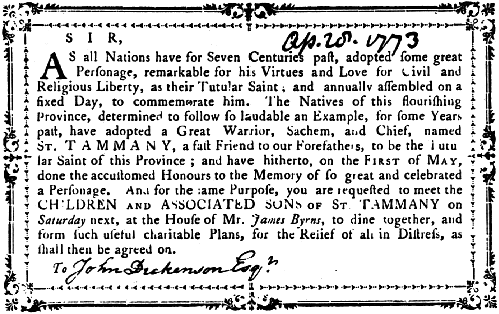
An invitation sent to Founding Father John Dickinson to join the Mother Lodge of the Society of St. Tammany in Philadelphia.  Unlike the lodge founded later in New York, many of the most important citizens of Philadelphia including Benjamin Franklin, the merchant/money lender Biddle Brothers,  James Hamilton, Thomas Mifflin, and Dr. Benjamin Rush, who all would make history.
The New York Society was dominated by tradesmen and mechanics and who were drawn to support of the emerging Jeffersonian party.  Whereas New Yorker Alexander Hamilton organized a powerful Federalist presence in the city based around the elite Order of Cincinnatus composed of Revolutionary War officers and the city’s wealthy merchants and professionals, the lower class Tammany members tended to overlap in membership with the Democratic Societies.  By 1800 a parallel political organization, separate from, but sharing membership and meeting space with the fraternal order, was established.  Crafty politician Aaron Burr, not a member of the Society himself, gathered the political branch into a potent force, complete with organization down to the ward level.  He crushed the Federalists in the City while the aristocratic Clinton family carried much of the Hudson Valley delivering the state’s Electoral College votes, and thus the Presidential Election to the Democratic-Republican ticket of Jefferson and Burr.  In the process he nearly became President himself, but that is a story for another entry. 
Tammany erected their first building at Nassau and Frankfort Streets.  It was officially name the Wigwam, but it was soon known by all as Tammany Hall as was the political operation.  By 1829 Tammany was the official body of the Democratic Party in the city.  During this period many Tammany leaders were also Free Masons, another source of power. Until immigrants—mostly Irish and Catholic—began pouring into the city in unprecedented numbers in the 1840’s Tammany was largely Protestant and nativist.  It actually opposed the first efforts of the Irish to enter into politics.  But shrewd Tammany Sachems, beginning with Fernando Wood, soon saw the writing on the wall and eventually welcomed the Irish and incorporated their considerable political skills.  
Fernando Wood was the first Sachem to begin to reach out to immigrants.  He became the first Tammany Mayor and during the Civil War was a pro-Confederate and painful thorn in the side of Abraham Linoln.


Tammany Hall secured the loyalty of largely poverty stricken new immigrants by providing charity and relief at a time when none was forthcoming from the government.  They also provided a social network in the new country and helped educate immigrants in the language and culture of their new nation.  Through an ever widening patronage system they provided jobs.  And finally Tammany organized special teams to expedite citizenship for the immigrants, sometimes by outright bribery of officials, which got the grateful newcomers quickly onto the voting rolls.  It was a winning proposition developed to perfection by William “Boss” Tweed, himself a former nativist, who became Sachem in 1856. 
By that time the Hall had already elected Fernando Woods its first Mayor.  Tweed and his associates used their power to establish the infamous Graft Ring that stole the City, State, and Federal governments blind for the next twenty years. 
After the Civil War Boss Tweed and Tammany Hall became the arch enemy of a parade of reformers—and of the Republican Party who used their tarnished image against Democrats nationally.  Cartoonist Thomas Nast created the Tammany Tiger as a symbol for Democrats and relentlessly lampooned Tweed and his cronies.  
This Thomas Nast cartoon of the Tweed Ring--Boss Tweed is the fat man--has become a staple of American history text books and shaped most of our images of Tammany Hall.

Reform Democrats led by Governor Samuel Tilden, who had national ambitions, realized that Democrats could never retake Federal power as long as Tweed poisoned the atmosphere.  They forced him out as Sachem in 1872 and shortly after he was sent to prison on bribery charges. 
With Tweed and the worst of his cronies gone, John Kelly finally led the Irish to control of Tammany Hall themselves, leading to its period of greatest power.  For the next sixty years they were the undisputed masters of the Democratic Party in the City and produced every party candidate for mayor.  Their power extended to the state level as well.  Although reform candidates could sometimes win an election after a particularly egregious outbreak of scandal, over all Tammany rolled on undisturbed. 
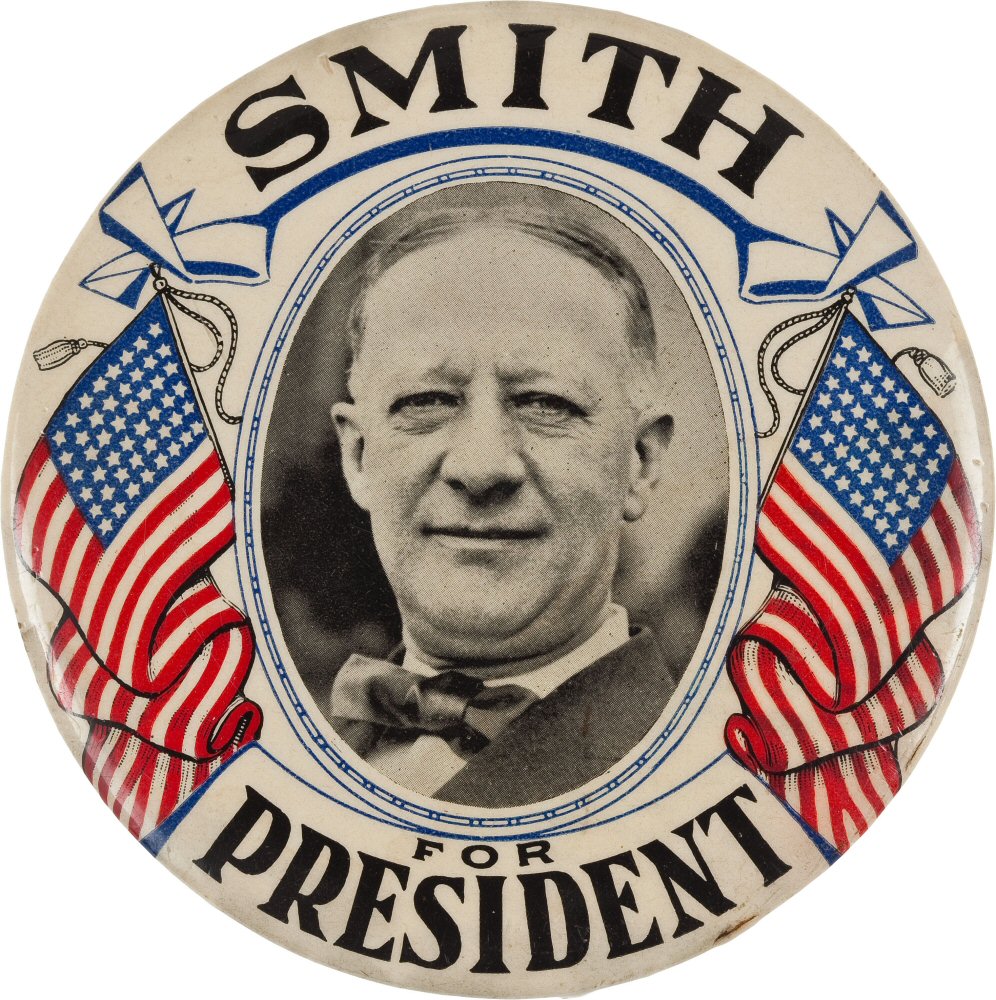
The Hall reached it greatest heights with the election of Alfred E. Smith as governor and James J. Walker, Gentleman Jimmy, as mayor in the 1920’s.  They even had enough muscle to elevate the Happy Warrior to the Democratic Presidential nomination in 1928—the first Catholic to be nominated by a major party.  But the downfall of Walker on corruption charges and Smith’s estrangement from reform Democratic Governor Franklin D. Roosevelt was a blow to their power.  

The election of Catholic Al Smith as Governor and securing the Democratic Party nomination for President in 1928 represented the apex of power for Tammany Hall.
When elected president F.D.R. stripped the Hall of its substantial Federal patronage.  Then he supported the election of reformer Fiorello La Guardia on a fusion ticket striping City patronage as well.  It was a crippling blow. 
After World War II Tammany Hall rallied for a comeback under the decidedly non-Irish leadership of Carmine DeSapio.  He rebuilt Tammany and modernized it.  He beat an incumbent Italian-American mayor, Vincent R. Impellitteri with Robert F. Wagner in 1953 and the next year put W. Averell Harriman in the Governor’s seat.  In the process he earned the eternal enmity of Eleanor Roosevelt for derailing the political career of her son Franklin D. Roosevelt, Jr.  She worked for years to undermine DeSapio and Tammany in every way possible.  
 
Carmine de Sapio, the last Tammany Boss used Wasp fronts like Averell Harriman and Robert Wagoner (who converted to Catholicism) as good government fronts for Tammany buisness as usual.  When they turned against him and the Hall, it doomed the organization's power.
With another round of scandals brewing, Wagoner abandoned Tammany for his second re-election bid and trounced the mope the Hall put up against him.  There would never again be another Tammany mayor.  By 1961 DeSapio was out as leader and would be indicted and jailed on corruption charges later. 
When Ed Koch’s Village Independent Democrats seized the Manhattan Party apparatus from the shell of Tammany it was all over.  By the end of the decade Tammany Hall was extinct.  

The last Wigwam today.
Its last building on Union Square still stands and houses the New York Film Society.