Showing posts with label Bill Murray. Show all posts

Thursday, February 2, 2023

Déjà vu All Over Again—Ground Hog Day Cult Classic Film at 30

Despite bone chilling sub-zero temperatures in 2019 thousands showed up for Woodstock Willie's prognostication. 

Note—Local Groundhog Day hoopla is scheduled for 7 am on Woodstock Square.  Word has it our local prognosticator Woodstock Willy will see his shadow in bright sunlight boding six more weeks of winter--which we were going to get anyway.  But to prove the point temps are expected to plunge Friday to a high of only 10 degrees.

Bill Murray in Groundhog Day.

I used to work in Woodstock.  It’s a country town, the government center for suburban/rural McHenry County.  The 19th Century Square, replete with Civil War Monument and gazebo, seems sometimes to rise like Brigadoon or Avalon from the mists of a forgotten time.

The venerable Opera House dominates one side of the Square.  On another side sits a large red brick building with a restored copper dome, the former McHenry County Courthouse built in 1854 and the Jail and Sheriff’s House next to it.  

Historic public buildings, churches, and graceful old homes on tree-lined streets radiate out from the Square.  Three blocks away as the crow flies the Peter Nestor House, built in 1900, sits halfway up Madison Street. I worked there in an office in the basement of my employer’s home.

At the far end of the street, on a small hill and facing all of us on the block when we walked out the front door and looked up the road, looms the manor house of our neighborhood, a large imposing Victorian mansion.

You may have seen it before.

A private residence when used as a Bed and Breakfast in the movie, this old home has since become one--The Cherry Street Inn.

This mansion played the role of a bed and breakfast in the classic Bill Murray comedy Groundhog Day.   In the movie, the Square was dubbed Gobbler’s Knob, the name of the site in Pennsylvania where a Groundhog is pulled from his sleepy den every February 2 to prognosticate whether or not spring was coming. 

Most movie comedies sink below the surface of memory without leaving a ripple.  But since its release this film has resonated with audiences in a way that is reminiscent of the James Stewart/Frank Capra classic It’s a Wonderful Life—with which it shares important themes.

However, unlike James Stewart’s likable character, Bill Murray begins the film as a repellant jerk.  An arrogant Pittsburgh TV weatherman, Murray has been assigned to cover the Punxsutawney festivities.  He is surly to his camera man, Chris Elliot, insulting to his lovely and generous producer, Andie MacDowell, condescending and disdainful to the local Punxsutawney yokels, and their ridiculous pageant.

While Stewart learned to value the person he actually was, Murray in Groundhog Day learns how to change the world for the better—but only after he becomes someone other than the vain, shallow human being we first see in this film.

After being forced to stay in Punxsutawney by a blizzard, Murray wakes up in that Victorian bed and breakfast—the one at the end of the block—only to find that his bedside clock/calendar tells him that he has awakened once again on the morning of February 2. Then the film shows us that day repeated, and then again repeated, as day after day he wakes up again on February 2.  He is caught somehow in a closed loop of time.  The movie shows snippets from dozens of these February 2s, but makes clear that he experienced hundreds, perhaps thousands of them.

After being astonished to discover that is his life is an apparently endless series of empty, identical experiences, Murray goes through the stages of grief over the meaningless of his existence—denial, anger, bargaining, depression, and finally, acceptance.  He tries to escape by repeated, ever more creative attempts at suicide, always to re-awaken in the same bed to the same song on the clock radio.

Guess what day it is...

When he finally comes to acceptance, he learns something remarkable.

He learns that he is actually able to change how this otherwise repetitious day unfolds—by how he himself behaves.  He discovers he can change the outcomes of lives around him.  For instance, every day when the moment comes when a certain child is to fall out of the tree, hit the ground, and break his arm, he arranges to be there, under the tree where he can catch the child.  He uncharacteristically acts kindly to a sick and dying homeless man.  He creates an engaging conversation with an otherwise annoying insurance salesman who—as his previously repetitive experiences had taught him—will accost him every morning on a certain street corner.

He also learns he can improve himself.  He becomes a piano virtuoso by showing up each day and presenting himself as a new student to a piano teacher.  Each day having mastered what she is unaware she that has taught him, he presents himself anew and learns from there.

At first the object of this self-improvement is largely to win over and seduce his lovely producer.   And each day he makes progress with her.  As he comes to know her, his feelings turn to something like real affection and love.  But he’s not through learning yet.  Each day at some point his old, habitually self-centered arrogance rises and puts the kibosh on their blooming relationship.

Yet he really is changing.  Eventually the whole town comes to adore him for the many kindnesses this one-day visitor bestows on them, not just for his wit, his talent and his fame.

And each day we see an implicit love affair that had previously been stymied become something possible. We see it in Andie McDowell’s eyes which—when in his presence—shine a little brighter a little longer.

True love cannot blossom until Bill Murray painfully changes himself and finally puts Andie McDowell's needs before his own.

But this love relationship cannot break through until that day arises when, in a simple act of complete unselfishness, Bill puts Andie entirely ahead of his own needs and wants.  We are then shown a scene in which she comes to his bed at the inn, and they awake in each other’s arms when the clock/calendar awakens them to February 3. We know that he and she may have an unfolding future together that would not have been possible for him prior to his awakening.

So, Groundhog Day becomes the metaphor, not of some automatic seasonal rebirth experience, something that appropriately takes place in the spring, but rather of a breakthrough in taking responsibility now. By taking an action that anyone can take when one chooses freshly—an action that is not a mere repetition of the past, not the result of some long-established habit—Murray, you, or I, can cause a future that otherwise would not be.  And we can take such an action anytime—

Even in the dead of winter.  Even in the dead of winter.

Groundhog Day is featured prominently in a Welcome to Woodstock Mural which also celebrates Orson Wells, Opera House stars, and Dick Tracy creator Chester Gould.


Sunday, February 2, 2020

Déjà vu All Over Again—Ground Hog Day Cult Classic Film

Bill Murray in Woodstock again.  This time the snow was real.  An unusually mild winter in 1992 forced fill crews to use fake snow for the filming of Groundhog Day.
Bill Murray created quite a stir in these parts when he showed up in Woodstock, Illinois last week to film a Jeep commercial on the Square.  I believe it was the first time he has been back since filming wrapped on Groundhog Day in 1992.  Also on hand were his brother Brian Doyle Murray who played the Mayor of Punxsutawney, Pennsylvania and Stephen Tobolowsky who played effusive insurance agent Ned Ryerson and who has regularly returned to town of annual Groundhog Day festivities.  Murray, older, heavier, and greyer was even wearing the same dark overcoat he wore in the film.
Jeep has been exceptionally coy about the commercial and when it will air.  But if you think that they went to the huge expense to hire a movie star and get authentic props like Murray’s TV news van to run randomly during some Thursday night sit-com you are not very bright.  Yesterday the company released a 15 second tease.  Since today is both Groundhog Day, the folk celebration, and Supper Bowl Sunday you can bet your bippy that you will be able to see it during the Big Game along with all of the other hugely hyped spots.
The enormous success of the movie and the fond memories of the hundreds of locals who were featured as extras and in small speaking spots in the film or who rubbed shoulders with the cast over the two months or so of location shooting led to the creation of a Groundhog Day event recreating the revelation of the rodent dubbed Woodstock Willie.  It was such a success that it became an annual event now in its 26th year and stretching out over three or four days.  It attracts dead-of-winter tourists and gives the locals a chance to party hearty.  In addition to the official prognostication at precisely 7:07 this morning, events include free showing of the film at the Woodstock Theater, storytelling, a dinner-dance at the Moose Lodge, a chili cook-off, pub crawl, tours of the Old Court House and Woodstock Opera House (both featured in the film), a walking tour of shot locations which are now marked by brass plaques, and a “Drink to World Peace” at the bar in the Woodstock Public House.  Visit the schedule of events on the Real Woodstock web page for details.

Groundhog Day is featured prominently in the Welcome to Woodstock Mural which also celebrates Orson Wells, Opera House stars, and Dick Tracy creator Chester Gould.
The city also commemorates the film as part of the Welcome to Woodstock mural on a wall next to the Woodstock Theater.
Despite bone chilling sub-zero temperatures last year thousands showed up for Woodstock Willie's prognostication. 

In contrast to the 25th anniversary unveiling last year when Woodstock was in the grips of an extended string of sub-zero days, the TV weather people tell us that the city can expect to see the sun for the first time in ten days and that temperatures could near 50 degrees by afternoon. We shall see.
A few years ago I mused about the movie and it meaning in a blog post essay I have updated.

Bill Murray in Groundhog Day.
I used to work Woodstock.  It’s a country town, the government center for suburban/rural McHenry County.  The 19th Century Square, replete with Civil War Monument and gazebo, seems sometimes to rise like Brigadoon or Avalon from the mists of a forgotten time.

The venerable Opera House dominates one side of the Square.  On another side sits a large red brick building with a restored copper dome, the former McHenry County Courthouse built in 1854 and the Jail and Sheriff’s House next to it.  

Historic public buildings, churches, and graceful old homes on tree-lined streets radiate out from the Square.  Three blocks away as the crow flies the Peter Nestor House, built in 1900, sits halfway up Madison Street. I worked there in an office in the basement of my employer’s home.

At the far end of the street, on a small hill and facing all of us on the block when we walked out the front door and looked up the road, looms the manor house of our neighborhood, a large imposing Victorian mansion.

You may have seen it before.

A private residence when used as a Bed and Breakfast in the movie, this old home has since become one--The Cherry Street Inn.
This mansion played the role of a bed and breakfast in the classic Bill Murray comedy Groundhog Day.   In the movie, the Square was dubbed Gobbler’s Knob, the name of the site in the Pennsylvania town where a Groundhog is pulled from his sleepy den every February 2 to prognosticate whether or not spring was coming. 

Most movie comedies sink below the surface of memory without leaving a ripple.  But since its release this film has resonated with audiences in a way that is reminiscent of the James Stewart/Frank Capra classic It’s a Wonderful Life—with which it shares important themes.

However, unlike James Stewart’s likable character, Bill Murray begins the film as a repellant jerk.  An arrogant Pittsburgh TV weatherman, Murray has been assigned to cover the Punxsutawney festivities.  He is surly to his camera man, Chris Elliot, insulting to his lovely and generous producer, Andie MacDowell, condescending and disdainful to the local Punxsutawney yokels, and their ridiculous pageant.

While Stewart learned to value the person he actually was, Murray in Groundhog Day learns how to change the world for the better—but only after he becomes someone other than the vain, shallow human being we first see in this film.

After being forced to stay in Punxsutawney by a blizzard, Murray wakes up in that Victorian bed and breakfast—the one at the end of the block—only to find that his bedside clock/calendar tells him that he has awakened once again on the morning of February 2. Then the film shows us that day repeated, and then again repeated, as day after day he wakes up again on February 2.  He is caught somehow in a closed loop of time.  The movie shows snippets from dozens of these February 2s, but makes clear that he experienced hundreds, perhaps thousands of them.

After being astonished to discover that is his life is an apparently endless series of empty, identical experiences, Murray goes through the stages of grief over the meaningless of his existence—denial, anger, bargaining, depression, and finally, acceptance.  He tries to escape by repeated, ever more creative attempts at suicide, always to re-awaken in the same bed to the same song on the clock radio.

Guess what day it is...
When he finally comes to acceptance, he learns something remarkable.

He learns that he is actually able to change how this otherwise repetitious day unfolds—by how he himself behaves.  He discovers he can change the outcomes of lives around him.  For instance, every day when the moment comes when a certain child is to fall out of the tree, hit the ground and break his arm, he arranges to be there, under the tree where he can catch the child.  He uncharacteristically acts kindly to a sick and dying homeless man.  He creates an engaging conversation with an otherwise annoying insurance salesman who—as his previously repetitive experiences had taught him—will accost him every morning on a certain street corner.

He also learns he can improve himself.  He becomes a piano virtuoso by showing up each day and presenting himself as a new student to a piano teacher.  Each day having mastered what she is unaware she that has taught him, he presents himself anew and learns from there.

At first the object of this self-improvement is largely to win over and seduce his lovely producer.   And each day he makes progress with her.  As he comes to know her, his feelings turn to something like real affection and love.  But he’s not through learning yet.  Each day at some point his old, habitual, self-centered arrogance rises and puts the kibosh on their blooming relationship.

Yet he really is changing.  Eventually the whole town comes to adore him for the many kindnesses this one-day visitor bestows on them, not just for his wit, his talent and his fame.

And each day we see an implicit love affair that had previously been stymied become something possible. We see it in Andie McDowell’s eyes which—when in his presence—shine a little brighter a little longer.

True love cannot blossom until Bill Murray painfully changes himself and finally puts Andie McDowell's needs before his own.
But this love relationship cannot break through until that day arises when, in a simple act of complete unselfishness, Bill puts Andie entirely ahead of his own needs and wants.  We are then shown a scene in which she comes to his bed at the inn and they awake in each other’s arms when the clock/calendar awakens them to February 3. We know that he and she may have an unfolding future together that would not have been possible for him prior to his awakening.

So Groundhog Day becomes the metaphor, not of some automatic seasonal rebirth experience, something that appropriately takes place in the spring, but rather of a breakthrough in taking responsibility now. By taking an action that anyone can take when one chooses freshly—an action that is not a mere repetition of the past, not the result of some long-established habit—Murray, you, or I, can cause a future that otherwise would not be.  And we can take such an action anytime—

Even in the dead of winter.  Even in the dead of winter.


Thursday, February 2, 2017

All Things Groundhog


Tom Skilling, the WGN TV weather maven and something of a local folk hero really, really hates Groundhog Day.  Old Chicagoans now tune in just to see if his head really does explode this year, which annually seems more likely as he has grown fatter year by year.  Sadly for him, it is a losing battle.  Instead of withering under scientific scorn and the weight of irrefutable evidence, Groundhog Day continues to grow in popularity and spread every year.  From an obscure folk custom observed by a handful of German immigrants and their decedents in isolate pockets of Pennsylvania in the late 18th and 19th Centuries it has spread nationwide.  Now that Trump is in the White House plump rodent stands a good chance of being appointed head of the National Weather Service.
In 2015 Wikipedia identified no fewer than 38 woodchucks dragged from their winter hibernation and exposed to the sky across the U.S. and Canada.  Come hell or high water virtually every news broadcast in North America today, including Skillings’s own WGN, will feature stories about one or more of the creatures and whether he—almost always identified as a male but most frequently a she—will see his shadow supposedly signifying six more weeks of winter weather.
These local observations got big boost with the release of the movie Groundhog Day starring Bill Murray and Andie MacDowell in 1992.  The film has become a beloved classic with a cult following often compared to Frank Capra’s It’s A Wonderful Life.  It was filmed in my neck of the woods, as another TV weatherman used to say, in Woodstock, Illinois.  Just after 7 am Woodstock Willie will make his grumpy appearance from the Gazebo as he has every year since the film came out.  The city has stretched the celebration into a week-long festival in hopes of luring pilgrims and tourists.  It works.  The Woodstock ritual is now the second-most famous celebration in the country behind the original at Punxsutawney, Pennsylvania, which the McHenry County town portrayed in the film.

The film Groundhog Day was filmed in Woodstock, Illinois and hyped interest in the pseudo holiday.

This year after a nearly snowless January, it is supposed to be a tad colder with temperatures struggling to get above freezing and the sun playing tag with scattered clouds. Call it a coin toss whether Willie will see his shadow when he is yanked from his nap.  
Part of the spreading appeal of the celebrations is because they are a welcome, if silly, relief from the dreary tedium of the depths of the winter, long after the razzmatazz of the Holidays have past when everyone in cold climes are sick to death of snow, ice, howling winds, and leaden skies.  But a philosopher might speculate that the surging popularity of Groundhog Days mirrors the growing anti-intellectualism of modern America and the spreading animus to science now officially embraced by a major political party and reflected in rejection of evolution, denial of climate change, anti-vaccine hokum, and a general rejection of rationality.  Or maybe that would be reading too much into a harmless custom.
So how did all of this come to pass?  Some claim religious roots stretching back to Neolithic Europe.  The growing neo-pagan movement is explicit in laying claim to it, but Catholics have their own customs which may, or may not have been cribbed from older traditions.
Groundhog Day has been traced to pre-Christian Northern European folk traditions stretching back in the mists of time.  It is notoriously difficult to pin down precise origins of such oral traditions or to know the complete religious significance of them.  Tales about a beast—usually envisioned as a bear or a badger that had powers to predict or control the weather seem to have originated in Norse and/or Germanic tribal societies and spread by diffusion or osmosis to other European peoples including the Slavs to the east and the Celts to the south and west.  The celebration of the animal was tied to the half-way point between Winter Solstice—Yule—and the Spring Equinox.  
Although most of the animal and weather lore that leads directly to Groundhog Day are of Northern European origins, modern Wiccans and neo-pagans have identified it with the Celtic festival of Imbolc one of the four seasonal quarter festivals along with Beltane (Spring/Easter), Lughnasadh (Mid-Summer) and Samhain (Fall/Halloween) that fall between the solstices and equinoxes.  Traditionally it was a festival marking the first glimmers of spring while still in the grip of the cold and dark of winter.  As such it was distantly related to transition predicted by the Norse totem animal, but had no known direct corresponding myth.
Instead it celebrated the goddess Brigid patroness of poetry, healing, smith crafts, midwifery, and all arts of hand.  In some stories her feast on February 1 celebrated her recovery after giving birth to the God—the Green Man—who will come into his own and rule from Lughnasadh to winter.  

Wiccans and other neo-pagans identify Groundhog day with the Celtic seasonal celebration of Imbolic and the goddess Brigid.


In Ireland with the coming of Christianity the Goddess and her festival became identified with St. Brigid of Kildare, along with Patrick and Brendon one of the three Patron Saints of the country.  Now thought to be apocryphal, St. Brigid in lore was first recorded in the 7th Century and expanded upon by later monks and scribes.  She was described as the daughter of a Pict slave woman converted by Patrick himself. Born in 451 in Faughart, County Louth  she became a holy woman, nun, and abbess who founded a monastery on the site of an ancient temple to the Goddess Brigid in Kildare.  She assumed many of the pagan goddess’s attributes and performed many miracles.  Stories about the Goddess and the Nun are so intertwined that it is impossible to figure out if the holy woman was real or an invention of the Church intended to comfort converts with familiar and beloved tradition.
Today the best known tradition associated with the Feast of St. Brigid is the making of the off-center straw crosses from last season’s straw that are hung as talismans in Irish homes through Lent until Easter.
Almost all of the original traditions associated with the Goddess Brigid and Imbolc had been eradicated or simply faded away by the 18th Century even in Gaelic speaking regions.  In the 20th Century Wiccans and other neo-pagans have attempted to revive the old Celtic traditions and in the process invented rituals and lore to fill in the lost gaps.  Many believe the Quarter Festivals and old Gods and Goddesses are accessible spiritual metaphors for worship of the natural world and the timeless rhythm of the seasons.

Which came first?  The straw Cross of St. Brigid has been interpreted as representative of the quarter festival and cardinal directions by Wiccans.
That included borrowing from St. Brigid, as well.  Her straw crosses are now described as not Christian at all but as ancient symbols representing the Four Quarter Festivals and the Four Cardinal Directions.  There is no way to prove or disprove that assertion.
The Rev. Catharine Clarenbach, a Unitarian Universalist minister explained how modern practitioners view Imbolc in an entry on Nature’s Path, a U.U. pagan experience and earth centered blog hosted by the religious site Patheos.  She called it “a light not heat holiday” in which the slowly lengthening days and first tenuous hints at Spring-to-come give hope to those trudging through the hard days. “When people are desperately ill, hope can fuel the long slog toward wholeness and healing, even if that healing is not a cure.”
That certainly ennobles the day beyond the giddy fantasy of groundhog magic.
But our trail to modern Groundhog Day does not end with the re-invention of Imbolc.  Indeed other than sharing a date, the two celebrations have little in common.
Over in England and Scotland a different Christian tradition evolved—Candlemas observed on February 1, the eve of St. Brigid’s Day and often confused as British equivalent.  But Candlemas has very early 4th Century Christmas roots as The Feast of the Presentation celebrated by early Church patriarchs including Methodius of Patara, Cyril of Jerusalem, Gregory the Theologian, Amphilochius of Iconium, Gregory of Nyssa, and John Chrysostom.  It celebrated the presentation of Jesus at the Temple in Jerusalem as an infant.  
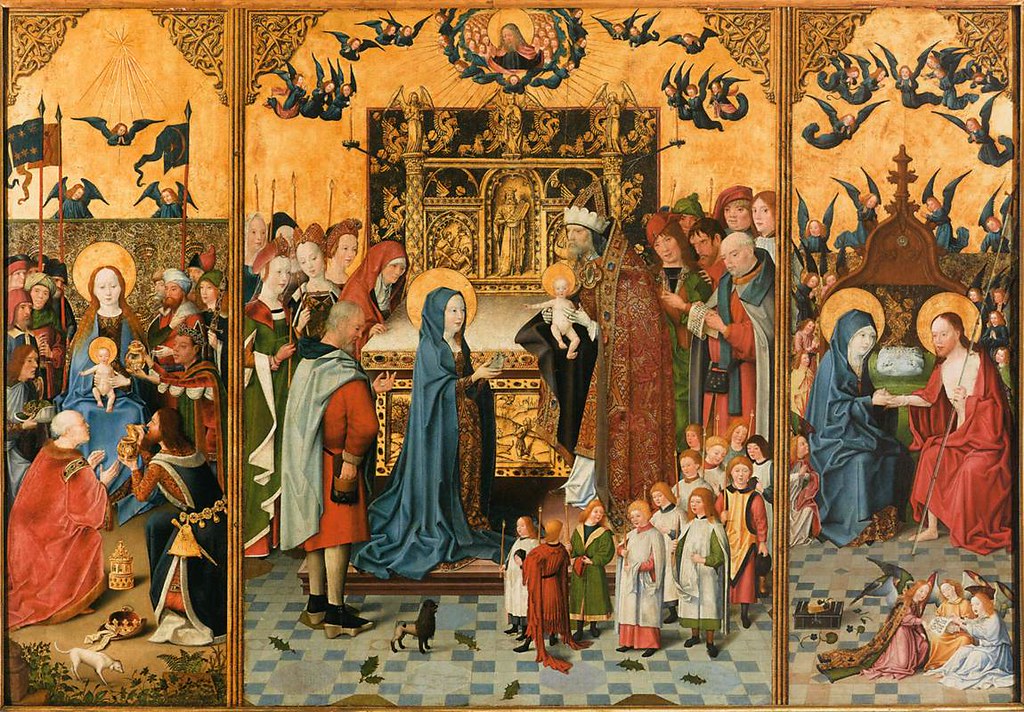
Candlemas celebrated the presentation of the infant Jesus in the Temple in Jerusalem and its celebration was meant to ween the people from pre-Christian seasonal celebrations like the Roman Lupercalia.


The celebration slowly spread from the Levant to the rest of the Church and Roman Empire.  When the date of Christmas was finally fixed on December 25, the Feast of the Presentation was added to the liturgical calendar forty days later on February 2.  That date by happenstance nearly coincided with the old Roman festival Lupercalia which simultaneously celebrated the Roman version of the Greek God Pan who was sacred to shepherds in the Spring lambing festival and Lupa the she-wolf who suckled Romulus and Remus, legendary twin founders of Rome.  In evolving Roman practice it had become a major popular holiday in Rome itself and associated with the revelry and abandon of other feasts.  Lupercalia was outlawed by the ascendant Christians but still widely, if covertly, celebrated by ordinary Romans.  The official Feast of the Presentation, coming just before Lent was hoped to ease acceptance of Church teachings.
Pope Gelasius I began calling this festival, which set off the carnival season, the Feast of the Candles, later known as Chandelours in parts of France, the Alps, and the Pyrenees and as Candlemas in Britain.  It connections to Lupercalia have caused some modern neo-pagans to view that celebration as a Latin equivalent of the German and Norse totem animal observations.  That is highly speculative and tenuous at best.
But in Scotland we do find Candlemas as the first indication that the Northern European custom had been introduced to Britain.  An early Scots Gaelic proverb went:
The serpent will come from the hole
On the brown Day of Bríde,
Though there should be three feet of snow
On the flat surface of the ground.
Although it was a serpent, not a bear, that was mentioned, the emergence of a totem animal to herald Spring was clearly there.  Over time looking for badgers stretching their legs at Candlemas became a folk tradition in rural areas of Scotland and England. 
Without mention of an animal witness this early English verse asserts
If Candlemas be fair and bright,
Winter has another flight.
If Candlemas brings clouds and rain,
Winter will not come again.
But that custom was never wide spread and did not seem to have traveled to the New World with early settlers from the colonies.
It took German peasants lured to frontier areas of Pennsylvania in the late 1700s to do that.  The use of groundhogs for prognostication rather than bears or badgers—both of which were far more dangerous and hard to manage than the lumbering and common local rodents—was well established when the first recorded note of the celebration was made in English in an 1841 diary entry by Morgantown shopkeeper James Morris:
Last Tuesday, the 2nd, was Candlemas day, the day on which, according to the Germans, the Groundhog peeps out of his winter quarters and if he sees his shadow he pops back for another six weeks nap, but if the day be cloudy he remains out, as the weather is to be moderate.
All across central and western Pennsylvania where Germans had settled in large numbers local Groundhog lodges sprang up in many towns to celebrate the annual appearance of the weather predicting critters.  An elaborate communal meal called a Fersommling featuring groaning tables, orations, skits, and music led up to a ritual presentation of the local groundhog.  These lodges and festival gatherings were also an important tools to preserve German cultural identity in communities pressed hard by Englanders—native English speakers.  Only the Pennsylvania Dutch dialect was allowed to be spoken at 19th Century Fersommlings with fines levied for each English word uttered.

An early Groundhog Day cartoon.


In 1887 in a burst of civic boosterism Colby Camps, editor of the Punxsutawney Spirit promoted his home town as the official Groundhog Day home and the local beast, always named Phil generation after generation regardless of gender, as the town’s official meteorologist.  The first story rapidly got picked up by other local and national publications which eagerly reported the result of Phil’s observation.  It became an annual tradition and publicity for the event and town grew year after year.
By the 1920 towns from the East Texas Hill Country and North Carolina, many with their own German immigrant populations, to Ontario and French speaking Quebec were hosting their own celebrations. 
Then, as noted, the 1993 movie inspired still more.
Today the accuracy of the various groundhogs is in dispute.  Backers, including the local Groundhog society boast accuracy rates of between 80 and 90%.  Cold hard statistical analysis refutes that unsubstantiated claim.  A study of several Canadian towns with Groundhog celebrations dating back 30 to 40 years found only 37% rate of accuracy.  The record at  Punxsutawney dating all the way back to that first 1887 outing is hardly better—only 38%.  Both are much worse than random 50/50 odds.