Showing posts with label Eastridge Elementary School. Show all posts

Monday, October 27, 2025

A Dorky Cheyenne Boy Had aNutty Obsession With the Rough Rider


Theodore Roosevelt--boyhood idol turned obsession.

Brilliant. Bombastic. Explosively energetic.  Arrogant.  Innovative.  Ego maniacal.  Heroic.  Perpetually manic.  Self-inventing.  Those are some of the words and phrases the immediately spring to mind when contemplating the life of Theodore Roosevelt, the man who, among other things, reinvented the Presidency for the 20th Century.  The man who was born into a wealthy and influential old Knickerbocker Dutch family on October 27, 1858 continues to fascinate 106 years after his death in 1919 at the age of 60. 

In recent years he was the subject of widely hailed three volume biography by Edmund Morris and several other books examining various parts of his multi-faceted life, studied in Doris Kearns Goodwin’s close examination of the Progressive era in The Bully Pulpit, portrayed by Tom Berenger in the TV miniseries Rough Riders, and was one of the three main characters profiled in Ken Burns epic 5 night PBS documentary series The Roosevelts. And one of my favorite novelists and Facebook connections Jerome Charyn got inside T.R.’s head in The Perilous Adventures of the Cowboy King.


Jerome Charyn's The Cowboy King was a rip-roaring romp and a reminder of why idolized Theodore Roosevelt.  It even echoed the vibe of my Classic Illustrated comic book.

But 40 years after Roosevelt’s death, he also grabbed the idolizing attention of a 10 year old nerd from Cheyenne, Wyoming.  I was already in the grips of fascination with history as a bespectacled, bookish kid with no friends when I first encountered passing notice of him in my entirely inadequate elementary school social studies text.  From there I checked him out in the illustrated Presidential biography books that I had already collected.  And my folks rook me to the Black Hills where I saq Roosevelt’s visage squeezed in between Jefferson and Lincoln on Mount Rushmore.  So I knew he was a big deal.

But what turned Roosevelt from a passing interest into an obsession was a Classics Illustrated   comic book, The Roughrider.  It told the story of how young Theodore, the weakling asthmatic who was bullied and mocked for his myopia and thick glasses but who by dint of sheer grit and determination transformed himself into a Harvard boxer, South Dakota rancher, New York City Police Commissioner, war hero, and eventually President.  A particularly satisfying panel in the book depicted Roosevelt knocking out with one mighty blow a cowboy who mocked him as four eyes.  The boy Teddy seemed a lot like me, likewise the brunt of ridicule and abuse.  The adult hero held out promise that it did not always have to be that way.

It was a short step from hero worship to nutty obsession.  How so?  Let me count the ways.

Not Batman, Superman, or The Flash could compete with my comic book super hero..

The first thing was appearance.  The mustache stubbornly refused to rise from the fine blonde down on my upper  lip Halloween costume fakes were all jet black, lacked the distinctive inward curl around the sides of the mouth, and, well, looked like crap.  And I discovered that pince-nez glasses were not available at my local optician.  I was stuck with the clunky plastic faux tortoise shell frames fit for a middle aged accountant.  But I could get the hat right.

I started with a cheap gray felt hat I bought at a souvenir stand at Cheyenne Frontier Days.  It was supposed to be a Confederate hat and had a paper Stars and Bars Flag sticker on the front.  I was a loyal Union man and spent hours trying to get all vestiges of that peeled off.  The hat did have a satisfyingly military looking gold braid band with end tassels.  I pinned up one side with a brass US collar insignia from my Dad’s World War II uniform.  It made a satisfying reproduction of Col. Roosevelt’s famous Rough Rider campaign hat.

At first I decorated it with a long pheasant tail feather, but discarded that when I realized that no photo showed my beloved Teddy sporting such a plume.  I wore that increasingly battered hat every single day from the moment I got out of bed to the time I turned in at night—except when required to remove it at schooor church—for almost three years until it practically disintegrated, and my head got too big.  Needless to say, I attracted a lot of gaping stares.  And the bullies were unimpressed by its martial appearance.

The hat was useful in the back yard fantasy games I played largely by myself.  None of the other neighborhood kids, least of all twin brother Tim who was running with a faster older crowd and already smoking cigarettes in their fort/club house, were interested in daily charges up San Juan Hill or whatever other adventures I could conjure.  My red and white Firestone coaster brake bicycle with the plastic streamers on the hand grips had to be my noble steed.

Alas, there are no extant photos of me in my Rough Rider hat, although I know that several were snapped on our old Kodak Brownie Box Camera.  My mom, likely out of shame and humiliation, left them out of her meticulously maintained photo albums and they can’t even be located in the unsorted shoe boxes of old photos. 

School was a place where my obsession played out with a bit of drama.  I started handing in my homework, busy work Ditto activity sheets, quizzes, and tests with the correct day of the month underneath my name but instead of 1959 listing the year as 1905, the year after Roosevelt’s election to a full term on his own. I picked the year because the old movies I watched on TV when I got home from school painted that era as sunny, pleasant, and free from looming nuclear annihilation—something that was constantly on our minds in Cheyenne where the Air Force was beginning to build the nation’s first ICBM missile base and which, the civic boast proclaimed, would be a top target for Commie obliteration.  The movies, mostly musicals and comedies like Meet Me in St. Louis or Life With Father were all made in the ‘30’s and ‘40s when many ticket buyers were of an age to recall those days with wistful nostalgia.  Most depicted the comfortable middle class in large homes with live-in servants.  It seemed to me that Teddy Roosevelt ruled over an ideal time to be alive.

The comfortable family life depicted in movies like Meet Me in St. Louis made me long to live in the days of Teddy Roosevelt's Presidency. After all, no Ruskie was apt to drop a nuke on this house..

So I decided that, come hell or high water, I would live then.  Neither my teachers, nor the Principal at Eastridge Elementary where I was routinely sent for an attitude adjustment, were amused by this quirk.  They demanded that I use the correct date and used every punishment in their arsenal to compel my acquiescence.  For a while I was given an (actually a 5 because Cheyenne Public Schools were then using an odd numerical grading system) on every paper I turned in with the wrong year.  But I was a student reading at the level of a senior in high School and in subjects like social studies and science showed every evidence of complete mastery of the lessons.  Of course my spelling was atrocious, my hand writing cramped and nearly illegible, and I was too bored by arithmetic to bother with accurate computations and, it would be discovered much later, was mildly dyslexic compounding that problem.  Despite my wildly uneven academic performance, eventually it was decided that it was hopeless the hold the date thing against my grades.  Besides, if the teachers kept it up, I would be held back for another year and they would be stuck with me again.

So, they tried keeping me in for recess.  Hardly a punishment as it kept me from getting beat up on the playground.  While the others were outside running around and screaming, I was happily alone in the classroom partaking of my favorite activity—reading.  Keeping me after school was no skin off my nose either.  Things were not all that rosy at home where my Mom was battling mental health and rage issues and I was the #1 object of her wrath and dissatisfaction with the hand life had dealt her.  Of course, that also meant that when the school sent home notes complaining about my stubborn misdating, she took it as a purposeful disgrace to the familythe gravest of all possible offenses.  Then out would come the wire handle of the fly swatter, down would drop my jeans and underwear and my ass got whipped to hamburger.

None of it mattered I just kept entering that date, and dreaming of the time and place where nothing like that happened. 


Roosevelt made several visits to Wyoming including this 1902 Presidential visit to Yellowstone National Park.  A special full scale rodeo was once put on for him in Cheyenne at the Frontier Days grounds.  Several Wyoming cowboys had joined his Rough Riders and other were ready to sign up for the new volunteer cavalry unit that Woodrow Wilson would not let him raise for World War I.

The whole thing lasted almost three years until I entered Junior High School and just let it all slide for new dreams and obsessions, every bit as weird perhaps, but not as apt to draw notice. 

Then in a few more years I would discover the underside of 1905 and the Roosevelt utopia—the world of vicious capitalist exploitation of working peopletheir resistance and rebellion, of open class war, Jim Crowlynchings, and of nasty little imperialist wars.

Friday, November 15, 2024

The Fight—A Murfin Cheyenne Boyhood Memoir

Back then the culture took a sometimes amused, sometimes encouraging view of children fighting.  Boys will be boys, that sort of thing, and a feeling that it would "toughen 'em up"   and that the victims of bullies could only be redeemed by standing up to their tormentors.

Note—This Cheyenne memoir originated and was adapted from a presentation at a Panel on Peace at what was then still the Congregational Unitarian Church of Woodstock on November 30, 2008 and which was first posted on the blog in this form in 2012. 

I pretty much defined the word dork. That was the preferred term, way back when, for guys who would now be called nerds.  Back in the sixth grade at Eastridge Elementary School in Cheyenne, Wyoming, I was the pasty, pudgy kid with the cowlick and thick horn-rim glasses.  A bookish kid with an irritating know-it-all attitude, I favored plaid shirts with—no kidding—pocket protectors and an assortment of leaking pens.  And I stuffed that cowlick under a grey, broad-brimmed hat pinned up on one side with an Army insignia stolen from my Dad’s World War II uniform, an homage to my personal hero, Theodore Roosevelt.  I told you I was a dork.

Then, as now, dorks have few friends.  In fact, in school, I had exactly zero friends.  I irritated just about everyone, including my teachers, mostly because I just would not shut up.  Despite being kind of a large oaf, I naturally got picked on—a lot—on the playground. Teachers, who thought I was pretty much getting what I deserved anyway, made a point of being occupied elsewhere when I was getting my face washed with gravely snow, being tied up with the girls’ jump ropes, or having my pants pulled down.

I dealt with it by reading a lot, watching old movies on TV, and indulging in a rich, rich fantasy life.  Mostly I read histories and biographies with a dose of hairy-chested fiction with historical themes, by which I mean I mostly read about war.  I watched the old John Wayne war movies on TV re-enacting my father’s war, the war of all of the neighborhood fathers.  And I, this lump of child who never could stand up the most pathetic playground bully, dreamed of being a hero, dreamed of glory.

One fine spring day it happened.  Instead of just being teased and roughed up at recess, I was called out. In the time honored way schoolboys, I was formally challenged to a fight.  The challenger was a grade up from me.  I barely knew him.  I am sure that he barely knew me.  I have no memory of what perceived offense I committed against him.  Indeed, there may have been none at all.  He may have just needed to notch up a cheap and easy victory to establish himself in the school pecking order.  I was a big kid, but he was bigger—a full head taller and maybe twenty pounds heavier.

The usual procedure was to meet out by the dumpsters behind the school for the fight.  I told the kid I wouldn’t meet him.  I didn’t have any reason to fight him.  He taunted me and we were soon surrounded by a knot of others, all jeering.  “Fine,” I said at last, “I’m not looking for a fight.  But I cut across the football field every night on my way home.  You can find me if you want.”

It was a fine, bright, sunny afternoon cold enough for heavy coats and breath that hung in visible clouds.  Time moved like molasses as I crossed the wide school yard, the gravel parking lot, the cinder track.  I carried my books in my dad’s old briefcase in one gloved hand, and my lunch box in the other.  Ahead a dozen or so eager spectators gathered on the gridiron in anticipation of a fine beating.  The kid stood apart, arms folded waiting my slow approach.

My heart boomed in my hollow chest, my stomach knotted, my breathing labored.  I had never in my entire life known such abject terror.  I walked directly up to my doom.  “Ya gonna fight?” he asked.

“No,” I said and tried to move around him.  His fist caught me by the side of the head before I ever saw it.  My glasses and hat etched different arcs in the air as I stumbled and crumpled ripping a hole in the knee of my jeans.  I was stunned, but oddly felt no pain.  I could hear the cheering and yelling as if it came from far, far away.  I groped for my glasses, hat, brief case and lunch box and rose unsteadily. 

“Now,” the kid demanded.  “No,” I said and tried to move forward.  This time I saw the fist coming, square at my face.  I could feel my lip split and the metallic taste of blood seep between my teeth and bathe my tongue.  I stumbled backwards but kept my feet somehow.  “Fight! Fight! Fight!” little mob chanted.

I clutched my bag and box tighter and pushed forward one more time.  This time he hit me in the stomach, the weak spot of any fat kid.  He hit me so hard that I turned a forward somersault in the air landing with a crashing thud on my back, all the wind knocked out of me.  I lay stunned and gasping for a moment.  The crowd grew quiet.  The kid pushed at me with the toe of his boot, not kicking but just kind of nudging my body.  I rose very slowly and gathered my things.  I began walking again.  Nobody stopped me.   Nobody said a word.

By the time I walked the half mile or so home, I was strangely exhilarated, almost euphoric.  I had not fought.  They could not make me fight.  But I had not given in.  I kept getting back up.  I imagined—foolishly as it turned out—that my bravery and determination had somehow won the grudging respect of the kid and crowd.  It turned out, they all just thought I was crazy and the legend of my dorkiness only grew.  But for that one afternoon, I imagined something like glory.

My mother, of course, was horrified and was ready to march back to school to demand punishment of my tormentors until I literally threw myself in the door to prevent it.  I didn’t try to tell her what happened.  She would not have understood it.  When my Dad came home from work, I did tell him, blurting it all out with excitement and even pride.  He tried to understand and to be supportive, but I could tell that he would much rather that I just “stood up and fought back.”  For him, there was greater honor in taking a licking in a fair fight than refraining from being goaded into one.

And I knew, when I thought about it lying in bed alone that night, that my hero Teddy Roosevelt, a fat, four-eyed, asthmatic outcast, would not have approved either.  He would have—as he did—studied boxing for months and come back and given the miscreant the thrashing he so richly deserved.  I knew I was supposed to be a failure.  But still didn’t feel like one.

Where had this strange thing come from, this oddly prideful, totally unexpected pacifism?

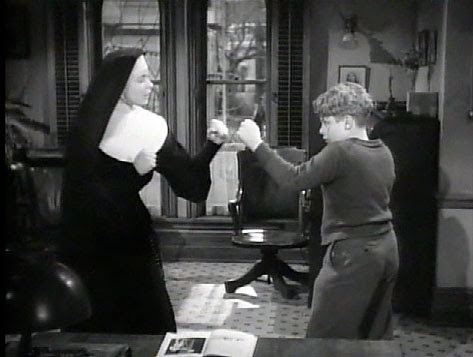
Maybe I needed a nun to teach me to stand up to bullies and fight like a Christian.

Maybe I had just taken too literally to heart the Sunday School lessons about the Gentle Jesus in all of his brightly colored, lithographed glory in my weekly study tracts.  Had I actually taken to heart the Master’s words—I tell you, do not resist him who is evil; but whoever strikes you on your right cheek, turn to him the other also—spelled out in bright red letters in my very own King James Version of the Bible?

Of course, as a good Christian boy, I knew that whatever good I might have done following the great preaching, I had washed away in my sinful pride.  There were, after all, so many ways to be unworthy.

And could this one commandment overturn a lifetime of playing Davey Crockett, Hopalong Cassidy, Teddy Roosevelt himself, and gallant GIs storming bloody beaches and imagining over and over the accolades and honors due a fighting hero?  It seemed doubtful.

Time went by.  I never stopped being the star of the violent movies that played in my head.  But I never fought.  And I never ceased to be a dork. 

By the mid-Sixties, I was becoming aware of a new kind of hero, brought to me in grainy black and white by Chet Huntley, David Brinkley, and Walter Cronkite—Martin Luther King and the marchers and protestors who stood up to dogs, batons, and fire hoses, singing hymns, turning cheeks, and changing the world by just getting back up and walking again.

Later, when the time came, I chose peace over war.  I resisted the Vietnam draft.  I did my stint in prison.  And I was as unfoundedly prideful over that as I had been on a cold and sunny football field more than a decade earlier.


Wednesday, November 16, 2022

The Fight—A Murfin Memoir of a Cheyenne Boyhood

Back then the culture took a sometimes amused, sometimes encouraging view of children fighting.  Boys will be boys, that sort of thing, and a feeling that it would "toughen 'em up"   and that the victims of bullies could only be redeemed by standing up to their tormentors.

Note—This Cheyenne memoir peace originated and was adapted from a presentation at a Panel on Peace at what was then still the Congregational Unitarian Church of Woodstock on November 30, 2008 and which was first posted on the blog in this form in 2012. 

I pretty much defined the word dork. That was the preferred term, way back when, for guys who would now be called nerds.  Back in the sixth grade at Eastridge Elementary School in Cheyenne, Wyoming, I was the pasty, pudgy kid with the cowlick and thick horn-rim glasses.  A bookish kid with an irritating know-it-all attitude, I favored plaid shirts with—no kidding—pocket protectors and an assortment of leaking pens.  And I stuffed that cowlick under a grey, broad-brimmed hat pinned up on one side with an Army insignia stolen from my Dad’s World War II uniform, an homage to my personal hero, Theodore Roosevelt.  I told you I was a dork.

Then, as now, dorks have few friends.  In fact, in school, I had exactly zero friends.  I irritated just about everyone, including my teachers, mostly because I just would not shut up.  Despite being kind of a large oaf, I naturally got picked on—a lot—on the playground. Teachers, who thought I was pretty much getting what I deserved anyway, made a point of being occupied elsewhere when I was getting my face washed with gravely snow, being tied up with the girls’ jump ropes, or having my pants pulled down.

I dealt with it by reading a lot, watching old movies on TV, and indulging in a rich, rich fantasy life.  Mostly I read histories and biographies with a dose of hairy-chested fiction with historical themes, by which I mean I mostly read about war.  I watched the old John Wayne war movies on TV re-enacting my father’s war, the war of all of the neighborhood fathers.  And I, this lump of child who never could stand up the most pathetic playground bully, dreamed of being a hero, dreamed of glory.

One fine spring day it happened.  Instead of just being teased and roughed up at recess, I was called out. In the time honored way schoolboys, I was formally challenged to a fight.  The challenger was a grade up from me.  I barely knew him.  I am sure that he barely knew me.  I have no memory of what perceived offense I committed against him.  Indeed, there may have been none at all.  He may have just needed to notch up a cheap and easy victory to establish himself in the school pecking order.  I was a big kid, but he was bigger—a full head taller and maybe twenty pounds heavier.

The usual procedure was to meet out by the dumpsters behind the school for the fight.  I told the kid I wouldn’t meet him.  I didn’t have any reason to fight him.  He taunted me and we were soon surrounded by a knot of others, all jeering.  “Fine,” I said at last, “I’m not looking for a fight.  But I cut across the football field every night on my way home.  You can find me if you want.”

It was a fine, bright, sunny afternoon cold enough for heavy coats and breath that hung in visible clouds.  Time moved like molasses as I crossed the wide school yard, the gravel parking lot, the cinder track.  I carried my books in my dad’s old briefcase in one gloved hand, and my lunch box in the other.  Ahead a dozen or so eager spectators gathered on the gridiron in anticipation of a fine beating.  The kid stood apart, arms folded waiting my slow approach.

My heart boomed in my hollow chest, my stomach knotted, my breathing labored.  I had never in my entire life known such abject terror.  I walked directly up to my doom.  “Ya gonna fight?” he asked.

“No,” I said and tried to move around him.  His fist caught me by the side of the head before I ever saw it.  My glasses and hat etched different arcs in the air as I stumbled and crumpled ripping a hole in the knee of my jeans.  I was stunned, but oddly felt no pain.  I could hear the cheering and yelling as if it came from far, far away.  I groped for my glasses, hat, brief case and lunch box and rose unsteadily. 

“Now,” the kid demanded.  “No,” I said and tried to move forward.  This time I saw the fist coming, square at my face.  I could feel my lip split and the metallic taste of blood seep between my teeth and bathe my tongue.  I stumbled backwards but kept my feet somehow.  “Fight! Fight! Fight!” little mob chanted.

I clutched my bag and box tighter and pushed forward one more time.  This time he hit me in the stomach, the weak spot of any fat kid.  He hit me so hard that I turned a forward somersault in the air landing with a crashing thud on my back, all the wind knocked out of me.  I lay stunned and gasping for a moment.  The crowd grew quiet.  The kid pushed at me with the toe of his boot, not kicking but just kind of nudging my body.  I rose very slowly and gathered my things.  I began walking again.  Nobody stopped me.   Nobody said a word.

By the time I walked the half mile or so home, I was strangely exhilarated, almost euphoric.  I had not fought.  They could not make me fight.  But I had not given in.  I kept getting back up.  I imagined—foolishly as it turned out—that my bravery and determination had somehow won the grudging respect of the kid and crowd.  It turned out, they all just thought I was crazy and the legend of my dorkiness only grew.  But for that one afternoon, I imagined something like glory.

My mother, of course, was horrified and was ready to march back to school to demand punishment of my tormentors until I literally threw myself in the door to prevent it.  I didn’t try to tell her what happened.  She would not have understood it.  When my Dad came home from work, I did tell him, blurting it all out with excitement and even pride.  He tried to understand and to be supportive, but I could tell that he would much rather that I just “stood up and fought back.”  For him, there was greater honor in taking a licking in a fair fight than refraining from being goaded into one.

And I knew, when I thought about it lying in bed alone that night, that my hero Teddy Roosevelt, a fat, four-eyed, asthmatic outcast, would not have approved either.  He would have—as he did—studied boxing for months and come back and given the miscreant the thrashing he so richly deserved.  I knew I was supposed to be a failure.  But still didn’t feel like one.

Where had this strange thing come from, this oddly prideful, totally unexpected pacifism?

Maybe I needed a nun to teach me to stand up to bullies and fight like a Christian.

Maybe I had just taken too literally to heart the Sunday School lessons about the Gentle Jesus in all of his brightly colored, lithographed glory in my weekly study tracts.  Had I actually taken to heart the Master’s words—I tell you, do not resist him who is evil; but whoever strikes you on your right cheek, turn to him the other also—spelled out in bright red letters in my very own King James Version of the Bible?

Of course, as a good Christian boy, I knew that whatever good I might have done following the great preaching, I had washed away in my sinful pride.  There were, after all, so many ways to be unworthy.

And could this one commandment overturn a lifetime of playing Davey Crockett, Hopalong Cassidy, Teddy Roosevelt himself, and gallant GIs storming bloody beaches and imagining over and over the accolades and honors due a fighting hero?  It seemed doubtful.

Time went by.  I never stopped being the star of the violent movies that played in my head.  But I never fought.  And I never ceased to be a dork. 

By the mid-Sixties, I was becoming aware of a new kind of hero, brought to me in grainy black and white by Chet Huntley, David Brinkley, and Walter Cronkite—Martin Luther King and the marchers and protestors who stood up to dogs, batons, and fire hoses, singing hymns, turning cheeks, and changing the world by just getting back up and walking again.

Later, when the time came, I chose peace over war.  I resisted the Vietnam draft.  I did my stint in prison.  And I was as unfoundedly prideful over that as I had been on a cold and sunny football field more than a decade earlier. 

Thursday, October 27, 2022

Idolizing TR—A Dorky Kid Had a Nutty Obsession With the Rough Rider

Theodore Roosevelt--boyhood idol turned obsession.

Brilliant. Bombastic. Explosively energeticArrogantInnovativeEgomaniacalHeroicPerpetually manicSelf-inventing.  Those are some of the words and phrases the immediately spring to mind when contemplating the life of Theodore Roosevelt, the man who, among other things, reinvented the Presidency for the 20th Century.  The man who was born into a wealthy and influential old Knickerbocker Dutch family on October 27, 1858 continues to fascinate 103 years after his death in 1919 at the age of 60. 

In recent years he was the subject of widely hailed three volume biography by Edmund Morris and several other books examining various parts of his multi-faceted life, studied in Doris Kearns Goodwin’s close examination of the Progressive era in The Bully Pulpit, portrayed by Tom Berenger in the TV miniseries Rough Riders, and was one of the three main characters profiled in Ken Burns epic 5 night PBS documentary series The Roosevelts. And one of my favorite novelists and Facebook connections Jerome Charyn got inside T.R.’s head in The Perilous Adventures of the Cowboy King.

Jerome Charyn's The Cowboy King was a rip-roaring romp and a reminder of why idolized Theodore Roosevelt.  It even echoed the vibe of my Classic Illustrated comic book.

But 40 years after Roosevelt’s death, he also grabbed the idolizing attention of a 10 year old nerd from Cheyenne, Wyoming.  I was already in the grips of fascination with history as a bespectacled, bookish kid with no friends when I first encountered passing notice of him in my entirely inadequate elementary school social studies text.  From there I checked him out in the illustrated Presidential biography books that I had already collected.  And my folks had taken me to the Black Hills where I had seen Roosevelt’s visage squeezed in between Jefferson and Lincoln on Mount Rushmore.  So I knew he was a big deal.

But what turned Roosevelt from a passing interest into an obsession was a Classics Illustrated   comic book The Roughrider.  It told the story of how young Theodore, the weakling asthmatic who was bullied and mocked for his myopia and thick glasses but who by dint of sheer grit and determination transformed himself into a Harvard boxer, South Dakota rancher, New York City Police Commissioner, war hero, and eventually President.  A particularly satisfying panel in the book depicted Roosevelt knocking out with one mighty blow a cowboy who mocked him as four eyes.  The boy Teddy seemed a lot like me, likewise the brunt of ridicule and abuse.  The adult hero held out promise that it did not always have to be that way.

It was a short step from hero worship to nutty obsession.  How so?  Let me count the ways.

Not Batman, Superman, or The Flash could compete with my comic book super hero..

The first thing was appearance.  The mustache stubbornly refused to rise from the fine blonde down on my upper lipHalloween costume fakes were all jet black, lacked the distinctive inward curl around the sides of the mouth, and, well, looked like crap.  And I discovered that pince-nez glasses were not available at my local opticians.  I was stuck with the clunky plastic faux tortoise shell frames fit for a middle aged accountant.  But I could get the hat right.

I started with a cheap gray felt hat I bought at a souvenir stand at Cheyenne Frontier Days.  It was supposed to be a Confederate hat and had a paper Stars and Bars Flag sticker on the front.  I was a loyal Union man and spent hours trying to get all vestiges of that peeled off.  The hat did have a satisfyingly military looking gold cord band with end tassels.  I pinned up one side with a brass US collar insignia from my Dads World War II uniform.  It made a satisfying reproduction of Col. Roosevelt’s famous Rough Rider campaign hat.

At first I decorated it with a long pheasant tail feather, but discarded that when I realized that no photo showed my beloved Teddy sporting such a plume.  I wore that increasingly battered hat every single day from the moment I got out of bed to the time I turned in at night—except when required to remove it at school or church—for almost three years until it practically disintegrated, and my head got too big.  Needless to say, I attracted a lot of gaping stares.  And the bullies were unimpressed by its martial appearance.

The hat was useful in the back yard fantasy games I played largely by myself.  None of the other neighborhood kids, least of all twin brother Tim who was running with a faster older crowd and already smoking cigarettes in their fort/club house, were interested in daily charges up San Juan Hill or whatever other adventures I could conjure.  My red and white Firestone coaster brake bicycle with the plastic streamers on the hand grips had to be my noble steed.

Alas, there are no extant photos of me in my Rough Rider hat, although I know that several were snapped on our old Kodak Brownie Box Camera.  My mom, likely out of shame and humiliation, left them out of her meticulously maintained photo albums and they can’t even be located in the unsorted shoe boxes of old photos. 

School was a place where my obsession played out with a bit of drama.  I started handing in my homework, busy work Ditto activity sheets, quizzes, and tests with the correct day of the month underneath my name but instead of 1959 listing the year as 1905, the year after Roosevelt’s election to a full term on his own. I picked the year because the old movies I watched on TV when I got home from school painted that era as sunny, pleasant, and free from looming nuclear annihilation—something that was constantly on our minds in Cheyenne where the Air Force was beginning to build the nation’s first ICBM missile base and which, the civic boast proclaimed, would be a top target for Commie obliteration.  The movies, mostly musicals and comedies like Meet Me in St. Louis or Life With Father were all made in the ‘30’ and ‘40’s when many ticket buyers were of an age to recall those days with wistful nostalgia.  Most depicted the comfortable middle class in large homes with live-in servants.  It seemed to me that Teddy Roosevelt ruled over an ideal time to be alive.

The comfortable family life depicted in movies like Meet Me in St. Louis made me long to live in the days of Teddy Roosevelt's Presidency. After all, no Ruskie was apt to drop a nuke on this house...

So I decided that, come hell or high water, I would live then.  Neither my teachers, nor the Principal at Eastridge Elementary where I was routinely sent for an attitude adjustment, were amused by this quirk.  They demanded that I use the correct date and used every punishment in their arsenal to compel my acquiescence.  For a while I was given an F (actually a 5 because Cheyenne Public Schools were then using an odd numerical grading system) on every paper I turned in with the wrong year.  But I was a student reading at the level of a senior in high School and in subjects like social studies and science showed every evidence of complete mastery of the lessons.  Of course my spelling was atrocious, my hand writing cramped and nearly illegible, and I was too bored by arithmetic to bother with accurate computations and, it would be discovered much later, was mildly dyslexic compounding that problem.  Despite my wildly uneven academic performance, eventually it was decided that it was hopeless the hold the date thing against my grades.  Besides, if the teachers kept it up, I would be held back for another year and they would be stuck with me again.

So, they tried keeping me in for recessHardly a punishment as it kept me from getting beat up on the playground.  While the others were outside running around and screaming, I was happily alone in the classroom partaking of my favorite activityreading.  Keeping me after school was no skin off my nose either.  Things were not all that rosy at home where my Mom was battling mental health and rage issues and I was the #1 object of her wrath and dissatisfaction with the hand life had dealt her.  Of course, that also meant that when the school sent home notes complaining about my stubborn misdating, she took it as a purposeful disgrace to the family—the gravest of all possible offenses.  Then out would come the wire handle of the fly swatter, down would drop my jeans and underwear and my ass got whipped to hamburger.

None of it mattered.  I just kept entering that date, and dreaming of the time and place where nothing like that happened. 

Roosevelt made several visits to Wyoming including this 1902 Presidential visit to Yellowstone National Park.  A special full scale rodeo was once put on for him in Cheyenne at the Frontier Days grounds.  Several Wyoming cowboys had joined his Rough Riders and other were ready to sign up for the new volunteer cavalry unit that Woodrow Wilson would not let him raise for World War I.

The whole thing lasted almost three years until I entered Junior High School and just let it all slide for new dreams and obsessions, every bit as weird perhaps, but not as apt to draw notice

Then in a few more years I would discover the underside of 1905 and the Roosevelt utopia—the world of vicious capitalist exploitation of working people, their resistance and rebellion, of open class war, Jim Crow, lynchings, and of nasty little imperialist wars.

But that’s another story….


Friday, November 15, 2019

The Fight—A Cheyenne Murfin Memoir

Back then the culture took a sometimes amused, sometimes encouraging view of children fighting.  Boys will be boys, that sort of thing, and a feeling that it would "toughen 'em up"   and that the victims of bullies could only be redeemed by standing up to their tormentors.

Note—This Cheyenne memoir peace originated and was adapted from a presentation at a Panel on Peace at what was then still the Congregational Unitarian Church of Woodstock on November 30, 2008 and which was first posted in this form in 2012.  

I pretty much defined the word dork. That was the preferred term, way back when, for guys who would now be called nerds.  Back in the sixth grade at Eastridge Elementary School in Cheyenne, Wyoming, I was the pasty, pudgy kid with the cowlick and thick horn-rim glasses.  A bookish kid with an irritating know-it-all attitude, I favored plaid shirts with—no kidding—pocket protectors and an assortment of leaking pens.  And I stuffed that cowlick under a grey, broad-brimmed hat pinned up on one side with an Army insignia stolen from my Dad’s World War II uniform, an homage to my personal hero, Theodore Roosevelt.  I told you I was a dork.

Then, as now, dorks have few friends.  In fact in school I had exactly zero friends.  I irritated just about everyone, including my teachers, mostly because I just would not shut up.  Despite being kind of a large oaf, I naturally got picked on—a lot—on the playground. Teachers, who thought I was pretty much getting what I deserved anyway, made a point of being occupied elsewhere when I was getting my face washed with gravely snow, being tied up with the girls’ jump ropes, or having my pants pulled down.

I dealt with it by reading a lot, watching old movies on TV, and indulging in a rich, rich fantasy life.  Mostly I read histories and biographies with a dose of hairy-chested fiction with historical themes, by which I mean I mostly read about war.  I watched the old John Wayne war movies on TV re-enacting my father’s war, the war of all of the neighborhood fathers.  And I, this lump of child who never could stand up the most pathetic playground bully, dreamed of being a hero, dreamed of glory.

One fine spring day it happened.  Instead of just being teased and roughed up at recess, I was called out. In the time honored way school boys, I was formally challenged to a fight.  The challenger was a grade up from me.  I barely knew him.  I am sure that he barely knew me.  I have no memory of what perceived offense I committed against him.  Indeed, there may have been none at all.  He may have just needed to notch up a cheap and easy victory to establish himself in the school pecking order.  I was a big kid, but he was bigger—a full head taller and maybe twenty pounds heavier.

The usual procedure was to meet out by the dumpsters behind the school for the fight.  I told the kid I wouldn’t meet him.  I didn’t have any reason to fight him.  He taunted me and we were soon surrounded by a knot of others, all jeering.  “Fine,” I said at last, “I’m not looking for a fight.  But I cut across the football field every night on my way home.  You can find me if you want.”

It was a fine, bright, sunny afternoon cold enough for heavy coats and breath that hung in visible clouds.  Time moved like molasses as I crossed the wide school yard, the gravel parking lot, the cinder track.  I carried my books in my dad’s old briefcase in one gloved hand, and my lunch box in the other.  Ahead a dozen or so eager spectators gathered on the gridiron in anticipation of a fine beating.  The kid stood apart, arms folded waiting my slow approach.

My heart boomed in my hollow chest, my stomach knotted, my breathing labored.  I had never in my entire life known such abject terror.  I walked directly up to my doom.  “Ya gonna fight?” he asked.

“No,” I said and tried to move around him.  His fist caught me by the side of the head before I ever saw it.  My glasses and hat etched different arcs in the air as I stumbled and crumpled ripping a hole in the knee of my jeans.  I was stunned, but oddly felt no pain.  I could hear the cheering and yelling as if it came from far, far away.  I groped for my glasses, hat, brief case and lunch box and rose unsteadily. 

“Now,” the kid demanded.  “No,” I said and tried to move forward.  This time I saw the fist coming, square at my face.  I could feel my lip split and the metallic taste of blood seep between my teeth and bathe my tongue.  I stumbled backwards but kept my feet somehow.  “Fight! Fight! Fight!” little mob chanted.

I clutched my bag and box tighter and pushed forward one more time.  This time he hit me in the stomach, the weak spot of any fat kid.  He hit me so hard that I turned a forward somersault in the air landing with a crashing thud on my back, all the wind knocked out of me.  I lay stunned and gasping for a moment.  The crowd grew quiet.  The kid pushed at me with the toe of his boot, not kicking but just kind of nudging my body.  I rose very slowly and gathered my things.  I began walking again.  Nobody stopped me.   Nobody said a word.

By the time I walked the half mile or so home, I was strangely exhilarated, almost euphoric.  I had not fought.  They could not make me fight.  But I had not given in.  I kept getting back up.  I imagined—foolishly as it turned out—that my bravery and determination had somehow won the grudging respect of the kid and crowd.  It turned out, they all just thought I was crazy and the legend of my dorkiness only grew.  But for that one afternoon, I imagined something like glory.

My mother, of course, was horrified and was ready to march back to school to demand punishment of my tormentors until I literally threw myself in the door to prevent it.  I didn’t try to tell her what happened.  She would not have understood it.  When my Dad came home from work, I did tell him, blurting it all out with excitement and even pride.  He tried to understand and to be supportive, but I could tell that he would much rather that I just “stood up and fought back.”  For him, there was greater honor in taking a licking in a fair fight than refraining from being goaded into one.

And I knew, when I thought about it laying in bed alone that night, that my hero Teddy Roosevelt, a fat, four-eyed, asthmatic outcast, would not have approved either.  He would have—as he did—studied boxing for months and come back and given the miscreant the thrashing he so richly deserved.  I knew I was supposed to be a failure.  But still didn’t feel like one.

Where had this strange thing come from, this oddly prideful, totally unexpected pacifism?

Maybe I had just taken too literally to heart the Sunday School lessons about the Gentle Jesus in all of his brightly colored, lithographed glory in my weekly study tracts.  Had I actually taken to heart the Master’s words—I tell you, do not resist him who is evil; but whoever strikes you on your right cheek, turn to him the other also—spelled out in bright red letters in my very own King James Version of the Bible?

Of course as a good Christian boy, I knew that whatever good I might have done following the great preaching, I had washed away in my sinful pride.  There were, after all, so many ways to be unworthy.

And could this one commandment overturn a lifetime of playing Davey Crockett, Hopalong Cassidy, Teddy Roosevelt himself, and gallant GIs storming bloody beaches and imagining over and over the accolades and honors due a fighting hero?  It seemed doubtful.

Time went by.  I never stopped being the star of the violent movies that played in my head.  But I never fought.  And I never ceased to be a dork. 

By the mid-Sixties, I was becoming aware of a new kind of hero, brought to me in grainy black and white by Chet Huntley, David Brinkley, and Walter Cronkite—Martin Luther King and the marchers and protestors who stood up to dogs, batons, and fire hoses, singing hymns, turning cheeks, and changing the world by just getting back up and walking again.

Later, when the time came, I chose peace over war.  I resisted the Vietnam draft.  I did my stint in prison.  And I was as unfoundedly prideful over that as I had been on a cold and sunny football field more than a decade earlier.