Showing posts with label Hardin Montana. Show all posts

Thursday, December 8, 2016

Early December, 1941, Hardin, Montana

Ruby Murfin in Hibbing, Minnesota, 1937 showing off her new bought-on-time furniture and prosperity for her family.


Note—We are not quite finished with Pearl Harbor.  Herewith, a Murfin Memoir story of those days.
Mrs. Murfin, Ruby to her friends and family, was still in her chenille robe and slippers lingering over a strong cup of coffee perked on the range and listening idly to the stock reports from Omaha waiting for some morning music to come on when she heard the mail man pull up in his rattle-trap Model A truck and slam the door of the post box by the road.  Eager for some good news in those bleak days—maybe a letter from home or some Christmas cards.
For more than a week there had been nothing but talk of war on the radio, down at the grocery store, at the beauty parlor, even in Church.  Her husband Murf had grown sullen and restless.  After years of struggle and sometimes outright hunger, they were finally set.  He had a good job with prospects at the bank.  They just took out a mortgage on a snug little house.  But now Murf, an old married man of 28 and probably safe from the Draft for at least a while, wanted to throw it all away and run off to enlist.  Ruby could use some cheer.
So she rushed out of the house letting the heavy storm door slam after her.  It was in the teens and the wind howled down the mountains to the west and swept the little town on the prairie.  A couple of inches of fresh, dry, powdery snow swirled along the ground, her bare toes in the mule slippers hardly noticing.  She pulled the robe tight around her and dashed to the road and the mail box on the post, its little red flag up and signaling there was mail.
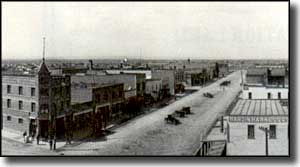
Down town Hardin, Montana, seat of Big Horn County about 1930.  It hadn't changed much by '41.

Inside, shivering at the table, Ruby poured another cup of coffee and measured a spoon of sugar into its blackness. She sorted through the small bundle.  Yes, some cards.  Looked like a letter from little sister Mildred.  A butcher and the telephone bill.  The weekly church bulletin and something for Murf from the Masons.  And…what’s this!...a squarish pastel blue tissue envelope edge all around with red and blue stripes…Air Mail!  From Oahu…addressed to her!
She didn’t know anybody in Hawaii and if it had not been in the news all week would have had no idea where Oahu was.  She peered at the envelope intently.  She thought she recognized the smoothly looping Palmer method handwriting.  Her heart suddenly sank.  Her hands trembled.  She laid aside the rest of the mail and held the envelope in her hands for several moments before slitting it open with a paring knife.
“Dear Daughter Ruby,” it began.  “I know you have not heard from me for a good long while, but as you see, I’m in Honolulu…”
No she had not seen him for a long time, nor had she missed him.  Sometimes he haunted her nightmare.  He had long since abandoned the family or the family had abandoned him.  Six of on, half a dozen of the other.  Good riddance, either way.

Mona and Lemuel Mills on their wedding day in 1910.  He hardly looked like a monster then.  The only picture of him the family kept.

Lemuel Mills had been a vicious drunk.  Born into a good family he had wasted once bright prospects and even in the boom days of the ‘20’s the family had half-starved on a neglected Missouri farm.  And he had beat his wife Mona terribly and often in his rages and spared not his children including Ruby, the eldest daughter his discipline.  One summer evening in the park in Kirksville he had caught a glimpse of him raping a high school class mate in the bushes.  In shame and terror she had said nothing.
It got so bad that one night Mona packed up the kids while Lem was out on a toot with his gang of lay-about pals, and fled the whole damn state of Missouri in his broken down Fliver.  The fled to Mona’s sister Myrtle and her husband Vern’s in in Des Moines.  After a while Lem found them there and after an infusion of corn courage, kicked the front door down blasting his shotgun as everyone fled out the back door or jumped through widows. 
The Sheriff got him and after a couple of month in the cooler got out with a stern warning not to be found in town again.  The deputies, friends of Vern, may have thrown him on a freight train.  No one had seen or heard from him since.
Ruby went back to Kirksville and married the handsome boy who had courted her in high school—Will Murfin, the son of the music store manager.  She always called him Murf.  He worked in the Bank which never re-opened after FDR’s bank holiday.  After that he could not find good, steady work for years.
They had to go back to Iowa and move in with Myrtle and Vern again.  Murf peddled vacuum cleaners door to door for a while.  No one was buying.  He got on here and there as a store clerk for a while, but it always petered out.  It was not until 1937 that he landed a job as teller in a Hibbing, Minnesota bank, more than five years into marriage, that they had finally been able to establish themselves as a married couple on their own in a cozy three room apartment.  Ruby sent pictures home to Mona proudly posing with bought-on-time Sears furniture and cathedral radio.
That had led, eventually here to Hardin where Murf was promised that if he worked hard he could become vice president of the bank in a few years.  Not long after settling in Ruby finally became pregnant.  It was a difficult birth and within two days the baby Murf had already nicknamed Butch was dead and lay beneath a small stone inscribed “William Infant Son.”
She had sunk into black depression and Murf went a little wild and crazy, taking to the mountains with his Mason buddy Hollis Johnson and Yellow Tail, the Chief at near-by Crow Agency for long hunts.  Try as she might, Ruby could not conceive another child.
They were just getting back to a semblance of normal when they heard the news about Pearl Harbor on the radio after Church.  Ruby was frightened.  Murf seemed exhilarated.
Now this letter in her hands brought it all back.

Hickam Field under attack on December 7, 1941.  Somewhere there Lemuel Mills was scrambling for cover.
It went on to say that he had taken to working construction on some of the big projects out west.  He ended up in a civilian construction gang at Hickam Field, living on the base in barracks.  That Sunday morning he was sleeping off last night’s Honolulu binge when he was awaked by explosions and machine gun chatter.  He ran outside and saw the swooping planes.  Dodging strafing runs he ran to a slit trench and dived in.  After a seeming eternity the noise stopped and he emerged.
“Just wanted you to know the old man is safe,” he wrote and added a clumsy sentiment that invited a reply to the hotel address on the envelope.
Weeping, Ruby, laid the letter down.  She never answered it.  That evening she told Murf, “He thinks this makes him a hero.”
Just after the New Year Murf was gone to basic training at Camp Grant in Illinois.  Ruby tried to busy herself with war work in Hardin—organizing scrap drives, bond sales, and knitting projects with the Ladies Aid.  She was good at it.  Always a go-getter and organizer when presented with a challenge.  It kept her, mostly, from slipping back into the blackness.
She saw Murf on furlough before he went to the California desert to train with a Field Hospital.  Then he was shipped out.  After a long wait not knowing where he was going, she got a letter from Cape Town telling her that he was on his way by ship around Africa and up the Red Sea to Egypt where the hospital would be attached to the British and Anzacs fighting Rommel.
Ruby gave up the snug little house in Hardin and moved to Omaha to work in the Boeing plant with her younger sister Mildred.  Murf came back stateside for Officer Candidate School and they spent about three months together while he was posted to Ft. Lewis in Washington State.  And then he was gone again into the green hell of the Pacific War—landings at Leyte in the Philippines, Guam, and Okinawa. 
Late in ’46 he came back, a changed man.  They lived in Helena and then he opened a sporting goods store and hunting guide service in West Yellowstone.  It went bust.  He went crazy again for a while.  To settle them both down they adopted twin boys at birth in ’49.
Ruby never heard from Lemuel again.  When her brother Pearl, now a doctor, got word that he died in Arizona in the ‘70’s, he went out there to arrange a burial and “make sure the bastard was dead and piss on his grave.”


Thursday, December 24, 2015

Christmas Eve, 1942 Somewhere West of El Alamein

A clear winter night on the Libyan Desert.


Somewhere in the Libyan dessert west of El Alamein and east of Tripoli the naked Milky Way dazzled the sky that Christmas Eve.  Stretching sands that radiated back the sun’s searing heat in the daylight cooled and the temperature dropped chilling to shivers the men in their light summer khakis.  Odd flashes and dull thuds played on the western horizon like distant thunderstorms on the high Montana plains back home.
The men of the Yank field hospital gathered listlessly in the mess tent in a forlorn attempt at holiday gayety.  The cooks had done their best but despite promises there was no turkey, just another round of British bully beef and ripe Australian mutton.  Here and there a bottle of Scotch, horded since leave in Cairo was passed from hand to hand. 
Someone had built a Christmas tree from a tripod of broomsticks wrapped in green fabric.  Cutout ornaments of paper, snipped tin cans, and icicles made from 30 caliber machine gun shells provided decoration and a scrap metal star listed precariously from the top.  Paper chains looped from tent post to tent post and someone had woven a wreath from palm fronds. 
By in large it was an enlisted men’s party.  The officers, save one duty doctor and the forlorn quartermaster, a second lieutenant from Harrisburg, had been invited to a shindig over at the AnZac brigade headquarters where a civilized meal was to be served and a dance band of regimental musicians would play.   So it was a gathering of medics, ambulance drivers, stretcher bearers, clerks, techs, orderlies, and privates. 
Some of the ambulatory patients from the ward tents were invited as well.  They were patched up and would be return to their units soon.  Most of the rest of the patients often maimed beyond recognition or hideously burned when their tanks were hit, waited on death or transportation back to Cairo and maybe home.  Their screams and moans could sometimes be heard over the phonograph in the mess tent.
First Sergeant Will Murfin, a tall fellow with black hair, a patrician nose and the long slender fingers of a musician surveyed the scene with concern.  He took a sip of his Scotch, wished momentarily for the blessing of ice, and took a long drag on his cigaretteLucky Strike Green to Win the War.  A year ago he had not smoked at all and although he enjoyed an occasional drink with his hunting buddies, did not yearn for whisky’s numbing solace like he did now.
So much had happened in a year.  Just the previous November he had tracked elk in the early snows in the high country above his home in Hardin, Montana.  With Hollis Johnson and Yellowtail, the Crow chief, he had to hike out three days dragging the dressed kill on a makeshift travois after the ’28 DeSoto they had used to get to the high camp broke an axle.  It had been a cold, hard thing but in that company of those men a kind of ecstatic joy.  “We will tell our grandchildren about this hunt,” Yellowtail had said,  “and twenty years from now someone will find the bones of that old DeSoto and wonder how in the hell it ever got there.”
Ruby Murfin in the two room apartment in Hibbing before the move to Montana.
Ruby had made a rump roast from that elk for Thanksgiving dinner.  In the little house there was much to be thankful for.  Murf, as she invariable called her husband, had a good job as chief teller in the local bank.  The hardscrabble years were behind them—the desperate jobless Depression years when they had to live with her aunt in Des Moines and the years on the desolate Minnesota Iron range while Murf had tellered at a Hibbing bank and they had lived in the two room apartment.  For the last three years they had been in Harding where Murf had a job with real promise.  He could be vice-president in a couple of years and manager when the old man retired.  Hell, he might even be able to buy the bank.  “These things could happen out here,” he told her clapping his hands together, “This is young man’s territory.”
Of course the real draw was not just the job.  Sooner or later something would have opened up in Duluth, or Minneapolis or even Chicago.  He could have held out for a bigger job that would have taken him farther.  But he wanted to hunt. He wanted to wade the high country streams, snapping his dry flies just so enticing the trout to rise, watching them dance on their tails at the end of his line as his split bamboo pole bent u-shaped. 
Then, just after the first of December Ruby gave birth to the baby.  They had waited a long time, had thought that she was infertile, he sterile.  They had been so excited.  Murf was sure it was a boy and took to calling him Butch in the womb.  He dreamed of them fishing together, sharing those long, satisfying silences in the woods that he had shared with his father.  And Ruby dreamed of raising a Fine Young Man who would be a Credit to the Family and erase the White Trash stigma she had grown up with as the daughter of the town’s crazy mean drunk.  But the baby was born too soon, its tiny lungs unable to breath on their own.  In a day and a half he was gone.
They laid him in a tiny grave in a windswept cemetery.  Murf had a small stone marker set—“Beloved son William, 1941.”  He never went to the graveyard to see it.  Instead he grabbed his rifle and headed to the high country alone.  He shot at everything and nothing, wounding trees and scarring boulders, scaring the game for miles around.  After five days he staggered home leaving his rifle and snow shoes in a pile on the porch.
Ruby was stricken hard.  She wept uncontrollably for days, thrashed around the empty house alone with Murf run off when she needed him most.  She thought for a while she would slip into her father’s insanity.  She had always feared that most of all, now it seemed to taunt her sleepless nights.
When Murf returned she had beaten him with every object she could lift, screamed obscenities she did not know she knew, railed at him for days unceasing.  He took it mutely, nodding his head at every accusation of betrayal.  Things would never be the same between them again.
In the midst of this the Japanese bombed Pearl Harbor.  Private and public rage and grief compounded.  They walked through December like zombies, strangers in the same house.
Ruby tried to rally for Christmas.  She sent Murf out to cut a fresh tree, hoping against hope he would not loose himself in the wilderness again.  He didn’t.  He cut a fine small spruce, and brought it home across the saddle of Yellowtail’s pony.  He hoped it would make peace.  Ruby carefully unpacked the treasured German glass ornaments that she had been accumulating year by year, even in the darkest days of the Depression, stung cranberry and popcorn garlands and laid carefully saved strands of tinsel one strand at a time upon the branches.
They invited Hollis Johnson and his wife and a couple of other young couples over for drinks on Christmas Eve.  That day Ruby got a letter from her little brother Pearl in Des Moines.  “I heard from Dad,” he wrote, “The bastard was working construction at Pearl Harbor.  One American on the whole damn island who deserved to die and the Japs missed him.”
Murf waited until after New Years to tell Ruby that he had gone downtown and enlisted in the Army.  “I’d probably get drafted anyway,” he explained lamely.  She knew he just wanted to escape.
He wrote a letter to the Army explaining that he was an Eagle Scout and a master woodsman.  He had great survival skills and could pick off a pronghorn antelope at half of a mile with a good rifle and scope.  He thought he might be useful along the lines of a scout or a ranger.
Will Murfin, left, and a buddy at relax after Basic Training at Camp Douglas.

The Army, predictably, had other ideas.  At 28 they though him too old for combat.  But they did admire his almost phenomenal speed as a typist.  They decided he would make a good clerk in the Medical Administrative Corps.  After basic training at Camp Grant in Illinois, he was off to Indio in the high California dessert.  There he joined a couple of hundred other men in building a new camp from scratch and training together to become a Field Hospital.
Almost from the first moment, the Army had recognized his leadership skills.  He was made a temporary corporal in basic training and arrived at Indio already a staff sergeant.  There was no bluster about him, none of the strutting martinet that many NCOs affected.  There was an earnest, calm sincerity, a sense of confidence, and an easy humor that made men want to do what he asked.  And at 28, he was nearly a decade older than most of his men.  He let them call him Will when the officers were not around.  Behind his back they called him Grandfather.
He and Ruby exchanged cheerful, newsy letters.  He called her Wisie.  She called him darling.  They never wrote about their aches and longings, their guilts and regrets.  At home Ruby was numb with depression.  At Indio he worked 16 hours a day.
The unit set sail on the SS Mauritania, the sister ship of the ill-fated Lusitania.  The British had stripped the luxury liner down to be a troop ship.  Thousands of Australian troops were already on board, along with a heard of live sheep to provide mutton for them.  Trying to stay away far as possible from Jap subs, the ship hugged the coastline South America making a port call at Santiago, Chile.  They rounded Cape Horn in a howling Southern Hemisphere winter storm.  They made another stop in Rio, darted across the South Atlantic to Nigeria, on to Cape Town, up the east coast of Africa into the Red Sea and finally land fall in Egypt.
All the long voyage men and animals were sick.  The Americans suffered as much from the awful Australian rations as from the tossing sea.  The air below was so foul with vomit and feces the men crowded the deck topside in all but the fiercest gales.
Predictably the unit arrived in Egypt without their equipment, which was being sent along in a much slower Liberty ship.  Aside from a handful of engineers and a scattering of liaison and observation officers they were the first Americans to reach the war zone.  For a few weeks, waiting for the supplies, the British treated them like kings.  They had the run of Cairo, including the Colonial bars, rode camels to the pyramids, even got passes to visit Jerusalem and the Holy Land.
By then Will was First Sergeant.  The gear arrived just days before Montgomery was to loose his long planned offensive.  The men had gotten a little soft.  The NCOs were hollering and screaming at them to get a move on as they assembled the hospital.  The men were getting resentful.  “I called out a sergeant’s detail this morning,” he wrote Ruby “and gave the men a morning off.  I took them out and handed out shovels.  We’re going to dig a latrine line, I told them.  They complained, ‘we’re sergeants we don’t have to do this kind of thing.’  ‘Like hell you don’t,’ I said.  Then I stripped of my shirt and began digging.  We made a game of it with the enlisted men standing by cheering.  By the end of the morning there were a lot of blistered hands and bum backs.  But my sergeants got the message.  They’ll never call a fatigue detail again where they don’t work along side of the men.”
A few days later Will got a V-mail from his mother.  The FBI had been to the house in Kirksville looking for him for draft dodging.  It seemed that Willard Maurice had never registered.  That was the name on the birth certificate.  But his mother had always called him Maurice Willard.  Since he had always loathed the name Maurice, he was thrilled.  “Well, I guess they can call me Will for real from now on,” he wrote.  He added that he would be glad to come home and straiten the matter out with the FBI.
The hospital opened to service the British and AnZac troops.  At first it was light duty.  A lot of dysentery, sand flea bites, sun stroke, vehicle accidents and an occasional unhappy soldier who blew his toe off trying to get sent home.
But late in October Montgomery finally moved against El Alamein.  The hospital was on the move too, following the army, setting up just outside artillery range staying for a few days then pushing on.  By November 4 Rommel and the Afrika Korps were in full retreat across North Africa.  Tobruk, where so many AnZacs had died, was retaken to delirious celebrations.  And they kept pressing westward to Gazala, Benghazi, and El Aghelia.  
An AnZac trooper carrying an injured mate who might have ended up in the American Field Hospital.


The British 8th Army had terrible medical services.  Taxies from Cairo were pressed into service as ambulances and regimental surgeons were overwhelmed.  The American’s modern mobile hospital was a wonder to them and was soon flooded with casualties, British, AnZac, German and Italian alike.  It was a nightmare carnal house, men dying on stretchers in the sand before they could be seen, bodies left behind in heaps for graves registration as the hospital moved on.
Meanwhile the Americans and British under Eisenhower had landed at Casablanca on the Atlantic coast and were driving toward Tunis hopping to crush the Germans between the two armies.
Occasionally the hospital came under artillery fire or was strafed by the Luftwaffe.  But the danger lay not in enemy fire, but in the numbing parade of horror that never seemed to stop.
Now, on Christmas Eve, they were gathered in the dessert for one desperate attempt to forget what had happened to them.  Will looked around the tent.  Every man here has a story, he thought, a life left behind barely begun, even the callow Lieutenant, who the Captain said couldn’t command the bell line of a third rate hotel, was loved by someone, ached to be a better man than he knew he was, just like all of us.
Some of the Aussies started to sing the old Christmas songs.  The Yanks joined in on the ones that they knew, voices growing stronger with each pass of the bottle.  The tent seemed cheerier, the listing “Christmas tree” less pitiful.  When there was a lull Will reached into his bag.  “Here, I have a new one,” he said.
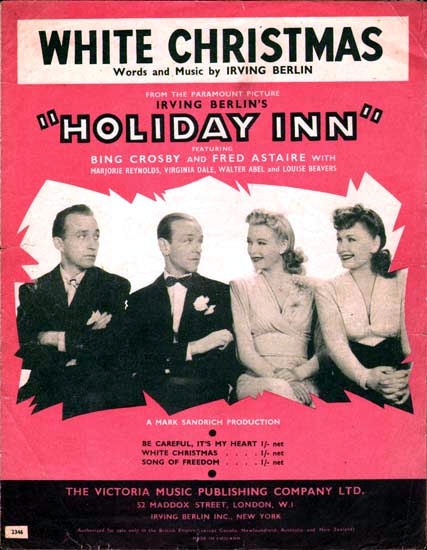
The sheet music Will's father sent.

His father, who managed the music store in Kirksville, had sent a Hohner harmonica and some sheet music in the Christmas package from home stuffed amid his mother’s cookies, press clippings, and letters from his brothers and sisters.  “Can any one sing something like this?”  he asked, waving the music.  Fred Astair and Bing Crosby in tuxedos were the cover.  “It’s from a movie called Holiday Inn that came out over the summer.”
“I used to sing for a dance band when I was in college,” the Lieutenant said, “Let me see that.”
Will and the Lieutenant looked over the music for a while.  Will began to feel out the melody on the harmonica.  The young officer in a clear, strong tenor, his voice surer than it ever was when he tried to stammer out an order, began to sing:
“I’m dreaming of a white Christmas
Just Like the Ones I used to know…” 
The background chatter began to fade, the men closed in on the sergeant and lieutenant.  There was silence when the song ended until some on called out “Sing it again!”  And they did.  They did it two times, three until the men knew the words.  And in that cold Libyan night a tentful of voices joined in words by a Jew sentimental for a holiday he did not celebrate.  The wept as they sang.