 |
| Grange Founder Oliver Hudson Kelley |
Officially
it was known by the grandiose name of The
National Grange of the Order of Patrons of Husbandry, a fraternal organization with rites and oaths seemingly not much different than the dozens of other such
organizations which were spreading like wildfire across mid-19th Century America.
But the Grange, as it was more simply and universally known, quickly
became the most important voice for family
farmers in the country, the spearhead of a growing anti-monopolist social movement, and an organization remarkably egalitarian and inclusive in its membership
and philosophy.
It
came together on December 4, 1867 thanks to the efforts of Oliver Hudson Kelley and seven other Founders including one woman,
Kelley’s 29 year old niece Caroline A.
Hall. Grange #1 in Fredonia, New York became the first
chartered unit. From there the
organization spread with astonishing speed and gathering momentum as a social
force.
Kelley
was born on January 7, 1826 in Boston. Despite
these urban roots he moved to the virtual frontier
in Minnesota in 1849. He prospered moderately but like many pioneer
farmers he was dislocated by the Great Sioux
Uprising of 1862. Two years later,
in 1864 he got an appointment to a clerkship at the Bureau of Agriculture in Washington. His intelligence, organizational skills, and
deep knowledge of agricultural conditions brought him to the attention of President Andrew Johnson after the Civil War.
Disrupted
by the war—and the abolition of slavery—the
South’s agricultural economy had
collapsed causing actual local famine. The accidental President and former Tennessee
Democrat, Johnson was more eager to reconcile the country than the Radical Republicans who controlled Congress and wanted a punitive policy for the former Rebels while providing modest land
claims for the new Freedmen. Johnson dispatched Kelley on a mission to
survey conditions on Southern farms and to make recommendations to aid in their
recovery.
On
his first visits Kelley found himself stonewalled as a damned Yankee. He
discovered, however, that his status as a Mason
could open doors and he was soon escorted everywhere he went by brother
Masons. He found the operational
condition of most farms appallingly primitive, whether small family homesteads
or the old plantations. Reliance on cheap slave labor had
prevented the introduction of more efficient agricultural innovations and machinery
while the dedication of much of the land to cash crops like cotton, tobacco, or sugar cane—all of which wore
out the soil after years of mono-production—left
food production to small garden plots
and with little access to markets more than a day’s walk away.
Appalled,
Kelley submitted his report, which like most such reports simply gathered dust
with no effective action taken. He
turned to discussions with other farmers and agricultural experts around the
country to seek solutions that would not only aid Southern farmers and perhaps
heal the wounds of the war, but advance the condition or agriculture generally.
Kelley
recruited a strong nucleus for a new kind of organization which he
envisioned. Scottish born botanist, nurseryman, and horticulturalist William Saunders
became the first Master of the Grange. Francis
M. McDowell was a former stockbroker
turned Upstate New York vintner
who provided many of the new groups organizational structures and became the
first High Priest in the Assembly of
Demeter. The Reverend Aaron Burt Grosh was a Universalist minister had a major part in the design of the Grange
ritual and was also responsible for the various songs used during various
celebrations of the Grange who also played a similar role in another important
fraternal organization, the Oddfellows. John R. Thompson of New Hampshire was Kelley’s first confidant on the project and a
high ranking Mason who collaborated with Grosh in creating ritual and establishing criteria for the seven degrees of membership. William
M. Ireland was Chief Clerk of the
Post Office who brought organizational and accounting skills to the new organization. The Rev.
John Trimble was an Episcopal priest
who had kept a school in Kentucky that
was lost in the War and then had taken a clerkship in the Department of the Treasury.
He was the organization’s main connection to the South and served as its
first Treasurer. Kelly took the position of Secretary, which encompassed the
day-to-day management of the Grange’s affairs with Caroline Hall became his
chief assistant and managed much of the communications with affiliates.
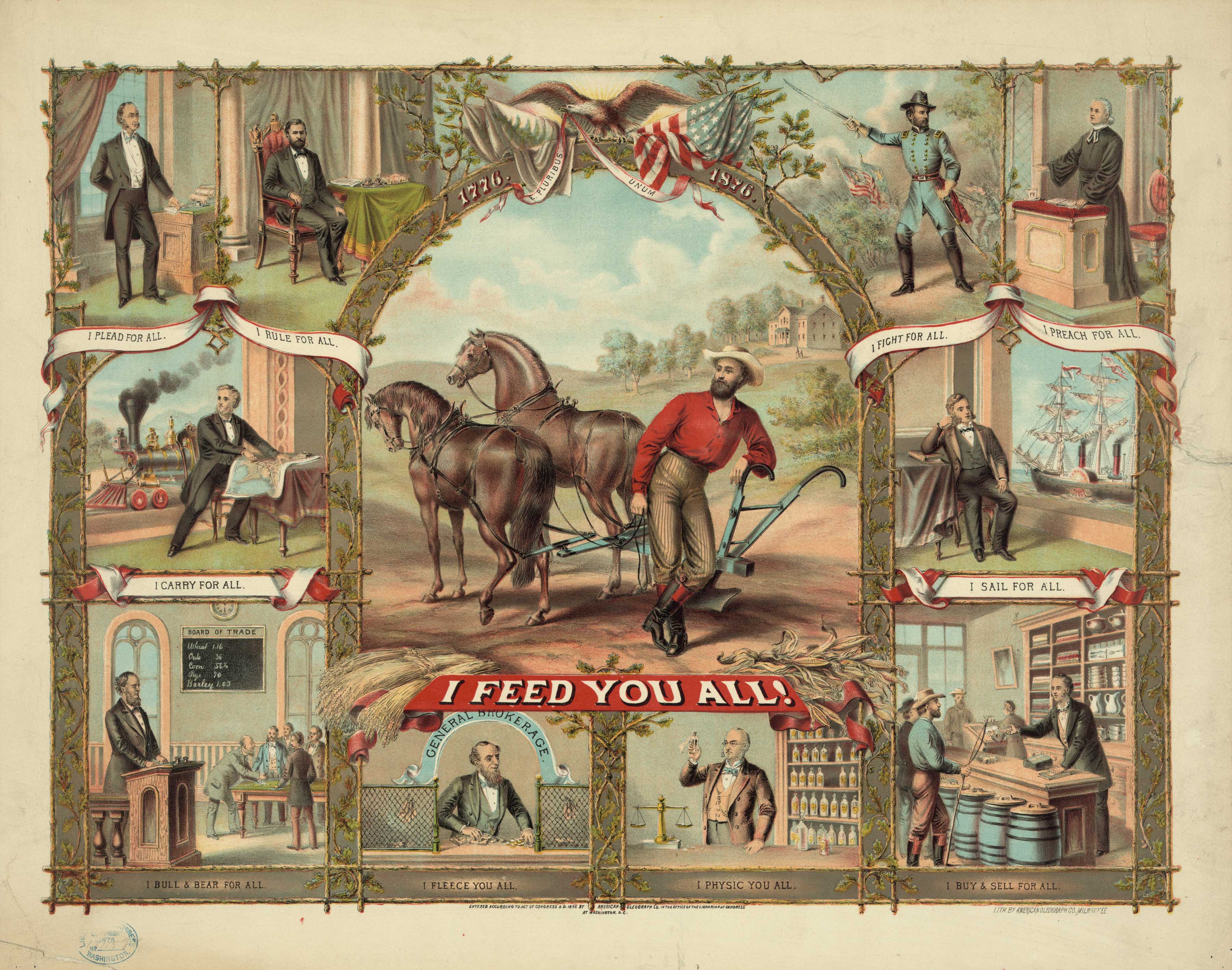 |
| A Grange poster from 1876 |
The
Grange was organized a secret society loosely
modeled on Freemasonry because such
organizations were wildly popular. But
the secrecy also had benefits, as the Knights
of Labor, an early labor union of
the same vintage, also discovered. It
meant members were able to freely and openly discuss their problems—and to plan
for action in pressing reforms. This
would be critical to its quickly growing influence. The rituals and secrets were less daunting
than the Masons. They were
non-sectarian, and in fact not even explicitly Christian. It could appeal
to members of all denominations, and was even open to freethinkers and agnostics. That meant that Grange Halls rapidly became the social center of many rural
communities, the only place where Methodists,
Baptists, even Catholics and apostates could meet and mingle.
Similarly
the Grange was strictly non-partisan when
it came to elections. Prominent members were Republicans,
Democrats, and later Greenbacks and Populists. The organization adopted and advanced many
causes including the establishment of Rural
Free Delivery by the Post Office,
the construction of county and state farm-to-market roads, regulation
of railroad freight rates, the direct election of U.S. Senators, and the adoption of Women’s Suffrage but did so without endorsing parties and
candidates. This approach made their
advocacy often stunningly successful.
In
the immediate post-war ere the Grange also was probably the only institution in
many communities, especially in Border
States and in the West which
attracted emigrants from all
sections, where Union and Confederate Veterans could safely join
together for cooperation.
One
of the most remarkable features of the Grange which set it apart from all of
the other fraternal organizations of its day was the absolute equality of women
in membership. The grange recognized
that farming was a family affair with all members needed to keep the homestead operating. To insure representation at every level some
elected positions were reserved for women, but they could hold any. They helped steer the organization’s advocacy
for suffrage, improved rural schools, and in many areas Temperance. Likewise full
membership was open to youths of both sexes “old enough to pull a plow,” at age
14. Younger children were enlisted in
active auxiliaries. Young people were this groomed and
introduced to leadership preventing the organization from stagnating.
In
areas where it was safe to do so, local Granges were open to Blacks.
In the South were that would have been impossible, segregated Granges
were established, but these had to cooperate at higher levels of the organization. Likewise the Grange was open to immigrants and non-citizens.
Structurally
the organization is hierarchical. The basic unit is the local or subordinate Grange
meant to include members from a single rural community, often hamlets too small to be incorporated. All of the local Granges in a county, or
sometimes a group of counties, belong to and are active in Pomona Granges which in turn belong to State Granges. All of this
is coordinated by the National Grange headquartered in
Washington. Granges at each level
determine their own agendas and are active in their respective
communities. Thus Pomona Granges were
especially active in pushing county governments to building and maintaining
roads and consolidating tiny one room school houses while State Granges became
powerful lobbying forces, as did the National Grange in Congress.
Ideally
in this arrangement authority passes
upward from the local to the National while organizational services flow
downward. As in all organizations this
ideal was not always fulfilled in practice, but was common. Due to unusually effective organization, the
National Grange was able to employ a number of agents who helped establish local Granges and organize
participation at the various levels.
That led to the astonishingly rapid rise of the organization.
In
the period of 1872-1875 the Grange grew from 200,000 to 850,000 members with
local Granges in most states. It was
most successful in a broad swath from New England and New York State, through the Great Lakes region, the Midwest, Great Plains, and onto the Pacific Coast. It was weakest in the Deep South, Inter-Mountain West, and Southwest. Its backbone was the family farm and the local businesses
supporting agriculture.
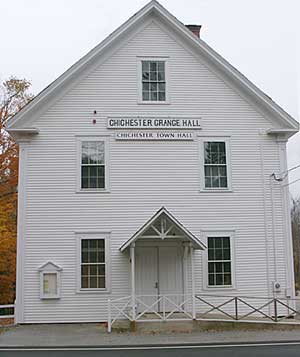 |
| A typical Grange Hall, Chichester, New Hampshire. |
Much
of the growth in this period came from a program encouraging local Granges to
establish buying cooperatives for seed, utensils, and other essential. Local Granges were also encouraged to have
members pool their money to buy otherwise prohibitively expensive farm
equipment—modern reapers, planters, and even steam tractors. This was
assisted by State and National. Aaron Montgomery Ward was one of the businessmen that supplied the equipment
and stocked the cooperatives. Local
Granges were also encouraged to build halls, which were popular community
centers and became a ubiquitous feature of small town life. Most of these Halls were financed by mortgages.
The
ripple effect of the Panic of 1873 eventually
caused the collapse of most of the buying cooperatives and both communal
equipment and Halls were seized and foreclosed on by banks. Membership dropped significantly in the second
half of the decade. Kelley resigned as
managing Secretary and the National Grange struggled. Many thought it would die.
But
re-focusing on farm issues rallied the remaining Granges and led to a slow
recovery of membership which accelerated in the 1890’s with the rise of the Populist Movement which mirrored many
Grange priorities. The Grange could take
credit for significant reforms including Rural Free Delivery, the establishment
of the Cooperative Extension Service
in the Department of Agriculture plus
state extension services, and establishment of the Farm Credit System for reliable and affordable loans. The peak of their political power was marked
by their success in Munn v. Illinois in 1877, which held that the grain warehouses were a private utility in the public interest,
and therefore could be regulated by public law. However this achievement
was overturned later by the Supreme
Court in Wabash v. Illinois in 1886.
The
early 20th Century saw a resurgence
of the Grange in both membership and influence.
It helped set the stage for the Progressive
Era and for developments like the Farmer-Labor
Party movement in the upper Midwest.
Other
farm organizations arose to challenge the dominance of the Grange, and its
progressive program, most notably the conservative Farm Bureau—eventually to become a virtual extension of the
Republican Party—on one hand and the radical National Farmers Union, which conducted the widely publicized dumping of milk early in the Depression. The Grange wove a path between but usually
found allies in the New Deal. Both Franklin
Roosevelt and his successor Harry S
Truman were members.
The
Grange has long since abandoned secret meetings. And it streamlined rituals are just a vestige
of what they once were. Many Grange
halls have closed and been converted to other uses or razed. In fact many of the small towns that once
hosted them have vanished. As the
portion of the American population directly engaged in agriculture has shrunken
to about 2% membership and affiliates have both declined.
But
the Grange remains active with a membership of 160,000, with organizations in
2,100 communities in 36 states. After
years of sharp decline, the organization is reporting a modest resurgence
mostly based in the far west and boasted that 7 new Granges were chartered in
2011.


