Today is the 47th annual international celebration of Earth
Day. Launched in 1970 with unexpectedly mass marches the event
marked the graduation of the infant
ecology movement from the provenance
of a few hippies, tree huggers, and
old line conservationists to a mass movement political muscle that
seemed to transcend traditional political party divides. Many of the early success of the movement including the establishment of the Environmental
Protection Agency (EPA) in the U.S. and
the adoption of meaningful pollution standards
that in a matter of decades dramatically
cleaned up American waters and air came under the Presidency of Richard Nixon
and with his blessing. By the turn
of the 21st Century being pro-environment
was like being for motherhood and
the middle class family—the expected
default position of any politician.
Here on the blog during National Poetry
Month Earth Day has typically been observed with a sampling of nature and eco-poetry even as we noted with growing alarm a rising tide of
attacks on ecological gains and environment protection we had once
thought secure and sacrosanct.
But all the while climate
change deniers were quietly amassing
unprecedented political power with the deep
pocket spending of billionaire
libertarians and old fashion
loot-and-pillage capitalist exploiters; a network of pseudo-scientific
think tanks; bought and paid for media including radio ravers and Fox News; and alliances-of-convenience
with religious fanatics bent on denying evolution and gender fluidity; right to lifers at war
with abortion, Scientologists against
all modern psychiatry. Together they have taken over a radicalized Republican Party that is
now in unchallenged control of all three branches of the Federal Government and
many statehouses.
 |
| Science March poster by Stacy Kendra Williams |
With a profoundly ignorant President who is beholden to them and has no choice but to pander to their every whim the stage has been set for a jaw dropping broad push against science on all fronts. Among the
administration’s very first acts were stripping the web pages of Federal Departments and government agencies of vast stores of scientific research. Research
libraries were closed and in at
least one instance steps were taken
to physically destroy the collection. Government scientists were muzzled. Research grants frozen and cancelled. Lexicons of forbidden words and phrases were
issued to agency spokespersons. Congress adopted rules forbidding some
scientists from offering expert
testimony in public hearings. International agreements are being abrogated, broken, or ignored with
impunity. Education funding is slashed
and attacks on public education are
meant to drive students of religious
academies where they will be taught blatant
lies in the guise of science.
Scientists themselves are publicly vilified
and shamed and some doing
research in particularly sensitive areas have found themselves targets of on-line harassment and even death threats.
Of course all of this is like King Canute bidding the tide to roll away.
Neither the King and his sycophantic courtiers nor the Cheeto-in-Charge and his minions can change reality. The tide will wash the shore or the seas
will rise as ice caps melt despite any incantation. But there is much danger in what is undone
and more in creating a legacy of ignorance.
Which is why this year Earth Day is
not being celebrated as it has in the past.
It is being marked with Marches
for Science around the country that may echo the Women’s Marches earlier this year in scope. As more than one
astonished person has exclaimed, who
ever thought we would need to march for science? Yet there it is. In 2017 marching for science is part of the fabric of resistance necessary to save our society and the earth.
 |
| Science March poster by Stacy Kendra Williams |
The Partnership for Science sponsoring the marches includes dozens of
the most important scientific
organizations and societies in the United States including the American Association for the Advancement of
Science (AAAS), The Union of Concerned Scientists, The
Nature Conservancy, Earth Day Network, and many professional societies and education
institutions. Not your usual radical suspects. Most of these groups have never taken part in mass political action before. The ranks of the march will be swelled by
many rank and file educators from
all levels and ordinary concerned citizens.
The main march will be in Washington, DC and be accompanied by a
number of programs over the weekend.
Hundreds of thousands are expected there alone. There are also 905 Satellite marches in cities
great and small. Most are in the
United States, Canada, and Europe but there are events on every continent including at Antarctic stations. Members of Tree of Life Unitarian Universalist Congregation in McHenry will be marching in
Chicago. There are also near-by Palatine and Rockford.
To reinforce the message there will be another massive march with satellites
next Saturday—The People’s Climate March. It’s a one-two-punch
against ignorance and for action.
The arts and sciences are
often seen as mutually exclusive. While that has never been true, there has
been some cultural alienation between
the two camps, particularly with the virtual
collapse of a broad liberal arts
education on the undergraduate level
that used to expose students destined for specialized graduate education into realms outside their bailiwick. Today the liberal arts are scorned as a useless waste of time and universities
become increasingly intent on technical
and career education. Hell, state
legislatures like Florida’s practically demand that.
But many thoughtful poets and
artists have always been in tune with
science.
For background, let us turn to an old dead white guy, William Makepeace
Thackeray to remind us of the Canute legend in this excerpt from his longer poem.
 |
| King Canute futility bade the waves roll back. |
King Canute
“Might I stay the sun above us, good
sir Bishop?” Canute cried;
“Could I bid the silver moon to pause upon her heavenly ride?
If the moon obeys my orders, sure I can command the tide.
“Will the advancing waves obey me, Bishop, if I make the sign?”
Said the Bishop, bowing lowly, “Land and sea, my lord, are thine.”
Canute turned towards the ocean—“Back!"” he said, “thou foaming brine.
“From the sacred shore I stand on, I command thee to retreat;
Venture not, thou stormy rebel, to approach thy master's seat:
Ocean, be thou still! I bid thee come not nearer to my feet!”
But the sullen ocean answered with a louder, deeper roar,
And the rapid waves drew nearer, falling sounding on the shore;
Back the Keeper and the Bishop, back the king and courtiers bore.
And he sternly bade them never more to kneel to human clay,
But alone to praise and worship That which earth and seas obey:
And his golden crown of empire never wore he from that day.
King Canute is dead and gone: Parasites exist always.
—William
Makepeace Thackeray
 |
| Jane Hirshfield. |
Jane
Hirshfield, the Chancellor of the
Academy of American Poets, was the very first poet featured here this
month. She is one of several leading
poets who have publicly endorsed the March for Science and will read this new
poem from the stage of the March in Washington today.
On the Fifth Day
On the fifth day
the scientists who studied the rivers
were forbidden to speak
or to study the rivers.
The scientists who studied the air
were told not to speak of the air,
and the ones who worked for the farmers
were silenced,
and the ones who worked for the bees.
Someone, from deep in the Badlands,
began posting facts.
The facts were told not to speak
and were taken away.
The facts, surprised to be taken, were silent.
Now it was only the rivers
that spoke of the rivers,
and only the wind that spoke of its bees,
while the unpausing factual buds of the fruit trees
continued to move toward their fruit.
The silence spoke loudly of silence,
and the rivers kept speaking,
of rivers, of boulders and air.
Bound to gravity, earless and tongueless,
the untested rivers kept speaking.
Bus drivers, shelf stockers,
code writers, machinists, accountants,
lab techs, cellists kept speaking.
They spoke, the fifth day,
of silence.
—Jane Hirshfield
 |
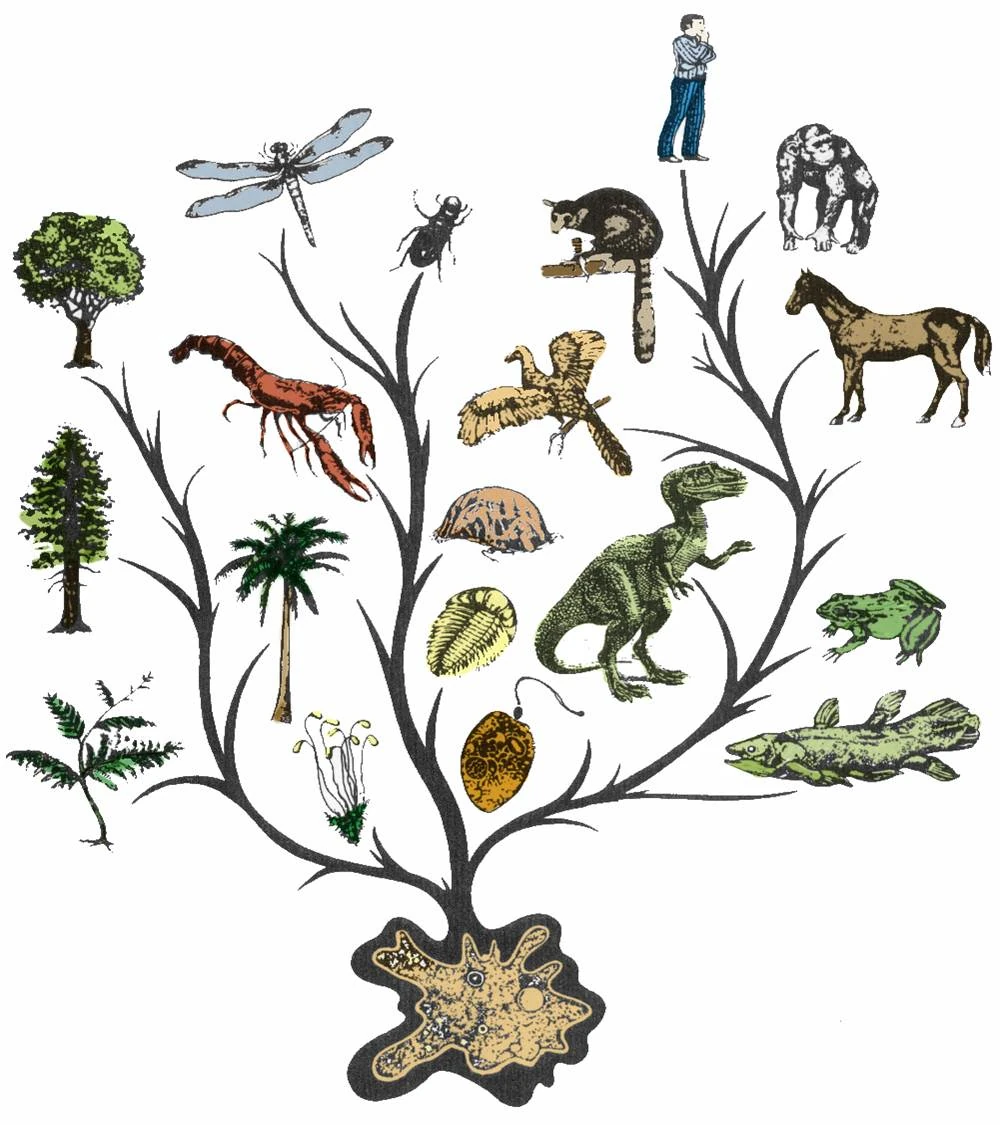
| In Evolution by Linda Beirds Alan Turing contemplate the amoeba and the horse. |
Linda
Bierds was born in 1945 in Alaska and
educated at the University of Washington. Much of her considerable body or work
explores science.
Evolution
How, Alan Turing thought, does the soft-walled,
jellied, symmetrical cell
become the asymmetrical horse? It was just before dusk,
the sun’s last shafts doubling the fence posts,
all the dark mares on their dark shadows. It was just
after Schrodinger’s What is Life,
not long before Watson, Franklin, Crick, not long before
supper. How does a chemical soup,
he asked, give rise to a biological pattern? And how
does a pattern shift, an outer ear
gradually slough its fur, or a shorebird’s stubby beak
sharpen toward the trout?
He was halfway between the War’s last enigmas
and the cyanide apple—two bites—
that would kill him. Halfway along the taut wires
that hummed between crime
and pardon, indecency and privacy. How do solutions,
chemical, personal, stable, unstable,
harden into shapes? And how do shapes break?
What slips a micro-fissure
across a lightless cell, until time and matter
double their easy bickering? God?
Chance? A chemical shudder? He was happy and not,
tired and not, humming a bit
with the fence wires. How does a germ split to a self?
And what is a—We are not our acts
and remembrances, Schrodinger wrote. Should something—
God, chance, a chemical shudder?—
sever us from all we have been, still it would not kill us.
It was just before dusk, his segment
of earth slowly ticking toward night. Like time, he thought,
we are almost erased by rotation,
as the dark, symmetrical planet lifts its asymmetrical cargo
up to the sunset: horses, ryegrass—
In no case, then, is there a loss of personal existence to
deplore—
marten, whitethroat, blackbird,
lark—nor will there ever be.
—Linda
Bierds
 |
| Japanese tsunami painting. |
|
Finally, indulge
one from the Old Man, the proprietor of this pop stand. This piece was
included in my recent chapbook Resistance Verse (available from the author for a virtual song, just ask.)
Zen and the Slow Earthquake
According to the Smithsonian—
and who am I argue
with such lofty
glossiness—
before the Big One
shook Japan
a few years ago—
you know the one
that shook like
nobody’s business
for six long minutes,
unleashed a tsunami
whose water wall
swept away damn near
everything,
killed tens of
thousands,
and uncorked nuclear Fukushima
spewing radioactive
crap
and polluting the
whole damn Pacific—
before that two long,
slow quakes
crept along the Japan Trench
under the water for days each
as two sides of the tectonic plates
slipped by each other in slo-mo
like a sports replay video
each one releasing almost as much
energy as the big trembler
and moving even more earth.
Yet no one on dry land felt a damn
thing,
not
a one going about his or her
humdrum
business was aware,
big
wig scientists could hardly measure it
and
figured out what had happened
only
after the fact
by
pouring over printouts of data
that
no one else would ever scan.
Slip events they called them
and
said they may—or may not—
have led to the big
one that
suddenly snapped things
and got everyone’s
attention
and that things like
that happen
along other fault
lines
all over the damn
world
and no one notices.
Quiet
quakes of unimaginable power indeed—
it’s like the Earth
practiced Zen.
—Patrick Murfin