Showing posts with label National Poetry Month. Show all posts

Thursday, April 30, 2026

If Talk Could Exalt a Nation--Jerry Pendergast's Irish Roots —National Poetry Month 2026


Jerry Pendergast reading.

The work of Jerry PendergastChicago poet, poetry slam emcee, and contributor to the Revolutionary Poets Brigade Facebook group, has regularly been featured in our National Poetry Month posts.  His work is influenced by jazz, Irish cultural identity, urban observation, and a keen sense of social justice.  Today’s verse is inspired by his Irish roots.

                               
                             Oscar Wilde.

If Talk Could Exalt a Nation

“We Irish are too Poetic to be poets…We are a nation of brilliant failures.

But we are the greatest talkers since the Greeks”. Oscar Wilde


If a stanza a river long

could sink a battle ship

If a run on sentence

taking a hearer through the mess u ages

could make a regiment

charging through a city street

drop their rifles.


If a tail end

of a narration

could disable a tank.


Wheels falling

with each change

Each embellishment

If an O’Carolan Concerto

Could misdirect a Cavalry

Put their commanders in a trance

If pipers could melt swords

Would Ireland be free?

Would it ever have been conquered?


If master fiddlers could make clergy

and officials scatter their thoughts

Dance like there were no floor director

Would Ireland imprison Wild Earnest Men?


Force young Women into work houses

for being young woman like?

or victims? Tell them their sins

are washed down the sink.?

Ban novels that win international awards?


Or would the state and the church

Be more well rounded.

Like the Ethiopian and Celtic crosses.


Jerry Pendergast


Monday, April 27, 2026

Paeans and Poems for Ella—National Poetry Month 2026


Young Ella with the diminutive Chick Webb at the drums in one of their famous Savoy Ballroom sets.

Ella Fitzgerald, the incomparable jazz singer whose career spanned decades would have turned 109- years-old yesterday.  As usual there were plenty of tributes for the beloved First Lady of Song.

Ella was not only a treasured performer, she was also profoundly inspirational.  There is a large body of poetry dedicated to her or inspired by her.  Two of those I selected for birthday tribute were penned by Beat influenced poets who frequently perform with jazz accompaniment--Sanchez and Jayne Cortez--are probably no surprise.  But Polish Nobel Laureate Wislawa Szymborska also wrote knowledgably about her showing Fitzgerald’s international appeal. 

Jillian Philips Twitter icon.

But first we will hear from Jillian Philips, “writer, poet, editor, actress, karaoke junkie, mom, and feminist” from Eau ClaireWisconsin.

Ella Fitzgerald in Her Livingroom

I find comfort in a downpour.
The sound of intermittent pings
is almost a sonata, lulling me.
If Beethoven played on tin,
it would sound like the rain on my roof:

      drip

           drip

                drip

                     DROP!

His fifth symphony forming
puddles on the sidewalk
as I watch and listen
through my window.

—Jillian Philips

                              
  Sonya Sanchez.

A Poem for Ella Fitzgerald

when she came on the stage, this Ella
there were rumors of hurricanes and
over the rooftops of concert stages
the moon turned red in the sky,
it was Ella, Ella.
queen Ella had come
and words spilled out
leaving a trail of witnesses smiling
amen - amen - a woman - a woman.

she began
this three agèd woman
nightingales in her throat
and squads of horns came out
to greet her.

streams of violins and pianos
splashed their welcome
and our stained glass silences
our braided spaces
unraveled
opened up
said who’s that coming?

Who’s that knocking at the door?
whose voice lingers on
that stage gone mad with
         perdido. perdido. perdido.
         i lost my heart in toledooooooo.

whose voice is climbing
up this morning chimney
smoking with life
carrying her basket of words
                 a tisket a tasket
                 my little yellow
                 basket-i wrote a
                 letter to my mom and
                 on the way i dropped it-
                 was it red... no no no no
                 was it green... no no no no
                 was it blue... no no no no
                 just a little yellow

voice rescuing razor thin lyrics
from hopscotching dreams.

we first watched her navigating
an apollo stage amid high-stepping
yellow legs
we watched her watching us
shiny and pure woman
sugar and spice woman
her voice a nun’s whisper
her voice pouring out
guitar thickened blues,
her voice a faraway horn
questioning the wind,
and she became Ella,
first lady of tongues
Ella cruising our veins
voice walking on water
crossed in prayer,
she became holy
a thousand sermons
concealed in her bones
as she raised them in a
symphonic shudder
carrying our sighs into
her bloodstream.

this voice, chasing the
morning waves,
this Ella-tonian voice soft
like four layers of lace.
                 when i die Ella
                 tell the whole joint
                 please, please, don't talk
                 about me when i'm gone....

i remember waiting one nite for her appearance
audience impatient at the lateness
of musicians,
i remember it was april
and the flowers ran yellow
the sun downpoured yellow butterflies
and the day was yellow and silent
all of spring held us
in a single drop of blood.

when she appeared on stage
she became Nut arching over us
feet and hands placed on the stage
music flowing from her breasts
she swallowed the sun
sang confessions from the evening stars
mage earth divulge her secrets
gave birth to skies in her song
remade the insistent air
and we became anointed found
inside her bop
                 bop bop dowa
                 bop bop doowaaa
                 bop bop dooooowaaa

Lady. Lady. Lady.
be good. be good
to me.
        to you.         to us all
cuz we just some lonesome babes
in the woods
hey lady. sweetellalady
Lady. Lady. Lady. be gooooood
ELLA ELLA ELLALADY
        be good
               gooooood
                      gooooood...

—Sonya Sanchez


                Wislawa Szymorska, Polish Nobel Laureate. 


Ella in Heaven

She prayed to God
with all her heart
to make her
a happy white girl.
And if it’s too late for such changes,
then at least, Lord God, see what I weigh,
subtract at least half of me.
But the good God answered No.
He just put his hand on her heart,
checked her throat, stroked her head.
But when everything is over – he added –
you’ll give me joy by coming to me,
my black comfort, my well-sung stump.


—Wislawa Szymborska


  Jayne Cortez.

Jazz Fan Looks Back

I crisscrossed with Monk

Wailed with Bud

Counted every star with Stitt

Sang “Don’t Blame Me” with Sarah

Wore a flower like Billie

Screamed in the range of Dinah

& scatted “How High the Moon” with Ella Fitzgerald

as she blew roof off the Shrine Auditorium

                    Jazz at the Philharmonic


I cut my hair into a permanent tam

Made my feet rebellious metronomes

Embedded record needles in paint on paper

Talked bopology talk

Laughed in high-pitched saxophone phrases

Became keeper of every Bird riff

every Lester lick

as Hawk melodicized my ear of infatuated tongues

& Blakey drummed militant messages in

soul of my applauding teeth

& Ray hit bass notes to the last love seat in my bones

I moved in triple time with Max

Grooved high with Diz

Perdidoed with Pettiford

Flew home with Hamp

Shuffled in Dexter’s Deck

Squatty-rooed with Peterson

Dreamed a “52nd Street Theme” with Fats

& scatted “Lady Be Good” with Ella Fitzgerald

as she blew roof off the Shrine Auditorium

                    Jazz at the Philharmonic.


—Jayne Cortez


Sunday, April 26, 2026

Gerard Malanga Imagined Elephant Armageddon--National Poetry Month 2026


Gerard Malanga--the Warhol years.

Poet and photographer Gerard Malanga is best known for his association with cultural icon Andy Warhol.  He was the pop artist’s personal assistant, photographer, and sometimes actor during Warhol’s most famous period in the 1960s and ‘70s.  In fact, he has been called Warhol’s “most important associate” during those years.

Malanga was the son of Italian immigrants and was raised in the Bronx.  He began writing poetry as a teenager and was soon immersed in the New York City avant garde art scene.  He began documenting that scene as a photographer.


Malanga and Warhol.

He was the chief assistant for Warhol from the mid-1960s and founded the magazine Interview with him in 1969. Malanga was also featured in several of Warhol’s films, collaborated with Warhol on his Screen Tests project, and was a member of Warhol’s cross-genre undertaking, The Exploding Plastic Inevitable.

He was also closely identified with the emerging punk rock movement, was close to The Velvet UndergroundIggy Pop, and was one of Patti Smiths lovers.

His numerous books of poetry, include chic death (1971), Mythologies of the Heart (1996), No Respect: New And Selected Poems 1964-2000 (2001), and Cool & Other Poems (2019).

The contemporary shutter bug in his element.

Malanga has also published the photography books Good Girls (1994) and Resistance to Memory (1998). He served as the NYC Department of Parks and Recreations first photo archivist, and edited a study on the link between photography and voyeurism, Scopophilia: The Love of Looking (1985). With Victor Bockris, he co-authored Up-Tight: The Velvet Underground Story (2003).

Malanga remains an active artist today.

This 2012 poem finds Malanga far from the gritty urban streets with which he is most identified.


African elephants endangered for their ivory.

Elephant Armageddon

NYTimes headline for September 4th 2012:

Elephants Dying in Epic Frenzy As Ivory Fuels Wars and Profits


          They return to the site whence they came with eyes tearful,

 with psalms trumpeting the air.

 They stand ever so watchful;

 guarding the graves of their ghosts and their kind.

 They shall not forget.  They shall not want.

 They lie down in green silky pastures

 and finding their way to the still waters.

 They restore and nourish their soul.

 They walk through the dark valleys; always the shadows

 of death lurking behind them.

 Always striding till they reach the comforting light.

 They fear no evil.  Man fears.

 They forage for food and they eat amongst their enemies

 because they fear not.  They are the happiest.

 The honey is under their tongue.

 The winter is past, the rain is over and gone.

 Their hearts awaken.  They know no violence.

 Even in the waning light they tower over all else.

 They are the landscape.  They are the trees.

 They throw up the dust in their dance.  The skies become misty.

 They rise up and lead each other away into the dusk.


Gerard Malanga


Friday, April 24, 2026

Lightening Up With Limericks--Parental Discretion Advised--National P{oetry Month 2026


We’ve been doing some heavy lifting the past few days in the annual National Poetry Month series—grim history, heavy current events, serious religion, and a doleful look at the planet’s future.  Time to lighten things up! and what could be lighter than limericks?  Like Japanese haiku, limericks are very short form poems with a strict form.  Unlike haiku they are not ethereal, spiritual, or calming On the contrary they are bawdy—often lewd—disrespectful, rude, and sassy.  Even “clean” limericks for children are often rowdy, rebellious, and mischievous.

A limerick must consist of five lines. The first, second, and fifth lines must have seven to ten syllables while rhyming and having the same verbal rhythm. The third and fourth lines only have to have five to seven syllables and have to rhyme with each other and have the same rhythm.  That’s an a-a-b-b-a rhyme scheme for those of you keeping score at home.

The form appeared in England in the early 18th Century and was popularized by Edward Lear, an artist, illustrator, musician, author, and poet, now known mostly for his literary nonsense in the 19th Century.  As a form of folk verse its origins may be much older. Gershon Legman compiled the largest and most scholarly anthology, held that the true limerick as a folk form is always obscene to which literary heavy weights Arnold Bennett and George Bernard Shaw concurred. Lear described the clean limerick as a “periodic fad and object of magazine contests, rarely rising above mediocrity.”

The connection between the limerick and the Irish County of the same name are satisfactorily obscure but may derive from an earlier form of a nonsense verse parlor game that traditionally included a refrain that included “Will [or won’t] you come (up) to Limerick?”  But perhaps it was simply because a little Old Sod poteen, loosened the tongue and inhibitions for ribald play.

The most famous limerick of all was considered so obscene that it seldom saw print, although it was recited in many a bar room.

There was a young man from Nantucket

Whose dick was so long he could suck it.

    He said with a grin

    As he wiped off his chin,

“If my ear was a cunt I would fuck it.


                                              Edward Lear, 1866.

Despite his opinion, that limericks were generally obscene, the ones Edward Lear wrote and published in his 1875 Book of Nonsense did not offend Victorian morality.  But these two seem to include a sly s.

There was an Old Man who said, “Hush!

I perceive a young bird in this bush!

When they said, “Is it small?”

He replied, “Not at all!

It is four times as big as the bush!”


—Edward Lear


There was a Young Lady of Dorking,

Who bought a large bonnet for walking;

But its colour and size,

So bedazzled her eyes,

That she very soon went back to Dorking.


—Edward Lear

One from America’s comic poet.


Here is a more modern example of the old fashion filthy absolutely guaranteed to offend.

The lass I brought home was a prize,

With an alluring set of bright eyes,

Her breasts, so well kept,

Were what I’d expect,

But her penis was quite a surprise!

Limericks are frequently used as political satire—usually scurrilous and—you should pardon the expression—below the belt employed by partisans of the Right and the Left with equal zest.

The President’s loud protestation

On his fall to his intern’s temptation:

“This affair is still moral

As long as it’s oral

Straight screwing I save for the nation.


A president famed for his spite*

Tweeted “I am outstandingly bright.

I’d be perfectly able

To muck out any stable

Because I am a genius at shite!


―Jim McLeod


Note: The limerick above won the fifth annual Bring your Limericks to Limerick contest, sponsored by the Limerick Writers Centre. We found the name of the winning limerick writer ironic, since Trumps mother was a MacLeod from Scotlands Outer Hebrides!


Dear Donald, when out on the stump

Please don’t lunge at our flag and then hump.

Such an act’s unbecoming

And vulgar — mind-numbing.

What’s your next flag-act? Taking a dump?


You get the idea.  Your efforts welcome in the [edited] comments.


Thursday, April 23, 2026

St. George and the Dragon Inspired Verse--National Poetry Month 2026


St. George in Myth.

Today is the Feast Day of St. George as observed in England where he became the nation’s Patron Saint and is represented on the Union Jack by the upright red cross.  George is also venerated by Orthodox Christians and is the Patron Saint of Greecewhich explains why so many restaurant owners are named George.  But the Eastern and Western versions of why George is such a popular saint are very different.

Unlike some early popular saints there was apparently a historical George.   He was born around 256 Common Era probably in Palestine where his father, Gerontius, was a Patrician noble of Greek origin in the Roman Army occupying the province of Syria Palaestina.  The family was Christian.  George followed his father’s profession and rose rapidly in the Legions.  By his mid-twenties he was said to be a military tribune and stationed as an Imperial Guard of the Emperor at Nicomedia in northeast Asia Minor, then the capital of the eastern portion of the Roman Empire.  He was said to be a favorite of Galerius Caesar in the East under Diocletian, Augustus in Rome. 

George would likely have campaigned with Galerius against the Copts in Egypt and in the disastrous war with the Sassanid Persians.  Christians in the Army, especially senior officers were scapegoated for the loss.  In 305 A.D.  Diocletian, with Galerius’s support ordered all army officers to abandon Christianity and make public sacrifice to the Roman gods on pain of death.

George reportedly sold his slaves and gave away his wealth to the poor preparing to meet his fate.  Called personally before Galerius, the Emperor tried to convert his soldier and offered him new honors, titles, and lands as inducement.  George remained steadfast and was sentenced to death.  According to legend on his last night Galerius dispatched a comely virgin to George to remind him of the pleasures of the flesh, but instead of sleeping with her, he converted her on the spot, thus sealing the lass’s doom as well.

The next day, April 23, 303 CE George was beheaded but faced his fate with such equanimity that Empress Alexandra of Rome became a Christian as well and soon she joined George in martyrdom.

                                
                                        The elaborate Martyrdom of St. George by Renaissance master Paolo Veronese.  Note--no dragon.

George’s body was returned to his hometown of Lydda in Palestine for burial.  His crypt quickly became a shrine for pilgrims and a sect of veneration spread across the East.  He was the most prominent of the 14 Soldier Saints who fell to Diocletian’s persecution.  He is venerated among Orthodox Christians as one of the great martyrs of the Church and is especially adored by Greeks.

Historians quibble over the veracity of all of the details of this narrative, but most agree that there was soldier and that he was connected with the Diocletian persecution.

But you will notice the total absence of any mention of a dragon in this account, nor does the beast figure in Greek veneration or traditional iconography at least until the dragon tale is introduced from the West.

                               
                                            St. George, soldier saint, in a traditional style Greek icon.

George was so popular that the Muslims adopted him as a saint, transferring his martyrdom to the Kingdom of Mosul where he was said to have been executed three times and been resurrected from the dead each time.

George was officially canonized in the Western or Catholic Church in 494 by Pope Gelasius I, as among those “whose names are justly reverenced among men, but whose acts are known only to God,” which included other legendary figures like St. Christopher and St. Valentine.  Still, he was little known in the West until Crusaders brought his cult home, where it especially flourished in England and Sweden.  The knightly reverence for a soldier saint was key.

                    Horus slays Set as a crocodile in Egyptian myth--a model for St. George.

The origins of the Dragon story are somewhat obscure.  Elements of the tale may be traced to Egypt where the god Horus killed Set metamorphosed into a crocodile.  It may also have borrowed from the Muslim accounts with the dragon as a metaphor for the monster King of Mosul.  The Crusaders, however, were literalists, and the symbol may have been transformed into substance.

The earliest reference to a Dragon may have been in a 12th Century Latin text but the story began to be codified in the Speculum Historiale and the Golden Legend of the 13th Century.  The latter was especially the inspiration of bards, poets, and various versions of the tale started showing up across late Midlevel Europe. 

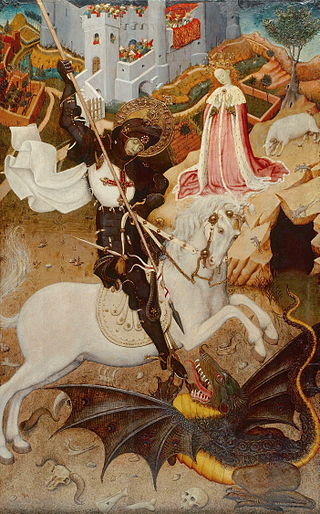
In Jacobus de Voragine’s Legenda aureaThe Golden LegendSilene in Libya was plagued by a venom-spewing dragon dwelling in a nearby pond, poisoning the countryside.  The local people placated the dragon with gifts of sheep but the insatiable beast was soon demanding human sacrifices which were chosen by lot among the children.  Eventually the King’s daughter fell to the lottery and she was sent, dressed a bride, to meet her doom.  The king offered his fortune to save his favorite child.


The Marriage of St. George and the Princes from the Golden Legend by Dante Gabriel Rosset
ti.

Enter George, a virtuous Knight traveling by chance alone in the Kingdom.  Hearing of the damsel’s plight, he made the Sign of the Cross and charged the monster on horseback, seriously wounding it with his lance.  The princess lassoed the dragon with her girdle and together the two led the subdued beast back to the King’s city, where George decapitated it with his broadsword.  In gratitude the King and all of the citizens convert to Christianity.   In later versions of the story George weds the lovely Princes, who is given different names.

The story may have originated with Georgian folk tales before the Crusader’s got it into the hands of Jacobus de Voragine.

At any rate, it was the perfect yarn for the age that was inventing Chivalry, as magical as any Arthurian legend

George began to inspire armies including the Franks at the siege of Antioch, in 1098, and at Jerusalem the following year.  The knightly Order of Sant Jordi d’Alfama was established by King Peter the Catholic of Aragon in 1201 followed by the Republic of GenoaKingdom of Hungary, and by Frederick III, Holy Roman Emperor in the 14th Century.

In England George was mentioned as early as Alfred the Great’s will but it was not until 1222 Synod of Oxford that Saint George's Day was declared a feast day. Edward III of put the Order of the Garter under the banner of St. George around 1348. The chronicler Jean Froissart observed the English invoked Saint George as a battle cry on several occasions during the Hundred Years’ War with France.

George was slowly, unofficially rising as a national saint, a position officially occupied by Edward the Confessor.  England was rife with local saints and their shrines like that of Thomas Becket at Canterbury, but these could invoke regional loyalties, not national ones, and be identified with Normans or Saxons.  George was aided by the very fact that he had no legendary connection with England, and no specifically localized shrine.  He could thus be a national symbol—or at least one for the feudal warlords and their men at arms who held sway over the country.

                                        
                                                      St. George as a Crusader knight.by Bernot Martorell.

The red-on-white cross was originally associated with the Knights Templar and subsequently with the Crusades in general and the noble houses who wished to be associated with it.  It began to be identified with St. George and began to be used as a banner by the Knights of the Order of the Garter.  From 1348 and throughout the 15th Century, the Saint George’s Cross was shown in the hoist of the Royal Standards of the Plantagenet kings of England.  With the dynastic union of England and Scotland in 1603, it was combined with the white on blue x-shaped Cross of St. Andrew for Scotland for what became the Union Flag, eventually the national flag of Great Britain.  In 1801 following the following the union Great Britain and Ireland the red Cross of St. Patrick was imposed on a background of the white Cross of St. Andrew to complete the modern Union Jack national flag of the United Kingdom.


The England's Flag of St. George, right, incorporated into the Union Jack.

St. George and his Cross were such a popular symbol for England that both survived the Puritan Commonwealth unscathed.  St. George’s Cross was the only Saint’s banner that was allowed to be flown.

Today the modern Catholic Church is somewhat embarrassed by the dragon lore.  Like Valentine and others his feast has been demoted on the liturgical calendar, although he did not lose his saintly status entirely like St. Christopher.  His feast, however, is still celebrated in by Catholics and the Church of England alike as well as across much of the old Empire and Commonwealth.

Needless to say, with such fertile ground, poets have had much to say about St. George and his dragon beginning with almost endless medieval ballads, which I will spare you here.

Cicely Fox Smith was an English poet and writer born in LymmCheshire on February 1, 1882 and educated at Manchester High School for Girls.  She briefly lived in Canada, before returning to the United Kingdom shortly before the outbreak of World War I.  Before her death in 1954 she wrote and published more than 600 poems, many with patriotic or naval themes.  A popular and much beloved non-academic poet, she invoked St. George, as so many had done before, to answer the call to battle, this time against the “Huns” in the Great War of 1914-1918.

                 
                                   Cicely Fox Smith.

St. George of England

Saint George he was a fighting man, as all the tales do tell;
He fought a battle long ago, and fought it wondrous well.
With his helmet, and his hauberk, and his good cross-hilted sword,
Oh, he rode a-slaying dragons to the glory of the Lord.
And when his time on earth was done, he found he could not rest
Where the year is always summer in the Islands of the Blest;
So he came to earth again, to see what he could do,
And they cradled him in England -
In England, April England -
Oh, they cradled him in England where the golden willows blew!

Saint George he was a fighting man, and loved a fighting breed,
And whenever England wants him now, he's ready at her need,
From Crecy field to Neuve Chapelle he's there with hand and sword,
And he sailed with Drake from Devon to the glory of the Lord.
His arm is strong to smite the wrong and break the tyrant's pride,
He was there when Nelsom triumphed, he was there when Gordon died;
He sees his red-cross ensign float on all the winds that blow,
But ah! His heart’s in England -
In England, April England -
Oh, his heart it turns to England where the golden willows grow!

Saint George he was a fighting man, he’s here and fighting still
While any wrong is yet to right or Dragon yet to kill,
And faith! He’s finding work this day to suit his war-worn sword,
For he’s strafing Huns in Flanders to the glory of the Lord.
Saint George he is a fighting man, but when the fighting’s past,
And dead among the trampled fields the fiercest and the last
Of all the Dragons earth has known beneath his feet lies low,
Oh, his heart will turn to England -
To England, April England -
He’ll come home to rest in England where the golden willows blow!

Cicely Fox Smith


Brian Patten.

Brian Patten is an 80-year-old English poet from Liverpool who first rose to prominence with the late ‘60s poetry anthology The Mersey Sound.  He has written autobiographical collections for adults as well as books for children and young adults.  Here he had a very different take on both the dragon and St. George.  Of note, you should know that it is customary to wear a red rose on St. George’s Day in England, which, by the way was also the symbol of the Lancastrians in the War of the Roses.

The True Dragon

St George was out walking
He met a dragon on a hill,
It was wise and wonderful
Too glorious to kill
 
It slept amongst the wild thyme
Where the oxlips and violets grow
Its skin was a luminous fire
That made the English landscape glow
 
Its tears were England’s crystal rivers
Its breath the mist on England’s moors
Its larder was England’s orchards,
Its house was without doors
 
St George was in awe of it
It was a thing apart
He hid the sleeping dragon
Inside every English heart
 
So on this day let’s celebrate
England’s valleys full of light,
The green fire of the landscape
Lakes shivering with delight
 
Let’s celebrate St George’s Day,
The dragon in repose;
The brilliant lark ascending,
The yew, the oak, the rose.


—Brian Patten


Elvis Mcgonagall
.

Elvis Mcgonagall was born in Dundee, Scotland in 1960 and is a stand-up comic and is notable for poetry slam performances.  He is also something of a Scottish nationalist despite currently residing in Dorset in England.  He takes a Scott’s more jaundiced view of George and the hoopla surrounding him.

George!


Once more unto the breach, dear Morris Dancers once more

Jingle your bells, thwack sticks, raise flagons

Cry “God for Harry and Saint George!”

Gallant knight and slayer of dragons

Patron saint of merry England –

And Georgia, and Catalonia, and Portugal, Beirut, Moscow

Istanbul, Germany, Greece

Archers, farmers, boy scouts, butchers and sufferers of syphilis

Multicultural icon with sword and codpiece

On, on you bullet-headed saxon sons

Fly flags from white van and cab

But remember stout yeomen, your champion was Turkish

So – get drunk and have a kebab.


—Elvis Mcgonagall

Another dissenting view came from Nancy Senior, who casts a skeptical eye on the assumptions of would-be savior knights, and maybe men in general.


St. George  slays the Dragon by Jost Haller.

St. George

My dragon always loved walks

He used to go to the wall

where the golden chain hung

and take it in his mouth

laying his head on my lap sideways,

so the fire wouldn’t burn my skirt


He looked so funny that way

with his wings dragging the floor

and his rear end high up

because he couldn’t bend his hind legs.


With him on the leash,

I could go anywhere

No band of robbers dared attack.


This morning in the woods

we had stopped for a drink

where a spring gushes out of a cave.


when suddenly, a man in amour

riding a white horse

leapt out of the bushes crying

“Have no fear I will save you”

And before I could say a word

he had stabbed my dragon in the throat

and leaping down from the horse

cut off his head

and held it up for me to see

the poor eyes still surprised

and mine filling with tears/

He hadn’t even had time to put out his claws.


And the man said

“Don’t cry, Maiden

You are safe now

But let me give some good advice

Don’t ever walk alone in the woods

for the next time you meet a dragon

there might not be a knight around to save you."


—Nancy Senior