Showing posts with label Roy Wilkins. Show all posts

Sunday, August 28, 2022

It Was Bigger and Wider than Dr. King—The March for Jobs and Freedom Moved a Nation

Dr. Martin Luther King's ringing I Have a Dream speech was the highlight and climax of the 1963 March for Jobs and Freedom in Washington and helped change America, but the March itself was bigger than any one man.

Like a lot of people back in ’63 I was glued to the television for the beginning-to-end coverage provided by CBS News of the March for Jobs and Justice on August 28.  I was a 14 year old in Cheyenne, Wyoming at the time.  I was both thrilled and awestruck.  Listening to Dr. King’s I Have a Dream Speech literally changed my life.

The March was the brain child of labor and Civil Rights leader A. Phillip Randolph.

The march originally was the brainchild of an elder of both the labor and Civil Rights movements.  A. Philip Randolph, President of the Brotherhood of Sleeping Car Porters and of the Negro American Labor Council as well as a Vice President of the AFL-CIO modeled his call for a march on Washington on a similar event he had planned back in 1941 to force President Franklin D. Roosevelt to open employment in the burgeoning defense industry to Blacks.  Just the threat of thousands of Negros descending on the Capital had been enough to cause the President to establish the Committee on Fair Employment Practice and bar discriminatory hiring in the defense industry.  Randolph wanted to bring similar pressure on President John F. Kennedy and Congress to move on stalled Civil Rights legislation, but also to bring up new issues of jobs that had been overshadowed by the tumultuous battle for civil rights in the South

Randolph brought together the leaders of all of the largest national Civil Rights organizations including James Farmer, President of the Congress of Racial Equality (CORE); John Lewis, President of the Student Nonviolent Coordinating Committee (SNCC); Roy Wilkins, President of the National Association for the Advancement of Colored People (NAACP); Whitney Young, President of the National Urban League; and Dr. King, President of the Southern Christian Leadership Conference (SCLC) to form a coalition to sponsor the march.  It was no small feat because of turf wars, ideological differences, and egos.

Civil Rights Leaders and major speakers at the March for Jobs and Justice, standing left to right are Director of the National Catholic Conference for Interracial Justice Matthew Ahmann, Rabbi Joachim Prinz, Student Nonviolent Coordinating Committee (SNCC) leader John Lewis, Protestant minister Eugene Carson Blake, Congress of Racial Equality (CORE) leader Floyd McKissick, and UAW President Walter Reuther; sitting are National Urban League Executive Director Whitney Young, chairman of the Demonstration Committee Cleveland Robinson, Brotherhood of Sleeping Car Porters President A. Philip Randolph, Dr. Martin Luther King Jr. of the Southern Christian Leadership Conference (SCLC), and National Association for the Advancement of Colored People (NAACP) leader Roy Wilkins.

In addition, Randolph sought support from the Labor movement, most significantly from Walter Reuther, President of the United Auto Workers (UAW)The white dominated craft unions of the AFL, however, were notable for their absence

Bayard Rustin of the pacifist Fellowship of Reconciliation (FOR) and the organizer of the 1947 Journey of Reconciliation, an early forerunner of the Freedom Rides that was meant to test a Supreme Court ruling that banned racial discrimination in interstate travel, was tapped to coordinate volunteers and logistics, recruit marchers from across the country, and attend to all the other details of the march while Randolph pulled together political, labor and religious support for the march. 

Veteran pacifist and Civil Rights leader Bayard Rustin of the Fellowship of Reconciliation was the Deputy Director of the March and in charge of most of the planning and logistics.  As an openly Gay man his public profile was kept low.  Retail workers labor leader Cleveland Robinson was named Chairman of the Administrative Committee.

Other than being a star speaker that day King was not heavily involved in the planning or management of the event. He even left the details of mobilizing SCLC supporters to his aides.

As word spread, it became apparent that the march was going to turn into the largest event of its kind in history.  The media began to pay attention.  On the day of the march, buses poured into the city from sleepy Mississippi towns and from gritty industrial hubs like Detroit and Chicago.  Trains from Boston, New York, and Philadelphia were jammed.  Thousands of local Washington residents swelled the throng. 

Organizers put the crowd at more than 300,000.  The National Park Service, in charge because the speakers’ platform was erected at the Lincoln Memorial, said 200,000.  Whatever was the case, crowds filled the Mall far past the Washington Monument.  About 80% of the marchers were Black. Marchers included many celebrities including actors like Sidney Poitier, Harry Bellefonte, and Charlton Heston—yes that Charlton Heston. 

Charlton Heston, Harry Bellefonte, novelist James Baldwin, and Marlon Brando added star power to the March.

It was a Wednesday afternoon, but the three major broadcast networks broke away from their usual programming of afternoon soap operas to cover the swelling crowd and speeches live

Marian Anderson, who had sung on the same steps at the invitation of Eleanor Roosevelt after she was denied use of the Daughters of the American Revolution Constitution Hall in 1939, opened the program with the National Anthem.  Several other performers took to the stage over the course of the program, perhaps most notably Peter, Paul & Mary, Joan Baez, Bob Dylan, and Mahalia Jackson. 
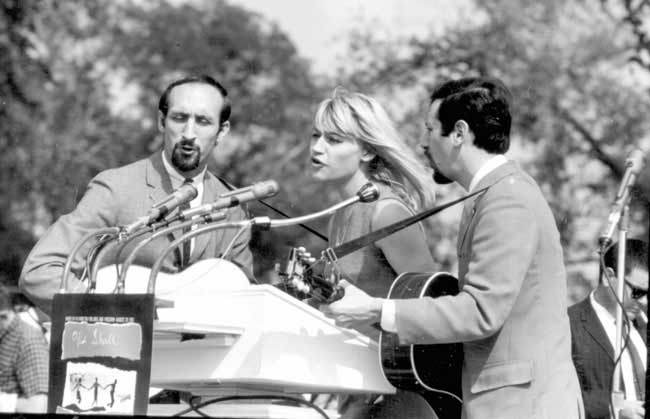
Peter Paul & Mary were among the notable entertainers who performed.  They led the crowd in Pete Seeger's anthem If I Had a Hammer.

The Catholic Archbishop of Washington, Patrick OBoyle led the invocation.  Other religious leaders on the program included Dr. Eugene Blake on behalf of the Protestant National Council of Churches and two leading Rabbis. 

After Randolph’s opening remarks each of the major civil rights leaders took the stage in turn. Floyd McKissick had to read the remarks of CORE’s James Farmer, who was in a Louisiana jail. The youngest leader, John Lewis of the militant SNCC, excoriated the Kennedy Administration for not acting to protect Civil Rights workers who were under regular and violent attack across the South.  Randolph and others who were trying to flatter and coax the President into action forced Lewis to strike the most inflammatory portions of his speech, but what was left was still plenty critical. 

Despite their notable contributions to the Civil Rights Movement key figures like Rosa Parks, and Dianne Nash were excluded from the speaker's list.  In the end the only woman to address the crowd was singer and dancer Josephine Baker who had spent most of the previous 30 years as an expatriate in Paris.  She wore her World War II uniform as a decorated member of the French Resistance.

Slain NAACP organizer Medgar Everss wife Myrlie was on the announced program to lead a Tribute to Negro Women but did not appear.  In fact, several prominent female figures in the Movement were either not invited or had their requests to be added to the program rejected by Randolph.  In the end the only woman to speak was jazz singer and dancer Josephine Baker who wore her World War II Free French uniform emblazoned with her medal of the Légion d’honneur

It all led up the last major address—the highly anticipated speech of Dr. King.  If civil rights veterans knew what to expect from the notoriously eloquent leader, millions of Americans viewing at home were in for an eye opening experience.  The speech, built to the thundering crescendo:

Let freedom ring. And when this happens, and when we allow freedom ring—when we let it ring from every village and every hamlet, from every state and every city, we will be able to speed up that day when all of God's children—black men and white men, Jews and Gentiles, Protestants and Catholics—will be able to join hands and sing in the words of the old Negro spiritual: “Free at last! Free at last! Thank God Almighty, we are free at last!”

The hundreds of thousands of ordinary folks who showed up for the March for Jobs and Justice were just as important as any of the movement heavies and celebrities.

The nation, or much of, it was awestruck and impressed.  That speech, along with the continued televised violence against Blacks struggling for equal access to public accommodations and the vote, helped set the stage for the major Civil Rights legislation enacted in the next three years.  


Saturday, February 20, 2021

The March for Jobs and Freedom Was Bigger than Dr. King— Focus on Black History Month 2021

Dr. Martin Luther King's ringing I Have a Dream speech was the highlight and climax of the 1963 March for Jobs and Freedom in Washington and helped change America, but the March itself was bigger than any one man.

Like a lot of people back in ’63 I was glued to the television for the beginning-to-end coverage provided by CBS News of the March for Jobs and Justice on August 28.  I was a 14 year old in Cheyenne, Wyoming at the time.  I was both thrilled and awestruck.  Listening to Dr. King’s I Have a Dream Speech literally changed my life.

The March was the brain child of labor and Civil Rights leader A. Phillip Randolph.

The march originally was the brainchild of an elder of both the labor and Civil Rights movements.  A. Philip Randolph, President of the Brotherhood of Sleeping Car Porters and of the Negro American Labor Council as well as a Vice President of the AFL-CIO modeled his call for a march on Washington on a similar event he had planned back in 1941 to force President Franklin D. Roosevelt to open up employment in the burgeoning defense industry to Blacks.  Just the threat of thousands of Negros descending on the Capital had been enough to cause the President to establish the Committee on Fair Employment Practice and bar discriminatory hiring in the defense industry.  Randolph wanted to bring similar pressure on President John F. Kennedy and Congress to move on stalled Civil Rights legislation, but also to bring up new issues of jobs that had been overshadowed by the tumultuous battle for civil rights in the South. 

Randolph brought together the leaders of all of the largest national Civil Rights organizations including James Farmer, President of the Congress of Racial Equality (CORE); John Lewis, President of the Student Nonviolent Coordinating Committee (SNCC); Roy Wilkins, President of the National Association for the Advancement of Colored People (NAACP); Whitney Young, President of the National Urban League; and Dr. King, President of the Southern Christian Leadership Conference (SCLC) to form a coalition to sponsor the march.  It was no small feat because of turf wars, ideological differences, and egos.

Civil Rights Leaders and major speakers at the March for Jobs and Justice, standing left to right are Director of the National Catholic Conference for Interracial Justice Matthew Ahmann, Rabbi Joachim Prinz, Student Nonviolent Coordinating Committee (SNCC) leader John Lewis, Protestant minister Eugene Carson Blake, Congress of Racial Equality (CORE) leader Floyd McKissick, and UAW President Walter Reuther; sitting are National Urban League Executive Director Whitney Young, chairman of the Demonstration Committee Cleveland Robinson, Brotherhood of Sleeping Car Porters President A. Philip Randolph, Dr. Reverend Martin Luther King Jr. of the Southern Christian Leadership Conference (SCLC), and National Association for the Advancement of Colored People (NAACP) leader Roy Wilkins.

In addition Randolph sought support from the Labor movement, most significantly from Walter Reuther, President of the United Auto Workers (UAW).  The White dominated craft unions of the AFL, however, were notable for their absence. 

Bayard Rustin of the pacifist Fellowship of Reconciliation (FOR) and the organizer of the 1947 Journey of Reconciliation, an early forerunner of the Freedom Rides that was meant to test a Supreme Court ruling that banned racial discrimination in interstate travel, was tapped to coordinate volunteers and logistics, recruit marchers from across the country, and attend to all of the other details of the march while Randolph pulled together political, labor and religious support for the march. 

Veteran pacifist and Civil Rights leader Beyard Rustin of the Fellowship of Reconciliation was the Deputy Director of the March and in charge of most of the planning and logistics.  As an openly Gay man his public profile was kept low.  Retail workers labor leader Cleveland Robinson was named Chairman of the Administrative Committee.

Other than being a star speaker that day King was not heavily involved in the planning or management of the event. He even left the details of mobilizing SCLC supporters to his aides.

As word spread, it became apparent that the march was going to turn into the largest event of its kind in history.  The media began to pay attention.  On the day of the march, buses poured into the city from sleepy Mississippi towns and from gritty industrial hubs like Detroit and Chicago.  Trains from Boston, New York, and Philadelphia were jammed.  Thousands of local Washington residents swelled the throng. 

Organizers put the crowd at more than 300,000.  The National Park Service, in charge because the speakers’ platform was erected at the Lincoln Memorial, said 200,000.  Whatever was the case, crowds filled the Mall far passed the Washington Monument.  About 80% of the marchers were Black. Marchers included many celebrities including actors like Sidney Poitier, Harry Bellefonte, and Charlton Heston—yes that Charlton Heston. 

Charlton Heston, Harry Bellefonte, novelist James Baldwin, and Marlon Brando added star power to the March.

It was a Wednesday afternoon but the three major broadcast networks broke away from their usual programming of afternoon soap operas to cover the swelling crowd and speeches live. 

Marian Anderson, who had sung on the same steps at the invitation of Eleanor Roosevelt after she was denied use of the Daughters of the American Revolution Constitution Hall in 1939, opened the program with the National Anthem.  Several other performers took to the stage over the course of the program, perhaps most notably Peter, Paul and Mary, Joan Baez, Bob Dylan, and Mahalia Jackson.

Peter Paul & Mary were among the notable entertainers who performed.  They led the crowd in Pete Seeger's anthem If I Had a Hammer. Seeger himself did not appear despite his close association with the Civil Rights Movement in he South because memories of his his former Communist Party membership and indictment for his First Amendment refusal to testify against others before the House Un-American Activities Committee.

The Catholic Archbishop of Washington, Patrick O’Boyle led the invocation.  Other religious leaders on the program included Dr. Eugene Blake on behalf of the Protestant National Council of Churches and two leading Rabbis. 

After Randolph’s opening remarks each of the major civil rights leaders took the stage in turn. Floyd McKissick had to read the remarks of CORE’s James Farmer, who was in a Louisiana jail. The youngest leader, John Lewis of the militant SNCC, excoriated the Kennedy Administration for not acting to protect Civil Rights workers who were under regular and violent attack across the South.  Randolph and others who were trying to flatter and coax the President into action forced Lewis to strike the most inflammatory portions of his speech, but what was left was still plenty critical. 

Despite their notable contributions to the Civil Rights Movement key figures like Rosa Parks, and Dianne Nash were excluded from the speaker's list.  In the end the only woman to address the crowd was singer and dancer Josephine Baker who had spent most of the previous 30 years as an expatriate in Paris.  She wore her World War II uniform as a decorated member of the French Resistance.

Slain NAACP organizer Medgar Evers’s wife Myrlie was on the announced program to lead a Tribute to Negro Women, but did not appear.  In fact several prominent female figures in the Movement were either not invited or had their requests to be added to the program rejected by Randolph.  In the end the only woman to speak was jazz singer and dancer Josephine Baker who wore her World War II Free French uniform emblazoned with her medal of the Légion d’honneur. 

It all led up the last major address—the highly anticipated speech of Dr. King.  If civil rights veterans knew what to expect from the notoriously eloquent leader, millions of Americans viewing at home were in for an eye opening experience.  The speech, built to the thundering crescendo:

Let freedom ring. And when this happens, and when we allow freedom ring—when we let it ring from every village and every hamlet, from every state and every city, we will be able to speed up that day when all of God's children—black men and white men, Jews and Gentiles, Protestants and Catholics—will be able to join hands and sing in the words of the old Negro spiritual: “Free at last! Free at last! Thank God Almighty, we are free at last!”

The hundreds of thousands of ordinary folks who showed up for the March for Jobs and Justice were just as important as any of the movement heavies and celebrities.

The nation, or much of, it was awestruck and impressed.  That speech, along with the continued televised violence against Blacks struggling for equal access to public accommodations and the vote, helped set the stage for the major Civil Rights legislation enacted in the next three years. 


Wednesday, August 28, 2019

Bigger than Dr. King—The March for Jobs and Freedom Moved a Nation

Dr. Martin Luther King's ringing I Have a Dream speech was the highlight and climax of the 1963 March for Jobs and Freedom in Washington and helped change America, but the March itself was bigger than any one man.
Like a lot of people back in ’63 I was glued to the television for the beginning-to-end coverage provided by CBS News of the March for Jobs and Justice on August 28.  I was a 14 year old in Cheyenne, Wyoming at the time.  I was both thrilled and awestruck.  Listening to Dr. King’s I Have a Dream Speech literally changed my life.

The March was the brain child of labor and Civil Rights leader A. Phillip Randolph.
The march originally was the brainchild of an elder of both the labor and Civil Rights movements.  A. Philip Randolph, President of the Brotherhood of Sleeping Car Porters and of the Negro American Labor Council as well as a Vice President of the AFL-CIO modeled his call for a march on Washington on a similar event he had planned back in 1941 to force President Franklin D. Roosevelt to open up employment in the burgeoning defense industry to Blacks.  Just the threat of thousands of Negros descending on the Capital had been enough to cause the President to establish the Committee on Fair Employment Practice and bar discriminatory hiring in the defense industry.  Randolph wanted to bring similar pressure on President John F. Kennedy and Congress to move on stalled Civil Rights legislation, but also to bring up new issues of jobs that had been overshadowed by the tumultuous battle for civil rights in the South. 
Randolph brought together the leaders of all of the largest national Civil Rights organizations including James Farmer, President of the Congress of Racial Equality (CORE); John Lewis, President of the Student Nonviolent Coordinating Committee (SNCC); Roy Wilkins, President of the National Association for the Advancement of Colored People (NAACP); Whitney Young, President of the National Urban League; and Dr. King, President of the Southern Christian Leadership Conference (SCLC) to form a coalition to sponsor the march.  It was no small feat because of turf wars, ideological differences, and egos.

Civil Rights Leaders and major speakers at the March for Jobs and Justice, standing left to right are Director of the National Catholic Conference for Interracial Justice Matthew Ahmann, Rabbi Joachim Prinz, Student Nonviolent Coordinating Committee (SNCC) leader John Lewis, Protestant minister Eugene Carson Blake, Congress of Racial Equality (CORE) leader Floyd McKissick, and UAW President Walter Reuther; sitting are National Urban League Executive Director Whitney Young, chairman of the Demonstration Committee Cleveland Robinson, Brotherhood of Sleeping Car Porters President A. Philip Randolph, Dr. Reverend Martin Luther King Jr. of the Southern Christian Leadership Conference (SCLC), and National Association for the Advancement of Colored People (NAACP) leader Roy Wilkins.
In addition Randolph sought support from the Labor movement, most significantly from Walter Reuther, President of the United Auto Workers (UAW).  The White dominated craft unions of the AFL, however, were notable for their absence. 
Bayard Rustin of the pacifist Fellowship of Reconciliation (FOR) and the organizer of the 1947 Journey of Reconciliation, an early forerunner of the Freedom Rides that was meant to test a Supreme Court ruling that banned racial discrimination in interstate travel, was tapped to coordinate volunteers and logistics, recruit marchers from across the country, and attend to all of the other details of the march while Randolph pulled together political, labor and religious support for the march.  
Veteran pacifist and Civil Rights leader Beyard Rustin of the Fellowship of Reconciliation was the Deputy Director of the March and in charge of most of the planning and logistics.  As an openly Gay man his public profile was kept low.  Retail workers labor leader Cleveland Robinson was named Chairman of the Administrative Committee.
Other than being a star speaker that day King was not heavily involved in the planning or management of the event. He even left the details of mobilizing SCLC supporters to his aides.
As word spread, it became apparent that the march was going to turn into the largest event of its kind in history.  The media began to pay attention.  On the day of the march, buses poured into the city from sleepy Mississippi towns and from gritty industrial hubs like Detroit and Chicago.  Trains from Boston, New York, and Philadelphia were jammed.  Thousands of local Washington residents swelled the throng. 
Organizers put the crowd at more than 300,000.  The National Park Service, in charge because the speakers’ platform was erected at the Lincoln Memorial, said 200,000.  Whatever was the case, crowds filled the Mall far passed the Washington Monument.  About 80% of the marchers were Black. Marchers included many celebrities including actors like Sidney Poitier, Harry Bellefonte, and Charlton Heston—yes that Charlton Heston.  

Charlton Heston, Harry Bellefonte, novelist James Baldwin, and Marlon Brando added star power to the March.
It was a Wednesday afternoon but the three major broadcast networks broke away from their usual programming of afternoon soap operas to cover the swelling crowd and speeches live. 
Marian Anderson, who had sung on the same steps at the invitation of Eleanor Roosevelt after she was denied use of the Daughters of the American Revolution Constitution Hall in 1939, opened the program with the National Anthem.  Several other performers took to the stage over the course of the program, perhaps most notably Peter, Paul and Mary, Joan Baez, Bob Dylan, and Mahalia Jackson.  

Peter Paul & Mary were among the notable entertainers who performed.  They led the crowd in Pete Seger's anthem If I Had a Hammer.
The Catholic Archbishop of Washington, Patrick O’Boyle led the invocation.  Other religious leaders on the program included Dr. Eugene Blake on behalf of the Protestant National Council of Churches and two leading Rabbis. 
After Randolph’s opening remarks each of the major civil rights leaders took the stage in turn. Floyd McKissick had to read the remarks of CORE’s James Farmer, who was in a Louisiana jail. The youngest leader, John Lewis of the militant SNCC, excoriated the Kennedy Administration for not acting to protect Civil Rights workers who were under regular and violent attack across the South.  Randolph and others who were trying to flatter and coax the President into action forced Lewis to strike the most inflammatory portions of his speech, but what was left was still plenty critical.  

Despite their notable contributions to the Civil Rights Movement key figures like Rosa Parks, and Dianne Nash were excluded from the speaker's list.  In the end the only woman to address the crowd was singer and dancer Josephine Baker who had spent most of the previous 30 years as an expatriate in Paris.  She wore her World War II uniform as a decorated member of the French Resistance.
Slain NAACP organizer Medgar Evers’s wife Myrlie was on the announced program to lead a Tribute to Negro Women, but did not appear.  In fact several prominent female figures in the Movement were either not invited or had their requests to be added to the program rejected by Randolph.  In the end the only woman to speak was jazz singer and dancer Josephine Baker who wore her World War II Free French uniform emblazoned with her medal of the Légion d’honneur. 
It all led up the last major address—the highly anticipated speech of Dr. King.  If civil rights veterans knew what to expect from the notoriously eloquent leader, millions of Americans viewing at home were in for an eye opening experience.  The speech, built to the thundering crescendo:
Let freedom ring. And when this happens, and when we allow freedom ring—when we let it ring from every village and every hamlet, from every state and every city, we will be able to speed up that day when all of God's children—black men and white men, Jews and Gentiles, Protestants and Catholics—will be able to join hands and sing in the words of the old Negro spiritual: “Free at last! Free at last! Thank God Almighty, we are free at last!”

The hundreds of thousands of ordinary folks who showed up for the March for Jobs and Justice were just as important as any of the movement heavies and celebrities.
The nation, or much of, it was awestruck and impressed.  That speech, along with the continued televised violence against Blacks struggling for equal access to public accommodations and the vote, helped set the stage for the major Civil Rights legislation enacted in the next three years. 

Wednesday, June 12, 2019

Murder in Jackson—The Assassination of Medgar Evers

Medgar Evers was a tireless champion for Civil Rights as a Mississippi  NAACP leader.
Late in the evening of June 12, 1963 fertilizer salesman/Ku Klux Klansman Byron De La Beckwith lay in wait outside a modest Jackson, Mississippi home. When Medgar Evers returned from a round of NAACP (National Association for the Advancement of Colored People) meetings and got out of his car carrying an armload of Jim Crow Must Go t-shirts, Beckwith shot him once in the back once with a 1917 Enfield .306 rifle.  The bullet tore through his body and ricocheted into his home. 

Evers’ wife and their three children rushed out to find Evers face down on the porch bleeding heavily.  He died within an hour at a local hospital.  His death, just hours after President John F. Kennedy had delivered a nationally televised speech on Civil Rights, became a flashpoint of the bloody struggle in the South.  

As a U.S. soldier Evers was engaged in the invasion of Normandy and was discharged in 1947 after nearly five years of service as a sergeant.
Evers was born in 1925 the son of a farmer and saw mill worker in Decatur, Mississippi.  Drafted into the Army in 1943, he served in France and emerged from the war with the rank of sergeant. 

Like so many of his generation he used the G.I. Bill to get an education.  As a business major at Alcorn College, a state supported school for Black students, Evers was an athlete and student leader.  Before graduation he married fellow student Myrlie Beasley.  He got his B.A. in 1952.  

The wedding of Medgar and Myrlie  Evers.

The Evers moved to Mound Bayou, Mississippi where Edgar got a job selling insurance.  He also became involved in a local campaign to boycott service stations that would not allow Blacks to use their restrooms.  Soon he was the   President of the Regional Council of Negro Leadership (RCNL). 

In 1953 he applied to the still segregated University of Mississippi Law School.  When inevitably rejected, he filed suit with the support of the NAACP.  The organization was so impressed with him that they appointed Evers the first NAACP Field Director for Mississippi. 

As his family grew to three children Evers spent the next decade as one of the highest profile Civil Rights figures in the state.  He launched an investigation into the lynching of Chicago teenager Emmet Hill, and was a vigorous supporter of Clyde Kennard, a young activist who tried to de-segregate Mississippi Southern College, was framed on bogus charges, and sentenced to seven years in prison.  After the trial Evers was charged with contempt of court and sentenced to six months in jail for calling the verdict “a mockery of judicial justice.” 

Police Arrest Medgar Evers and NAACP Executive Secretary Roy Wilkins for protesting outside a Woolworth’s  store In Jackson, Mississippi on June 1, 1963 just days before his murder.

But Evers truly drew the wrath of the White Citizen Council—of which De La Beckwith was a founding member—for his work getting James Meredith enrolled in the University of Mississippi in 1962.  Threats against Evers and his family escalated.  In May1963 a Molotov cocktail was thrown into the family’s attached carport.  Myrlie put out the fire with a garden hose.  Evers refused to give in to threats, although he spoke of being a marked man.  

Assassin Byron De La Beckwith was a Klansman and leader of the White Citizen Council who was cockily sure that he was safe from justice.
After the murder it did not take long to trace it De La Beckwith—he left the rifle behind with his thumbprint, was seen in the neighborhood by several witnesses, and boasted about the murder to his fellow Klansmen.  But despite overwhelming evidence, two all-white juries failed to convict him in 1964 and 1965 trials.  

Myrlie moved the family to the safety of Los Angeles where she became a businesswoman and twice a candidate for Congress.  After re-marrying as Myrlie Evers-Williams she served as a commissioner on the Los Angeles Board of Public Works, and NAACP Chairwoman from 1995-98.  
Medgar Evers' widow Myrlie became a Civil Rights leader and public servant in her own right.

All the while she fought to have the murder case against De La Beckwith reopened.  In 1994 at her urging prosecutor Bobby DeLaughter re-opened the case and with new evidence.  After thirty years the killer was finally convicted.  He died in prison in 2001. 

The story of Medgar Evers quickly entered the culture.  Phil Ochs, Bob Dylan, and Nina Simone all wrote and recorded songs about the murder.  Writers as varied as Eudora Welty and Rex Stout wrote fictional pieces based on the case.  PBS aired a made-for-TV movie about the case, For Us the Living: The Medgar Evers Story starring Howard Rollins, Jr. and Irene Cara as Medgar and Myrlie Evers 1983.  

Director Rob Reiner's 1993 film Ghosts of Mississippi had star power with Whoopi Goldberg, Alec Baldwin, and James Wood.  It was one of many Hollywood films about the Civil Rights movement to focus on a white hero.

A better known theatrical film Ghosts of Mississippi by Rob Reiner, recounted the story of the final prosecution with Alec Baldwin as DeLaughter, James Woods as De La Beckwith, and Whoopi Goldberg as Myrlie.  As in so many Hollywood takes on the Civil Rights movement, the hero was not the black victim, but a noble White man. 

Jackson, Mississippi, a now Black majority city, has several times memorialized Evers—with a 1992 statue, the re-naming of a stretch of U.S. Highway 49, and changing the name of the city's air field to Jackson-Evers International Airport in 2001.