Showing posts with label UN General Assembly. Show all posts

Thursday, October 2, 2014

I’m Not Sure They Really Want You to Know that this is the International Day of Non-Violence


Did you know October 2 is the International Day of Non-Violence?  Neither did I and it was a big surprise when I stumble on the information during my daily scrounging for something—any damn thing—to write about.  My first thought was that it is such a good idea that it is no wonder it is obscure.
It’s one of those United Nations observances.  Right away that makes it deeply suspect here in America where a huge chunk of the population is convinced that UN black helicopters supported by the minions Barak Hussein Obama are poised to swoop down and rip the guns from the hands of patriots.  But other UN holidays get better press even here—International Women’s Day, International Children’s Day, the International Day of Indigenous Peoples—to name a few examples.
Maybe it’s because it is still pretty new and hasn’t had a chance to catch on—it was first observed in 2008 after being adopted General Assembly on June 15, 2007.  Apparently the ambassadors of several countries were asleep.  After all protest—even non-violent protest—is not popular with a wide range of dictatorships and even with oligarchies posing as democracies.  It’s law breaking and anarchy in practice in most countries and only to be encouraged in the realms of one’s enemies.  Take the U.S. which gets giddy in support of various color coded non-violent revolutions where the old Soviet Union held sway or about Arab Springs, but shovels riot gear and arms to dozens of repressive regimes when those being repressed are on our own shit list.
And in an era of militarized police, free speech zones, the general criminalization of dissent, and FBI/NSS coordination of local law enforcement suppression of the Occupy movement, it is pretty clear that there is no commitment to respecting non-violent protest at home, either.
The very origins of the UN observance are, after all, suspect.
In 2003 Shirin Ebadi an Iranian lawyer, a former judge, human rights activist,  founder of Defenders of Human Rights Center in Iran, and Nobel Peace Prize Laureate met an   Indian teacher, Akshay Bakaya in Paris.  Bakaya brought her an idea that he said originated with his students—an international observance honoring non-violence as a tool for social change tied in some way to its greatest modern proponent, Mahatma Gandhi.
On January 30, 2004 while in Bombay, India for the World Social Forum, Ebadi first proposed that the date, also the anniversary of Gandhi’s assassination by Hindi extremists in 1948 be designated as an international day of non-violence.
In tandem with South African Anglican Archbishop Desmond Tutu, Ebadi reiterated the proposal at the Satyagraha Conference at Delhi but changed the proposed date to October 2, Gandhi’s birthday which already was an Indian celebration known as Gandhi Jayanti.  The conference had been cosponsored by Tutu and Sonia Gandhi, President of the Indian National Congress Party.  The term satyagraha was coined and developed by Mahatma Gandhi and translates as “insistence on truth” or “soul force.” It is a philosophy and practice within the broader idea of non-violent resistance.  
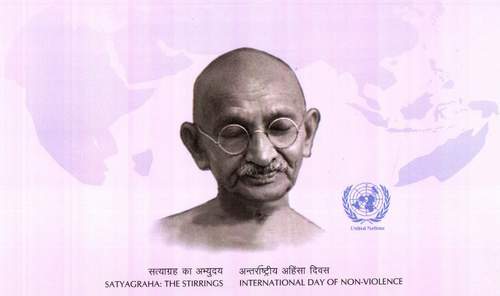


With the support of the ruling Congress Party, India brought the idea to the U.N. General Assembly, which acted with unusual speed adopting the proposal on June 15 of the same year.  The resolution called on member states to commemorate October 2 in “an appropriate manner and disseminate the message of non-violence, including through education and public awareness.”
The first year celebration was marked by the issuance of a postal cachet by the United Nations Postal Administration in New York City which was used on all outgoing U.N. mail between October 2 and 31 of that year.
Since then celebrations in most countries outside of India and South Africa have been, at best, muted.
Perhaps that is because the Non-Violence promoted by the commemoration is not just a sort of vague warm fuzzy pacifism, but an active strategy for social change.  The U.N. puts it this way:
One key tenet of the theory of non-violence is that the power of rulers depends on the consent of the population, and non-violence therefore seeks to undermine such power through withdrawal of the consent and cooperation of the populace.
There are three main categories of non-violence action:
protest and persuasion, including marches and vigils;
non-cooperation; and
non-violent intervention, such as blockades and occupations.
Gee, that sounds like the last thing most regimes want to happen.
Maybe today is a good day to dust off this neglected celebration….in the streets.  Seems to me we have plenty of reasons to do it….


Friday, October 12, 2012

About That Shoe Banging…

This poorly doctored photo was the main "evidence" of the Great Shoe Pounding Incident of 1960


For those of us of a certain rare vintage, the image of the Evil Dictator of Communist Russia, an ugly little man who resembled a pig, pounding his shoe on a table at the United Nations confirmed our worst fears that the possibility of a nuclear World War III was in the hands of a crude mad man.  And that’s exactly what we were supposed to think.
According to most of the almanacs I consult regularly in preparation of these blog posts, it was October 12 1960 when Nikita Khrushchev, First Secretary of the Communist Party and Premier of the Soviet Union threw that famous temper tantrum.
But it turns out that it may have been September 23 or 29, or October 13 during the 902nd Plenary Meeting of the UN General Assembly in New York.  It may have come in protest to a speech by British Prime Minister Harold Macmillan or remarks by Philippine delegate Lorenzo Sumulong.  He was visibly upset by statements of both men.
He may have banged his shoe at the podium…or at his seat in the Soviet delegation…or perhaps not at all.
And the old man was not really a dictator, as in the single, unquestioned authority of the nation in the way of Hitler, Stalin, or Third World generalissimos.
How could we have gotten it so wrong?
The trouble is, there is no documentation of the event in the official records of the United Nations.  It was not mentioned in daily press reports of any of the possible dates.  No footage could be found in the archives of NBC and CBC, both of which covered the General Assembly regularly and often broadcast important speeches live.  Nor have any photograph of the episode been found—more on that later. 
Fuzzy accounts of the event have been pieced together from memories and memoirs, many of which don’t agree.
In retrospect, it is astonishing that the leader of one of the most powerful nations on earth came to the major city of his chief rival to sit for hours daily over a span of weeks for the meeting of the Security Council.  And he wasn’t the only one—Macmillan was only one of the top Western leaders who did the same, as did a parade of presidents, prime ministers, kings and despots from lesser nations.  If Dwight Eisenhower elected only to attend briefly to make his annual speech and to consult with world leaders in private meetings, the United States was represented at the top level by the Secretary of State as well as the Cabinet Ambassador to the world body.  It shows how important the UN was viewed in those distant days.
Most historians now discount the possibility that the shoe came off in September.  He did take to the podium, pounding his fists, in angry denunciation of Mcmillans’s speech that day.  Later an AP photo of that diatribe would be altered by someone and a shoe inserted into Khrushchev’s fist.  It was released and widely circulated by the media within weeks of the alleged event and not questioned at the time.  Who made the alteration and how did get to the media?  No one seems to know, but it has all of the earmarks of a classic intelligence service disinformation operation.
The consensus now is that it was Sumulong’s speech on October 12 that was the trigger.  The Philippine delegate rose in support of an anti-colonial resolution that had the support of the Soviets and their allies.  The delegate spoke as a representative of a nation with a colonial past which had achieved its independence.  Of course, the Philippines, while independent, were known as a staunch ally of their former colonial master, the United States.  Although the resolution was tailored to the remaining colonial holdings of the Western powers, Sumulong strayed from the topic at hand to offer a slap at the Soviet Union, “…It is our view that the declaration proposed by the Soviet Union should cover the inalienable right to independence not only of the peoples and territories which yet remain under the rule of Western colonial Powers, but also of the peoples of Eastern Europe and elsewhere which have been deprived of the free exercise of their civil and political rights and which have been swallowed up, so to speak, by the Soviet Union.”
An enraged Khrushchev was recognized on a point of order and rushed the podium. He shoved the Philippine diplomat aside and launched an extended diatribe calling Sumulong a “jerk, a stooge, and a lackey…a toady of American imperialism” and demanding that he be ruled out of order.  Assembly President Frederick Boland of Ireland did caution the Sumulong to “avoid wandering out into an argument which is certain to provoke further interventions.”  But Sumulong was permitted to continue his speech and Khrushchev returned to his seat in the Soviet delegation.
At least one person remembers the Soviet premier as using his shoe at the rostrum in this confrontation.
But most agree that it happened after he sat back down.  As the Filipino continued to speak, Khrushchev pounded both fists angrily on his desk, joined obediently by other members of the Soviet delegation and Eastern Bloc nations.  In fact, he pounded so hard that his watch stopped or flew off of his wrist—not speaking well of quality of Soviet consumer goods.  According to a memoir by Khrushchev’s daughter Nina, confirmed by interpreter Viktor Sukhodrev who sat next to him, he looked down and saw his shoe, which he had removed for some reason earlier and spontaneously picked it up and began pounding the table.  He never, as some reports had it, removed the shoe from his foot, a virtual impossibility in the cramped space of the desk and given his girth.
Decorum at the session soon broke down and it was gaveled to adjournment by President Boland, who was being abused and booed from the Soviet bloc seats.
However, other accounts do not remember or mention the shoe at all.
To make matters even more confusing in his own memoirs Khrushchev remembered a shoe pounding incident but placed it in an entirely different context—a protest to remarks by a diplomat from Franco’s Spain.  A later published edition, however, contained a foot note saying that the incident was misremembered.
No matter what happened, Americans were soon convinced that Khrushchev was an arch-villain and dictator.  In fact, although he had consolidated considerable power in the party, Khrushchev was never able to rule alone.  He was answerable to the Presidium of the Party and to the larger Polit Bureau, each of which included powerful party rivals who limited his freedom of action.
Moreover, in the Soviet sense, Khrushchev was a liberal and reformer.  Not only had he engineered the ouster of a real dictator, Joseph Stalin, he had presided over de-Stalinization of the party.  He had also loosened economic regulations, liberalized the still restricted freedom of writers and intellectuals to express themselves, and had been a general break on the most aggressive military ambitions of hard liners.  Western intelligence agencies undoubtedly knew all of this.
In fact, four years later Khrushchev was deposed by the hardliners led by Leonid Brezhnev.
But in order to keep up public support for continued high defense spending and the proclaimed policy of aggressive containment of Communism, it was necessary to paint the Soviet leaders in the same stark terms the county’s late enemies in World War II.
All of this should be kept well in mind as one after another leaders of small and weak nations are portrayed to the American people as, inevitably, Hitlers.