Showing posts with label War of the First Coalition. Show all posts

Monday, February 24, 2025

The Last Invasion of Britain Was an Opéra Boufee Farce

The whole saga of The Last Invasion of Britain is told on the panoramic Fishguard Tapestry from beginning to end and is on display in its own museum in the Welsh village.  Captioned in Welsh and English it begins here with the spotting of the French fleet.

On February 24, 1797 the remnants of a star crossed French invasion surrendered to local Welsh and English forces raised mostly from the local yeomanry.

It began as a diversion to a diversion, an ill planned and worse executed scheme to draw British troops from Continental Europe where they were engaged in the struggle with revolutionary France known as the War of the First Coalition.  But for Wolfe Tone and the United Irishmen, the tawdry affair was the beginning of a collapse of a great dream of Irish Independence secured with the assistance of French arms.

At the instigation of Tone, an Anglo-Irish idealist then serving as an officer in the French Army while trying to lead from exile the growing United Irishmen movement he had founded in his homeland, the French Directory authorized a complex and ambitious plan put forward by General Louis Lazare Hoche.  Tone had promised the French that 30, 000 United Irishmen would lead a mass popular uprising with the support of a fairly modest French invasion.  As a diversion to the main effort in Ireland, Hoche planned two more limited raids on the British home island.  The most significant would land in Wales and then march to Bristol to sack and burn the city.


Wolfe Tone was a Protestant Anglo-Irish patriot and founder of the United Irishmen.  As a French officer during the post-revolutionary wars, he convinced the French Directory to lend troops to an invasion of Ireland meant to trigger a general uprising against the English. 

Tone issued bloodthirsty manifestos smuggled into Ireland calling for the uprising and urging no quarter to British troops.  The stage was set for the great adventure.

On December 15, 1796, 43 ships carrying about 14,450 men and an arsenal war material for distribution in Ireland sailed from Brest.  Tone accompanied Hoche under the nom du guerre Adjutant General Smith, a thin disguise meant to protect him should he be captured by the British. 

The planned three prong operation had already fallen apart.  The main force for the actual invasion of Ireland arrived off Bantry Bay on the west coast but was prevented by high winter seas from attempting a landing.  The naval and troop carrier commanders were, in Tone’s acid opinion, largely incompetent.  After a heavy gale nearly destroyed the fleet, it had to limp back to France.

La Légion des Francs, under General Quantain, was instructed to attack Newcastle upon Tyne and destroy local shipping. It had set out from Dunkirk in November of 1796 but turned back in Dutch waters after bad weather had swamped several of the invasion barges.  The troops, mostly impressed convicts and even British prisoners of war, mutinied back in port and refused to re-embark for a second attempt. 

Astoundingly, the third force, a flotilla of French warships, now with no main effort to support, left Brest flying Russian colors on February 16, 1797 headed for Britain.

Young French General Louis Lazare Hoche was Tone's friend and ally and devised the plan for the Irish invastion that included two diversionary raids on the British home island.   Nothing worked as planned.

The second diversionary force was La Légion Noire (The Black Legion), a fierce sounding name for a rag-tag brigade sized force of 1,400 men and 46 officers.  Like the ill-fated Légion des Francs, it was also made up mostly of half-trained conscripts described, charitably, as irregulars.  But the was a core of the force were 600 Grenadiers of the line. The unit took its name from its uniforms, which were captured English redcoats that had been poorly died to a range of colors from muddy brown to a sooty black. Their trousers were a ludicrous and unmilitary  The poor condition of their outfits was an indication that the French command saw them as doomed pawns.  The unit was under the command of an Irish American, chef de brigade (colonel) William Tate who could not speak French and had to communicate with his men through translators.  Several of his subordinate officers were Irish, as well.

At least the warships under the command of Commodore Castagnier were first rate.  They included the frigates La Vengeance and La Resistance on her maiden voyage, the corvette La Constance, and Le Vautour a smaller lugger.  The plan was to provide cover for and land troops near Bristol, then to dash north to rendezvous with Hoche’s shattered fleet to provide them cover and protection on the limp home.  Of course, that meant that the small invasion force would be abandoned on the home island of the enemy.  What could possibly go wrong?

Apparently, a lot.  The same high seas and winds that had scattered Hoche’s fleet prevented a landing as originally planned.  Castagnier was forced to turn around and try to land at secondary choice, Cardigan Bay on the west coast of Wales.  Making its way through the Bristol Channel, the flotilla was spotted from land and despite now flying English colors was identified as hostile.  Surprise was gone.

La Vegengeance and La Resistance land their Troops in Cardigan Bay in Wales, unable to land nearer their target of Bristol.  Troops under Irish-American Col. Robert Tate had already taken the crest of the shore cliffs.  What looks at first glance like and American flag on the hill and on the ships is a French ensign.

At 2 in the morning of on February 22, 1797, the French landed 17 boatloads of troops, 47 barrels of gunpowder, 50 tons of cartridges and grenades, and 2,000 stands of arms. One boat was lost in the surf and sank, with the critical loss of artillery and ammunition.Lieutenant-Colonel Thomas Knox of the 400-man local Fishguard and Newport Volunteer Infantry had already been alerted of the invasion force and was mobilizing his troops.  In addition, other units in the region were rushing to the invasion site including Lord Cawdors Castlemartin Troop of the Pembroke Yeomanry Cavalry the along with the Pembroke Volunteers and the Cardiganshire MilitiaLieutenant-Colonel Colby of the Pembrokeshire Militia assembled 250 men.  A Royal Navy pressgang, tough thugs usually employed in emptying sea side pubs of drunken sailors and swooping up un-alert farm lads from the fields, 150 strong also landed with several pieces of artillery.  All began converging on the threat.  Lord Cawdor assumed overall command.

At dawn after a three-mile forced march from the landing site, Tate’s men looked down from the surrounding hills at the small port of Fishguard.  They observed it bustling with activity, no doubt stirred by the fast flying word of the invasion.  A good many women were assembled in the market dressed in a traditional local costume which included high black hats and scarlet shawls.  From the distance they apparently were mistaken for Redcoats in black shakos sending some of the ill trained irregulars into a near panic.

None-the-less the French began to push inland, capturing several farm houses.  Some of the irregulars broke loose and began pillaging the farmsteads and rural hamlets for loot, dashing the unrealistic hopes that the Celtic Welsh might see the invasion as liberators and rise up against English rule.

Tate was left with only a handful of his irregulars, mostly Irish exiles, and his regular Grenadiers.  He set up a headquarters and occupied strong defensive positions on the high rocky outcrops of Garnwnda and Carngelli.  

On February 23 the two hundred or so local militia at Fishguard under colonel Knox, re-enforced by an influx of angry civilian volunteers armed with scythes, pitch forks, pikes, and other odd implements, began a retreat from the port after realizing that they were facing a much larger force.  But they encountered Lord Cawdor’s hastily assembled force and turned around to join his march to meet the enemy.

As they advanced, Tate’s forces began to fall apart.  Conscripts discovered a warehouse of Portuguese wine and began drinking heavily.  Many, especially impressed English prisoners of war, simply deserted.  Most of the rest were soon drunk or sick in farm houses scattered about.


Enshrined on the Fishgaurd Tapestry farm wife Jemima Nicholas single handedly captured a dozen drunk French conscripts in their shabby uniforms and became a legend along with her traditional Welsh dress and high black hat.

One local farm wife, Jemima Nicholas, armed only with a pitchfork rounded up 12 of the drunken conscripts and locked them in St. Marys Church in the town.

That evening Cawdor and 600 men advanced from Fishguard on the French strong points but turned back fearing ambush.  But Tate’s men saw the size of the well-armed forces against them, including artillery.  Knowing that the fleet had already abandoned them, his officers began to council surrender.

The Pembroke Yeomanry and and other British troops form on the sands to accept the formal French surrender on February 24.

 The morning of the 24 two French officers entered Cawdor’s camp under a white flag to attempt to negotiate an honorable surrender with safety guaranteed Irish officers.  Cawdor refused the terms and set a 10 am deadline for unconditional surrender or he would attack.  Part of that was bluff.  Cawdor still believed he was outnumbered and planned to await further reinforcements before an all-out assault.
The deadline passed, but Tate realized his position was hopeless and announced his unconditional surrender at 2 pm.  Tate and his men were taken prisoner, although rounding up all the deserters and stragglers took time.  Eventually Tate and most of the others were paroled and returned to France.  Some of the conscripts simply agreed to switch uniforms, some for the second time.

But the disaster was not over for the French.  On March 9 La Resistance, which had been crippled by the adverse weather in the Irish Sea and La Constance were captured after a short but bloody engagement with HMS St Fiorenzo and HMS Nymphe.  Both were re-fitted and commissioned in the Royal Navy.  Commodore Castagnier on board La Vengeance managed to escape to France.

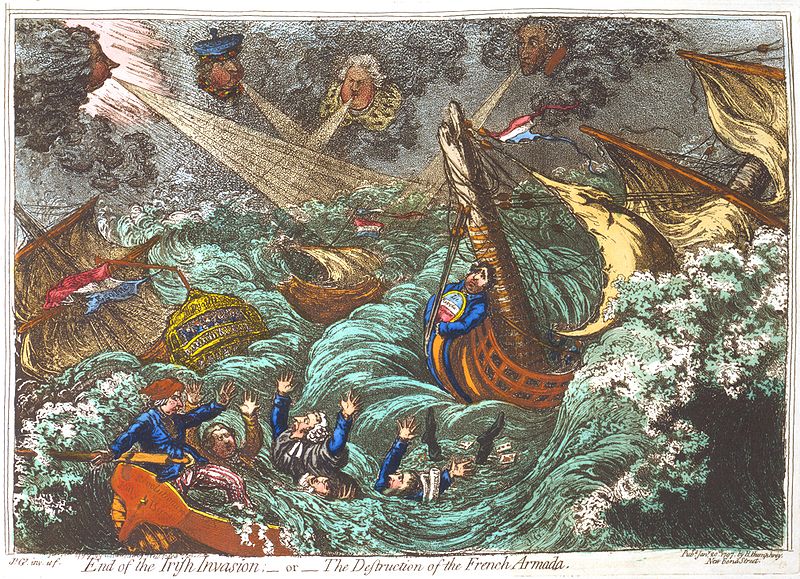
This tinted British print compared the damage to the French fleets to the destruction of the Spanish Armada more than 200 years before.  Perfect war time propaganda

As for Wolfe Tone, well he pressed for another invasion.  His ardent supporter Hoche died of tuberculosis and he found ascending French authorities, including Napoléon Bonaparte less enamored of his Irish schemes.  But when open rebellion broke out in Ireland and with Napoléon off on his Egyptian adventure, he persuaded the government to back a second expedition.

This time a force under General Humbert succeeded in landing near Killala, County Mayo and marching through the countryside gathering United Irishmen with “their pikes upon their shoulders” before it was smashed.  A second force broke up again in the raging seas, and the third, accompanied by Tone himself was intercepted by the Royal Navy.  Tone was taken prisoner.  He died of wounds of a botched suicide attempt after several days, but in time to cheat the hangman.

The pitiful and fruitless so-called Battle of Fishguard is now remembered as the last invasion of Great Britain. 

The Guidon of the Pembroke Yeomanry commemorates their famous victory.
 
In 1853 the Pembroke Yeomanry was awarded the battle honor “Fishguard” to be attached as a ribbon to their colors. It is the only regiment in the British Army, regular or territorial, which bears a battle honor for an engagement on the British mainland and the first battle honor awarded to a volunteer unit.


Monday, June 27, 2022

An Early Start—French Deploy Combat Aviation in 1794

L'Entreprenat  over the Battle of Fleurus.  Gen. Jourdan posing.

Although it was a very big deal at the time, unless you are a hard core military history geek chances are that you have never heard of the Battle of Fleurus in what is now Belgium on June 26, 1794.  For Americans it is just a blip in the blur of the near constant warfare between the French and pretty much everyone else in Europe from the 1792 and the final defeat of Napoleon in 1815.  Only the arrival of Napoleon on the scene results in serious attention the on-going struggles, a series of world wars.  When we picture the battles we see paintings of huge blocks of soldiers in towering high hats and brilliant uniforms marching with determined precision to their doom amid canon bombardment and charging cavalry.

Of course, there was that, but these epic battles were rife with carnage on an almost unimaginable scale.  The Battle at Fleurus, with 80,000 men engaged on each side, would be dwarfed by the numbers fighting in Napoleon’s most famous battles.  But it was large scale for its time and opened the door to eventual French victory in what became known as the War of the First Coalition.  And the key to that victory was likely the first use of an aircraft—a hydrogen observation balloon—in combat.

The war broke out in 1792 as the French Revolutionaries were establishing a government with King Louis XVI still sitting as a powerless figurehead on his throne.  Hapsburg Holy Roman Emperor Leopold II, brother of the French Queen Marie Antoinette, began to be alarmed by the advancing radicalism of the Revolution and began to fear for the safety of Bourbon royal family.  He whipped up an alliance with the rising star of the independent German states, King Frederick William II of Prussia and frightened French nobles and delivered an ultimatum demanding the French government guarantee the safety of the King.  The French Assembly responded with an ultimatum of their own—that the Austrians renounce alliances against France and withdraw troops from her borders.  When their ultimatum was ignored the Assembly, ironically in the name of King Louis, declared war on April 20, 1792.

At first the war went disastrously for the French.  Overconfident, they attempted an invasion of the Hapsburg Netherlands—Flanders—counting on an uprising of the local population against their foreign rulers.  But the French Army had been stripped of its experienced core of aristocratic senior officers and commanders, replacing them with junior officers and even non-commissioned officers.  Troops were ill supplied, organized, and suffered low morale.  Thousands deserted and some murdered the commander of the planned innovation, the Irish Wild Goose Théobald Dillon.

A largely Prussian Army with a corps of French Royalists crossed the Rhine and invaded France.  They rang up a string of victories at Longwy and Verdun.  The leader of the Royalists, king’s cousin, Louis Joseph de Bourbon, Prince de Condé joined the Austrians in issuing the Brunswick Manifesto which threatened French armies and towns that did not surrender unconditionally with execution and extermination under Martial Law.  The threat outraged much of the French public.  The Paris Mob responded by seizing the King and Queen leading to their death on the guillotine.

Meanwhile French artillery stopped allied advance at the otherwise stalemated battle of Valmy on September 20 and the Prussians later decided to withdraw across the Rhine for the winter.  That brought the new French Republic time to rebuild its army.  A draft of 300,000 men was levied to build up an overwhelming new force.  They were armed and trained.

Things went well for France in the south where it scored victories against Sardinia by occupying Savoy and Nice.  There were serious Royalist uprisings in the countryside.  As the new army entered the field, things began to look up for the French on other fronts as well.  Troops under the Comte de Custine invaded the German states and took Speyer, Worms, and Mainz along the Rhine and nearly reaching Frankfurt.  The former Foreign Minister turned General, Charles François Dumouriez led a second invasion of the Hapsburg Netherlands, beating the Austrians at Jemappes on November 6, 1792, and occupying the entire country by the beginning of winter.

Over that winter, however, things once again began to unravel.  After the execution of the King Britain, Spain, Portugal, Savoy, and the Dutch Republic entered the war on the Coalition side, opening new fronts and encouraging even more Royalist revolts in the provinces.  In response to the threats from the Royalists, increasingly the radicalized Revolutionary government began deeper purges of aristocrats, many of them liberals who had fought in America during our Revolution, in the Army which lost many officers down to almost the company level.  Demoralized survivors had to be wary of their backs.  Inexperienced officers had to learn on the job.  The French army was growing rapidly, but without experienced leadership lacked training.  Meanwhile the Austrians, Prussians and other Coalition members increased their own mobilizations to match the huge number of troops the French were trying to field.

In 1793 the French lost their gains in Germany and were pushed back in Flanders.  Royalist rebellions kept much of France in virtual civil war.  Defeats and setbacks for the Army were increasingly seen as betrayals by in Paris.  The radical Jacobins with support of the Paris mob was able to seize power and launch the Reign of Terror which sent thousands of aristocrats, Catholic clergy, wealthy merchants, and revolutionary rivals to the guillotine and by summary execution in areas of revolt.  In September of 1793 the Jacobins established the Committee on Public Safety to simultaneously prosecute the terror at home and rebuild, once again the Army with an even more sweeping mobilization of virtually all young able bodied men of military age.

The Committee on Public Safety planned on new operations against the Hapsburgs in Flanders for the following spring under the command of Jean-Baptiste Jourdan.  It also had something else up its sleeve.

Before the Revolution flights by hot air and hydrogen balloons had excited Paris.  Now members of the Committee on Public Safety were interested in developing the use of balloons for use as observation platforms.  Hot air balloons were quickly ruled out because they had limited time aloft due to the need to carry enough fuel to keep the balloon inflated and to the danger of the open flames required.   But gas balloons required hydrogen which was dangerous and expensive to generate using a process involving sulfuric acid to liberate it from water.  Experiments near conducted near the Tuileries in September confirmed that a new, cheaper process without the use of sulfuric acid could produce enough hydrogen and store it for military use.  In October they sent chemist Jean-Marie-Joseph Coutelle and his engineer Nicolas Lhomond north to join Jourdan’s army.  They brought with them the healthy sum of 50,000 Livre in coin to purchase the equipment locally to refine Hydrogen and build a balloon.  Jourdan was contemptuous of what he considered a hare-brained scheme and sent Coutelle and Lhomond packing back to Paris.


Jean-Marie-Joseph Coutelle, Captain of the Aerostatic Corps.  

There the committee ordered more experiments and tests to improve the gas production process and refine the design of the balloon, including the shape and size of the envelope.  After a series of test ascensions were witness by the Committee, the Aerostatic Corps was created on April 2, 1794 to consist of a captain and a lieutenant, a sergeant-major and sergeant, two corporals, and twenty privates, all required to have skills relevant to ballooning, such as chemistry and carpentry. Thus, the world’s first official and organized air corps was born.  Coutelle was commissioned Captain and Lhomond as his Lieutenant. 

They were once again dispatched north to Jourdan who had no choice but to add them to his forces, however reluctantly.  In Flanders by May Coutelle build the furnace necessary and finished work on the balloon that they had brought with them, the L’Entreprenant.  On June 2 the balloon was successfully launched for reconnaissance during an enemy bombardment.  That was the first ever military deployment of a balloon or any other form of air ship, although it did not then actively direct return fire. 

On June 12 nearly 70,000 of Jourdan’s 96,000 man Army of the Sambre-et-Meuse accompanied and “advised” by Louis de Saint-Just of the Committee on Public Safety (think of him as sort of an early version of a Red Army political commissar) had surrounded and laid siege the strategic city Charleroi on the Sambre River.  Four days later a force of 46,000 Austrians and Dutch counter attacked driving Saint-Just back across the river at Lambusart with heavy casualties.  Jourdan, however, bringing up his reserves, managed to take the city on June 26.


Walking the balloon to the battle with inset of its construction.

During these actions on June 22 Captain Coutelle finally got his orders to move his balloon forward to the Plain of Fleurus, in front of the Austrian troops still trying to lift the siege at Charleroi.  The balloon had to be inflated from the gas stored by the furnace.   Then 40 men holding the buoyant balloon down by tethers had to walk it cross countryside for more than 30 miles.  The journey took three days with Coutelle and his apparatus arriving at the front on June 24.  Thus they were in place for the action.

For three days either Coutelle or Lhomond went up on reconnaissance.  They helped spot the arrival of 55,000 fresh Austrian and Dutch troops under the command of the Prince of Saxe-Coburg who arrived shortly after Jourdan took the city.  The Austrian commander split his forces into five columns to attack Jourdan’s army.  Coutelle and his assistant Antoine Morlot stayed aloft for the nine long hours of the battle, monitoring Austrian maneuvers and dropping reports to the ground where troops then transmitted the information by semaphore to French headquarters. 

The Austrian attacks collapsed both of Jourdan’s wings, but he reinforced his center desperate charges and counter charges including hand-to-hand combat lasted all day.  Fighting continued into the night when the balloon was brought down for lack of light.  A senior French officer described the day as “Fifteen of the most desperate hours of fighting I saw in my life.”

In the end Coburg pulled his exhausted troops back to Braine-l’Alleud and Waterloo giving the French the victory despite having suffered much higher casualties.

Many observers credited the information supplied by the Aerostatic Corps as vital in helping set the defense.  But Jourdan denied they were of much use, perhaps to enhance his own reputation as a general who did not need newfangled toys to win a battle.

The battle was a turning point.  The newly confident French advanced through Flanders.  The balloon corps accompanied the army and was present at two more successful battles at Liege and Brussels but was not deployed.  It established a winter quarters at Borcette near Aachen.  The Hapsburgs were permanently ousted from the Low Countries and the Dutch Republic finished, to be replaced by a French puppet state.

The Aerostatic Corps was deemed a success and a second company was formed under Coutelle’s command with the first company given to a promoted Lhomond.  Both companies joined the next year’s invasion of Germany and once again were used for observation in a number of actions.

The execution of Robespierre and other Jacobin leaders.

Just a little more than a month after the battle, which greatly relieved the perceived danger to France from its foreign enemies, the mood in Paris shifted and the excesses of the Jacobins and Reign of Terror brought about a coup d’état on July 27, 1794—9 Thermidor Year II by the Revolutionary calendar.  Shortly after Robespierre and other Jacobin leaders went to the guillotine.  About the same time Saint-Just arrived back in Paris from the front expecting to be hailed as a hero for his part in the Flanders campaign.  He was immediately arrested and quickly fell under the Razor of the Revolution.

As for the war itself, one by one France picked off its enemies, destroying them like Holland or forcing them into humiliating separate peace treaties with loss of land.  First Prussia, then Spain and Portugal, Savoy, and finally Austria itself all sued for peace.  The First Coalition was shattered.  Britain was left to battle France alone.  And a young artillery officer named Napoleon Bonaparte achieved such great victories that he was elevated to the ruling Directory and had yet bigger things ahead.


Thursday, February 22, 2018

The Last Invasion of Britain Was a Comic Opera Farce

The whole saga of The Last Invasion of Britain is told on the panoramic Fishguard Tapestry from beginning to end and is on display in its own museum in the Welsh village.  Captioned in Welsh and English it begins here with the spotting of the French fleet.


It began as a diversion to a diversion, an ill planned and worse executed scheme to draw British troops from Continental Europe where they were engaged in the struggle with revolutionary France known as the War of the First Coalition.  But for Wolfe Tone and the United Irishmen, the tawdry affair was the beginning of a collapse of a great dream of Irish Independence secured with the assistance of French Arms.
At the instigation of Tone, an Anglo-Irish idealist then serving as an officer in the French Army while trying to lead from exile the growing United Irishmen movement he had founded in his homeland, the French Directory authorized a complex and ambitious plan put forward by General Louis Lazare Hoche.  Tone had promised the French that 30, 000 United Irishmen would lead a mass popular uprising with the support of a fairly modest French invasion.  As a diversion to the main effort in Ireland, Hoche planned two more limited raids on the British home island.  The most significant would land in Wales and then march to Bristol to sack and burn the city.

Wolfe Tone was a Protestant Anglo-Irish Patriot and founder of the United Irishmen.  As a French officer during the post-revolutionary wars, he convinced the French Directory to lend troops to an invasion of Ireland meant to trigger a general uprising against the English. 
Tone issued bloodthirsty manifestos smuggled into Ireland calling for the uprising and urging no quarter to British troops.  The stage was set for the great adventure.
On December 15, 1796, 43 ships carrying about 14,450 men and an arsenal war material for distribution in Ireland sailed from Brest.  Tone accompanied Hoche under the nom du guerre Adjutant General Smith, a thin disguise meant to protect him should he be captured by the British. 
The planned three prong operation had already fallen apart.  The main force for the actual invasion of Ireland arrived off Bantry Bay on the west coast but was prevented by high winter seas from attempting a landing.  The naval and troop carrier commanders were, in Tone’s acid opinion, largely incompetent.  After a heavy gale nearly destroyed the fleet, it had to limp back to France.
La Légion des Francs, under General Quantain, was instructed to attack Newcastle upon Tyne and destroy local shipping. It had set out from Dunkirk in November of 1796 but turned back in Dutch waters after bad weather had swamped several of the invasion barges.  The troops, mostly impressed convicts and even British prisoners of war, mutinied back in port and refused to re-embark for a second attempt. 
Astoundingly, the third force, a flotilla of French warships, now with no main effort to support, left Brest flying Russian colors on February 16, 1797 headed for Britain.

Young French General Louis Lazare Hoche was Tone's friend and ally and devised the plan for the Irish invastion that included two diversionary raids on the British home island.   Nothing worked as planned.
The second diversionary force was La Légion Noire (The Black Legion), a fierce sounding name for a rag-tag brigade sized force of 1,400 men and 46 officers.  Like the ill-fated Légion des Francs, it was also made up mostly of half-trained conscripts described, charitably, as irregulars.  But at the was a core of the force were 600 Grenadiers of the line. The unit took its name from its uniforms, which were captured English redcoats that had been poorly died to a range of colors from muddy brown to a sooty black. Their trousers were a ludicrous and unmilitary  The poor condition of their outfits was an indication that the French command saw them as doomed pawns.  The unit was under the command of an Irish American, chef de brigade (colonel) William Tate who could not speak French and had to communicate with his men through translators.  Several of his subordinate officers were Irish, as well.
At least the warships under the command of Commodore Castagnier were first rate.  They included the frigates La Vengeance and La Resistance on her maiden voyage, the corvette La Constance, and Le Vautour a smaller lugger.  The plan was to provide cover for and land troops near Bristol, then to dash north to rendezvous with Hoche’s shattered fleet to provide them cover and protection on the limp home.  Of course, that meant that the small invasion force would be abandoned on the home island of the enemy.  What could possibly go wrong?
Apparently, a lot.  The same high seas and winds that had scattered Hoche’s fleet prevented a landing as originally planned.  Castagnier was forced to turn around and try to land at secondary choice, Cardigan Bay on the west coast of Wales.  Making its way through the Bristol Channel, the flotilla was spotted from land and despite now flying English colors was identified as hostile.  Surprise was gone.

La Vegengeance and La Resistance land their Troops in Cardigan Bay in Wales, unable to land nearer their target of Bristol.  Troops under Irish-American Col. Robert Tate had already taken the crest of the shore cliffs.  What looks at first glance like and American flag on the hill and on the ships is a French ensign. 
At 2 in the morning of on February 22, 1797, the French landed 17 boatloads of troops, 47 barrels of gunpowder, 50 tons of cartridges and grenades, and 2,000 stands of arms. One boat was lost in the surf and sank, with the critical loss of artillery and ammunition.
Lieutenant-Colonel Thomas Knox of the 400-man local Fishguard & Newport Volunteer Infantry had already been alerted of the invasion force and was mobilizing his troops.  In addition, other units in the region were rushing to the invasion site including Lord Cawdor’s Castlemartin Troop of the Pembroke Yeomanry Cavalry the along with the Pembroke Volunteers and the Cardiganshire Militia.  Lieutenant-Colonel Colby of the Pembrokeshire Militia assembled 250 men.  A Royal Navy pressgang, tough thugs usually employed in emptying sea side pubs of drunken sailors and swooping up un-alert farm lads from the fields, 150 strong also landed with several pieces of artillery.  All began converging on the threat.  Lord Cawdor assumed overall command.
At dawn after a three-mile forced march from the landing site, Tate’s men looked down from the surrounding hills at the small port of Fishguard.  They observed it bustling with activity, no doubt stirred by the fast flying word of the invasion.  A good many woman were assembled in the market dressed in a traditional local costume which included high black hats and scarlet shawls.  From the distance they apparently were mistaken for Redcoats in black shakos sending some of the ill trained irregulars into a near panic.
None-the-less the French began to push inland, capturing several farm houses.  Some of the irregulars broke loose and began pillaging the farmsteads and rural hamlets for loot, dashing the unrealistic hopes that the Celtic Welsh might see the invasion as liberators and rise up against English rule.
Tate was left with only a handful of his irregulars, mostly Irish exiles, and his regular Grenadiers.  He set up a headquarters and occupied strong defensive positions on the high rocky outcrops of Garnwnda and Carngelli. 
On February 23 the two hundred or so local militia at Fishguard under colonel Knox, re-enforced by an influx of angry civilian volunteers armed with scythes, pitch forks, pikes, and other odd implements, began a retreat from the port after realizing that they were facing a much larger force.  But they encountered Lord Cawdor’s hastily assembled force and turned around to join his march to meet the enemy.
As they advanced, Tate’s forces began to fall apart.  Conscripts discovered a warehouse of Portuguese wine and began drinking heavily.  Many, especially impressed English prisoners of war, simply deserted.  Most of the rest were soon drunk and or sick in farm houses scattered about.

Enshrined on the Fishgaurd Tapestry farm wife Jemima Nicholas single handedly captured a dozen drunk French conscripts in their shabby uniforms and became a legend along with her traditional Welsh dress and high black hat.
One local farm wife, Jemima Nicholas, armed only with a pitchfork rounded up 12 of the drunken conscripts and locked them in St. Mary’s Church in the town.
That evening Cawdor and 600 men advanced from Fishguard on the French strong points but turned back fearing ambush.  But Tate’s men saw the size of the well-armed forces against them, including artillery.  Knowing that the fleet had already abandoned them, his officers began to council surrender.
The morning of the 24 two French officers entered Cawdor’s camp under a white flag to attempt to negotiate an honorable surrender with safety guaranteed Irish officers.  Cawdor refused the terms and set a 10 am deadline for unconditional surrender or he would attack.  Part of that was bluff.  Cawdor still believed he was outnumbered and planned to await further reinforcements before an all-out assault. 

The Pembroke Yeomanry and and other British toops form on the sands to accept the formal French surrender on February 24.

The deadline passed, but Tate realized his position was hopeless and announced his unconditional surrender at 2 pm.  Tate and his men were taken prisoner, although rounding up all the deserters and stragglers took time.  Eventually Tate and most of the others were paroled and returned to France.  Some of the conscripts simply agreed to switch uniforms, some for the second time.
But the disaster was not over for the French.  On March 9 La Resistance, which had been crippled by the adverse weather in the Irish Sea and La Constance were captured after a short but bloody engagement with HMS St Fiorenzo and HMS Nymphe.  Both were re-fitted and commissioned in the Royal Navy.  Commodore Castagnier on board La Vengeance managed to escape to France.

This tinted British print compared the damage to the French fleets to the destruction of the Spanish Armada more than 200 years before.  Perfect war time propaganda.
As for Wolfe Tone, well he pressed for another invasion.  His ardent supporter Hoche died of tuberculosis and he found ascending French authorities, including Napoléon Bonaparte less enamored of his Irish schemes.  But when open rebellion broke out in Ireland and with Napoléon off on his Egyptian adventure, he persuaded the government to back a second expedition.
This time a force under General Humbert succeeded in landing near Killala, County Mayo and marching through the countryside gathering United Irishmen with “their pikes upon their shoulders” before it was smashed.  A second force broke up again in the raging seas, and the third, accompanied by Tone himself was intercepted by the Royal Navy.  Tone was taken prisoner.  He died of wounds of a botched suicide attempt after several days, but in time to cheat the hangman.
The pitiful and fruitless so-called Battle of Fishguard is now remembered as the last invasion of Great Britain. 
The Guidon of the Pembroke Yeomanry commemorates their famous victory.
In 1853 the Pembroke Yeomanry was awarded the battle honorFishguard” to be attached as a ribbon to their colors. It is the only regiment in the British Army, regular or territorial, that bears a battle honor for an engagement on the British mainland and the first battle honor awarded to a volunteer unit.