Showing posts with label Wobblies. Show all posts

Sunday, November 2, 2025

Why Wobblies Filled the Jail in Spokane Free Speech Fight


 The IWW relied on street meetings like this one in New York state to organize workers.  When Spokane, Washington authorities tried to shut them down in 1909 they sparked a legendary Free Speech Fight.

It didn’t start out to be probably the greatest landmark battle for free speech and free assembly in American history.  It grew out of the practical, if militant concerns of a labor union trying to establish itself in an all important local industry—the lumber trade of the Pacific Northwest.  But on November 2, 1909 the Industrial Workers of the World (IWW) launched a Free Speech Fight in the streets of Spokane, Washington.  Before the first day was out 103 workers who tried to mount a literal wooden soap box on Stevens Street had been hauled off to jail.  Many were beaten or roughed up in the process.

The IWW was still a new outfit, but it was rapidly gaining a reputation for militancy and a willingness to organize unskilled laborers as well as skilled craftsmen and those employed in seasonal industries with unstable work forces.  The timber industry, in which the American Federation of Labor (AFL) had a small and ineffective presence limited to mill men and mechanics and which hired large gangs of workers off the streets of local towns in the months between the snows, was an enticing target.  Spokane was the center of the industry in western Washington.


Stevens Street in Spokane in 1909 before all hell broke out. 

By 1908 the union had established a branch with its own meeting hall, news stand, and canteen.  Members were mostly conducting regular educational meetings, hoping to build an organization.  They had also established a weekly newspaper, The Industrial Worker which eventually became the union’s chief western journal and eventually relocated to Chicago as the official organ of the whole organization.  It’s the same paper to which I contributed and edited in the 1970’s.

Progress was steady and the local members were convinced that given great dissatisfaction over the employment agency system through which men were hired for the lumber camps or big railroad construction jobs.  General Secretary William D. Big Bill Haywood and the General Executive Board in Chicago decided to dispatch one of the union’s top organizers to Spokane to help.

James H. Walsh was something of a firebrand organizer, but an effective one.  He had been working in Seattle and other lumber centers.  He felt that the leadership in Chicago had become too preoccupied with eastern factory struggles and were slipping toward “plain and simple” unionism devoid of class struggle and consciousness.  That summer he led a group of 20 men, lumberjacks, construction workers, casual laborers, to the IWW General Convention in Chicago.  The Overalls Brigade, as they came to be known, traveled across country riding the rails.  Their arrival at the convention in rough work clothes and dusty from days on the road grabbed everyone’s attention.  As did their demands for action in the West.  


Dolly Reed Walsh, wife of organizer James Walsh, made the trip to the 1908 IWW General Convention in Chicago hopping freight trains with the Overalls Brigade.  That was new in the Chicago Inter-Ocean.  She was photographed with 18 year old Wobbly orator Elizabeth Gurly Flynn.  Flynn did not make the trip, but went to Spokane for the Free Speech Fight and was arrested.  Confirmed photos of James Walsh hard to find.  Perhaps wisely, he was camera shy. 

Some officials may have been a bit intimidated. The Overalls Brigade literally drove Daniel DeLeon and his Socialist Labor Party faction to bolt the convention and set up a rival IWW in Detroit. Haywood was impressed.  He gave Walsh General Organizing Credentials and sent him to Spokane with a promise of support.

When Walsh arrived in September, he found a riot on Stevens Street.  The job sharks, as the 31 employment agencies that lined that strip were known, were up to their old tricks.  They would charge a man a dollar for a hiring ticket to remote lumber or construction camps.  They camps would only hire men referred by the agencies.  Corrupt foremen would keep men for a few days then find an excuse to fire them, making them beat their way back to town on their own.  The agencies paid the foremen kickbacks for churning the labor force.  The system was thoroughly corrupt, and everyone knew it.


Wobbly street meetings were aimed a attacking the job shark hiring system in the lumber industry.  The locally published Industrial Worker was another key organizing tool.  

On his first day in town Walsh found nearly 2000 men milling on Stevens street.  Rocks were  thrown through windows and some were gathering fuel and torches to burn down the agencies.  Walsh mounted a wagon and convinced the near mob that violence would only lead to suppression.  He must have been a hell of a speaker.  He invited the crowd to come to the IWW hall to discuss what to do or go home. 

All fall meetings at the hall were jammed as workers learned the basics of unionism and plans were hatched to find a way to end the agency system and replace it with an honest union hireling hall.  But disturbances still occasionally flared up on the street.  Walsh suspected Pinkertons or other spies were acting as provocateurs to open the door for the kind of mass armed suppression that was common in western labor struggles.

Walsh and other members regularly conducted street meetings. More and more men were taking out Red Cards and it was obvious that the union would soon conduct a major campaign. On January 17, 1909 the biggest mob yet, estimated at upwards of three thousand men, formed outside the Red Cross Agency—no relation to the venerable organization—one of the worst of the job sharks.  They had already shattered the windows with chunks of ice when Walsh arrived around 6 PM.  According to the local pro-business daily, The Spokesman Review, Walsh once again calmed the crowd telling them “There were a lot of hired Pinkertons in the crowd.  All they wanted you fellows to do was to start something and then they would have an excuse for shooting you down or smashing your heads in…You can gain nothing by resorting to mob rule.”


Halleluiah I'm a Bum by Haywire "Mac" McClintock was one of eight song printed on a song card in Spokane of tunes sung at IWW meetings.  It was the ancestor of the union's famous Little Red Songbooks. 

Even though the IWW’s street meetings were a demonstrably a brake on violence, the City Council was easily persuaded by the employment agencies and lumber interests to enact a local ordinance banning street meetings and protests.  By in large, the union tried to obey.  They scheduled almost daily meetings and educational programs at the hall and conducted most of their organizing on the street by selling copies of the Industrial Worker and the popular red card printed with union songs—the ancestor of the famous Little Red Song Book.

In the summer workers not in the lumber and construction camps largely left town to follow the crops as fruit pickers or in the threshing crews that so that the union hall easily accommodated most meetings.  But as migrants drifted back into town looking for work in the woods, it became apparent that outdoor meeting would be needed again.

Still, Walsh was reluctant to challenge the city—until they allowed the Salvation Army to conduct street meeting despite the law.  When appealing to the city council for fair and equal treatment failed the union decided it had to act.

In the October 23 issue of the Industrial Worker, which by then was widely circulated in the Northwest, the union issued its famous call:

Wanted:  Men to fill the jails of Spokane…Nov. 2 is Free Speech Day—IWW local will be notified by wire how many men to send, if any…Meetings will be orderly and no irregularities of any kind will be permitted.


Wobblies in Spokane getting their day in court. 

So, what has been described as the first mass peaceful civil disobedience in American history was on.  Hobos, bindle stiffs, and footloose Wobblies poured into town not waiting for direction from IWW locals.

The union set up its soap box on Stevens street.  One after another, men mounted it and began to speak.  Most got no further than announcing “Fellow Workers…” before they were dragged away.  The police, however, were so busy that one shy worker took his turn and when no one was on hand to immediately arrest him and too tongue-tied to give a speech simply bleated, “Where are the cops?”


An IWW cartoon depicting members marching into jail proclaiming that they were all "leaders and editors."  This Spartacus inspired declaration galvanized more "Footloose Wobblies" to flood the city. 

On day two there were plenty more men lined up to join their first 103 comrades.  And more every day after that.  Eventually more than 500 jammed the jail and second holding facility in a school.  Some men even refused to be released when their sentences were up.  The men were brutalized, under fed, subjected to horrific sanitation conditions.  Many showed up in court still bleeding from wounds.

Not all the Wobblies were men.  The original Rebel Girl, 16 year old Elizabeth Gurley Flynn, already known as one of the union’s greatest speakers, chained herself to a lamp post so that she could actually get her speech in before she was arrested.


A Free Speech fighter whose health was broken by brutal jail conditions in Spokane. 

Eight consecutive members got the Industrial Worker out with full reports on the campaign.  Each in turn was arrested.  City authorities tried to seize and suppress the December 10 issue of the paper which included Flynn’s scandalous charges that jailers were operation the women’s section of the jail as brothel and police were pimping.  The paper had to be temporarily moved to Seattle to continue printing.

The national press began to pay attention and sympathy for the Free Speech fighters grew.  Men still in the camps boycotted Spokane business.  The city’s reputation was being ruined and the cost of keeping so many in jail and paying for extra police was bankrupting the city, just as the union knew it would.

On March 4, 1910 the city ran up the white flag—it revoked the ordinance and released all the prisoners.  In addition, the worst 19 agencies lost their city licenses.  The union did not win a hiring hall, but the system of direct hires by the companies either in town or at the camps was established.  That allowed the IWW to effectively organize on the job, concentrating on tactics of direct action and solidarity.  Within a few years the union was strong enough to enforce an 8 hour day in the camps by the expediency of simply refusing to work longer or evacuate the camps if fired.  When workers burned filthy bedding on one day across the region, employers were forced to provide clean blankets, linens, and mattress pads.  Food improved.  The desperate timber beasts of old were transformed into clean and self-respecting working men.

The tactic of the Free Speech fight spread as other cities attempted to squelch public meetings.  A big one in Fresno, California erupted right on the heels of Spokane.  Over the next few years there would be dozens more, the largest in Seattle.  The results were always the same.

Eventually, at least until the post-World War I Red Scare, cities mostly gave up trying to restrict street meetings.  As for the union, it was glad to be able to refocus energy from the Free Speech fights and constant campaigns to support the class war prisoners, to be able to concentrate more on job action.

The sites of many IWW events in the Pacific Northwest have been commemorated with official state or local historical markers but not in Spokane where attempts to erase the memory of the fight continue.

But the IWW in these fights won the admiration and loyalty of a lot of workers, and the fear and hatred of the bosses.


Friday, November 4, 2022

An Ambush and Mass Murder Under Color of Law—The Everett Massacre

The IWW circulated this "silent agitator" sticker throughout the Pacific Northwest timber industry country in the wake of the ambush an murder.  A version was also used as a special assessment stamp to raise money for the Wobblies held on murder charges.

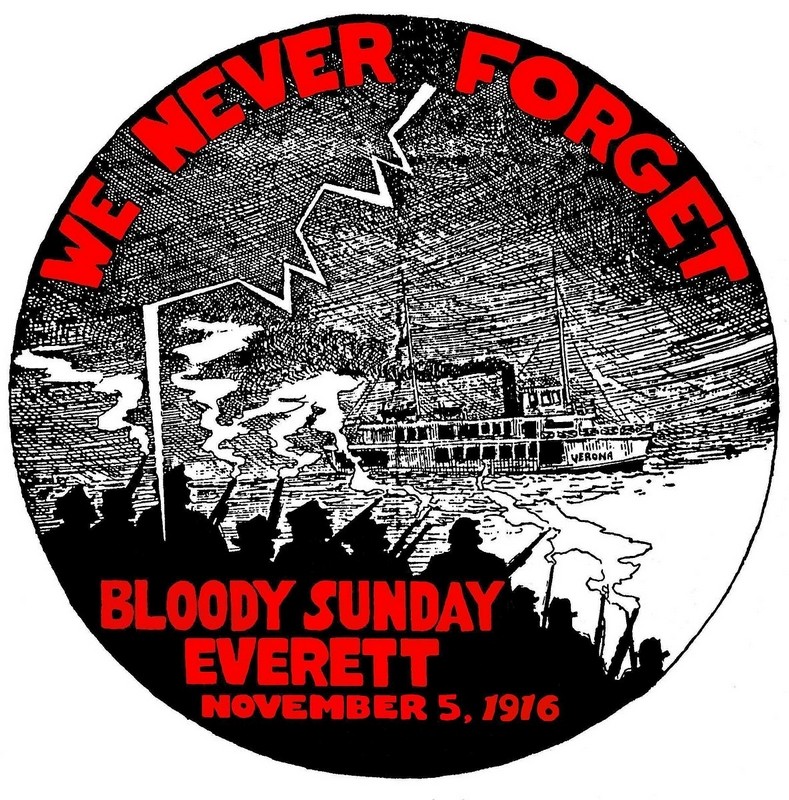
On November 5, 1916 two boatloads of Wobbly militants approached the dock of a Washington State lumber town.  They were coming to support a bitter strike by another and competing labor union.  For the IWW militants singing on the deck solidarity with fellow workers was more important than the union card in the overalls or dues button on a cap.  Before they could tie up, they were met by a hail of gun fire.  At least five were killed—others fell overboard and were never found—and more than two score treated for wounds.  When the boats limped back to Seattle, the survivors were arrested and put on trial for murder.  It was one of the most celebrated outrages of a bloody era of open class warfare.

Back in 1916 the town of Everett in the heart of Washington state’s timber region was not what you would call a labor friendly town.  The city and surrounding Snohomish County governments were firmly in the hands of lumber and commercial interests determined to keep any kind of unionism out of the woods.  And they meant to enforce their will with special deputies and vigilantes organized by the Commercial Club.  Things had been dangerous for unionists for some time.  On November 5 they turned deadly when two boats of Wobblies tried to dock for a rally in support of striking AFL Shingle weavers.

Shingle weaving was the highly dangerous craft of cutting cedar shakes using a series of saws and shears.  Many men lost fingers or hands in the unguarded equipment.

1916 was a panic year and around the country construction ground to a near halt and with it demand for lumber.  Already tense with long-term efforts of both the American Federation of Labor and the more militant Industrial Workers of the World (IWW) to organize in the woods, industry bosses decided to step up opposition

The IWW was especially feared.  It had already launched several Free Speech Fights clogging local jails with prisoners for the right to soap box.  That soap boxing was an important organizing tool to educate men and break the power of the job sharks who contracted labor for the remote lumber camps.  Worse, even without formal recognition, IWW job delegates were organizing in the camps, getting men to lay down their tools after 8 hours, burning vermin infested bedding, and abandoning camps entirely at critical production times.  The union was thus able to actually enforce working conditions even where the bosses would not speak to it.

                                An IWW recruitment cartoon highlighting the crowded and primitive conditions of the lumber camps.

The AFL, a union representing skilled craftsmen and ignoring more manual casual laborers, had been seen, however reluctantly by some, as a safety valve to keep workers out of the notorious Red union.  In other areas of the state the AFL had been able to gain recognition.

Not around Snohomish County.  When Shingle Weavers went out on strike for recognition that summer, they discovered just how determined authorities were to keep them out.  On August 19 a group of strikers were waylaid, ambushed, and trapped on a railway trestle outside of Everett and many were beaten severely with clubs, whips, and axe handles.

Relationships were often tense on the official level between the AFL and IWW.  The Seattle based IWW newspaper The Industrial Worker often derided conservative business unionism” and poked fun at workers swallowing the boss’s or AFL lines in Mr. Block Cartoon and in song lyrics by Joe Hill.  But on the principle of solidarity, there was no division.  IWW leadership and members determined to come to the aid of the besieged Shingle Weavers.

Despite being a former shingle weaver himself, Sheriff Donald McRae was ruthless in his organization of a local posse and company thugs in a series of brutal attacks on union members even before the day on the dock.

The Wobblies tried to open a hall in Everett.  Sheriff Donald McRae, who organized and led the legal posse and Commercial Club goons, quickly shut it down.  On September 11 IWW organizer James Rowan was seized and taken to the woods where he was sadistically beaten.  Responding to calls in the Industrial Worker for reinforcements over the next month or so about 400 Wobs drifted into town in groups only to be met by armed violence and driven away.

On October 30 about 40 harvest stiffs arrived from the wheat fields in eastern Washington.  They were rounded up as they arrived on freight trains and taken to a secluded railway crossing.  There they were made to run a gauntlet over a cattle crossing grating between lines of club wielding deputies.  All were gruesomely injured.  A committee of churchmen investigating the incident soon after reported finding the men’s skin, hair, and blood still sticking to the grating.  Their blistering report and plea to allow free speech to resume in Everett helped shift public opinion.  With the advice of the ministers, the IWW circulated a flyer in the town calling for a mass protest.

Meanwhile, the Shingle Weaver strike dragged on.  In Seattle IWW organizers decided it was fruitless and dangerous for small groups to try and come into town by rail.  It was decided to rally hundreds on a Sunday afternoon, bringing them down from the city on chartered boats for a scheduled rally at a local park.

Between 300 and 400 Wobs rallied at the Seattle hall and marched to the waterfront where they boarded two small steamers, the Verona carrying the bulk of them and the slower Calista carrying the overflow.

The Verona was well ahead when it pulled up to the dock in Everett.  The men on board were singing the IWW version of Hold the Fort.  Most crowed the rail on the dock side, eager to get off.  Sheriff McRae and 200 deputies met them.  Most were on or near the dock.  A few were hidden in a warehouse and others were on board a harbor tug, the Edison. 

The Verona managed to come into dock and got one line looped around a bollard.  Sheriff McRae stepped forward, pistol in hand and asked, “Who’s in charge there?”  In true Wobbly fashion and in the tradition of Spartacus the men on the boat yelled back, “We all are!”  McRae announced he was “upholding the law” and that the men would not be able to land.  “The hell we can’t,” was the unanimous response.

Seconds later a first shot was fired.  No source was ever identified, but almost immediately teen age Hugo Gerlot, who had shimmied up a mast to act as a lookout, fell dead to the deck.  Then the whole line of gunmen on the dock and those in the warehouse and on the Edison unloaded a terrible fusillade.

A sketch of the attack on the Verorna from the Everett City Dock.

On board the Verona, the Wobblies stampeded to the other side of the ship, causing it to nearly capsize and sending several into the waters Puget Sound where some drowned.  Firing kept up for almost 10 minutes.  The pilot house was later found to be peppered with more than 177 bullet holes.  Captain Chance Wiman only saved himself by crouching behind the ships safe.

After the ship righted itself from the near capsize, below deck engineer Shellgren frantically and blindly put the engines hard astern.  The line tying the ship to the dock finally snapped and she was able to pull away.  Wiman resumed his place at the wheel, but deputies using hunting rifles continued to pepper the retreating boat with sniper fire.  The Verona met the lagging Calista and frantically signaled her to turn around.

At least 5 Wobblies were known dead.  But no manifest was kept and many of the men had just arrived in Seattle in response to the Industrial Worker calls and were unknown to others on board.  Several men had gone overboard and not all were accounted for.  Some scholars of the event believe as many as 12 may actually have died of gunshot wounds or drown and their bodies either never recovered or hidden by Everett authorities.  27 would be treated for wounds in Seattle, and others undoubtedly likely suffered minor wounds untreated by medical personnel.

The death masks of the five known IWW dead.

There was carnage among the attackers, too.  Two men in the warehouse died, shot in the back by their fellow ambushers in the wild shooting as no incoming bullet holes were ever found in the building.  Ashore and on the dock 20, including Sheriff McCrae were injured.  Despite claims that they had been fired upon from the ship, no evidence of that was ever found.  IWW leaders regularly and routinely discouraged members from carrying guns.  Even if a handful had been armed with concealed handguns and managed to get off a shot or two, all the wounds were from long guns.  The Sheriff and his men were the victims of their own crossfire, especially fire from the Edison.

Despite this, when the Verona tied up in Seattle the passengers were arrested.  75 of them would be charged with murder.   IWW leader Thomas H. Tracy was the first to face trial in the hostile Snohomish County courthouse.  The trial dragged on for two months.  Mountains of testimony and evidence revealed that the shooting was planned by the posse, that IWW had either not been shooters or acted in self-defense, and that the deaths and injuries among the posse members were all “friendly fire.”  Tracy was acquitted in May 1917 and publicity around the case aroused considerable public sympathy for the IWW.  None of the other members charged were ever brought to trial.

IWW leader Tom Tracy was the first and only one of the Wobblies charged with murder who was  brought to trial.  He was acquitted.

As for the Shingle Weavers, well their AFL leaders never came to the defense of the IWW members who had died trying to aid them.  They eventually lost their strike.  Many of their former members took out Red Cards. 

With World War I once again ramping up demand for lumber and labor shortages as young men were drafted or enlisted, the IWW was able to exert greater than ever de facto job control in the region’s lumber camps.  Conditions improved, clean bedding was provided, plentiful and good quality food was on the mess table, the eight hour day strictly enforced, and the power of the job sharks at least temporarily broken.  This prevailed until after the war and a new wave of repression in the infamous Red Scare.

The Everett Massacre is one of several labor tragedies that occurred in November and which Wobblies annually commemorate with In November We Remember.  The other events include the execution of the Haymarket martyrs, Joe Hills death by firing squad, the lynching of Frank Little in Butte, Montana, and the Armistice Day 1919 attack by an American Legion mob on an IWW hall in Centralia, Washington and subsequent lynching of Wesley Everest.

A hundred years after the massacre the event was finally commemorated in Everett with this historic marker.

On a personal note, I spoke in Everett on an IWW soapboxing tour in 1970.  Not only was our street meeting allowed to go on unmolested, but I was interviewed by the local newspaper and featured in a front page article with a big photo.  The young reporter who conducted the interview said I was the first Wobbly the newspaper had actually talked to in its long history.  Later in Seattle on that same trip the old Norwegian lumber worker Herb Edwards took me to a nursing home and introduced me to one of the last surviving veterans of that awful day in 1916.