Showing posts with label anarchism. Show all posts

Friday, October 10, 2025

Joseph Labadie Anarchist Labor Leader and Hoarder Bequeathed a Lasting Legacy


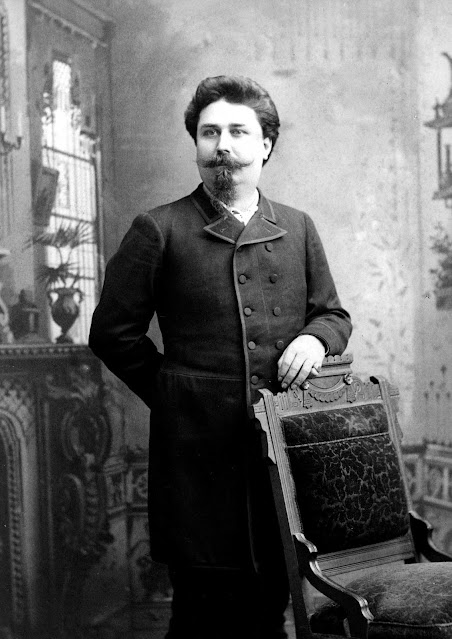
                                                 Joseph Labadie circa 1880. 

Joseph Labadie with his flowing moustache and imperial goatee cut quite a dashing figure as a young man and after his adoption of big wide-brimmed hats in his later years looked like he might have toured with Buffalo Bill Cody and Ned Buntline.  But he was one of the late 19th and early 20th Centurys leading anarchists and the only one to have a long career at the very center of the labor movement.

His background was strikingly different from most of the better known figures of the movement—the German Johann Most who introduced the European model featuring the idealization of the propaganda of the deed or immigrants like most of the Haymarket Martyrs, Emma Goldman, Alexander Berkman, and Carlo Tresca.  He was also unique among home grown anarchist figures like Bostonian Benjamin Tucker and former Confederate trooper, Texas Radical Republican, and Chicago labor leader Albert Parsons and his bi-racial wife Lucy Parsons.

He was born as Charles Joseph Antoine Labadie on April 18, 1850 in Paw Paw, Michigan into a French family who settled on both sides of the Detroit River when the land was claimed as New France.  Even at this late date the area was still frontier-like and as a boy spent much time fishing and hunting with the Potawatomi tribes in southern Michigan, where his father served as interpreter between Jesuit missionaries and the native tribes.  He deeply admired their culture, especially a sense of communalism. 

His only formal schooling was a few months in a parochial school.  But he was bright, inquisitive, and read everything he could lay his hands on.  He must have had some informal apprentice training because by his late teens he became a tramp printer, literally packing a small press and type font cases on his back or in a pushcart as he made a circuit of small towns and farming villages.  The life on the road was an eye-opening experience in and of itself. 

After five years on the road, Labadie settled in Detroit where he became a typesetter at the Detroit Post and Tribune.  He joined Typographical Union Local No. 18, rapidly rose in its leadership and was one of its two delegates to the International Typographical Union convention in Detroit in 1878.
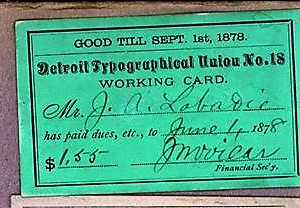
 

Labadie's dues card for the Detroit Typographical Union No. 18.  His vast collection of included every dues card he ever had. 

He married his first cousin, Sophie Elizabeth Archambeau, in 1877. Together they had a happy marriage and raised three children Laura, Charlotte, and Laurance, who also became a prominent anarchist essayist.

Labor conditions of the post—Civil War Era of rapid industrialization were brutal and labor unrest was sweeping the country culminating in the Great Railway Strike of 1877.  Although Detroit was only on the fringes of that epic battle it inspired Labadie as it did his fellow typographer in Chicago, Albert Parsons.  Like Parsons he joined the early Socialist Labor Party, which included all sorts of radical tendencies and was soon a familiar sight handing out its tracts and pamphlets on the streets of Detroit.  He was gaining a reputation.

Like others of the era, he dabbled in several radical ventures while slowly evolving his unique political philosophy.  In 1878 he organized Detroit’s first assembly of the Knights of Labor and ran unsuccessfully for Mayor on the Greenback-Labor ticket.  In 1880 he served as the first President of the Detroit Trades Council which united both Knights lodges and craft unions. He also founded the Michigan Federation of Labor.

His positions with the Detroit Trades Council and the Michigan Federation of Labor eventually made him a de facto ally of Samuel Gompers and the emerging American Federation of Labor (AFL) although the relationship was often strained and tenuous.

Labadie also edited a succession of local labor papers and began contributing articles and columns to several other publications including the Detroit Times, Advance and Labor Leaf, Labor Review, The Socialist, and the Lansing Sentinel.  His long running opinion column Cranky Notions was carried widely and admired for its forthright style and humor.
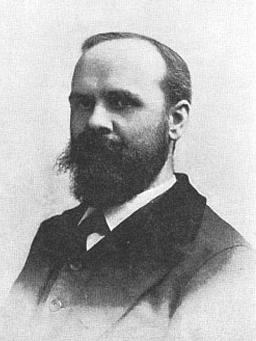
 

                                                 Labadie became a supporter of individualist anarchist Benjamin Tucker.

In 1883 Labadie announced that he was embracing the individual anarchism of Benjamin Tucker.  It was a somewhat odd and contradictory association that he never renounced even though his commitment to an organized labor movement was at odds with Tucker.   But both renounced violence and owed much to the philosophy of the American Universalist anarcho-pacifist Aden Ballou, Russian Mikhail Bakunin, and presaged the work of Leo Tolstoy.

Nominally accepting identity as a socialist in the days before Marxism solidified as the dominant trend in the international labor movement, Tucker rejected any permanent or transitional state involvement and advocated for a free market solution.   Tucker wrote

The fact that one class of men are dependent for their living upon the sale of their labor, while another class of men are relieved of the necessity of labour by being legally privileged to sell something that is not labour...And to such a state of things I am as much opposed as any one. But the minute you remove privilege...every man will be a labourer exchanging with fellow-labourers...What Anarchistic-Socialism aims to abolish is usury... It wants to deprive capital of its reward.

Tucker also rejected organized labor unions and their intermediate reform demands like the eight hour day and minimum wage laws.  He believed instead that strikes should be organized by free workers rather than by bureaucratic union officials and organizations and that such spontaneous uprisings would lead to the collapse of the state.  Labadie was sympathetic in the abstract but as a practical leader he never abandoned the labor movement which he continued to serve the rest of his life.  In fact, no other anarchist ever had a longer or more fruitful association with organized labor that Labadie.

Both Tucker and Labadie were initially critical of the violence advocated by the German anarchists and the Haymarket defendants.  But both became active in international defense efforts because they did not believe they were the sole perpetrators of violence. Labadie broke with the Knights of Labor when Grandmaster Workman Terrance V. Powderly their national leader, repudiated the defendants completely.

Without the oppression of the state, Labadie believed, humans would choose to harmonize with “the great natural laws...without robbing [their] fellows through interest, profit, rent and taxes.” But sometimes at odds with Tucker, he supported localized public cooperation and was an advocate for community control of water utilities, streets, and railroads.

By the turn of the 20th Century the great majority of the labor left of the anarchist movement rejected Tuckerism and became centered on anarcho-syndicalism which viewed labor unions as the natural building blocks of a society without state oppression.  Today Tucker is considered the inspiration for modern libertarianism.  Labadie’s association with him has tainted his reputation on the left.
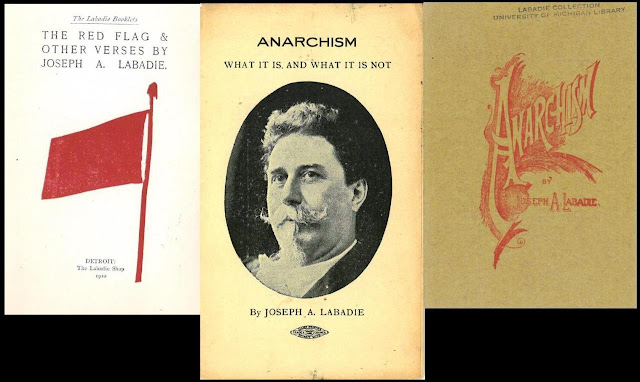
 

Some of the pamphlets and books that Labadie issued on his own press. 

After the turn of the Century Labadie also began writing poetry and issuing both prose and verse publications that he handcrafted using his skills as a typographer.  In 1908 a zealous postal inspector refused to handle his mail because it bore stickers with anarchist quotations. After the ensuing uproar the Detroit Water Board, where Labadie then worked as a clerk, fired him for expressing anarchist sentiments.  But by then he was a beloved figure in the city not only with the labor movement but with much of the public which admired him as the “Gentle Anarchist.” In both cases the officials were forced to back down in the face of mass public protests in support. 
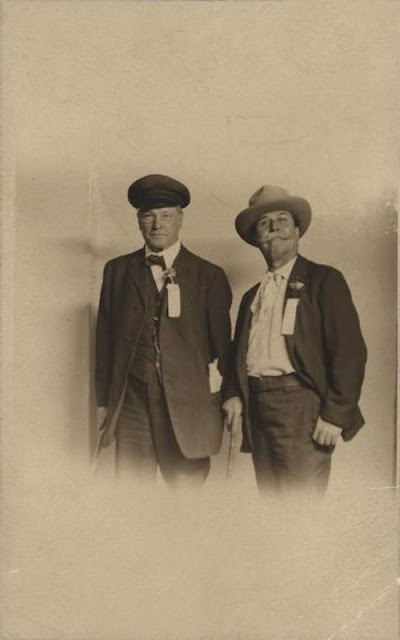
 

Labadie and Judson Grennell, labor editor of the Detroit News at a union convention in 1918.  The two had been friends and comrades since they both worked together in the same print shop in 1877. 

Despite his considerable achievements his best remembered because he was something of a hoarder—he never threw any scrap of paper the passed through his hands or over his desk away.  That included all his personal manuscripts and coorespondence with figures like Tucker, Powderly, Albert and Lucy Parsons, Voltairine de Cleyre, Emma Goldman, Gompers, and Eugene V. Debs; clippings of articles; copies of pamphlets, leaflets, and handbills; posters; and photographs.  Significantly it also included records of all the organizations he was part of or related to including membership rolls, meeting minutes, by-laws and constitutions, ledgers and invoices, correspondence, invitations to programs and social occations, and the badges and ribbons of membership and for attendance at meetings, conventions, and even funerals.  Taken together the collection that filled the attic of his home constituted the most complete and detailed archive of labor, socialist, anarchist activity of almost forty years, including the ephemora that rarely survives.

Labadie knew his collection would be a gold mine for historians.  Arround 1910 he began to look for a repository that would value, cataloge, and maintain it.  The libraries of Johns Hopkins Univeristy and Michigan State in East Lancing expressed interest.  The University of Wisconsin in Madison vigorously pursued it and made an attractive offer to purchase the collection which would have been a great boon to Labadie who was still a poor man and near the end of his working life.

But he was determined to place his collection at the University of Michigan in near-by Ann Arbor, close enough for him to make regular visits.  The U of M was more than coy.  It sent an inspector to Labadie’s home to determine the value of the collection.  He returned a negative report that scorned it as a useless “mass of stuff.”  The school demurred on several offers.  Finnally nine Detroit residents, including several businessmen donated $100 each to purchase of the collection, which was then donated to the university with requisite pomp.  The university did not have to directly pay the notorious anarchist. 

In 1912 twenty crates of material were moved from Labadie’s attic to Ann Arbor.  Labadie spent the remaining years of his life soliciting contributions of additional material from his wide circle of friends and aquaintences across the labor and radical movements.  But the University did not seem to know what to do with the ever-increasing mass.  The material remained un-sorted and uncatalogued and was kept in  receiving boxes in a locked room of the library.  Any interested researcher was given a key to the room and left to his or her own devices to sort through the mass.  Undoubtably some material was removed by some of the researchers and lost.

Shortly before his death, Labadie sent another large consignment of material to the University.

He died on October 7, 1933, in Detroit at the age of 83.
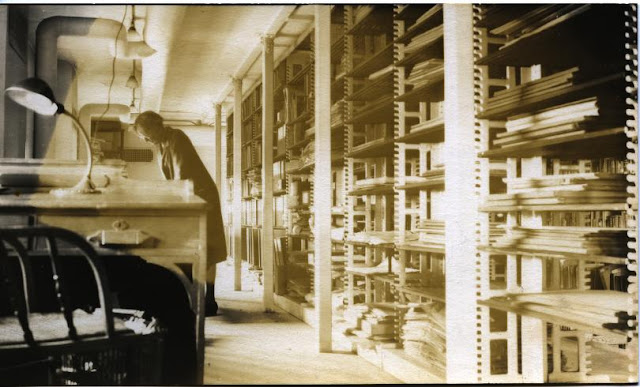
 

Iris Inglis working in the Labadie Collection in 1929. 

Wealthy Detroit activist Agnes Inglis began doing research in the Labadie Collection in the early 1920s.  Her inherent organizing instincts took over, and she stayed to sort out the materials and bring some order into the chaos. She stayed at the Labadie Collection for over 20 years as its unofficial curator. Inglis donated her time to the effort, working without a salary of any kind except for one brief period when she received a small stipend.

After Inglis died at age 81 on January 29, 1952 the administration did nothing to replace her and did not keep a promice to her to continue to collect contemporary radical and labor material.  The neglected collection was pillaged by researchers and collectors and Inglis’ careful catalogue system was disrupted and eventually lost.  Only her note cards on most items remained in disturbed card files.

In 1960 reference librarian Edward Weber was finally appointed as formal curator.  Weber also brought his own social/political interests to the job, which included the radical elements of sexual freedom, gay liberation, Freethought, and civil liberties. Because there was still no acquisitions budget, Weber relied on donations and sympathetic library workers, who adjusted accounts somehow and funneled subversive literature into the Collection. Weber was an outspoken critic of censorship and ignorance, as well as a prolific letter writer, and the extensive correspondence he generated throughout his 40-year tenure kept the Collection growing.

It was not until the mid-1970s that the Labadie Collection was finally given a book budget. Weber was, for the first time in the history of the Collection, able to make legitimate purchases.

In 1994 Julie Herrada was hired as the first Assistant Curator, and as the first trained archivist in the Labadie Collection. When Weber retired in 2000, Herrada took over as curator.
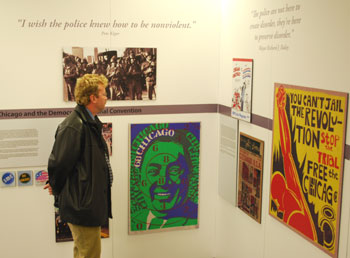
 

 Viewing an exhibit of radical posters from 1968 at the Labadie Collection.

The Collection currently contains over 50,000 books, 8,000 serials titles (including nearly 800 current periodical subscriptions) records and tape recordings of speeches, debates, songs, and oral histories, sheet music, buttons, posters, photographs, and comics. On the Labadie Collection’s website over 900 photographs can be viewed as well as the descriptions of over 100 archival collections, listings of some non-print materials, online exhibitions, and browse a directory of nearly 9,000 subject files.  

In short the Labadie Collection is the most comprehensive and still growing repository for radical American history.

That old hoarder would be proud.


Saturday, August 23, 2025

That Day They Finally Fried Sacco and Vanzetti


 Bartolomeo Vanzetti and Niccolo Sacco beings escorted to their trial.

Note—This is a near perennial post on the blog.  It is a critical chapter in American labor and radical history.

Left wing organizations—what was left of them—were forced to go on the defensive in the wake of the mass suppression and repression of the Red Scare following World War I.  For much of the following decade a lot of their organizational effort went into raising money and consciousness for the legal defense of scores of martyrs and for the support of the families of jailed militants.  The same pattern happened after the McCarthyite suppression of the 1950’s and in the backlash against student radicals, the anti-war movement, and militant Blacks and other minority movements in the early ’70s.

 But no case in any of these three eras attracted as much attention, indignation, and worldwide support as the case of Nicola Sacco and Bartolomeo Vanzetti, two immigrant Italian anarchists who were executed by the Commonwealth of Massachusetts on August 23, 1927. 

On April 15, 1920 an armed gang attacked a payroll shipment destined for the Slater-Morrill Shoe Company in Braintree, the ancestral hometown of John and John Quincy Adams.  Frederick Parmenter, a paymaster, and security guard Alessandro Berardelli were shot and killed and more than $15,000 cash—a major haul—was stolen.  The crime was part of an increasing wave of brazen robberies by armed gangs that spread across America in the years after the war. 

Police set a trap for suspects using a 1914 Oakland automobile believed to be used in the robbery as bait.  Sacco and Vanzetti accompanied two other men, both known members of their anarchist circle in attempting to reclaim the car from a garage.  The other suspects escaped.  Sacco and Vanzetti were soon arrested on a streetcar.  Each was carrying a pistol—which was both common and legal at the time.

Fearful that they were being targeted for deportation as many other members of their Italian anarchist community had been, both men originally lied to police about their political connections, which would later be used against them.  Amid sensational publicity, the two men were indicted for the crime. 

Sacco and Vanzetti both arrived in the United States from their native Italy in 1908 and settled in the Boston area, home of a large and growing immigrant community which provided hands for major local industries including textile and shoe manufacturing.  Sacco, then a 17 year old from Torremaggiore, Foggia got work as shoemaker.    Twenty year old Vanzetti from Villafalletto, Cuneo became a fish monger.  


Passport or immigration photos of Sacco and Vanzetti 1908. 

Both experienced the hostility and prejudice of New England Yankees to poverty stricken Italian immigrants and knew of the harsh conditions in mills and plants.  Each became a part of the loose knit anarchist community around Luigi Galleanis Cronaca Sovversiva (Subversive Chronicle), which advocated violent direct action against capitalists and the state.  Some members of the organization were known to make and use bombs as well as make other attacks.  Others supported the actions philosophically. 

Sacco and Vanzetti did not meet each other until working in support of a 1917 strike.  They became close friends and comrades.  Neither was considered a leader in the anarchist circle, although the more articulate Vanzetti sometimes was a speaker at meetings.  And neither had a criminal record, but both were known to local police for their activity as strike supporters and in demonstrations of the unemployed. 

During the suppression of radicals that began during the War, Luigi Galleani and his followers were top targets of the Bureau of Immigration for hasty deportation.  Galleani and dozens of others were sent packing.  Cronaca Sovversiva was banned from the U.S. Mail for advocating the overthrow of the government and opposing the Draft.  Sacco and Vanzetti were among a number of group members who went to Mexico during the war, allegedly to avoid the draft.  But the two claimed that they were only trying to avoid deportation to Italy and looking for a way to get to Russia to join the Revolution there.


                     Luigi Galleani, the Italian anarchist leader who promoted "propaganda of the deed."  Sacco and Vanzetti were associated with his circle.

At war’s end they returned to the U.S. and found their revolutionary comrades were largely driven underground and operating quietly in the Italian neighborhoods in something like secret cells. 

In preparation for the major case, Vanzetti was separately brought to trial in an earlier robbery in Bridgeport.  Virtually no evidence was presented tying him to that crime and a strong alibi supported by many witnesses, he was found guilty. Most of Vanzetti's witnesses were Italians who spoke English poorly, and their trial testimony, given largely in translation, was discounted by the American jury.  Vanzetti was given an unusually harsh sentence of 10-15 years in prison.  The success of that case encouraged prosecutors to pursue the Braintree case.  


Anarcho-syndicalist leader and IWW organizer Carlos Tresca organized the legal defense support for Sacco and Vanzetti for the IWW's General Defense Committee (GDC).  With his long time partner Elizabeth Gurley Flynn he also organized the International Legal Defense (ILD) which had ties to Marxism and Communist Parties. 

It became apparent that a fair trial would be next to impossible with prosecutors signaling that they were going to try the men more on their anarchism than on the evidence.  Enter Carlo Tresca, the best known Italian anarchist in America.  Tresca was an anarcho-syndicalist whose views were both more sophisticated than the Galleani circle and whose strategies relied on mass labor action rather than violent propaganda of the deed.  But he sympathized with his fellow Italians and, as he came to know them, admired them personally. 

Tresca was a leading organizer for Industrial Workers of the World (IWW) in the landmark Lawrence Strike of 1912 and had organized the defense of indicted Wobblies Arturo Giavanitti and Joe Ettor which had famously led to their acquittals for inciting a riot in which a young Italian mill worker was shot and killed by police.  Drawing on that experience, Tresca and Elizabeth Gurley Flynn, another Lawrence Strike leader and his sometimes lover, set out to organize mass support for the two men via newspaper articles, tracts and pamphlets, street corner oration, and mass demonstrations.  He also brought in the successful IWW lawyer from the Lawrence cases, Fred H. Moore.  To finance these operations, he mobilized the IWW’s General Defense Committee which raised funds from workers nationwide by the sale of inexpensive emergency defense stamps for membership cards.  The Committee was already well established and very busy with the follow up to the mass trials of IWW leaders by the Federal government and ongoing persecution by states. In addition, Flynn mobilized the International Labor Defense (ILD)


Even the conservative American Federation of Labor (AFL) rallied to the defense.   

Soon mass demonstrations were erupting not only in the U.S. but around the world.  And donations in support of Sacco and Vanzetti poured in.  Non-anarchist radical organizations, including the Socialist Party (SP) and the infant Communist Party (CP), while attempting to distance themselves from the men’s primitive anarchism joined in the defense as the case looked more and more like a railroad job. 

Moore decided it was no longer possible to defend Sacco and Vanzetti solely against the criminal charges of murder and robbery. Instead, he would have them frankly acknowledge their anarchism in court and try to establish that their arrest and prosecution stemmed from their radical activities.  He exposed the prosecution’s hidden motive—the desire to abet the Federal authorities in suppression of the Italian anarchist movement. 

After a six weeks long trial, presided over by a judge who referred to the defendants as anarchist bastards and during which the themes of patriotism and radicalism were often sharply contrasted by the prosecution and the defense, the jury found Sacco and Vanzetti guilty of robbery and murder on July 14, 1921.  But that was just the beginning. 

A long stream of competing investigations lay ahead as well as a blue ribbon panel made up of the toniest Boston Brahmins and endless court appeals.  After the men were condemned to death on what increasingly looked like shaky testimony and doctored physical evidence, the international protest grew.  The writer Anitole France, a veteran of the Dryfus Affair defense and fresh from winning the prestigious Nobel Prize penned an Appeal to the American People on behalf of Sacco and Vanzetti. 

In preparation for motions for a new trial Moore uncovered more damning evidence that the prosecution was a frame up.  Three key prosecution witnesses stated that they had been coerced into identifying Sacco at the scene of the crime, but when confronted they denied any coercion. One of them, nurse Lola Andrews told authorities that she was forced to sign an affidavit stating she had wrongfully identified Sacco and Vanzetti. She signed a counter-affidavit the following day. Another, Lewis Pelser, described how he had submitted to alleged prosecutorial coercion while drunk and signed a counter-affidavit shortly thereafter.  These conflicting accounts should have cast doubt on the testimony. 

Later it came to light that someone had switched the barrel of Sacco’s gun with that of another Colt automatic used for comparison, rendering that key physical evidence suspect.  Much later it was shown that the gun was outside of police custody for some time, disassembled and reassembled several times and that the shell casings and one bullet allegedly tying the gun to the robbery may themselves have been planted or switched. 

More eyewitnesses were found bolstering both men’s alibis—Vanzetti that he was selling Christmas eels and Sacco said that he was in Boston at the Italian Consulate renewing documents.  The presiding judge at both Vanzetti’s first trial and the combined Braintree case, Webster Thayer, consistently barred new evidence and denied all motions for a new trial on October 1, 1924.  His conduct during the hearings was so heavy handed that Boston Globe reporter Frank Sibley, who had covered the trial, wrote a protest to the Massachusetts Attorney General condemning Thayer’s blatant bias. 

Shortly after rejecting a new trial Thayer told a fellow attorney and Dartmouth alumnus, “Did you see what I did with those anarchistic bastards the other day? I guess that will hold them for a while ... Let them go to the Supreme Court now and see what they can get out of them.” 


 This demonstration in Paris was typical of those organized across the globe.

Public opinion was beginning to swing to Sacco and Vanzetti’s side, not because of sympathy for their politics, but because it became increasingly evident that they were being railroaded.

In 1924 Moore was replaced as chief defense council by William Thompson, a respected Boston lawyer with impeccable Brahmin connections.  The courtroom strategy swung back to legal technicalities. On May 12, 1926 the Massachusetts Supreme Judicial Court ruling not on the evidence but on Thayer’s conduct of the trial, ruled that it found no error. 

As Thompson turned to filing new appeals, support for the men continued to grow in radical, socialist, and now in respectable liberal circles. Felix Frankfurter, then a law professor at Harvard did more than any individual to rally respectable opinion behind the two men. 

Meanwhile the defense began to investigate a statement given in November 1925 by Celestino Medeiros, an ex-convict awaiting trial for murder, confessing to the Braintree robbery and absolving both Sacco and Vanzetti.  In May of 1926 Judge Thayer again took a hearing for a new trial based on the Medeiros confession, the striking resemblance between Sacco and known strong-arm gunman and gang leader Joe Morelli, an associate of Medeiros, and on Thompson’s frontal attack on Federal lawmen for withholding crucial evidence in the case.  Predictably, Thayer denied a new trial.    

The next day in a Pulitzer Prize winning editorial the Boston Herald called for a new trial.  No other major papers followed suit.  Frankfurter published his own forceful argument for a new trial in an influential article in the Atlantic Monthly.  

The Supreme Judicial Court held another hearing based on the Morelli testimony in January 1927 and ruled the following April against the appeal, upholding Thayer once again but, “not denying the truth of the new evidence.”  In other words, Sacco and Vanzetti might be innocent but it made no difference because the judge acted legally. 

Outrage was national and international as nothing now prevented the death sentence from being carried out. 

Biding their time away in prison, Saco and Vanzetti became used to their new celebrity.  They even began to regard their imprisonment as the work that they must do to further their revolutionary cause.  They impressed almost everyone who came in contact with them, ideological friend and foe alike, with their personal gentility and thoughtfulness. 

American and international intellectuals rallied to the cause.   John Dos Passos, Dorothy Parker, and Edna St. Vincent Millay were all arrested in Boston protesting the sentence.  Albert Einstein, George Bernard Shaw and H. G. Wells all joined in petitioning the governor for a new trial.  Demonstrations across the world stepped up, and there were some scattered reports of anarchist violence, particularly in Italy and among the large Italian immigrant population of Argentina. 

On April 9 Judge Thayer pronounced the death sentence on both men.  Bowing to public pressure for clemency Governor Alvan T. Fuller appointed a three member “blue ribbonAdvisory Committee to study the case consisting of Harvard President Abbott Lawrence Lowell, President Samuel Wesley Stratton of MIT, and Probate Judge Robert Grant.  Blue bloods Lowell and Grant were social acquaintances of Thayer and on record as opposing radicals and being disdainful of immigrants.  Grant had written several novels with ethnic slurs.  The only non Brahmin, Stratton, kept his mouth shut and head down as the council reported that it could find nothing wrong with Thayer’s conduct of the case, although they could not dispute the truth of the new evidence.  In other words, the defendants might not actually be guilty, but the verdict should stand because Thayer had not erred in his rulings. 

The Governor did not issue any commutation orders.  Tension mounted as the execution date entered.  The home of one juror was bombed.  Twenty thousand people jammed into Boston Common for a massive protest rally on August 15.  


The IWW and the General Defense Committee led the campaign to save Sacco and Vazzetti. 

The day of execution, Sacco went first.  He quietly sat in the chair then shouted “Viva l’anarchia!” and “Farewell, mia madre.”  The gentle Vanzetti shook hands with the staff and thanked them for courteous treatment.  He read a statement proclaiming his innocence and then, at the suggestion of his lawyer William Thompson said, “I wish to forgive some people for what they are now doing to me.” 

News of the executions set off sometimes violent demonstrations in Amsterdam, Berlin, Johannesburg, Geneva, London, Paris, and Tokyo.  Strikes erupted across Latin America.  In Boston more than 10,000 viewed the men’s bodies in open caskets before a massive funeral parade.  Police blocked the proposed route past the State House and there was some fighting with police.  After a brief ceremony at Forest Hill Cemetery the remains were cremated.  The Boston Globe said it was, “one of the most tremendous funerals of all time.”  Later Motion Picture Production Code sensor Will Hayes ordered all newsreel companies to destroy their footage of the funeral. 

The Letters of Sacco and Vanzetti were published in 1928 to worldwide acclaim.  Columnist Walter Lippmann wrote “If Sacco and Vanzetti were professional bandits, then historians and biographers who attempt to deduce character from personal documents might as well shut up shop. By every test that I know of for judging character, these are the letters of innocent men.”  And that summed up the prevailing opinion for the next forty years. 

The case entered American culture.  Dos Passos, Upton Sinclair, and James T. Farrell drew upon the case in their novels.  Maxwell Andersons play Winterset was based on the case.  Musicians around the world wrote songs.  A compilation of American protest songs by Woody Guthrie and Pete Seeger was released by Folkways in 1960.  Joan Baez recorded Heres to You using words from Vanzetti’s letters.  Marc Blitzstein was working on an opera when he died in 1960 which was completed posthumously by a collaborator and performed at the Metropolitan Opera.  Anton Coppola premiered his opera Sacco and Vanzetti in 2001.  There was an Italian film by Giuliano Montaldo in 1971.  


Woody Guthrie wrote and performed a whole album of songs about Sacco and Vaznetti.  

On the 50th anniversary of the execution in 1977 Governor Michael Dukakis declared Nicola Sacco and Bartolomeo Vanzetti Memorial Day and said that they had been unfairly tried and convicted and that “any disgrace should be forever removed from their names.”  In retaliation, Republicans attempted to have the governor censured by the legislature. 

The anniversary resulted in new interest in the case, and the emergence of revisionist opinion that one or both of the men were actually guilty of the Braintree robbery.  In 1961 Max Eastman, who had been active on the Sacco and Vanzetti Defense Committee claimed that in the late 1940’s Carlo Tresca had told him, “Sacco was guilty, but Vanzetti was innocent.”  Because Eastman had taken a sharp turn to the right and the article in which he made the claim was published in the conservative National Review, the claim was discounted by many. 

But other aging anarchists later reported hearing similar rumors.  This was countered by yet another confession, this time by gangster Frank Butsy Morelli, Joe’s brother. “We whacked them out, we killed those guys in the robbery…These two greaseballs Sacco and Vanzetti took it on the chin.”  Others revisited the gun evidence.  Some concluded that Sacco’s gun was definitely used in the crime while others argued that problems with switching the barrels, the repeated disassembly and assembly of the gun without proper supervision and the ample opportunity to plant or switch the bullet and cartridges should discount reliance on the gun to connect Sacco to the crime.  


The Sacco and Vanzetti memorial plaque in Boston.
 

Prevailing opinion seems to be that it was unlikely either man was actually at the robbery but that it may have been pulled off by anarchist comrades in conjunction with local toughs to finance the Galleani group’s bombing campaign.  There is also a feeling that the men may have been connected in at least supporting that campaign. 

Regardless of guilt or innocence, the trial was replete with class and ethnic prejudice and deeply flawed.  In the end Sacco and Vanzetti were just two more victims of America’s long war on dissent.