Showing posts with label martyr. Show all posts

Thursday, April 23, 2026

St. George and the Dragon Inspired Verse--National Poetry Month 2026


St. George in Myth.

Today is the Feast Day of St. George as observed in England where he became the nation’s Patron Saint and is represented on the Union Jack by the upright red cross.  George is also venerated by Orthodox Christians and is the Patron Saint of Greece, which explains why so many restaurant owners are named George.  But the Eastern and Western versions of why George is such a popular saint are very different.

Unlike some early popular saints there was apparently a historical George.   He was born around 256 Common Era probably in Palestine where his father, Gerontius, was a Patrician noble of Greek origin in the Roman Army occupying the province of Syria Palaestina.  The family was Christian.  George followed his father’s profession and rose rapidly in the Legions.  By his mid-twenties he was said to be a military tribune and stationed as an Imperial Guard of the Emperor at Nicomedia in northeast Asia Minor, then the capital of the eastern portion of the Roman Empire.  He was said to be a favorite of Galerius Caesar in the East under Diocletian, Augustus in Rome. 

George would likely have campaigned with Galerius against the Copts in Egypt and in the disastrous war with the Sassanid Persians.  Christians in the Army, especially senior officers were scapegoated for the loss.  In 305 A.D.  Diocletian, with Galerius’s support ordered all army officers to abandon Christianity and make public sacrifice to the Roman gods on pain of death.

George reportedly sold his slaves and gave away his wealth to the poor preparing to meet his fate.  Called personally before Galerius, the Emperor tried to convert his soldier and offered him new honors, titles, and lands as inducement.  George remained steadfast and was sentenced to death.  According to legend on his last night Galerius dispatched a comely virgin to George to remind him of the pleasures of the flesh, but instead of sleeping with her, he converted her on the spot, thus sealing the lass’s doom as well.

The next day, April 23, 303 CE George was beheaded but faced his fate with such equanimity that Empress Alexandra of Rome became a Christian as well and soon she joined George in martyrdom.

                                
                                        The elaborate Martyrdom of St. George by Renaissance master Paolo Veronese.  Note--no dragon.

George’s body was returned to his hometown of Lydda in Palestine for burial.  His crypt quickly became a shrine for pilgrims and a sect of veneration spread across the East.  He was the most prominent of the 14 Soldier Saints who fell to Diocletian’s persecution.  He is venerated among Orthodox Christians as one of the great martyrs of the Church and is especially adored by Greeks.

Historians quibble over the veracity of all of the details of this narrative, but most agree that there was soldier and that he was connected with the Diocletian persecution.

But you will notice the total absence of any mention of a dragon in this account, nor does the beast figure in Greek veneration or traditional iconography at least until the dragon tale is introduced from the West.

                               
                                            St. George, soldier saint, in a traditional style Greek icon.

George was so popular that the Muslims adopted him as a saint, transferring his martyrdom to the Kingdom of Mosul where he was said to have been executed three times and been resurrected from the dead each time.

George was officially canonized in the Western or Catholic Church in 494 by Pope Gelasius I, as among those “whose names are justly reverenced among men, but whose acts are known only to God,” which included other legendary figures like St. Christopher and St. Valentine.  Still, he was little known in the West until Crusaders brought his cult home, where it especially flourished in England and Sweden.  The knightly reverence for a soldier saint was key.

                    Horus slays Set as a crocodile in Egyptian myth--a model for St. George.

The origins of the Dragon story are somewhat obscure.  Elements of the tale may be traced to Egypt where the god Horus killed Set metamorphosed into a crocodile.  It may also have borrowed from the Muslim accounts with the dragon as a metaphor for the monster King of Mosul.  The Crusaders, however, were literalists, and the symbol may have been transformed into substance.

The earliest reference to a Dragon may have been in a 12th Century Latin text but the story began to be codified in the Speculum Historiale and the Golden Legend of the 13th Century.  The latter was especially the inspiration of bards, poets, and various versions of the tale started showing up across late Midlevel Europe. 

In Jacobus de Voragine’s Legenda aurea—The Golden Legend—Silene in Libya was plagued by a venom-spewing dragon dwelling in a nearby pond, poisoning the countryside.  The local people placated the dragon with gifts of sheep but the insatiable beast was soon demanding human sacrifices which were chosen by lot among the children.  Eventually the King’s daughter fell to the lottery and she was sent, dressed a bride, to meet her doom.  The king offered his fortune to save his favorite child.


The Marriage of St. George and the Princes from the Golden Legend by Dante Gabriel Rosset
ti.

Enter George, a virtuous Knight traveling by chance alone in the Kingdom.  Hearing of the damsel’s plight, he made the Sign of the Cross and charged the monster on horseback, seriously wounding it with his lance.  The princess lassoed the dragon with her girdle and together the two led the subdued beast back to the King’s city, where George decapitated it with his broadsword.  In gratitude the King and all of the citizens convert to Christianity.   In later versions of the story George weds the lovely Princes, who is given different names.

The story may have originated with Georgian folk tales before the Crusader’s got it into the hands of Jacobus de Voragine.

At any rate, it was the perfect yarn for the age that was inventing Chivalry, as magical as any Arthurian legend. 

George began to inspire armies including the Franks at the siege of Antioch, in 1098, and at Jerusalem the following year.  The knightly Order of Sant Jordi d’Alfama was established by King Peter the Catholic of Aragon in 1201 followed by the Republic of Genoa, Kingdom of Hungary, and by Frederick III, Holy Roman Emperor in the 14th Century.

In England George was mentioned as early as Alfred the Great’s will but it was not until 1222 Synod of Oxford that Saint George's Day was declared a feast day. Edward III of put the Order of the Garter under the banner of St. George around 1348. The chronicler Jean Froissart observed the English invoked Saint George as a battle cry on several occasions during the Hundred Years’ War with France.

George was slowly, unofficially rising as a national saint, a position officially occupied by Edward the Confessor.  England was rife with local saints and their shrines like that of Thomas Becket at Canterbury, but these could invoke regional loyalties, not national ones, and be identified with Normans or Saxons.  George was aided by the very fact that he had no legendary connection with England, and no specifically localized shrine.  He could thus be a national symbol—or at least one for the feudal warlords and their men at arms who held sway over the country.
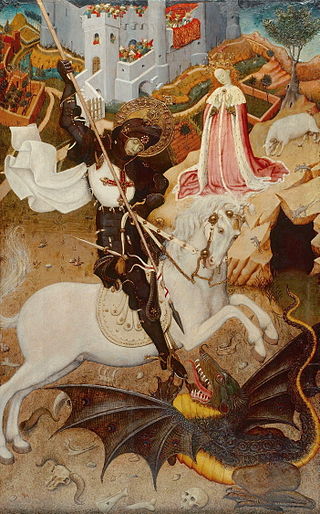
                                        
                                                      St. George as a Crusader knight.by Bernot Martorell.

The red-on-white cross was originally associated with the Knights Templar and subsequently with the Crusades in general and the noble houses who wished to be associated with it.  It began to be identified with St. George and began to be used as a banner by the Knights of the Order of the Garter.  From 1348 and throughout the 15th Century, the Saint George’s Cross was shown in the hoist of the Royal Standards of the Plantagenet kings of England.  With the dynastic union of England and Scotland in 1603, it was combined with the white on blue x-shaped Cross of St. Andrew for Scotland for what became the Union Flag, eventually the national flag of Great Britain.  In 1801 following the following the union Great Britain and Ireland the red Cross of St. Patrick was imposed on a background of the white Cross of St. Andrew to complete the modern Union Jack national flag of the United Kingdom.


The England's Flag of St. George, right, incorporated into the Union Jack.

St. George and his Cross were such a popular symbol for England that both survived the Puritan Commonwealth unscathed.  St. George’s Cross was the only Saint’s banner that was allowed to be flown.

Today the modern Catholic Church is somewhat embarrassed by the dragon lore.  Like Valentine and others his feast has been demoted on the liturgical calendar, although he did not lose his saintly status entirely like St. Christopher.  His feast, however, is still celebrated in by Catholics and the Church of England alike as well as across much of the old Empire and Commonwealth.

Needless to say, with such fertile ground, poets have had much to say about St. George and his dragon beginning with almost endless medieval ballads, which I will spare you here.

Cicely Fox Smith was an English poet and writer born in Lymm, Cheshire on February 1, 1882 and educated at Manchester High School for Girls.  She briefly lived in Canada, before returning to the United Kingdom shortly before the outbreak of World War I.  Before her death in 1954 she wrote and published more than 600 poems, many with patriotic or naval themes.  A popular and much beloved non-academic poet, she invoked St. George, as so many had done before, to answer the call to battle, this time against the “Huns” in the Great War of 1914-1918.

                 
                                   Cicely Fox Smith.

St. George of England

Saint George he was a fighting man, as all the tales do tell;
He fought a battle long ago, and fought it wondrous well.
With his helmet, and his hauberk, and his good cross-hilted sword,
Oh, he rode a-slaying dragons to the glory of the Lord.
And when his time on earth was done, he found he could not rest
Where the year is always summer in the Islands of the Blest;
So he came to earth again, to see what he could do,
And they cradled him in England -
In England, April England -
Oh, they cradled him in England where the golden willows blew!

Saint George he was a fighting man, and loved a fighting breed,
And whenever England wants him now, he's ready at her need,
From Crecy field to Neuve Chapelle he's there with hand and sword,
And he sailed with Drake from Devon to the glory of the Lord.
His arm is strong to smite the wrong and break the tyrant's pride,
He was there when Nelsom triumphed, he was there when Gordon died;
He sees his red-cross ensign float on all the winds that blow,
But ah! His heart’s in England -
In England, April England -
Oh, his heart it turns to England where the golden willows grow!

Saint George he was a fighting man, he’s here and fighting still
While any wrong is yet to right or Dragon yet to kill,
And faith! He’s finding work this day to suit his war-worn sword,
For he’s strafing Huns in Flanders to the glory of the Lord.
Saint George he is a fighting man, but when the fighting’s past,
And dead among the trampled fields the fiercest and the last
Of all the Dragons earth has known beneath his feet lies low,
Oh, his heart will turn to England -
To England, April England -
He’ll come home to rest in England where the golden willows blow!

—Cicely Fox Smith


Brian Patten.

Brian Patten is an 80-year-old English poet from Liverpool who first rose to prominence with the late ‘60s poetry anthology The Mersey Sound.  He has written autobiographical collections for adults as well as books for children and young adults.  Here he had a very different take on both the dragon and St. George.  Of note, you should know that it is customary to wear a red rose on St. George’s Day in England, which, by the way was also the symbol of the Lancastrians in the War of the Roses.

The True Dragon

St George was out walking
He met a dragon on a hill,
It was wise and wonderful
Too glorious to kill
 
It slept amongst the wild thyme
Where the oxlips and violets grow
Its skin was a luminous fire
That made the English landscape glow
 
Its tears were England’s crystal rivers
Its breath the mist on England’s moors
Its larder was England’s orchards,
Its house was without doors
 
St George was in awe of it
It was a thing apart
He hid the sleeping dragon
Inside every English heart
 
So on this day let’s celebrate
England’s valleys full of light,
The green fire of the landscape
Lakes shivering with delight
 
Let’s celebrate St George’s Day,
The dragon in repose;
The brilliant lark ascending,
The yew, the oak, the rose.


—Brian Patten


Elvis Mcgonagall
.

Elvis Mcgonagall was born in Dundee, Scotland in 1960 and is a stand-up comic and is notable for poetry slam performances.  He is also something of a Scottish nationalist despite currently residing in Dorset in England.  He takes a Scott’s more jaundiced view of George and the hoopla surrounding him.

George!


Once more unto the breach, dear Morris Dancers once more

Jingle your bells, thwack sticks, raise flagons

Cry “God for Harry and Saint George!”

Gallant knight and slayer of dragons

Patron saint of merry England –

And Georgia, and Catalonia, and Portugal, Beirut, Moscow

Istanbul, Germany, Greece

Archers, farmers, boy scouts, butchers and sufferers of syphilis

Multicultural icon with sword and codpiece

On, on you bullet-headed saxon sons

Fly flags from white van and cab

But remember stout yeomen, your champion was Turkish

So – get drunk and have a kebab.


—Elvis Mcgonagall

Another dissenting view came from Nancy Senior, who casts a skeptical eye on the assumptions of would-be savior knights, and maybe men in general.


St. George  slays the Dragon by Jost Haller.

St. George

My dragon always loved walks

He used to go to the wall

where the golden chain hung

and take it in his mouth

laying his head on my lap sideways,

so the fire wouldn’t burn my skirt


He looked so funny that way

with his wings dragging the floor

and his rear end high up

because he couldn’t bend his hind legs.


With him on the leash,

I could go anywhere

No band of robbers dared attack.


This morning in the woods

we had stopped for a drink

where a spring gushes out of a cave.


when suddenly, a man in amour

riding a white horse

leapt out of the bushes crying

“Have no fear I will save you”

And before I could say a word

he had stabbed my dragon in the throat

and leaping down from the horse

cut off his head

and held it up for me to see

the poor eyes still surprised

and mine filling with tears/

He hadn’t even had time to put out his claws.


And the man said

“Don’t cry, Maiden

You are safe now

But let me give some good advice

Don’t ever walk alone in the woods

for the next time you meet a dragon

there might not be a knight around to save you."


—Nancy Senior

Tuesday, November 7, 2023

Elijah P. Lovejoy Became the First Martyr of Abolitionism

A life profile of Elijah P. Lovejoy who was murdered before photography.

He was by almost all accounts, a difficult man to like.  Opinionated to the point of bigotry on innumerable subjects.  A totally humorless religious zealot consumed with the conviction of his own righteousness—and the sinfulness of just about anyone who did not agree with him on everything, down to the comma placement.  But such men—and women—often are what is needed to begin moving the fulcrum of history.  When Elijah P. Lovejoy was cut down in a hail of bullets defending his precious printing press from an Alton, Illinois mob on November 7, 1837 he became the first important martyr of abolitionism and helped galvanize the infant movement.

Lovejoy was born on November 9, 1802 on the frontier farm of his Congregationalist minister father, the Rev. Daniel Lovejoy and his zealous Christian wife in Albion, Maine.  While most ministers of the New England Standing Order were highly educated at Harvard or Yale, Elijah’s father was prepared for service on the fringes of civilization by reading with other ministers.  He keenly felt his educational deficiency and impressed the need for academic achievement on his oldest son and his siblings.  Both parents, but particularly his mother, emphasized it was his duty to fight sin and prepare the world for an imminent Second Coming.

After the customary attendance at rude rural schools and attending more ambitious academies in Monmouth and China, Maine, Elijah enrolled in the tiny Waterville College (now Colby College), a Baptist school that was both all he could afford, and which was imbued with righteous Christianity.  He was a serious, sober, dedicated student who impressed the faculty and alienated his more fun loving classmates for the same reason.  When he wasn’t studying, he was praying to have the conversion experience that would mark him as one of the saved.  Alas, it did not come, and the young man tortured himself with guilt over his unworthiness and fear for his immortal soul.

Waterville College in Maine, the Baptist school where Lovejoy was educate, as it appeared in the 1830s.

By the end of his second year, he was hired as an instructor in the College’s preparatory school.  He graduated at the top of his class in 1826.  Lacking the longed for conversion, Lovejoy felt unworthy to continue his planned education as a minister.  He continued to teach but yearned to find some other way to serve God.  After consultation with his mentors at the College, he decided the best course would be for him to head west, presumably a land of sinners requiring the stern admonitions of a faithful servant of the Lord. 

He went to Boston, to get work to finance his trip.  Finding none, with virtually no money, but grim determination, Lovejoy set out to reach his new life on foot.

After weeks of tramping, Lovejoy arrived in New York City foot sore and broke.  He decided to rest some and replenish his exhausted purse.  He arrived in the City in June of 1827 and found work of sorts—peddling subscriptions to the Saturday Evening Gazette.  The job required hours of walking block after block knocking on unfriendly doors and accosting prospects in the streets.  Customers were few and commissions slim.  In desperation Lovejoy wrote his mentor, Waterville College President Jeremiah Chaplin, who sent his favored former pupil enough money to resume his journey.

Still traveling mostly by foot, but occasionally parting with a few precious coins for short passage on canal boats or river flat boats, Lovejoy finally arrived at Hillsboro, Montgomery County in southern Illinois that fall with the intention of settling.  He found a village barely four years old that made Albion look like a sophisticated metropolis.  It was a brawling, profane frontier village where life centered on fiercely competing grocery store/taverns and settled mostly by Scotch Irish pioneer stock via Kentucky and other backwoods settlements of the upper South.  He was shocked and appalled.  He saw little opportunity to save the heathens he observed.  Better, he concluded to push on to the acknowledged capital of the hinterlands, St. Louis.

Flatboats still dominated commerce when Lovejoy arrived in bustling St. Louis in 1828.

St. Louis in 1827-28 was a busy, prosperous place indeed.  It was the hub of river commerce on the Mississippi.  Flatboats rafted lumber and crops south and poled their way laboriously north laden with the manufactured and luxury goods of the world.  It was enjoying a special boom as the outlet of a thriving and growing fur trade that was trapping the rivers and streams of the far-flung former Louisiana Purchase all the way to the Rocky Mountains.  It was also a slave state holding thumb pushing far north alongside neighboring free state Illinois.  The population of the state was mostly drawn from the same Scotch Irish pioneer stock that had so offended Lovejoy with a sprinkling of younger sons of the southern aristocracy seeking to establish their own plantations or enter the gentlemanly professions of lawyer, doctor, or editor.

St. Louis, however, as a successful commercial city, had also attracted fair numbers of Yankees and New Yorkers, the well educated sons of the first or second generation of the New England diaspora.  These folks dominated commerce and trade in the city and were building fine homes.  They yearned to establish a civilization that like beloved Boston could become a “shining city on the hill.”  Lovejoy was just the kind of earnest young man embodying all of the fine moral virtues of New England plus scholarship that they could use.

Lovejoy found a spiritual home among local Presbyterians.  Like most Congregationalists far from the orbit of New England he found their shared, strict old school Calvinism familiar and comforting even if there were differences of polity.  Since the Congregationalists resisted, at this point, missionary zeal for the West and their well-educated clergy felt disinclined to test out the wilderness, the Presbyterians offered really the only viable alternative.  The local Baptists he encountered were not like the serious and sober gentlemen of Waterville College but were served by ill-educated sometimes self appointed circuit riding shouters who seemed to appeal mostly to the illiterate and unwashed.  The Methodists were hardly better, if perhaps more literate.

One fly in the ointment was that Presbyterianism was also the native religion of the Scotch Irish, at least those had not given over completely to Godless heathenism or been converted by saddlebag evangelists.  It was the best class of the rowdy lot, and many of the ladies were both virtuous and pious.  But the men, outside of Sunday morning, were often profane and given to a stubborn affection for whiskey.  The Scots Irish and for the New England exiles somewhat uncomfortably worshiped together.

With the help of his new co-religionists, Lovejoy quickly established himself as a school master and was soon able to open his own academy for the sons and daughters of the city’s Yankee elite.  He approvingly described the families of his pupils as “the most orderly, most intelligent, and most valuable part of the community.”

Lovejoy prospered in the respect of his chosen community and was finally fairly financially secure.  But he was still restless.  He was not doing enough to fulfill his self-appointed mission. 

In 1830 a new opportunity arose, however.  He bought a partnership in and became editor of the St. Louis Times.  It was a political paper, fiercely anti-Jacksonian, which suited Lovejoy who was practically a genetic Federalist.  Much of Missouri was staunchly behind Old Hickory and his re-made Democratic Party.  But in St. Louis another Western politician, Henry Clay of Kentucky was popular.   He had been the architect of the Missouri Compromise and his proposed American System with its support for the National Bank, internal improvements, and a protective tariff resonated with Lovejoy.  He poured passion—and vitriol—into his role as a political editor.

He also promoted causes dear to him—teetotalism, public morality and order, civic improvement, and education.  He used his rising influence to help found the local Lyceum and to back the Missouri and Illinois Tract Society producing missionary tracts or moralistic screeds for distribution through the region.  But the issue of slavery did not yet much move him.  It was a major part of the local economy and practically taken for granted in the culture.  If he had any Yankee qualms about it he kept them largely to himself.  In fact, his newspaper advertised slave auctions and wanted notices for escaped slaves.

Then, in 1832 came the thunderclap that changed his life.  The Rev. David Nelson came to town to preach a revival over several weeks at the First Presbyterian Church.  Lovejoy dutifully attended the daily meetings.  He found himself soon under the sway of Nelson’s powerful preaching.  Before the revival was over, he finally had the personal conversion experience he had long prayed for.  He also was attracted to a second message preached by Nelson—the moral necessity of ending slavery.  

Having at long last experienced the conversion experience that marked him as saved, Lovejoy returned to the East to get his formal education as a minister at Princeton Theological Seminary, the most prestigious Presbyterian institution.

Lovejoy decided the time was finally right for him to become a minister.  He headed east and enrolled in the Princeton Theological Seminary.  Completing his studies in a year, he was granted his license to preach by the Philadelphia Presbytery on April 18, 1833.

He returned to St. Louis a rejuvenated man.  He established his own Presbyterian congregation for his Northern supporters.  His supporters underwrote a new newspaper, the St. Louis Observer which was dedicated less to sectarian politics and more to reform and moral uplift.  It was Lovejoy’s unrestrained voice, unleashed with passion.

In the very first issue he excoriated Catholicism and Papism in vitriolic language.  The language was familiar to any Calvinist ear from the East.  But St. Louis, a former French and Spanish provincial capital, had a large Catholic population and there had been a general toleration of religious differences as the city had grown.  Not only were his targets outraged, but so were some other Protestants.  In his first issue Lovejoy established a reputation as an extremist and a bigot.

Undeterred by the storm of criticism, he pressed on with attacks on Catholics as well screeds against alcohol, Sabbath breaking, and profanity.  And finally, slavery.

His editorials were unflinching in his denunciation of the moral evil of human bondage.  But at first he was also critical of the kind of abolitionist absolutism preached in William Lloyd Garrison’s The Liberator.  He denounced imposing abolition instead hoping that argument and religious conversion would change the hearts of slave holders who would see the error of their ways and free their slaves.  Despite the seeming moderation of this stance, it still outraged the Southern-dominated city.  By the summer of 1835 citizen’s committee passed a resolution aimed at Lovejoy declaring anti-slavery agitation inspired “insurrection and anarchy, and ultimately, a disseverment of our prosperous Union.”

As controversy swirled around him, Lovejoy married a fine Christian woman, Celia Ann French, the same year.

Married bliss did not mellow Lovejoy.  As public clamor against his anti-slavery stand grew, so did his defiance.  In fact, the reaction drove him ever more closely into the arms of the abolitionist extremists he had once derided.   Several times Lovejoy was accosted on the streets and barely escaped assault.  His office and shop were vandalized.  In response he printed a string of editorials vigorously defending the rights of freedom of the press and to express unpopular opinion.

The lynching of Francis McIntosh by burning him at the stake galvanized Lovejoy.  His editorials against mob violence and denouncing the failure to indict known mob leaders turned much of St. Louis violently against him.  He experience the first of many attacks on his printing press.

Things came to a head in April 1836 when a Black riverboat hand, Francis McIntosh, allegedly killed a deputy sheriff and injured other men in the posse sent to arrest him.  An outraged mob was not content to wait for a trial.  They broke into the courthouse jail and lynched McIntosh.  Despite overwhelming evidence that McIntosh was guilty, Lovejoy denounced the mob action writing “We must stand by the Constitution and laws, or all is gone.”  After that editorial an angry mob twice entered the offices of the Observer and seriously damaged the printing press.

When the Grand Jury failed to indict any of the known leaders of the lynch mob, Lovejoy railed against the injustice and the actions of the aptly named presiding judge, Luke E. Lawless who virtually laid out a legally questionable defense of the accused men.  Another mob gathered and attacked the office, this time throwing the press out the window and into the streets.

Lovejoy finally concluded it was unsafe to continue in St. Louis.  He decided to relocate to Alton, Illinois, upriver and 15 miles north of St. Louis.  He hoped that the free state would be more welcoming.  Vigilantes however followed Lovejoy’s move and when his precious press was unloaded to the quay in Alton, they threw it in the river.

Despite this set back, Lovejoy at first received a cautiously warm reception in his new town.  It was a growing city and its boosters envisioned it as a possible rival to St. Louis itself.  Despite a local population that was largely Southern in origin, some felt that the establishment of a new paper—and likely the founding of a new Presbyterian Church would enhance the city’s reputation in its bid as a long-shot contender for the relocation of the new state capital from Vandalia.

As Lovejoy raised money for a new press, he met with a local citizens committee which offered him a conditional welcome—if he would refrain from the kind of “agitation” that had caused trouble in St. Louis.  Lovejoy assured them that he now planned a purely civic and Christian paper.

Shortly after New Year’s 1837 the new Alton Observer began publication.  And despite his promises the very first issue contained a blistering attack on slavery and slavery apologists.   By spring he was calling on the citizens of the town to sign an abolitionist petition to the state legislature.  Then he urged citizens to “walk the streets of the town” pressing an anti-slavery message.  In August he called for a founding convention of an Illinois Anti-Slavery Society for the town.  After printing a broadside for the meeting, a mob once again stormed his shop and threw another press into the river.

Another one of Lovejoy's printing presses smashed.

Lovejoy, now attracting national support, ordered another.  But when that one was delivered, it was discovered on the dock and also deep sixed.

The proposed Anti-Slavery convention tried to convene in Alton in October, but pro-slavery men packed the meeting and prevented resolutions from being passed and business conducted.  Lovejoy and his supporters then convened again in secrecy at another location.  In addition to founding the society, money was raised to buy yet another press and to defend it with force, if necessary.

Lovejoy tried one more time to reach accommodation with his enemies in Alton.  He arranged a meeting with them at which he made an impassioned plea for freedom of the press which has become regarded as a classic.  On November 2 he said this to the assembly:

It is not true, as has been charged upon me, that I hold in contempt the feelings and sentiments of this community, in reference to the question which is now agitating it. I respect and appreciate the feelings and opinions of my fellow-citizens, and it is one of the most painful and unpleasant duties of my life, that I am called upon to act in opposition to them. If you suppose, sir, that I have published sentiments contrary to those generally held in this community, because I delighted in differing from them, or in occasioning a disturbance, you have entirely misapprehended me. But, sir, while I value the good opinion of my fellow-citizens, as highly as any one, I may be permitted to say, that I am governed by higher considerations than either the favor or the fear of man. I am impelled to the course I have taken, because I fear God. As I shall answer it to my God in the great day, I dare not abandon my sentiments, or cease in all proper ways to propagate them.

I, Mr. Chairman, have not desired, or asked any compromise. I have asked for nothing but to be protected in my rights as a citizen--rights which God has given me, and which are guaranteed to me by the constitution of my country. Have I, sir, been guilty of any infraction of the laws? Whose good name have I injured? When, and where, have I published anything injurious to the reputation of Alton?

Have I not, on the other hand, labored, in common with the rest of my fellow-citizens, to promote the reputation and interests of this City? What, sir, I ask, has been my offence? Put your finger upon it—define it—and I stand ready to answer for it. If I have committed any crime, you can easily convict me. You have public sentiment in your favor. You have juries, and you have your attorney, and I have no doubt you can convict me. But if I have been guilty of no violation of law, why am I hunted up and down continually like a partridge upon the mountains? Why am I threatened with the tar-barrel? Why am I waylaid every day, and from night to night, and my life in jeopardy every hour?

You have, sir, made up, as the lawyers say, a false issue; there are not two parties between whom there can be a compromise. I plant myself, sir, down on my unquestionable rights, and the question to be decided is, whether I shall be protected in the exercise and enjoyment of those rights…

I have no personal fears. Not that I feel able to contest the matter with the whole community; I know perfectly well I am not. I know, sir, you can tar and feather me, hang me up, or put me into the Mississippi, without the least difficulty. But what then? Where shall I go? I have been made to feel that if I am not safe at Alton, I shall not be safe anywhere. I recently visited St. Charles to bring home my family, and was torn from their frantic embrace by a mob. I have been beset night and day at Alton. And now, if I leave here and go elsewhere, violence may overtake me in my retreat, and I have no more claim upon the protection of any other community than I have upon this; and I have concluded, after consultation with my friends, and earnestly seeking counsel of God, to remain at Alton, and here to insist on protection in the exercise of my rights. If the civil authorities refuse to protect me, I must look to God; and if I die, I have determined to make my grave in Alton.

The last sentence proved all too accurate a prediction.  The meeting broke up with a resolution once again denouncing Lovejoy and demanding that he and his newspaper immediately leave the city.

Within days a new press arrived and under cover of darkness and armed guard it was moved by stealth into the relative safety of a sturdy stone warehouse near the river.  Lovejoy and a small volunteer militia of armed abolitionists stood guard.  It did not take long for the local citizenry to discover what had happened.

After reinforcing their courage at local taverns, a mob marched on the warehouse after 10 pm November 7.   A spokesman demanded the press be turned over to the mob.  After a curt refusal the windows of the warehouse were shattered with rocks and then the mob rushed the door.  There seems to be no doubt that Lovejoy or his followers fired the first shot.  A general gunfight broke out.  At least one member of the mob was killed and others injured.  

A mob attacking the warehouse of Godfrey & Gilman in Alton, Ill., where the abolitionist Elijah Lovejoy was killed.

After briefly retreating to consider the situation, it was decided to try and smoke Lovejoy out by setting fire to the roof of the three story warehouse.  There was a lull until a long ladder could be found.  Then under heavy cover fire the ladder was rushed forward and a man with a torch started to climb it.  Lovejoy and a supporter darted out from the building, knocked the ladder over, and then safely returned inside.  

A second attempt was made.  Lovejoy again sallied forth, this time he was cut down by at least 5 shotgun slugs in the chest.  He managed to cry, “My God, I’m hit” before staggering back inside. He died almost immediately.

Meanwhile the mob succeeded in torching the roof.  Lovejoy’s grief stricken companions managed barely to escape out a back door and flee along the riverbank.  The mob broke the door down and found Lovejoy dead.  Then they went about their methodical work.   They carried the press and cases of type to the top floor of the building then threw it out the window.  The mob, armed with hammers and stones continued to smash parts tossing them into the river.  They then left, leaving Lovejoy’s body, spit upon and abused, behind.

Two days later with little ceremony and in secret he was buried in a field near his home.  Evidence of the grave was erased, and it was left unmarked lest it be disturbed.  It remained so until 1860 when supporters finally erected a headstone.  Lovejoy’s wife, already in ill health, could not attend the service.

William Lloyd Garrison and The Liberator spread the word of the murder.  Abolitionist speakers fanned out across the North claiming Lovejoy as their first martyr.

An illustration for a pamphlet using Lovejoy's martyrdom to grow the abolitionist cause.

Elijah’s younger brother Owen, a Congregational minister, came to Illinois to finish his brother’s work and became the longtime leader of state Abolitionists.  From 1857 until his death in 1865 he served as a Republican Congressman from the state where his brother died.

Lovejoy's impressive memorial column in Alton, Illinois is a major local tourist attraction.

Today if you visit Alton you can see the grave, his relocated home, and a handsome monument—a 110 foot column surmounted by an Angel.  Ask anyone in town and they will be glad to tell you the story.  And despite the fact that many local families have been there since Lovejoy’s death, you won’t find any who will acknowledge that their ancestors were part of the mob.