Showing posts with label quotes. Show all posts

Monday, May 11, 2026

An AI Test About Yogi


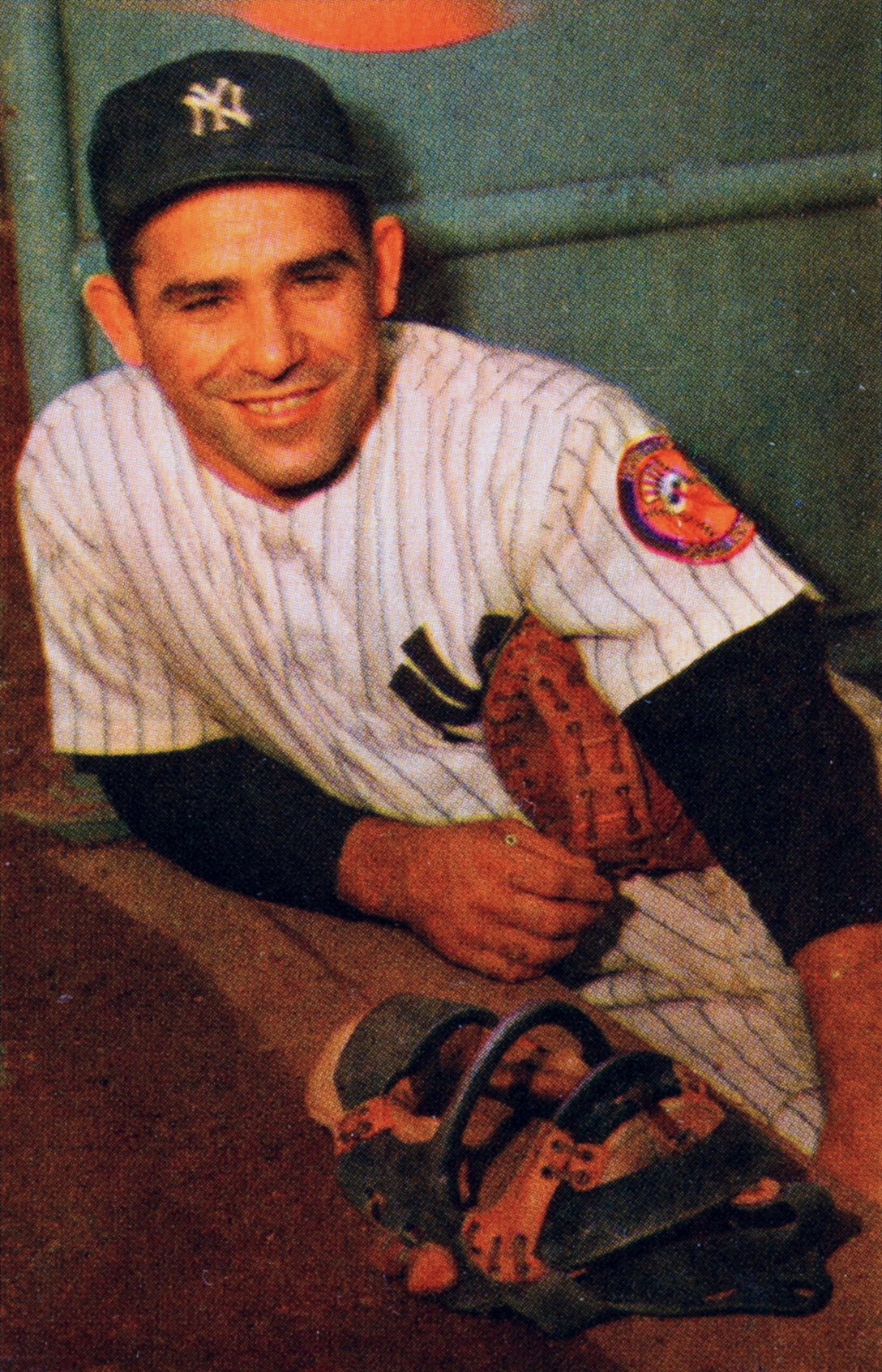
                                                         Yogi Berra in 1953.

Note—Back in 2024 all the buzz was about Artificial Intelligence (AI).  Word was that it would make most of us obsolete--especially writers.  So this as an experiment.  The following blog post on Yogi Berra for his birthday was not written by your reliable scribe but created, including the title, by the  program AI Article Writer 4.0 which is already obsolete.  I did not edit it in any way.  What say you?  Should the Old Man turn over his posts to this electronic gizmo, which undoubtedly contains fewer spelling errors and typos, or should he continue to bang out stuff the old fashion way?

Lawrence Peter “Yogi” Berra was an American professional baseball catcher, coach, and manager. He was born on May 12, 1925, in St. Louis, Missouri. Yogi Berra was one of the most successful and popular baseball players of his era, playing for the New York Yankees and the New York Mets. He played in more World Series games than any other player in history.

Yogi Berra grew up in a working-class family in St. Louis, Missouri. He dropped out of school after the eighth grade to help support his family. In his teens, he played baseball for a local team, and he was eventually signed by the New York Yankees.

                           Young Yogi with aging Babe Ruth at Yankee Stadium.

Berra made his Major League Baseball debut in 1946. He quickly became known for his excellent defensive skills as a catcher and his ability to hit for power. He was a 15-time All-Star and won three American League Most Valuable Player Awards.

Yogi Berra’s impact on the game of baseball cannot be overstated. He was a key player for the New York Yankees during their dynasty years in the 1950s and 1960s, helping them win 10 World Series championships. He was also a successful manager, leading the Yankees and the Mets to the postseason.

Berra was known for his “smart” play on the field. He was an excellent defensive catcher who could read the opposing team’s hitters and pitchers. He was also a great hitter, with a career batting average of .285 and 358 home runs.

Yogi quotes are the inspiration of untold memes.

Yogi Berra was famous for his witticisms and malapropisms. Many of his quotes have become timeless classics. Some of his most famous quotes include:

    It ain’t over ‘til it’s over.

    When you come to a fork in the road, take it.

    It’s like déjà vu all over again.

   I never said most of the things I said.

While some of his quotes may seem nonsensical, they often contain hidden wisdom. For example, “It ain’t over ‘til it’s over” means that anything can happen until the game is over, and you should never give up hope.

Yogi Berra was known for his leadership and coaching style. He was a players’ manager who treated his team like family. He was tough but fair and always had his players’ backs. He was also a great motivator who knew how to get the best out of his players.

Berra’s coaching style was based on his own experience as a player. He knew what it took to win, and he passed that knowledge on to his players. He was also a great communicator who could explain complex concepts in simple terms.

Berra with Yankee's owner George Steinbrenner in has managing years.

Yogi Berra's legacy goes beyond the game of baseball. He was a beloved figure who was known for his kindness, humility, and sense of humor. He was a family man who was devoted to his wife and children.

Berra was also a philanthropist who gave back to his community. He was involved in many charitable organizations, including the Yogi Berra Museum and Learning Center, which is dedicated to promoting the values of respect, perseverance, sportsmanship, and excellence through the lens of baseball.

Yogi Berra’s impact on popular culture cannot be understated. His quotes have become part of the American lexicon, and his name is synonymous with baseball. He has appeared in movies, TV shows, and commercials, and his likeness has been used in advertising and marketing campaigns.
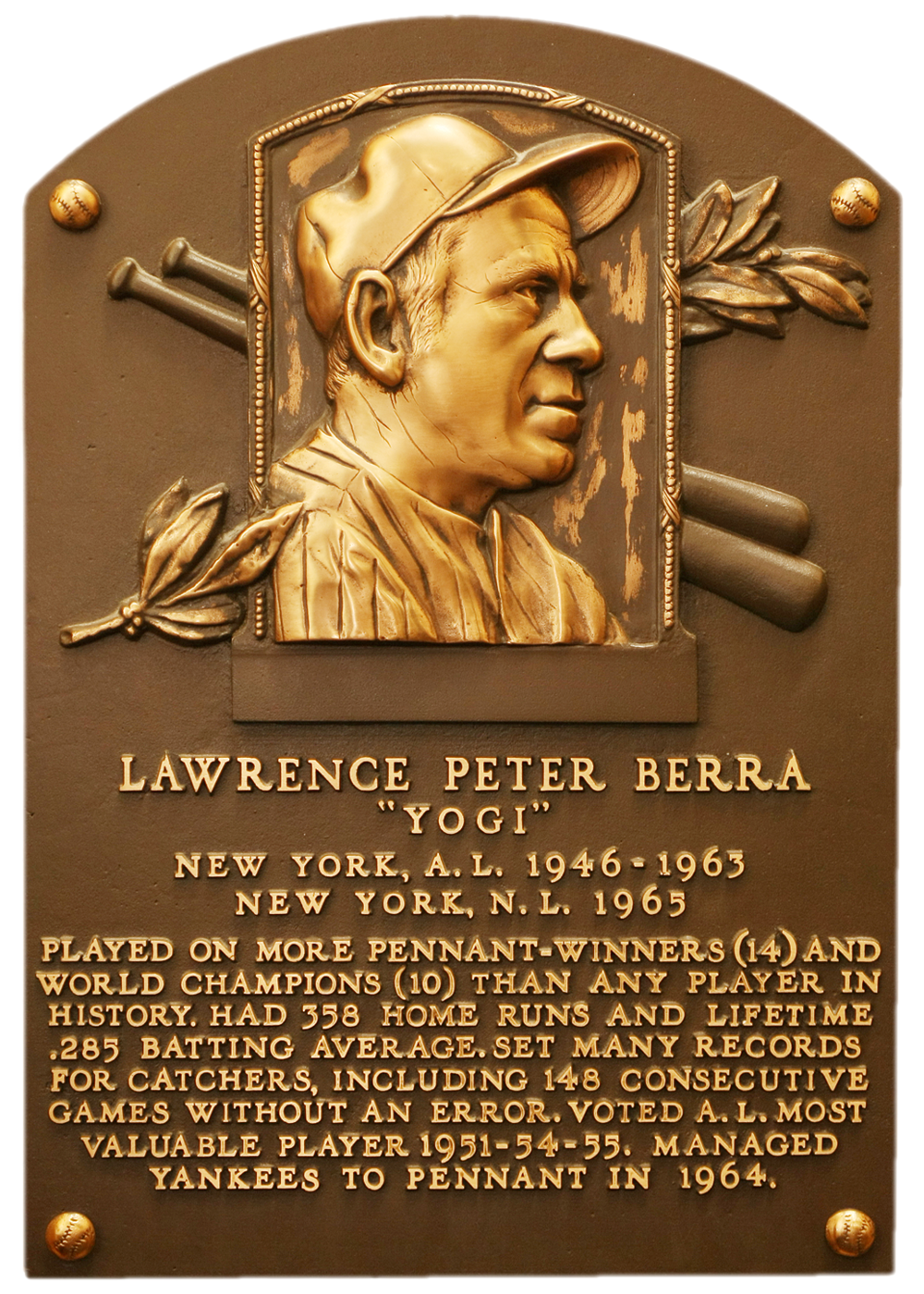
                                        Berra's Baseball Hall of Fame plaque.

Berra was also a cultural icon who represented the values of the American Dream. He was a self-made man who overcame adversity to achieve success. He embodied the spirit of hard work, determination, and perseverance that is so important in American culture.

Yogi Berra’s lessons go beyond the game of baseball. His quotes contain wisdom that can be applied to all areas of life. For example, “If you don’t know where you are going, you’ll end up someplace else” means that you need to have a plan if you want to succeed.

                                                Berra honored on a U.S.P.S. stamp.

Berra's leadership and coaching style also provide valuable lessons for life. He believed in treating people with respect and kindness, and he knew how to motivate and inspire his team. These are qualities that are important in all areas of life, whether you are a coach, a teacher, or a business leader.

Yogi Berra continues to inspire and influence people today. His quotes are still quoted by sports fans and non-sports fans alike, and his legacy lives on through the Yogi Berra Museum and Learning Center. His leadership and coaching style have also inspired many coaches and managers in all areas of life.

Berra's legacy is also a reminder of the importance of hard work, determination, and perseverance. He overcame many obstacles in his life to achieve success, and his story is a testament to the power of the American Dream.

                                Berra's death was big news.

Yogi Berra was a true legend who left a lasting impact on the game of baseball and on popular culture. His famous quotes and his leadership and coaching style have inspired generations of players, coaches, and fans. His legacy is a reminder of the importance of hard work, determination, and perseverance, and his spirit lives on through the Yogi Berra Museum and Learning Center.

P.S--the experiment was never repeated.  

Thursday, January 15, 2026

Dr. King Still Speaks to Us if We Will Listen and He’s Timelier Than Ever


Note:  Today is the actual birthday of the Rev. Martin Luther King, Jr.  The public Holiday in his honor will be held next Monday, January 19.  I will have more to say about that then.  Today I am resurrecting a post in which Dr. King himself reminds us how truly revolutionary he was. 

When the Reverend Martin Luther King, Jr. was being held in jail in Alabama in 1963 he received a letter signed by several well-known White self-proclaimed racial moderates and liberal ministers who decried the unpleasantness and social disruption of the on-going campaign against racial discrimination in Birmingham.  Since he had unaccustomed time on his hands he took the time to patiently, even lovingly explain the situation in America’s most segregated city and why he and the Black citizens of the city were compelled to launch their campaign of non-violent direct action braving beatingsdogsfirehosesthreatsbombings, and jail to do so. 

But he also chastised the ministers’ smug assumptions and refusal to either take any risks to attack the underlying cause of the unrest or dirty their hands in labor to correct it.  “Shallow understanding from people of good will is more frustrating than absolute misunderstanding from people of ill will. Lukewarm acceptance is much more bewildering than outright rejection.” He said that the White church needed to take a principled stand or risk being “dismissed as an irrelevant social club.” 


Dr. King in the Birmingham Jail.

That message could not be more pointed or relevant today.  The decedents of those nervous and alarmed clergy can still be found in too many pulpits and among too many “good Christians” who in today’s moral crisis fret that the simple declaration of the fact that Black Lives Matter is somehow racist; that a broken window, scuffle with police, or the disruption of holy commerce is somehow more terrible than Black bodies in the streets or whole communities living in the terror of a virtual occupation.  Ministers who do speak out, even in many liberal congregations, face backlash from both pledging members and the wider communities in which they must work. 

In 2022 the timidity of some Democrats and liberals to finally bring the Freedom to Vote Act and the John Lewis Voting Rights Advancement Act to a successful vote and passage was a stinging reminder of the cost of fair-weather friends and hypocrites. 


Dr. King once again offended the tender sensitivities of white liberals, this time in the North, when he led a "disruptive and provocative" 1965 open housing march in Chicago's Marquette Park neighborhood where his head provoked a stone attack by the neighbors.

If he had lived the Reverend Martin Luther King, Jr. would have turned 96 years old today.  Nothing would have surprised him more. 

Most folks know and can quote snatches of two or three of his most famous speeches.  TV will play clips of the I Had a Dream speech given at from the steps of the Lincoln Memorial at 1963’s March on Washington for Jobs and Justice.  Maybe they will also show a tad of his prophetic I Have Been to the Mountain Top speech given to a church audience in Memphis the night before he was killed. 

His more devoted fans treasure other things, perhaps most notably his Letter from the Birmingham Jail.  But that still make liberals uncomfortable. 

The quotes most apt to surface are about non-violence or his blander paeans to brotherhood.  That’s because the largely White establishment media wants to use his birthday and the official holiday as a sop to Blacks on one hand and an only thinly veiled, almost hysterical plea to them “Don’t hurt us!” on the other. 

Today, I would like to celebrate with a collection of quotes from Dr. King that illustrate exactly how radical, even revolutionary, he was.  Let him speak for himself. 

Freedom is never voluntarily given by the oppressor; it must be demanded by the oppressed. 

Change does not roll in on the wheels of inevitability, but comes through continuous struggle. And so we must straighten our backs and work for our freedom. A man can’t ride you unless your back is bent. 

Every man must decide whether he will walk in the light of creative altruism or in the darkness of destructive selfishness. 

Have we not come to such an impasse in the modern world that we must love our enemies—or else? The chain reaction of evil—hate begetting hate, wars producing more wars—must be broken, or else we shall be plunged into the dark abyss of annihilation. 

History will have to record that the greatest tragedy of this period of social transition was not the strident clamor of the bad people, but the appalling silence of the good people. 

Human progress is neither automatic nor inevitable... Every step toward the goal of justice requires sacrifice, suffering, and struggle; the tireless exertions and passionate concern of dedicated individuals. 

I have decided to stick with love. Hate is too great a burden to bear. 

submit to you that if a man hasn’t discovered something that he will die for, he isn’t fit to live. 

It may be true that the law cannot make a man love me, but it can keep him from lynching me, and I think that’s pretty important. 

Philanthropy is commendable, but it must not cause the philanthropist to overlook the circumstances of economic injustice which make philanthropy necessary. 

Property is intended to serve life, and no matter how much we surround it with rights and respect, it has no personal being. It is part of the earth man walks on. It is not man. 

That old law about “an eye for an eye” leaves everybody blind. The time is always right to do the right thing. 

The hottest place in Hell is reserved for those who remain neutral in times of great moral conflict. 

The past is prophetic in that it asserts loudly that wars are poor chisels for carving out peaceful tomorrows. 

We are not makers of history. We are made by history. 

When you are right you cannot be too radical; when you are wrong, you cannot be too conservative.