Showing posts with label trade unions. Show all posts

Friday, October 24, 2025

When the Women of Iceland Stopped Working One Day Everything Changed


25,000 swarmed central Reykjavik for Womens' Day off in 1975, 

Not to say all was perfect.  In 2005 on the 30th anniversary of the Day Off the gap between male and female wages had slipped back and women were making only 64% of men.  A new strike was called and the issue returned to the forefront of national attention with new reforms following. Ah, plucky Iceland, how we love you!  Although you missed the news if you relied on mainstream media, in 2015 Iceland sent 26 of its once powerful bankers to prison for their part in the schemes that led up to the 2008 economic crisis which nearly destroyed the economy.  No country fell harder than Iceland in the worldwide crisis.  But almost alone it did not react by scrambling to bail out the banks whose reckless conduct brought on the disaster.  Instead, the banks were allowed to fail, and new ones were created to serve the domestic economy.  Stockholders and foreign depositors attracted by the old banks’ debt-driven swashbuckling in world financial markets were allowed to eat their losses while the new state-owned banks protected and guaranteed Icelandic depositors and forgave much mortgage debt.  The policy drew howls of protest from the world banking establishment and not a few dire threats.   As a result, the country saw an arduous and difficult recovery, but one that outpaced the somewhat stagnant recoveries of the U.S. and Europe.

Much of the credit for the successful turn-around went to the government of Social Democratic Alliance Prime Minister Jóhanna Sigurðardóttir which came to power after weeks of outraged street demonstrations forced the resignation Geir Hilmar Haarde, a backer of the banking deregulation policy that led to the crisis.  Haarde was later brought to trial himself for his part in the collapse and convicted on one relatively minor count for negligence. 

Sigurðardóttir was a former trade union activist and the first openly lesbian head of government in the world.  The former flight attendant began her political career with her election to the Althing—parliament—in 1978.  To get there she was a beneficiary of one of the most unique, powerful, and successful protest movements in world history.

It was called, with typical Icelandic understatement, the Womens Day Off.  In reality it was a hugely successful one day general strike by women that was embraced by female members of all political parties, trade unions, and professional associations in protest to the significant wage gap between the genders, barriers to advancement, and the lack of support services like childcare.

The idea originated with the Red Stockings, a radical women’s movement founded in 1970 during the international surge of militant feminism.  It took a while for the idea to take hold.  Some women were initially put off by the rhetoric and confrontational style of the militants, but it began to gain momentum within the trade unions where women had been fighting for equal pay for some time.  Leadership of the movement to call a strike broadened and the new name of Women’s Day Off was more acceptable to some middle class and professional women than general strike.


 Some of the organizers for the Women's Day Off..

The date was set.  No one was entirely sure what to expect or how successful it would be.  Many thought it would be largely confined to labor movement women, students, and those radical feminists.  A turn out of a few thousand to a scheduled Reykjavik rally and a walk-out of maybe half the women in the country would have been considered a great victory.  But the call not only included employed women, but homemakers and mothers resentful that their work was not respected or compensated and fed up, like women everywhere, with the failure of the men in their lives to share domestic responsibilities.

In the weeks and days leading to the event an excited chatter spread across the country.  Women were asking each other, are you doing it?  Conversations swirled around workplaces, schools, and among generations of family members.  Many women were unsure of what they would do right up to the last moment.  But in the infectious joy empowered doubters and wafflers gleefully joined their sisters.

It has been estimated that 95% of all Icelandic women participated in the Day Off, a rate of participation unmatched by any general strike in history.  Fifty years ago, today on October 24, 1975, 25,000 women gathered in Reykjavik’s central square for a rally—that alone was 10% of the total Icelandic population of 250,000.  For comparison, a gathering of 10% of the current U.S. population would be more than 33 million people.  Rallies were also held in twenty other Icelandic cities and towns.


Icelandic women took to the streets.  Notice men with children observing from the sidewalk. 

How universal was the strike?  Few businesses had any female employees report to work, including managers.  Many had to close entirely for the day, as did schools without teachers, and many government agencies.  Those that remained open had to cope with their male workers bringing their children with them to work because women refused to do any childcare, house cleaning, or cooking that day or had male workers who had to stay home to take care of the children. On Icelandic television and radio broadcasts covering the Day Off noisy children could be heard in the background—and occasionally glimpsed running through the set. 

At the Reykjavik rally women of all ages and social classes mingled and embraced one another.  They heard a parade of speakers punctuated with singing and chants.  Among the speakers who moved the crowd was Adalheidur Bjarnfredsdottir representing Sokn, the union of the cleaners and other the lowest paid women in Iceland.  With no public speaking experience she roused the crowd, “Men have governed the world since time immemorial and what has the world been like?”  She described a world soaked in blood, polluted, and exploited to the point of ruin.  Surely women could do better.

Despite its size and militancy, the strike and the nation-wide rallies were completely peaceful.  The authorities made no effort to stop or ban it, and the police stood to the side with nothing to do. 

Many women also recall the general lack of attack by men.  There was plenty of skepticism and puzzlement, but no counterdemonstrations, few displays of anger, and retribution on the job or even docking pay for the time off was rare.  Many men expressed sympathy, and others were enlightened by experiencing the double burden of paid employment and childcare.  Some attitudes were genuinely changed.  But while women look back on the day with pride and enthusiasm, many men ruefully recall what they came to call as The Long Friday.

As if by magic at the stroke of midnight women took up their work again.  Those who were scheduled for overnight shifts came quietly back to work.  The women at the nation’s largest newspaper, who represented more than 60% of the reporters and editors returned to their desks and worked to get out a shortened 16-page Saturday edition containing nothing but news of the strike.

Unlike many mass protests, the Women’s Day Off produced tangible results as well as facilitating a paradigm shift in Icelandic society and culture.  In 1976 Iceland formed the Gender Equality Council and passed the Gender Equality Act, which outlawed gender discrimination in workplaces and schools.  Other reforms, including childcare provisions and paternal leave for parents of both sexes followed.  At the time of the strike women had held the franchise to vote since 1915 but in 1975 only three were sitting in the Althing, 5% of the total membership which lagged well behind other Scandinavian countries which averaged 15% female representation in their parliaments.  Subsequently many participants in the strike were moved to run for office and a movement to empower female candidates was embraced by most parties.  Within the first decade the percentage of female elected officials at all levels skyrocketed.  


Vigdis Finnbogadóttur, first woman President of Iceland. 

That included the election of Vigdis Finnbogadottir, a divorced single mother as President in 1980.  She became the first elected woman Head of State in the world.  She was reelected three more times and held office for 16 years, longer than any other female head of state.

Today, despite setbacks due to the near economic collapse, Iceland may be the best country in the world for women.   The wage gap has not been erased, but it is the lowest in the world.  The country has the highest percentage of female employment in the world.  Men and women are employed at nearly identical rates, but women represent a majority of skilled positions and a little more than 40% of leadership and management.  Childcare is universally available and of excellent quality.  Family stress is reduced as both women and men get generous leave on the arrival of a new baby or adoption and family leave to deal with emergencies.  An excellent national healthcare system covers the full spectrum reproductive health services.  Women outnumber men as university students, including those pursuing advanced degrees—very important in one of the most highly educated societies on Earth.  In politics, 44% of Althing seats are held by women and women have a majority of portfolios in the Cabinet and head many important departments.


 In 2015 Icelandic women once again took to the streets to protest the creeping wage gap.

And if things do not continue to improve or if, as an Icelandic proverb has it “the snows fill up the footprints” and thing back slide again, well, women are always ready for another Day Off.


Saturday, October 18, 2025

Colonial Shoemakers and Coopers Lead the Way to Early Labor Organizations


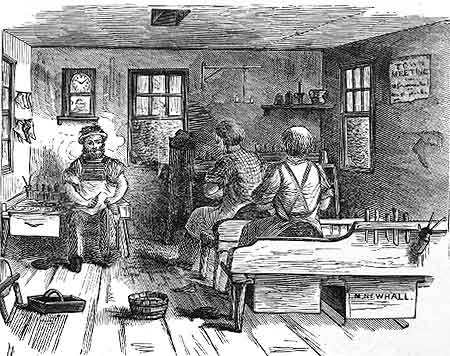
A typical Colonial shoe shop--a Master, journeymen, or possibly an apprentice.  Every shoe or boot made by hand with minimal tools and a small investment in leather.  Cobblers required much less capital and equipment than many other trades making it easier for craftsmen to set up shop. 

According to some sources the first labor unions in the English Colonies of North America were organized in Boston on this date in 1648.  Close but no cigar.  In fact, it is wrong on at least a couple of different counts.  

First, it was not the date that shoemakers and coopers first organized.  That had happened earlier.  It was the first time any organizations of craftsmen were legally recognized with an official Charter to allow them to operate.

Second, these organizations were not, in the modern sense, trade unions, which consist of employees organized to bargain with their employers for wages, benefits, and over conditions on the job like work rules and seniority.


                                                        Coats of Arms for some medieval German guilds featured tools of the craft.  Shoemakers top right. 

These organizations mimicked the medieval guilds, companies of master craftsmen organized to protect the craft, set prices, and provide fraternal aid and benefits to their members.  Guilds played a powerful roll in transitioning from a feudal system to the emergence of cities, mercantile trade, and the burgher class as a powerful new political force.  They were organizations of master craftsmen, who in turn were the employers of journeymen and apprentices. 

Since its founding in 1630 as the capital and hub of the new colony of Massachusetts Bay by that “company of saints,” the Puritans, civic authorities had tried to suppress class distinction.  But after only 18 years Boston was a rapidly growing port city and the trade center for an expanding arc of settlements stretching along the coast and reaching inland by dozens of miles.  Craftsmen had naturally emigrated from England and set up shops to make and sell goods that did not have to be imported at enormous cost across the Atlantic.  These crafts included those related to ship building and supplies; smithsmetal craftsmenof various types; carpenters, masons, thatchers, shingle weavers, and others in construction trades; and those who provided needed personal items like tailors, hatters, drapers, and shoemakers.

These craftsmen, sometimes relatively wealthy, but universally recognized as below the status of gentlemen or free holding farmers, yearned for the respect and mutual support they had enjoyed in the mother country as members of guilds.  And in some cases, there were now enough shops that competition was driving down prices.  They wanted to fix prices to preserve income, as well as to prevent others, not properly steeped in the traditions of the crafts and who had not completed training as apprentices and experience as journeymen from establishing themselves.

The Puritan fathers on the General Court, the colony’s governing body, were highly suspicious.


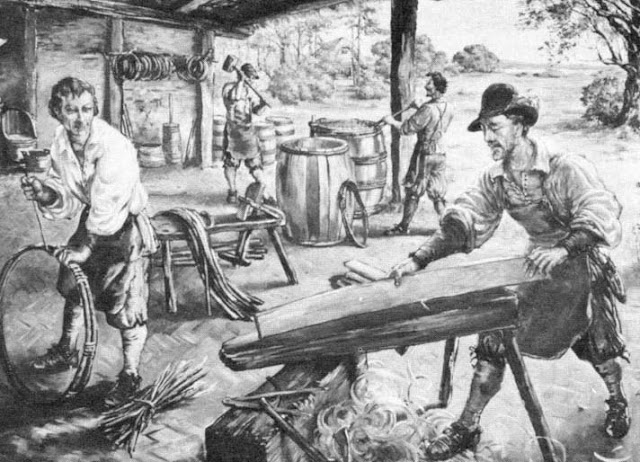
 An out-door Colonial cooperage.  Barrels were essential for trade and storage giving master coopers significant leverage.

The movement to gain official sanction with charters was led by the shoemakers and the coopers.  Of all of the trades, shoemakers probably had the lowest status because they did not require much capital to open a shop.  They were generally small shops where the craftsman did most or all of the work or employing only one or two journeymen and maybe an apprentice.  Coopers on the other hand, were essential for the colonies burgeoning trade.  So many things, solids as well as liquids, were shipped in barrels in those days—grain from the countryside and beer, the universal beverage of choice where potable water was scarce, for instance.  But perhaps most important—barrels made by coopers were essential for shipping what was becoming the number one export of the colony since local fur supplies were depleted—salt cod.

What the shoemakers lacked in social standing they made up for in numbers—there were several shops in Boston and more in the surrounding villages—and a certain propensity to make themselves heard in Town Meetings and elsewhere.  The coopers had economic clout.

So, it was two these two trades that the General Court granted the first charters to The Company of Shoemakers and The Company Coopers.  But they placed severe restrictions on the fledgling organizations, barring them from many of the privileges of English guilds. The Court approved the association solely “for the suppression of inferior workmanship.”  They were stripped of the power to cooperate to provide education and fraternal benefits to their members.  Most importantly, they were forbidden to act “contrary to the public interest” by fixing prices.

Despite the official limitations of the charters, once organized the companies informally and secretly compelled their members to adhere to agreed upon pricing.  Within decades they were doing so openly.

Shoemakers would continue to press for more effective organization.  Courts suppressed an attempt by Philadelphia shoemakers to organize to fix prices and set wages for journeymen and apprentices in 1805.


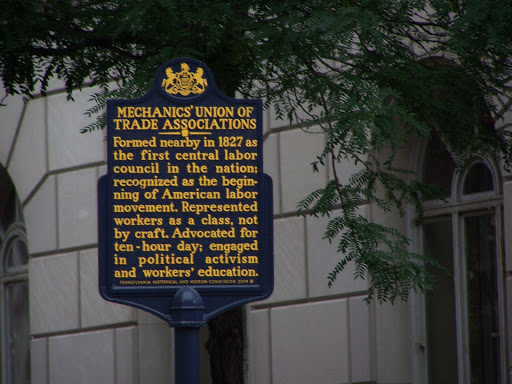
A Pennsylvania historical marker commemorating the establishment of the Mechanics' Union of Trade Associations--the first U.S. body of true trade unions.

About the same time those journeymen and apprentices began to organize trade organizations separate from the associations of the master craftsmen, their employers.  These were the first proto-unions.  In 1827 to protest debtors prison sentences in a time of financial panic, Philadelphia workers from several trades came together to launch the short-lived Mechanics’ Union of Trade Associations.  Although crushed within two years, they are generally viewed at the beginning of a true trade union movement in the United States 


Monday, November 13, 2023

That Bloody Sunday at Trafalgar Square—Victorian Class War

A popular British magazine illustration of the police charge on marchers in Trafalgar Square in 1887.

There sure are one hell of a lot of Bloody Sundays.  Could make your head spin.  A Wikipedia Disambiguation page lists 18 between 1873 and 1991 and I am not sure the list is definitive.  The first was a Reconstruction Era race riot in Colfax, Louisiana in which White Democrats attacked Black Republicans and Militia members trying to defend the ballot results of an election.  Between 50 and 160 Blacks were killed, most executed after surrendering and their bodies dumped in the river.  The most recent was on January 13, 1991 in Vilnius, Lithuania when Soviet troops opened fire on civilians protesting rising prices in newly independent nation.  In between most of the incidents were cases of police, military, or armed security guards opening fire on protestors.  A handful like a 1939 massacre of civilians at Bydgoszcz, Poland by Nazi Germany were war crimes.

Most Americans associate Bloody Sunday with the attack on voting rights marchers at the Edmund Pettus Bridge in Selma, Alabama on March 7, 1965 setting the stage for the historic Selma to Montgomery March on March 21.  They may also recall a Bloody Sunday on January 30, 1972 when British Army Paratroopers opened fire on unarmed Catholic demonstrators in Belfast, Northern Ireland leading to a twenty year-long guerilla war and bombing campaign by the Provisional IRA.  It is remembered as much for protest songs by Paul McCartney, Give Ireland Back to the Irish; John Lennon, Sunday Bloody Sunday; and U2s song of the same name.

The events in Londons famed Trafalgar Square on November 13, 1887 are virtually unknown to Americans, but this particular Bloody Sunday was pivotal in British political, class, and labor history and helped shape a generation of struggle.

Times were hard in Britain in the 1880’s.  Had been since a crash in 1873 and would continue to be until the turn of the 20th Century.  The period is remembered as the Long Depression.  There were many contributing causes but among the most significant was a collapse in agricultural commodity prices that combined with the introduction of modern farming equipment displaced rural agricultural laborers and tenant farmers who with nowhere else to go flooded the cities.  The infusion of so many unskilled laborers into the cities led to a collapse of wages.  Unemployment skyrocketed and depressed wages led to widespread want.

Nowhere was the agricultural depression felt more strongly than in Ireland where despite huge losses in population due to starvation and disease in the Potato Famine decades earlier and mass emigration to the United States, Canada, and Australia, continuing consolidation of landed estates forced more peasants off the land, many of them piling into English cities when they could not raise fare for new worlds. 

Discontent had been building in the cities where there had been demonstrations of the unemployed and clashes with police for two years.  And in rural Ireland there were rent strikes, boycotts, rioting, and unrest which caused the Coercion Act of 1881 allowing for persons to be imprisoned without trial.  The act was introduced by the Liberal Government of William Gladstone and, along with continued harsh measures in Ireland, led to the abandonment by the radical wing of the Party.  With the old Whigs shattered, the Tories—now officially the Conservatives, swept to power and would remain in the saddle almost continually through the rest of the century.  Their hold was secured by the allocation of seats in Parliament that still vastly underrepresented urban and working class districts while preserving rural safe ridings for the Conservatives.

The Conservatives ideologically refused to consider measures of domestic relief or economic reforms that might have interfered with a free market.  They were also most interested in the maintenance and extension of the Empire through which the vast wealth of the world settled into the hands of banks, corporations, and an entrenched elite who were thus insulated from the domestic economic crisis.

Starving men from London's East End slums line up for meal tickets from the Salvation Army.  Private charity was the only form of relief for the desperate.

These conditions had given rise to new movements—a small but growing socialist movement including the Marxists of the Social Democratic Federation (SDF) and Socialist League, and the middle class and intellectual Fabian Society of reformist socialists.  Discontented Liberals and former Liberals had rallied around organizations like the National Secular Society, various free thought movements, and radical religious dissenters including the Unitarians.

There were also organizations of the Irish diaspora, increasingly radicalized by the Coercion Acts.  These were galvanized by the recent arrest of Irish nationalist Member of Parliament William OBrien who was imprisoned for incitement as a result of an incident in the Irish Land War.  The Irish National League called for a mass demonstration to demand O’Brien’s release.

The SDF, led by William Morris, better known to American viewers of Antiques Road Show as the textile and furniture designer who was the father of the Arts and Crafts Movement, was eager to curry favor with the burgeoning Irish populations of the London slums and joined in the call for a demonstration.  They broadened demands to include unemployment relief.  They were able to attract fairly significant numbers of native English workers, many of them members of the struggling trade union movement.  The Fabians were not official sponsors, but most prominent members offered their support, including Irishman George Bernard Shaw, as did some of the radical Liberals and Freethinkers.

Artist and designer of furniture, wall paper, and domestic decorations, was also a leading radical and leader of the Social Democratic Federation which took the lead in organizing the Trafalgar march.

The march was well publicized in advance.  The Conservative government of Lord Salisbury vowed not to be intimidated and assigned infantry companies and cavalry troops in support of hundreds of massed Metropolitan Police who were armed only with their truncheons.

The flash point would be Trafalgar Square where the working class East End met the upper-class West End of London.  On that Sunday afternoon as many as 30,000 “respectable citizensringed the square in hopes of witnessing the suppression of the march as if it were a spectator sport.  Ironically, although many of the crowd probably hoped to see violence unleashed against the demonstrators, the presence of so many witnesses caused authorities to order that troops carry unloaded weapons and that the cavalry refrain from drawing their sabers.  There would be no repeat of the bloody military attacks on Chartist demonstrators 40 years before.

Annie Besant of the National Secularist League was the firs speaker physically restrained from speaking but she was not beaten or arrested like other march leaders.

The march was well organized and coordinated.  Various feeder marches converged on the Square from different points in the East End.  Columns were led by Morris, fiery trade unionist and SDF leader John Burns, National Secularist League speaker Annie Besant, Scottish radical Liberal MP Robert Cunninghame-Graham, and the socialist feminist Elizabeth Reynolds.  Their prominence is an indication of how much of the leadership of the movement had slipped from the hands of the Irish nationalists to the socialists and radicals.

But the majority of the marchers, estimated at around 10,000 in numbers were Irish.  And they were plenty mad.  By all accounts many had come armed with clubs, iron bars, gas pipes, and knives.  They were met with a force of 2,000 police and 400 troops.  As soon as Annie Besant attempted to address the crowd, she was restrained by police, who despite her insistence declined to arrest her.  But police did attack other leaders including Burns and Cunninhame-Graham beating both men badly before dragging them away.

Police and a "respectable citizen" detain a stereotypical Irish rioter. Most of the press was hostile to the demonstrators and supported the government.

Police charged the crowd with truncheon’s swinging.  They were met and resisted by many of the armed Irish in a bloody melee in which dozens on both sides were seriously injured.  Perhaps biased press accounts claimed that the Police suffered greater injuries. Troops surged forward to disperse the crowd, the cavalry trampling many and some demonstrators were stabbed by bayonets.  Scores were injured and at least two demonstrators, Alfred Linnell, a young clerk and W. B. Curner died later of their wounds.

Burns and Cunninhame-Graham and others who were arrested were sentenced to seven weeks in prison.  In Parliament most Liberal MPs supported the Conservative government’s use of force and its refusal to offer any concessions to the demonstrators.

One week later a second protest meeting was broken up by police.  Shortly after Linnell, who had not even been a participant in the march, but an unlucky spectator run down by a cavalry horse, died.  William Morris composed a memorial hymn which was published and widely disseminated.  Morris spoke at a memorial for Linnell telling thousands assembled that, “It is our business to begin to organize for the purpose of seeing that such things shall not happen; to try and make this earth a beautiful and happy place.”

When the prisoners were released in February an open meeting led to a breach between the radical Liberals, secularists, and reformist socialists and the more radical Marxists.   SDF leader Henry Hyndman violently denounced the Liberal party and singled out for criticism even radicals like Cunninghame-Graham for being insufficiently committed to the working class.  It represented a rejection of respectable middle class leadership leading eventually to a new strategy centering on the Trade Union movement and the creation of a working class led social democratic Labour Party.

The British labor and socialist movements would look back on Bloody Sunday as an almost mythic event in their self-defined origin stories.