Showing posts with label white skin privilege. Show all posts

Monday, January 19, 2015

What Still Pisses Me Off Every Martin Luther King Holiday

Rev. Martin Luther King, Jr. and his wife Corretta Scott King are among those leading the march from Selma as it enters the state capital, Montgomery, Alabama 50 years ago.


Yes, my annual rant seems more timely than ever this year with the hoopla over the 50th anniversaries of the Selma campaign and the subsequent enactment of the Voting Rights Act of 1965 including the released of the widely hailed motion picture Selma.  I have not yet seen that film which was just released this weekend just after it was it was largely snubbed by Academy Award voters.  Seeing it is high on my to-do list.  At least some have expressed the hope that the movie will be such an eye-opening experience that it will address some of the issues raised in this annual bloviation.  And perhaps it will—if the white people who most need to see it will—and I suspect they will avoid it like the plague—or recognize that they are a part of a continuing problem even if they are sympathetic.
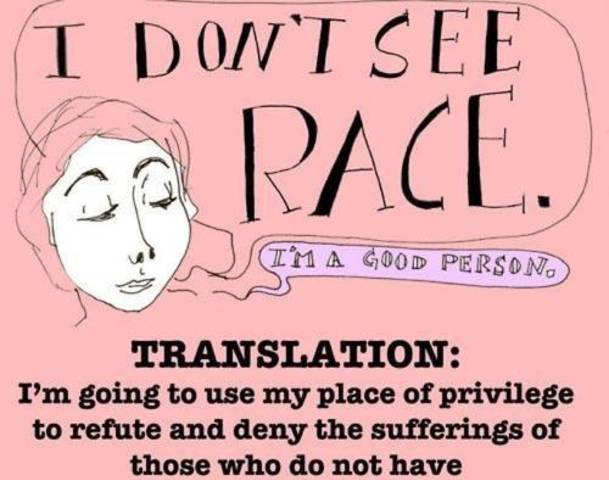
Which brings us to the elephant in the room—the exposure of the continued existence (to White folk) of systematic racism in this country and its deadly consequences as shown in a dreary parade of police executions of unarmed or minimally dangerous Black folk.  The self-organized eruption of the Black Lives Matter movement nationwide including relentless demonstrations, mass marches, wide spread civil disobedience, a refusal to allow society to proceed with business as usual, and, yes some venting, rock throwing, and window breaking is the Civil Rights Movement of our time.  And it has forced White people into an awkward debate about something called White Skin Privilage with attendant wails of denial and accusations racism against Whites.  Sigh.
So here, once again, is my rant on Why Martin Luther King Day Pisses Me Off.

***
Today is the Federal Holiday celebrating the Rev. Dr. Martin Luther King, Jr. He was born on January 15, 1929 and was assassinated on April 4, 1968 in Memphis, Tennessee.  It was a long, hard fought effort to create a federal holiday, following proclamations in several states.  President Ronald Reagan signed the legislation creating the holiday in 1983 and it was first celebrated nationally in 1986.  The senior George Bush moved the date to the third Monday in January. 
Despite the national observance, several states refused to enact state proclamations. After a threatened national economic boycott threatened the Super Bowl in Arizona, the holiday was officially observed in all 50 states for the first time in 2000.
Depending on your state, schools may or may not be open.  It they are you can count on some kind of touchy-feely programming that will assure children that once, long, long ago things weren’t so nice for Black people, but thanks to Dr. King everything is just fine now.  A tremendous amount of time will be spent emphasizing his non-violence and schools now routinely use the occasion as a center piece in their violence prevention programs.  They will also emphasize tolerance of those who are different—which it turns out may be the red-headed kid or the girl with a lisp. 
As laudable as these things are, children are not apt to be told that their grandparents may just have been the ones doing the oppression of Black folk.  Nor are they given any real sense of Dr. King as a truly revolutionary figure willfully defying the power of the state, demanding true systematic change, addressing class inequality, and in time of war leading an opposition to that war.
In cities, towns and villages across much of the country, there will be obligatory civic observations.  These most often take the form of prayer breakfasts, dutifully attended by local dignitaries of all races.  While some local Black preacher may take the occasion to lay out some harsh truths or even demand attention to continuing injustices, everybody will applaud politely.  Politicians will parade to the podium with bromides.  Some one—preferably the precocious son of a Black preacher—will intone words from the I Have a Dream Speech, and at the end maybe everyone will join hands and sing We Shall Over Come.  I bet you have been to just this kind of event.  Hell, I’ve even helped plan and put them on.
There will be nostalgic clips of the March on Washington on the news, maybe a documentary or two on the History Channel and Public Television.

Art and headline reality collided at the premier of the movie Selma in December when actor Wendel Price who portrayed the Rev. Hosea Williams in the film, wore this on the Red Carpet.
Many of the people who hated Dr. King when he was alive or who are their spiritual descendents will blandly join in the celebrations.  And then they will turn his words against him.  When you hear a plump politico with a honeyed accent quote, as they all love to do, the one phrase from the I Have a Dream speech where he spoke about the little children being judged not on the color of their skins but on the strength of their characters, watch out.  That hack is about to use Dr. Kings words to attack that dream.  He will say that now that we have erased statutory discrimination, any lingering program that gives disadvantaged minorities the slightest leg-up is itself discriminatory.  Dr. King would want a perfectly color blind society.  Unspoken is his deep conviction that in such a color blind society, white men will rise like cream and be restored to their rightful place on top of the ladder—as if they had ever really lost it.
Dr. King will also be invoked for his non-violence, which will be translated into passivity.  Law breaking—including the kind the Civil Rights Movement routinely used—will be denounced.  No word will be uttered that Dr. King’s non-violence actually expected to provoke violent opposition and use that response to tweak the conscience of a democratic nation. 
Since Dr. King’s time, police departments have been provided with new arms and tactics.  New crowd control methods and security provisions make the kind of marches, sit-ins, and demonstrations led by King either impossible or kept far away from threatening the safety of those being protested, as was seen repeatedly in attacks on the Occupy Movement. New restrictions on the press—and when that doesn’t work outright attacks, arrests, and physical intimidation—keeps reporters from fully reporting on acts of civil disobedience so that the public consciousness may be safely left un-tweaked.
A few of years ago, rising to a new level of audacious gall, a senior Pentagon official, in a program marking Dr. King’s birth at the Department of Defense, actually argued that the Nobel Peace Prize winner would “understand” and “approve” of the “work of our soldiers” in Iraq and Afghanistan.
We are told that because Dr. King was a faithful Baptist, he would not today support Gay, lesbian, and transgendered people and that it is a mockery to compare their struggle to the Civil Rights Movement.  The Black church is divided on this—even Dr. King’s children are—but it is hard to imagine his rejection of justice for them.
Likewise some Black leaders will claim, especially in their own communities, that Dr. King fought just for them, that gains he fought for should not be extended to the growing Latino minorities that threaten to displace them as the most oppressed.
All of this is possible because nearly 46 years after his death Martin Luther King has been sanitized.  He has been scrubbed clean of the any semblance of actual humanity, any personal foibles or flaws, and midnight doubts or struggles of the soul.  He has become an empty vessel into which can be poured a safe and bland pudding which can placate pesky Blacks with a pat-on-the-head while protecting the status-quo.
Enough!  The real, flesh and blood Dr. King would have none of it.  
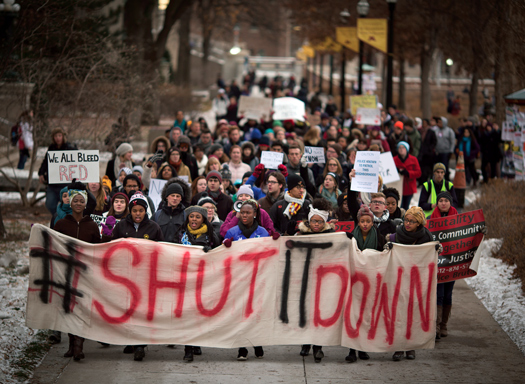
Self-organized, youth led marches and actions like this one aimed at disrupting business as usual during the Christmas buying season.  They directly carry on and honor the work of Dr. King and the Civil Rights movement whether hand wringing inconvenienced shoppers and store manager approved or not.

Let’s remember him today for who he was, not who the charlatans want to make him out to be.  And let’s remember that as great as he was, he was one man.  Let’s not denigrate the truly historic sacrifices of thousands and thousands of ordinary people who repeatedly literally put their lives on the line—and continue to do so today.  Let’s celebrate him and them by rededicating ourselves to standing up as they did, by putting our bodies, when necessary, on the line to achieve his true dream of an equitable and just society.


Friday, December 5, 2014

Lift Every Voice and Cry…

A die-in at Grand Central Station in New York protesting the refusal to indict the cop who choked Eric Garner to death.


An old, stirring song written in 1900 by James Weldon Johnson and set to music by his brother John Rosamund Johnson began with the words “Lift every voice and sing.”  It was written at a moment in time when Black Americans were under incredible pressure.  Almost all of the gains save the abolition of chattel slavery had been erased by the imposition of Jim Crow laws in the states of the old Confederacy and in border states as well.  In the North de facto segregation worked just as well as that imposed by law in hemming in the opportunities for most people of color.  Yet the song was a hopeful anthem.  It was first performed on Lincoln’s Birthday in honor of a speech to be given by the apostle of boot-strap racial self-improvement by education Booker T. Washington at a segregated school in Jacksonville, Florida.  It would be widely popularized by the Fisk Singers, the traveling choir from Nashville’s Fisk University, then the most prestigious Black college in the country.  It was a song that spoke for the dreams and aspirations of a sliver of the Black population—a tiny, educated elite that felt it must lift the whole race on its shoulders.
The song became known far and wide as the Black National Anthem and continued to be sung through the Civil Rights campaigns of the 1950’s and ‘60’s alongside earthier, more militant songs rooted more in Black gospel and blues and less on European choral traditions.
Much has changed since those hopeful words were first voiced.  Hard won victories smashed Jim Crow.  Voting rights were won at a painful cost in blood and tears.  The election of a Black man as President of the United States was heralded by some as the inauguration of a new, supposedly post-racial era. 
How quickly those gains have been eroded or shown to be illusionary.  That Black President in no time became the focus of rage for many whites many of whom barely understood that the root of their anger was the fear of losing privilege and its racial motivation.  A greater percent of children, North and South, are in segregated public schools today than in 1950.  Blacks lost more jobs in the Great Recession than any other racial or ethnic group, have recovered fewer of them, and have lost the most real income collapsing much of what had been a fragile Black middle class.  Most shockingly of all, a fifth of all adult black men at any time are incarcerated and more than half will be jailed in their lifetimes.  Police departments, largely White but including many Blacks, have become occupation armies whose primary function is the protection of White property and the preservation of systematic dominance.  The rule of an oligarchic elite—the 1% in the term popularized by the Occupy movement—survives by exploiting fear of supposedly animalistic Black violence to prevent almost equally disenfranchised and marginalized Whites, Latinos, Native American, and Asians from uniting with Blacks.
All of this has come to a head with a string of ugly police murders of unarmed Black males with seeming impunity.  You know the drill—Michael Brown in Ferguson, Missouri; 12 year old Tamir Rice killed for playing with a toy pistol just two seconds after the arrival of a White cop; and Eric Garner a very large Black man who may have been guilty—gasp!—of making some spare change by selling individual cigarettes to the desperate who was swarmed by police and wrestled to the ground by an illegal choke hold as he gasped, “I can’t breathe!”  In the first and last cases grand juries refused to indict the killer cop setting off nation-wide demonstrations.  In the case of young Rice absolutely nobody expects a different result.  And these are not isolated instances, but just egregious examples of police killing that have been repeated scores of time around the country every year.  More than 500 American citizens are killed by our own police every year—a hefty majority of whom are Black males, some unarmed, and many other in questionable circumstances.
The reactions to these events have divided the nation.  Black almost unanimously are outraged and hurt.  They are becoming more willing to confront the violent oppression on the streets which is a daily part of their lives.  Many Whites reflexively believe that any police action against Blacks is somehow justified.  Even many White liberals who annually celebrate Martin Luther King Day, who would never dream of uttering the N word, and who like to congratulate themselves on being colorblind cannot grasp that these killings are part and parcel of deeply ingrained racial animus.  They are taking affront by being accused benefiting from White skin privilege.  


I understand.  No one wants their virtuous self-image called into question.  After all, they say, I never owned a slave or oppressed a Black person.  Quite seriously more times than you think possible the next assertion is actually “some of my best friends are Black.”  Talk of White skin privilege sound like an accusation of personal racism.  And it is especially hard for those who may have come from less privileged background themselves to hear.
We will leave aside for the moment the even harder notion that society is so deeply saturated with racism that even the most enlightened and well-meaning of us have absorbed its assumptions and act on them every day.  And none of those assumptions is more deeply and viscerally held than fear of Black men.  This leads a lot White folks to say stupid thing when discussing these incidents, most frequently by trying to find some reason of individual behavior in each case that invited or caused a rationally violent response by the police.
Look I understand.  This well-meaning White guy with an actual history of working for and supporting Civil Rights is just as apt to fall into these traps as anyone else.  May be more so.  I can always bring out my I-marched-with-Martin-Luther-King trump card. 
But when I take the hard moment to look in the ugly mirror of reality I come upon some brutal reminders.  In my youth I was often in the streets taking part in demonstrations against the Vietnam War—think the ’68 Democratic Convention.  Things got hairy at times.  I dodged tear gas and police batons.  But in my worst moments I never for a moment believed that I might be shot, not even when the National Guard with Jeep mounted machine guns came rumbling down Michigan Avenue.  Yet in the very same city earlier in the very same year Mayor Richard J. Daley had issued his famous shoot to kill order against Black rioters.  The West Side became an actual war zone with the Black corpses to prove it.
Even in my later years I have led or participated in noisy and semi-raucous small demonstrations out here in the boonies of McHenry County touching on some hot-button emotional issues like immigration and marriage equality.  But my mostly White cohorts and I never drew more than a couple of polite police officers who mostly stayed out of our way and let us do our thing.  But a similar demonstration in size and noise by Black folk in many American cities and town would be more than enough to bring out the SWAT Teams, the armored vehicles, and phalanxes of cops arrayed for war.  Our demonstrations ended with us finishing up at the appointed hour and going home.  Black demonstrations might well end in tear gas, police charges, and mass arrests.  The media, if they took note of us would describe us as demonstrators.  They would describe the Blacks as a rowdy mob or rioters.
I’m a working class guy and often more than a little scruffy around the edges with my beat-up old hats, scraggly too-long hair, untamed goatee, and seedy, often second hand clothing.  I could pass for any homeless dude.  I know what it’s like to have a cop slow down as her rolls by when I am walking down some residential street.  I have been stopped for questioning walking home late from a second shift job.  As insulting and inconvenient as it is, I know that I just have to present some identification and politely explain that my house “is just over there” officer to be sent on my way—sometimes even with an apology.  Walking while Black in McHenry County, on the other hand is a good way to get stopped, frisked, and thrown into the back of a squad car.
When my oldest grandson Nicholas was in high school he lived with us.  He was tall and skinny with thick red hair down to the middle of his back.  He took to wearing all black including in cool weather an overcoat that made people think of Columbine school shooting Trench Coat Mafia and baggy jeans festooned with five pounds of chains.  He and his pals—we called them his posse—were into fantasy roll playing games.  Nick would roam the neighborhood with a five foot long reproduction English double-bladed broadsword.  It was not sharpened, but quite heavy and if swung with enough power could, I’m sure, separate an arm from a shoulder or get a head half-way off a neck.  His friends carried a variety of swords, sabers, dirks and the like, some of them quite real.  One even had a spiked mace on a chain.  I’m sure they were a terrifying sight.  A couple of times local cops stopped him and told him to “take it home.” 
Now try calculating the expected life span of a Black teenage boy under the identical circumstances.  Go ahead. It won’t take long to realize that he would be riddled with bullets long before he ever had a chance to explain that he was only playing a game.
I get the point.  You get the point.  All of this is only the tip of the iceberg of white skin privilege when it comes to our contacts with the police.
Some White folk are learning to face this reality, as bitter a pill as it may be.  The demonstrations around Ferguson and the Eric Garner case have included lots of White folks.  Members of various religious communities have taken lead rolls.  I am proud to say that my Unitarian Universalists have been there and done that.  Our ministers are, by in large, doing a good job at talking to their congregations about it.
But even notoriously liberal do-gooding UUs are not immune from either denial or of finding ways to justify police actions and the willful acts of society to refuse to punish obvious criminal behavior.  The Rev. Victoria Weinstein writing in her highly respected blog PeaceBang notes that many of her colleagues have received push back from resentful congregants.  She wrote:
The denial is staggering. My colleagues are weighing in, one by one and then in a rush, commenting on Facebook and e-mails and in messages about their conversations with white parishioners who don’t get it, who are sunk up to their knees like quicksand in white privilege and denial and a worldview that wants to assume that this doesn’t just happen and he must have done something and you don’t know everything and did you read the report? and did you read it as thoroughly as I did, because if you did you wouldn’t be so upset, you wouldn’t be sick and snarling and enraged and disgusted with humanity right now, you’d be the nice, comforting minister I expect you to be.
It’s tough.  I know. And exhausting.  I refrained since last summer from weighing in.  I told myself that others were saying what I would say and they are saying it better.  Who needs my voice?  And I don’t want to become a nuisance or a nag.  And I am just a two-bit blogger with a tiny following.  


But the time for silence is past, if it was ever appropriate.  Dr. King used to go on about how the silence of the good empowered evil.  He said it half a dozen different ways at different times.  He knew what he was talking about.
We, White folks who have finally grown tired of violence and oppression in our name need our own Anthem now.  Perhaps we could call it Lift Every Voice and Cry.  Perhaps it would inspire us to speak out, to march, and, yes, just to listen.
This is my cry.