Tuesday, December 2, 2014

Introducing the All New Ford Model A for 1928!

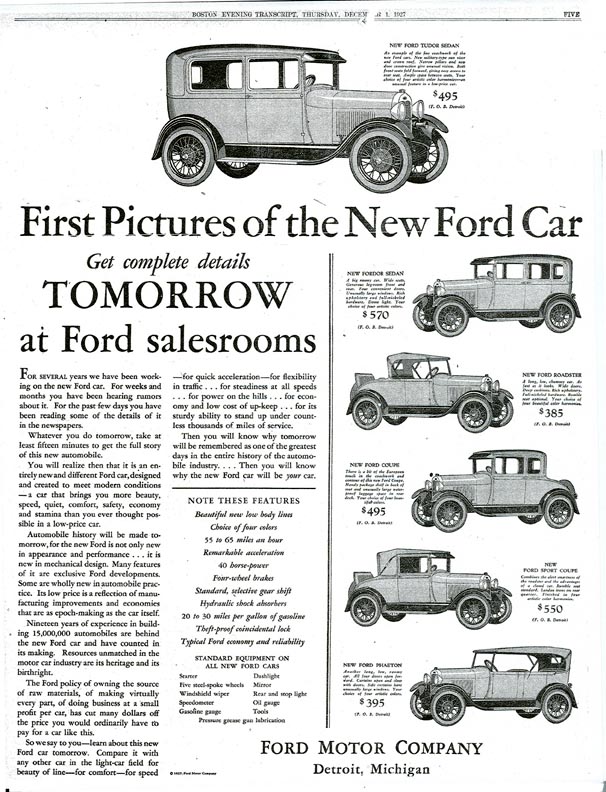
Launching the new model with pictures of body styles.


Henry Ford finally did it.  It was like pulling teeth and the man who once revolutionized an industry and put Americans behind to wheels of affordable automobiles was dragged into the wild new world of the Jazz Age and motorists with money burning holes in their pockets.  On December 2, 1927 Ford dealers began offering the brand new Model A replacing at long last 18 years of Model T production.
The Tin Lizzie had been the most successful automobile ever sold.  Using Ford’s innovative moving assembly line and a simple design it had been marketed at prices that any reasonably middle class American could afford.  Autos were no longer the exclusive plaything of the rich. And as they were produced year after year, millions of working class and even poor citizen were made mobile in second hand Flivers.
Ford was loath to make changes.  He was deep in his heart a stubborn conservative.  Moreover, he had peculiar ideas about the morality of automobile ownership.  He regarded such things as color choices or personalized options offered by competitors as vanities.  Of course his any-color-as-long-as-it’s-black philosophy also streamlined the production process and kept the per unit price of his cars low.  He considered innovations now common on competitors like electronic ignition and cabin heat in enclosed models as unnecessary frills.  But the public was growing tired of breaking their arms trying to turn over the Model T engine with a crank.  They were also wearing of an engine that by then was underpowered compared to other brands.  It may have been fine with Ford, who was in no hurry, by customers were tiring of a vehicle that could be passed by anything else on wheels on the road including a determined milk wagon.
Sales of the beloved Model T had been sinking as competitors, especially Chevrolet, matched Ford’s production innovations and added some of their own.  Chevy, and the turncoat former Ford engineers the Dodge Brothers were turning out their own right-priced mass produced cars and were regularly updating them.
Ford’s Board and his son Edsel finally convinced the old man it was time for a change.  Henry did not make the transition, mostly overseen by Edsel, easy.  He meddled in production maters—he tried to convert from die stamping body parts from sheet steel with more expensive drop forge technology which not only added production costs, but made the cars so heavy that even a new more powerful engine could not produce more speed.  The idea had to be junked at the cost of millions.  Edsel supervised the design which was much more modern and slightly less boxy than the Model T.  It was only after the new car was a success that Henry pushed his son aside and took the credit for himself.

New Model As on Edsel Ford's newly revamped assembly line at the giant River Rouge Plant in Dearborn, Michigan.

Edsel also tinkered with his father’s assembly line process, introducing flexible mass production, which allowed individual units on the line to be individualized including the use of four colors plus black and customer-ordered options.
The car was powered by a new water-cooled L-head 4-cylinder engine that could produce cruising speeds of 65 miles per hour.  It also contained industry innovations including the first use of shatter proof glass.
Six body styles could be built on the basic Model A chassis plus variation of each—a Coupe, a Roadster, a Four Door Sedan, a Four Door Convertible, a Station wagon or van, and a pick-up Truck.  A simple Roadster could be had for as little as $385 while a top-of-the-line Town Car with all the options ran to $1,200, not far below the price of luxury Cadillacs and Packards.
In the midst of the biggest economic boom in the country’s history, customers were ready, willing, and able to buy and spend.  By February 1929, one million Model As had been sold, and by that July, two million.  Even with the Wall Street Crash that October and the ensuing plunge into the Great Depression, Ford was able to sell more than three million units domestically before the car was taken out of production at the end of the 1932 model year.  In no time at all in its various forms the Model A was the most common sight on the road.

The actual 1930 Model A Roadster hijacked--along with its driver--in John Dillingers escape from the FBI attack on his gang at the Little Bohemia Lodge in Manitowish Waters, Wisconsin on April 23, 1934.  Just one of three million Model A stories.

Henry Ford had learned his lesson.  He did not become too attached to his new baby and replaced it in the 1933 model year with still more modern Model B with available with a flathead V-8 engine.  And after the mid-30’s the company began offering new models yearly.
The model A became, largely because of its widespread availability, the car on which the original hot rods were built.  It remains a starting point car for many classic car restorers and is still commonly customized.  Both historically accurate restorations and custom versions are common sights at car shows and in local parades. 

Monday, December 1, 2014

Two Beatles and a Flaming Condom—The Germans are not Amused

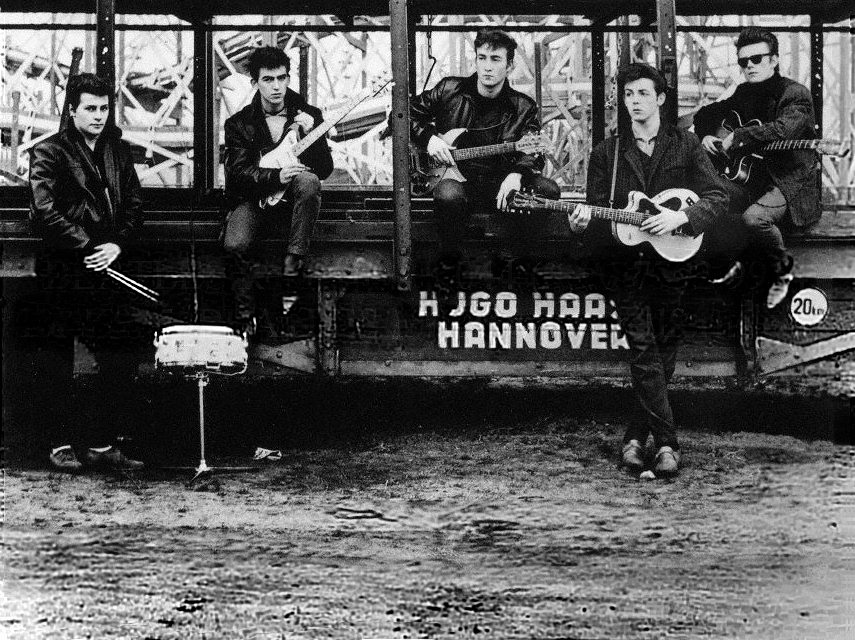
Stuart Sutcliffe's girl friend Astrid Kirchherr took the Beatles' first professional publicity photo in Hamburg in 1960.  Left to right Pete Best, George Harrison, John Lennon, Paul McCartney, and Sutcliffe.


Even the casual Beatles fan knows that the lads from Liverpool had some of their first success playing in Hamburg, Germany red light district.  From 1960 to ’62 the band made five trips to the port city under contract to club owner and producer Bruno Koschmider.  It was a sometimes stormy relationship with ups and downs but during the time the band spent playing in the German dives they tightened up and matured as musicians.  After the first stay they began to get a following at the Cavern and other Liverpool clubs where the Mercy Beat sound was being born.
Their first stay in Hamburg ended disastrously when on December 1, 1960 Paul McCartney and drummer Pete Best were arrested and deported back to England within hours. Just what happened is the stuff of underground legend.
The Beatles—they had finally settled on that name after running through The Beetles and the Silver Beetles—was quintet when they first arrived in Germany.  Longtime pals McCartney and John Lennon, who had played together since high school in pick-up and skiffle bands shared lead singing and played around at song writing.  The younger George Harrison, not yet 18, was the lead guitarist.  Lennon’s best pal from art school, Stuart Sutcliffe, sold his first painting and on a lark had bought a bass guitar and was learning to play it on the fly.  The group had been getting by with pick-up drummers for gigs in England but needed a steady stick man for their new engagement.  Lennon and McCartney had settled on Pete Best who had been knocking around in small time rock bands.
They arrived in Hamburg in August where Koschmider had converted a couple of former striptease joints/whore houses into music clubs.  He put his new act into the Indra Club as the house band.  The frugal Koschmider was not going to waste good money on comfortable accommodations for the band and the boys did not make enough money to rent rooms on their own.  He converted space behind the screen of his movie theater, the Bambi-Filmkunsttheater.  The accommodations for the five were Spartan at best.  The room was poorly lit, damp, crowded, they had to use the theater’s public restroom which was inconveniently located in the front of the theater.  But they were young and on an adventure and took it in stride.

As the house band the Beatles got second billing.

After a few weeks Koschminder had to close the Indra Club due to noise complaints from neighbors.  He moved the Beatles to his other club, the Kaiserkeller in October.  The band was quickly picking up a local following and the club was doing a robust business.  Band members, however, were not seeing much money from the gate.  For extra money they began playing at the rival Top Ten Club on their nights off.  When Koshminder heard of it, he was furious.  He informed the boys on November 1 that he was terminating their contract, originally scheduled to run six months, in 30 days. 
But he was not finished taking his revenge.  He went to the authorities and informed them that Harrison had lied about his age to get a work permit.  Harrison was quickly deported leaving the band scrambling without a lead guitarist.  Lennon and McCartney, neither as gifted as Harrison, divided the duties.  During their remaining month the handsome Sutcliffe moved out of the cinema and into his photographer girl friend Astrid Kirchherr’s pad. 
The band planned to stay in Hamburg and shift their primary venue to the Top Ten Club.  They had begun to move some of their equipment to an attic room over the Club and Lennon had already moved in there.
On their final day, November 30, McCartney and Best were gathering their belongings at the theater.  They had been drinking and popping pills.  Irked by the dim light in the room they decided to illuminate things by burning something.  Here accounts conflict.  Some say they used rags or towels, but according the version of the story that has entered folklore—and which Pete Best later told a radio interviewer—they decided that a pack of new latex condoms was just the ticket.  They lit them one by one and were amused by how they “burned and popped.”  In the excitement of the moment McCartney either threw one burning rubber against the wall or he pinned it there and lit it.  At any rate, it left a small scorch mark.  Thinking nothing further of it, the two collected their belongings and moved to the new room over the Top Ten.
That’s where the German police found them the next day.  Koschminder had found the scorch mark and was furious.  He went to the police and charged that Best and McCartney had tried to burn his theater down.  Most likely he simply wanted to find a way to keep the act he had helped make popular from headlining a rival club.  But the police took the charge seriously without much investigation of the facts.
They held the two Beatles most of the day.  Neither McCartney nor Best spoke German and did not understand why they were being held.   A request to speak to the British Consul was denied.  Late in the afternoon they were taken back to the Top Ten room and given five minutes to collect their belongings.  Best had to abandon his drum kit, but McCartney was able to salvage his guitar and a suitcase sized amp.  That evening they were placed on a plane and deported to London.
They arrived in the city broke and dazed.  They rang up friends and borrowed money for train fare back home to Liverpool.  Lennon, now without a band, returned on his own a few days later.  Sutcliffe stayed with his girlfriend through February.

Label for the first German hit with Tony Sheridan
Amazingly, the band and the German impresario patched things up and they returned for another engagement at the Kaiserkeller in 1961.  During that stay Koschminder got them into the studio to play back-up and sing harmonies on a rock version of the old Scottish song My Bonnie Lies Over the Ocean behind another British rocker, Tony Sheridan.  My Bonnie was released as a German single credited to Tony Sheridan and the Beat Brothers and became a modest hit—#35 on the local charts.
After this stay, Sutcliffe decided to return to art school in Germany and became engaged to Astrid, officially leaving the group without a bass player.  McCartney, who had never touched a bass, volunteered to replace him and in a matter of weeks back home in Liverpool learned the instrument, playing it upside down and backwards because he was left handed.
The band was getting hot back home at the Cavern club and had attracted a new manager, Brian Epstein and a record producer, George Martin.  But they were contractually obligated to Koschinder for more appearances in Hamburg and another German recording session.  Epstein negotiated a deal requiring a quick trip so that they could begin work at the Abby Road Studios for English releases on EMI and two more short appearences.
They arrived in Hamburg on April 11, 1962 only to be greeted with the devastating news that Sutcliffe had died of a brain aneurism the day before at the age of 21.   
The band returned twice more for brief appearances in Hamburg that year.  In between they began working with Martin and recording their early work with him.  At Martin’s urging they sacked Best, a drummer of limited ability and replaced him with journeyman drummer Ringo Starr, most lately of Rory Storm and the Hurricanes, who became the oldest member of the group.  They released their first English single, Love Me Do in October, and it went to #17 on the charts. 
Ringo accompanied the Band to Hamburg in December for their last engagement there.  Bigger things were on the horizon.