Friday, March 4, 2022

Reformer Frances Perkins Stepped Up for Labor

                            Frances Perkins--Madam Secretary.

On March 4, 1932 Franklin D. Roosevelt, the day of his first inauguration, nominated Frances Perkins as Secretary of Labor.  She was the first woman elevated to cabinet rank.  If anyone was expecting a docile figurehead, they were in for a big surprise.  Not only was she a key player in the New Deal and a key backer of a wide range of labor reforms, she held down the job for twelve years through FDR’s first three terms despite efforts to unseat her.

Born into a respectable Republican and Congregationalist New England family in 1880, she was radicalized by exposure to the yawning class divide while attending Mt. Holyoke College where she read Jacob Riis’s expose of slum conditions and attended lectures by leading reformers and labor advocates, especially Florence Kelley of the National Consumer’s League.  Graduating in 1902 she tried her hand at teaching science in urban schools while volunteering at settlement houses.

                          Perkins as a student at Mt. Holyoke.

But by 1909 she was ready to give up teaching for a career in social services and advocacy.  She moved to New York City to pursue a master’s degree in economics and sociology from Columbia University then joined her mentor Florence Kelley by serving as Secretary for the New York State Consumer’s League where she successfully led lobbing efforts to get the Legislature to limit the work week for women and children to 54 hours.  She also took up active support of the Suffrage movement.

In 1911 she personally witnessed women leaping to their deaths from the upper floors of the building at the Triangle Shirtwaist Fire, an event that would steel her determination to guarantee safe working conditions.  Where she had previously relied on legislation alone, she increasingly saw the need for workers to organize in their own defense and supported the work of Ladies Garment Workers leader Rose Schneiderman and others.  She even joined the Socialist Party, though she advocated gradual reform rather than revolutionary action.

                                    The young reformer and New York civil servant.

In 1912 she supported Woodrow Wilson over Eugene V. Debs believing that the Democrat would more effectively advance labor’s cause.  She was wrong, but in the long run was one of the people most responsible for seeing that the planks of the 1912 Socialist platform were finally enacted under another Democrat.

She briefly retired from public life to marry economist Paul Wilson and to give birth to a daughter.  But Wilson suffered a breakdown and Perkins returned to work as the family breadwinner.

In 1919 she joined the administration of New York Governor Al Smith as the first woman on the state Industrial Commission.  By 1926 she was Chair of the Commission.  In 1929 Governor Roosevelt appointed her to head the state Labor Department.  She pushed through another round of reduction of hours for women and children to 48, stepped up factory safety inspection, and lobbied for minimum wage and unemployment insurance laws.

Roosevelt took her with him to Washington.  As Labor Secretary she helped craft and get the Wagner Act through Congress, which finally guaranteed workers the right to organize into labor unions on the job and engage in collective bargaining.

Perkins, one of the chief architects, witnessed FDR sign the Social Security Act into law.

The Fair Labor Standards Act embodied her long cherished dreams for a minimum wage and a standard 40 hour work week for women and men.  She chaired the administration’s Committee on Economic Security which drafted the legislation embodied in the Social Security Act of 1935.

As the labor battles for representation in the basic industries intensified through the Depression, Perkins stood relentlessly on the side of working people to organize and resisted traditional calls to use Federal force and troops to suppress strikes.  She held firm against intervention in the 1934 San Francisco General Strike.

Conservatives and business interests put her in their cross hairs and in 1939 the House Un-American Activities Committee drew up a bill of impeachment against her for refusing to deport Harry Bridges, the Australian born West Coast Longshoremen’s leader who had been a key figure in the General Strike.  The impeachment attempt fizzled from lack of evidence and Perkins continued to serve until 1945 when she resigned to head the U.S. delegation to the International Labor Organization (ILO) conference in Paris.

                                              The Secretary of Labor on a coal mine safety inspection.

She concluded her public service when President Harry Truman appointed her to the Civil Service Commission.  With the return of Republicans to power in 1953 she took a professorship at Cornel University’s School of Industrial and Labor Relations.

Perkins died at age 85 in her beloved New York City in 1965.

Although revered by labor and feminists Perkins remains a reviled figure on the right.  In 2011 hyper reactionary Maine Governor Paul LePage tried to have a labor mural featuring Frances Perkins (center panel) from the State Department of Labor because it is too pro-labor and offended some business owners.

The Labor Department Building war re-named for Perkins on April 10, 1980—the 100th anniversary of her birth with President Jimmy Carter presiding over the ceremony.  On the same day the Postal Service issued a new 15-cent stamp bearing her likeness


Thursday, March 3, 2022

Bold New Militancy Launched Washington Woman Suffrage Procession of 1913

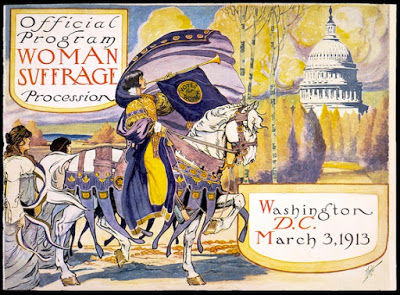
The stunning program cover for the 1913 Woman Suffrage Procession in Washington.

The giant Women’s March on Washington and sister marches across the country that greeted Donald Trump’s inauguration in January 2017 and they-said-it-couldn’t-be-done even larger marches a year later were seismic events that brought a broad, united, new intersessional feminism to the forefront of American social and political life after years on the defense as hard-fought gains once thought secure were under attack at every level.

Mass demonstrations no matter how large, critics maintained, had lost their power as the media lost interest in them and the public became bored.  Huge anti-war demonstrations that broke all records were barely covered by the press and had no discernable effect on curtailing a vastly unpopular war in Congress or in the Bush administration and only moderately moved the needle during the Obama years when painfully slow withdrawals of boots on the ground in Iraq and Afghanistan were matched by a brutal escalation of bombing and drone attacks not only in those two countries but across the region.

The Women's March on Washington was a rough welcome to Trump and a game changer for the feminist movement.

Instead, the media became fixated with a shiny new object—the tiny but colorful Tea Party movement.  Events drawing a few dozen in silly hats waving Don’t Tread on Me flags, and toting misspelled homemade signs received lead coverage night after night on network and cable TV news. Part of it was the sheer novelty of a right wing “grassroots” movement.  Traditional conservatives were at first dismissive and doubtful, but a hand-full of deep pocket millionaires saw potential pumped unlimited money into the movement, created faux grassroots national organizations to “lead it,” and soon used it to capture the Republican Party for their oligarchical aims.  Within what seemed like a blink of an eye they were in control of dozens of state governments, Congress, and the Presidency and seemed capable of completely remaking America with no effective opposition.

But there were signs of restiveness and resistance—the Occupy Movement that spread like wildfire, the up-from-the-streets youth-led Black Lives Matter movement, the May Day Immigration Rights marches and the rise of the Dreamers, the new Civil Rights movement represented by Moral Mondays.  But it was the Women’s Marches, perhaps because they included so many middle class white women, that finally recaptured the media and nation’s attention

To its credit the Women’s March movement has, not always smoothly, taken pains to broaden its leadership and representation and to stand for an intersessional struggle that includes not just traditional feminist objectives like preserving abortion rights, removing obstacles to social and professional advancement, the Equal Rights Amendment, and election of women, but support for Women of Color, immigrants and refugees, Muslims and other minority religions, the LBGTQ communities, Native Americans, the disabled, the labor movement, and environmentalists.  It has not been a perfect process and serious divisions remain over issues like electoral politics, particularly endorsement of Democrats, and levels of street militancy, but it has been a game changer.

One 109 years ago today, another march of women in Washington, in some ways quite different, marked a radical turning point in the long struggle for women’s suffrage and became a spiritual ancestor of today’s movements.

Alice Paul was inspired by the militant campaigns of the British Suffragettes led by Emmeline Pankhurst seen under arrest in the right foreground and her daughter Christabel in custody behind her.

Alice Paul and Lucy Burns were uppity women.  Worse they were angry, uppity women.  They were more youthful than the dowagers whose decades’ long drive for women’s suffrage had been noble, but fruitless.  Paul had been in England and was impressed with how Christabel Pankhurst and her mother Emmeline, leaders of a new militant suffrage movement which was making a sensation by using direct action tactics such as publicly heckling politicians, window smashing, and rock throwing raising the profile of the cause there.

When Paul returned to the United States in 1910 she joined the National American Women’s Suffrage Association (NAWSA) and soon advanced to a leadership role.  Although the national organization was committed to a state-by-state strategy as its top priority, Paul was made Chair of the Congressional Committee with the responsibility of lobbying for Federal actionCarrie Chapman Catt, formidable leader of the NAWSA, did not have much faith in Paul or her project, but was probably glad to have the gadfly out her hair in New York where she was carefully planning an elaborate political effort to win state approval of the Vote by referendum.

By 1912 Paul and Burns set up shop in the Capitol as the as a semi-autonomous affiliate of the NAWSA called the Congressional Union. 

Carrie Chapman Catt of New York was the formidable head of the National American Women's Suffrage Association.  She would split with Alice Paul over strategy and style and the two were sometimes bitter rivals.  Their two pronged suffrage campaign, moderate and radical, actually complimented each other and help rapidly move to the goal.  But when the 19th Amendment was ratified, it was the moderate Catt, not the bur-under-the-saddle Paul who was invited to the Wilson White House.

In the Presidential election that year, Catt had broken ranks with many older suffragists who were traditionally Republican, and endorsed Woodrow Wilson, a distinguished academic and supposedly a new breed of progressive Democrat, in the hopes that he would swing his party behind suffrage.

Paul, however, did not want to wait for a painfully slow lobbing process to nudge the new Chief Executive in the right direction.  She declared her intention to “hold his feet to the fire” from the very beginning with a huge Suffrage demonstration on the eve of his inaugural.

Don’t imagine a modern march on Washington with mobs of somewhat disorganized marchers in pink pussy caps carrying banners, signs, and puppets in a mass throng on the Capitol’s wide avenues.  Paul’s Woman Suffrage Procession was planned out with military precision, the thousands of women marchers were arrayed in designated units, marching abreast.  Most units wore white, the symbol of purity and adopted color of the suffrage movement.   The procession would be led by equestrians and floats with women as various allegorical figures broke up the ranks of marchers.  An elaborate program was printed for onlookers and a proper parade permit had been obtained from local authorities.

Wilson arrived by train from his New Jersey home on Monday, March 3, 1913, the day before his inauguration.  As the first Democrat since Grover Cleveland to break the grip of Republican dominance and as a man of known Southern roots and sympathies, he likely expected a whoopsie-do reception in the culturally Southern city.  Instead, only a handful of dignitaries, politicians, and the press were at handEverybody else in town seems to have been lining Pennsylvania Avenue.

Inez Milholland on her white steed was a dramatic and compelling lead to the Woman Suffrage Processional.

No wonder, for Paul had put on a dazzling show led by the beautiful blonde lawyer and activist Inez Milholland astride a white horse in flowing Greek robes.  Behind her, Paul and her friends, also on horseback, led 8,000 marchers, almost all women, and on parade. 

An estimated half a million viewers crowded the route including cheering supporters, the idly curious, a lot of very, very angry men.

The procession was quickly attacked by mobs of men along the route, throwing rocks and battering participants with clubs and fists as the police stood by without intervening.  Retaining as much courage and dignity as they could muster, the marchers continued on their route while running a virtual gauntlet.  Before the rear of the march reached its destination some hastily mobilized troops from Fort Myer arrived to provide some protection.  Over 800 marchers, almost all women, were injured in the attacks.

Mobs of men swarm and menace an ambulance trying to transport injured marchers as police stood by.  It took Army troops to restore order and allow the parade to finish.  Despite the violence, maybe because of it, Paul knew the Procession was a triumph.

Reaction to the parade and the attacks threatened to overwhelm news of the Presidential inauguration the next day, much to the annoyance of Wilson.  And to the delight of Paul who regarded the operation as successful in every way. She was sure that public outrage would lead to greater support of the cause.

A subsequent investigation held the police derelict in their duty for failing to protect the lawful demonstration and the District of Columbia Police Chief was fired.

In New York Catt was less than thrilled and feared the bold confrontation would alienate male supporters critical for her state-by-state campaign.  None-the-less Catt staged her own giant parade down Fifth Avenue in May as the kick-off for her ballot initiative plan.  A fifth the marchers in her parade were men.


                                                Alice Paul and her Federal strategy was big news in the New York Times.

The breach over militancy and confrontation between Catt and Paul became irreparable in 1914 and Paul’s group severed ties with the national organization.  Two years later they reorganized as the National Women’s Party (NWP.) 

They continued to press Wilson for action with daily picketing at the White House.  When the picketing continued even after the country entered the Great War in Europe, Wilson had Paul and dozens of her associates and supporters arrested, jailed, and force-fed during hunger strikes.  When word got out about the abuse, Wilson was embarrassed yet again. Exasperated, Wilson finally declared support of a Federal Constitutional Amendment for women’s suffrage as a “war measure” and in recognition of the contribution of women to the effort.  He made no mention of Paul or the NWP, but no one doubted that their stubborn militancy had forced his hand.

Alice Paul raises a grape juice toast to the banner that she and members of the National Women's Party sewed by hand to hang on their Washington, D.C. headquarters building in celebration of the ratification of the 19th Amendment just over 7 years after the Suffrage Procession--a remarkably swift victory.

Both houses of Congress passed the 19th Amendment in 1919.  Then the battle moved to ratification by state legislatures and the state-by-state struggle advocated by Catt was back on.  The NAWSA and NWP played a kind of “good cop/bad cop tag team on state legislatures with Catt’s group wooing them with compliments and charm, and Paul threatening disruption and defiance

It proceeded, all things considered, with astonishing speed. On August 19, 1920 Tennessee passed the Amendment by one vote in the legislature, securing the necessary support to become a part of the Constitution.  When the Secretary of State certified the adoption on August 26, Paul and her cohorts proudly unfolded a banner on the NWP headquarters building in Washington and toasted the event—with grape juice, of course.


Wednesday, March 2, 2022

Ash Wednesday with George—Murfin Verse


Note—Back in 2012 by calendar happenstance George Washington’s Birthday and Ash Wednesday coincided.  As regular denizens of this refuge for flying electrons knows that sort of thing often inexplicably moves me to commit poetry.  This year his birthday has passed, but today is Ash Wednesday—close enough for hand grenades, horseshoes, and Patrick poetry I say.

Since the entirely spurious story of the Vision at Valley Forge was reportedly made in 1859 reminiscences by 99-year-old Anthony Sherman, who was supposedly present with Continental Army at Valley Forge during the winter of 1777 and overheard Washington tell an officer that an angel had revealed a prophetic vision of America to him.  There is no other confirmation of this and the recollections or revels recounted second hand make it dubious.

It did not see print until April 1861 just at the outbreak of the Civil War by Philadelphia journalist Charles Wesley Alexander. Writing under the pseudonym Wesley Bradshaw, Alexander authored several fictional vision or dream pieces featuring historic American figures which were published as broadsheets and in various newspapers during the Civil War and were later offered for sale through advertisements in the pages of The Soldier’s Casket,   his post-war publication.  It was meant to be allegorical fiction but was swallowed hook, line, and sinker by American Evangelicals and some Catholics who would find the mystical revelation an echo of many saint tales.  It has also been cynically promoted by certain hyper-conservative elements as proof that Washington and other Founders were deep and profound Christians in refutation of the fact that many of them were rationalists, Deists, or adherents of heretical sects or theologies. 

 Arnold Fribeg's painting of Washington praying at Valley Forge has become an iconic symbol for the American right wing and Christian dominionists.   

An iconic image by artist Arnold Friberg—one of several versions created over the years—was widely used to promote this pseudo history.  The story, image, and propaganda punch got new wings during the McCarthy era Red Scare of the early ‘50’s when the original so called prophesy—obviously meant as a metaphor for the Civil War when it was first was retooled as an anti-Communist screed.

These days it is a handy tool in the dominionist belt for asserting a claim that the U.S. is a Christian Nation and should be ruled in the name of Christ.

All of which begs the questionwhat were Washington’s actual religious beliefs?  Conservatives point out that he was a life-long Anglican and served as a Vestryman in his local parish.  True enough.  As the local squire the role of Vestryman—a lay member of a parish governing council—was an expected duty.  Washington from adolescence always was keenly aware of the duties of a gentleman and his obligation to fill them.  But in adulthood like many Virginians of his class he became influenced by the heretical philosophies of the Scottish Enlightenment, and eventually Deism.  While never a deep religious thinker like young Thomas Jefferson, he privately discarded most of the tenets of orthodox Christianity.  In his letters, writings, and public utterances he sometimes used the word God but more frequently used Deist constructions like Providence.  He virtually never referenced Jesus Christ. 

George Washington supposedly takes communion with his aides and officers at an outdoor service  held by the Morristown Presbyterian Church which claims that he officially joined during the period when the Continental Army was headquartered there.  The claim is boosted on right wing web sites trying to prove that Washington was a fervent evangelical Christian.  But there is no evidence that Washington actually took the communion wafer or that he ever joined the congregation.

In adulthood he often skipped regular Sunday services when he could—his duties as a soldier and statesman provided ample excuses.   When he did attend, he always left after the sermon and before the call to the communion rail.

Washington’s real spiritual life was rooted in Freemasonry, to which he was devoted.  The Masonry of his era combined esoteric mystic ritual with strong Deist elements and more than a dash of republican (small r) radicalism.  Washington famously laid the cornerstone of the Capitol building wearing his Grand Master Mason apron.  The eye-in-the-pyramid on the obverse of the Great Seal of the United States, seen most commonly on the back of the one dollar bill is generally credited to the influence of the First President on its design.

Washington's true spiritual home was Freemasonry.  He laid the cornerstone of the U.S. capitol wearing his Masonic apron.

Anyway, all of that was rolling around my fevered brain and contributed to this opus.

The Vestryman

Ash Wednesday/Washington’s Birthday 2012


The Vestryman performing the duty expected of the local Squire

            attended chapel when absolutely necessary

            and when no good excuse like fighting an Empire

            or Fathering a Country was handy.


He sat bolt upright on a rigid pew

            contemplated the charms of Lady Fairfax

                        or later dental misery.


            When came the Altar Call, he would stand up,

                        turn on his heel, and march straight out

                        as if a legion was at his back.


            No filthy priestly thumb ever grimed

                        that noble brow.


—Patrick Murfin     

Tuesday, March 1, 2022

Tossed Like Beads—Fat Tuesday Mardis Gras and Murfin Verse


Note—In 2020 Mardis Gras went on in New Orleans just as the Coronavirus pandemic was picking up steam.  The predictable outcome was a massive outbreak which also spread the disease to the communities from which reveling tourists returned.  Last year the Big Easy like most Carnival celebrating cities, was a virtual ghost town.  This year it is pretty much back to business as usual and the pent-up energy might make things wilder than usual.

Revelers are crowding the French Quarter again in New Orleans.

There are a downsides to having been raised vaguely Protestant and residing in sometimes inhospitable northern climes.  Perhaps the biggest is regarding with wistful envy the liberating extravagance of Carnival and Mardi Gras.  It is the un-religious holiday—a day of wallowing in the ways of the flesh and merry making before getting down to the serious and unpleasant tasks of the proper piety of Lent.

Catholics seem to know how to take advantage of the opportunity, especially in warm places where the streets beckonNew Orleans and Rio de Janeiro most famously.  But folks from countries where Romance languages are spoken can find ways to celebrate even in icy Quebec City.  

It's Mardis Gras in warm places.

The idea is simple.  Finnish up the Christmas season on the Feast of the Epiphany, the fixed day of January 11, and then coast down the hill of Ordinary Time until Ash Wednesday kicks off of Lent, which by the lunar calendar falls anywhere from February to March, gathering speed all the while.  It is the “dead of winter.”  Even in Mediterranean countries it was dark and often cold.  Folks stayed inside more, got on each others’ nerves.  But by Fat Tuesday, the sap was running and Spring seemed just over the horizon.  Perfect for one last opportunity to bust loose before breaking out the sack cloth and ashes.

Protestants, particularly Calvinists, their decedents, and those who stood close enough by to be infected, took a dim view of the whole process.  More Papist/pagan nonsense to them.  A good Calvinist existed in a state of perpetual Lent.  The experience of any sensual pleasure was regarded as a sinful distraction from contemplation of the awesome majesty of God and our totally undeserving souls.  It was for good reason that Puritanism has been described as the nagging suspicion that somewhere, somehow, somebody is having a good time.  

Cute.  But English alter boys flipping pancakes is a poor substitute of sex, sin, and degradation

England, I am told, once celebrated Carnival—a cultural gift of the Norman French aristocracyCromwell and his boys pretty much wiped that out at the point of the sword.  Even when Kings remounted the Throne and the Anglican Church regained the upper hand, the old traditions fell away.  Instead, they shrank the celebration down to something called Shrove Tuesday, which is celebrated mostly by making and eating pancakes.  Now I bow to no man in my affection for the flapjack or griddle cake, but even a high pile drenched in butter and real maple syrup is a poor substitute for dancing semi-naked in the streets.  They passed this tradition on to all the former pink spots on the globe where the Empire once ruled and to all the Protestant sects derived from Anglicanism and Calvinism.

Of course, not all Catholics party with absolute abandon.  Those from northern and eastern Europe either never celebrated or toned down Carnival.  The Poles celebrate with PÄ…czki Day (pronounced pÅ­tch-kÄ“).  In the old country it was held on the Thursday before Ash Wednesday, but in the immigrant communities of North America it is held on Fat Tuesday.  Folks line up at bakeries at the crack of dawn to purchase pÄ…czkis, a kind of jelly doughnut made only once a year.  This is a much bigger deal than it sounds on Chicago’s Milwaukee Ave, the main street of the Windy Citys Polonia.

Near riots have been known to break out at certain celebrated Chicago bakeries.  Purists denounce the faux Pacziki sold in boxes at supermarkets starting weeks before Fat Tuesday--pretty much ordinary jelly donuts with plenty of preservatives.  Only fresh bakery ones served by a grandmotherly lady in a hairnet with a thick accent are acceptable.

In Germany, the Baltic states, and Scandinavian Fat Tuesday is likewise celebrated with special local pastries meant to use up the supply of sugar and lard before the Lenten fast.

Tonight, the biggest and most honored Krews will be conducting their parades in New Orleans.  Down there, they take Mardi Gras seriously and have stretched it to the whole season between the Epiphany and Lent.  Various parades have been winding down the streets of different neighborhoods for weeks, each followed by its own Ball.  The streets of the French Quarter will be crowded.  Many revelers will be drunken northerners and Calvinist escapees.  They will party next to the locals, drinking copiously, begging for beads cast from the parade floats, and eying the pretty young girls flashing their tits.  Everyone will forget Covid, the attempted insurrection at the Capitol and its endless investigation, inflation, and the war in Ukraine that threatens to spin out of control. A good many of the former Cheeto in Charge, his Hellfire and damnation Evangelical acolytes, and the rest of that tribe will be at the big party in the Big Easy hoping that TV cameras do not broadcast their participation back home. 

Despite all of this President Joe Biden will deliver his State of the Union Address tonight.  Mardi Gras partiers will miss it.  Given the grim circumstances of the world, it will be a buzz kill for those at home trying to celebrate vicariously.  I will dutifully tune in, but I will wish I was with them in New Orleans.  It’s been far too long since the Old Man reveled in sin and degradation

Eight years ago, Social Justice Committee of the Tree of Life Unitarian Universalist Congregation in McHenry was scheduled to dutifully meet to do its earnest work on the evening of Fat Tuesday.   We were, after all, the stepchildren of those old Massachusetts Puritans.  As Chair it was customary for me to open the proceedings with a reflection.  Usually, it’s a reading I snatched from the internet.  But that bitterly cold night smack dab in the Winter that would not end with howling winds blowing snow dangerously across the roads, we gathered anyway. I read them this.  Fitting and apt.   Sitting through my poetry ought to be hair shirt enough for any Puritan.

                              The radical equality of Samba dancers in Carnival in Rio.

A Prayer for a Committee Meeting on Mardi Gras

March 4, 2014


Drudges like us throw on our heavy coats

            and slog through the still arctic night

            to rendezvous around a table

            for the earnest business of making the world

            a kinder place

            or so we tell ourselves.


We pass the hours elbow deep

            in the common dishwater

            of routine and rote,

            duty and debate

            and adjourn the world not moved

            a centimeter from its calamitous orbit.


But tonight in the Big Easy,

            down in Rio or far off Nice,

                        any of the warm places

                        where the evening pulses expectantly,

            they don masks and dance heedless

            in the streets.


In timeless Carnival

            the rich and poor,

                        Black and White,

                                    queer and straight

                                                alien and citizen

            revel together in absolute equality.


In the common streets

            justice rolls down like bons temps

            and righteousness,

                        the enemy of comity,

            is tucked away in a samba dancer’s thong.


For this one night there is Joy

            and the old world dances to a coronet.


—Patrick Murfin