Saturday, July 28, 2012

MacArthur, Eisenhower and Patton Roust the Bonus Army

Army Chief of Staff Douglas MacArthur consults with his cavalry commander, Major George S. Patton, center as tear  gas envelopes the Bonus Army on Pennsylvania Avenue.  MacArhur's aide, Colonel Dwight Eisenhower on the right with his back to the camera. 

The streets are a little less full this summer as the Occupy Movement adjusts and re-assesses.  But the upcoming conventions of both political parties will likely result in mass direct action.  Meanwhile around the world literally millions are taking to the streets to protests austerity (Greece, Italy, and Spain,) for democratic reform (Bahrain and Egypt,) attacks on education (Quebec and increasingly the rest of Canada,) and against an apparently stolen election (Mexico.)
It may be news to you that the nations on both of our boarders are in such turmoil.  The American mass media, as if instructed to down play it to avoid contagion, have barely reported the dramatic events. 
In the U.S. we slide into an election season with a bitterly divided population and an oligarchy out of control as the economy bumps along the bottom of a very long depression.  It is a recipe for eventually brining mass protests back to our streets.
Today is the anniversary of one of the most important mass protests in American history being crushed by military force.  This is a bit of historical trivia that was never more relevant.
On July 28, 1932 Washington, D.C. became a battle zone when President Herbert Hoover ordered the Army to clear out veterans, their families and supporters who had been camped since June pressing demands for an early payment of a bonus promised to World War I soldiers. 
It was nearly four years into the Great Depression with no relief from an almost total economic collapse in sight.  True unemployment was estimated to be nearing 25% with no safety net other than voluntary soup kitchens.  Tens of thousands of small businesses had failed dropping once solid citizens into poverty.  Farm income had collapsed.  Across the board, conditions were bleak. 
Veterans of the Great War were still relatively young men, most in their early 30s.  They had been welcomed home as heroes.  Despite the inevitable post-traumatic stresses of any war’s aftermath, most had married and were raising families when disaster struck.  Largely able bodied and well disciplined, they were perhaps the most employable men in America.  But many, very many, were in desperate shape that summer. 
In 1924 under pressure from veterans’ organizations, especially the American Legion, Congress had passed the Adjusted Service Certificate Law over the strenuous objections of President Calvin Coolidge.  Vets had been issued 3,662,374 bonus certificates, the face amount determined by a formula of how many days each soldier served in the U.S. with a greater payment for each day overseas.  The maximum amount due was $500 for domestic service up to $650 payable when the certificates matured in twenty years—1945. 
Although veterans were allowed to borrow against a percentage of that sum—eventually raised to 50%, the money had to be repaid with interest. 
Congress financed the scheme with annual appropriations of more than $12 million to fund the 1945 payments which were expected to be more than $3.5 billion.  Loans paid out against the certificates had already placed the fund in the red. 
None the less, in face of the dire emergency leading figures like popular retired Marine Corps General Smedley Butler began advocating for an immediate early payment of the bonus certificates. 
Democratic Congressman Wright Patman of Texas, then in the second term of his long career, introduced a bill to authorize the payments.  It was ardently opposed by the President and Republicans in Congress. 
Hoover, a Quaker, had risen politically largely on his reputations as The Great Humanitarian for his work feeding starving European civilians in the wake of the war.  He was the only engineer until Jimmy Carter to be elected President, a man of meticulous attention to detail, a deep attachment to Republican laissez faire economic philosophy, and a practically physical revulsion of “disorder.”  He had responded to the Depression with cheerleading, rosy predictions for recovery, expressed sympathy for those affected but a firm belief that they were on their own and that the Federal Government had no Constitutional responsibility to them.  More concerned with the holy writ of a balance budget, he urged spending be slashed—a policy that not only did not help but actually deepened the Depression.  Naturally Hoover and unified Republicans railed against the proposed Patman Act as a budget buster.
The Bonus Expeditionary Force was organized by Walter W. Waters, a former sergeant in the AEF—American Expeditionary Force—in World War I, to descend in mass on Washington to pressure Congress to pass the Patman Act.  Veterans and their families from all over the country, but mostly from the East, responded to the call arriving in the city on June 17 as the Senate took up the bill, which had already cleared the House. 
Senate Republicans blocked action on the bill and the Bonus Marchers settled into makeshift camps, nick named Hoovervilles.  Although the shabby camps were assembled from what tents could be obtained and junk scavenged from scrap yards, the veteran leaders exercised military discipline.  They were laid out in orderly streets, sanitation facilities were dug and maintained, common kitchens established, and camps patrolled by volunteer M.P.s.  Men had to register producing evidence of honorable discharge to be admitted and were each expected to do duty keeping the camps clean, orderly and secure.  The men responded to daily  reveille and held regular parades.  American flags were prominent.
The veterans were very concerned that the public see them as loyal patriots.  And by in large, despite being denounced as dangerous Communists in the most conservative press, the public was at least sympathetic to them. 
Over 17,000 men enrolled. Their wives and children plus some approved volunteer supporters—especially nurses and medical personnel—swelled the camps to a total population of over 40,000.  The main camp was laid out on the mud flats and boggy ground by the Anacostia River across from the core of the city. 
Marchers gathered daily for orderly demonstrations near the Capital.  By late July it was evident that the Republicans in the Senate would not budge and that the Patman Act was doomed.  Acting on direction of the President, Attorney General William D. Mitchell ordered District Police to “evacuate the city” of bonus marchers on the morning of July 28. 
Veteran leaders were taken by surprise by a police charge and the men resisted.  Ill trained police responded by emptying their revolvers into the crowd killing two men outright and injuring dozens.  Enraged, the veterans fought back, pelting police with rocks, bricks and anything else they could lay their hands on.  A few may have had handguns and fired back or fired with weapons taken from disarmed officers.  Police were forced to withdraw with nearly 70 men injured.  The veterans remained on Pennsylvania Avenue. 
Learning of the failure of the police, Hoover ordered the Army to take action.  Army Chief of Staff Douglas MacArthur, in dress uniform and festooned with every decoration he ever received, decided to take personal command.  As commander of the famed Rainbow Division made up of National Guard units, many of the veterans in the streets had served under him. 
MacArthur deployed two full regiments, the 12th Infantry, and the 3rd Cavalry supported by six battle tanks commanded by Maj. George S. Patton.  The Army arrived on the scene about 4:30 as Federal employees were leaving their offices.  MacArthur, with his aide Major Dwight Eisenhower at his side, ordered his troops to advance. 
At first many of the veterans were glad to see their brother soldiers.  Some believed that they had arrived to protect them from the police, others said they thought the advance at first was a parade in their honor.  Then Patton ordered his cavalry to charge, sabers drawn.  As the horrified witnesses from surrounding office buildings screamed “Shame, Shame!” the cavalry crashed into the thick mass of veterans.  As the veterans reeled back toward their camps, the infantry came up with bayonets fixed.  Using adamsite gas, an arsenic based gas inducing violent vomiting, the troops began to clear the camps.  Women, children, and civilian volunteers alike were swept up. 
Against the President’s explicit order, MacArthur crossed the Anacostia into the vast main camp.  Tents and huts were put to the torch, destroying all of the personal positions of the veterans and their families.  Survivors, including many injured, were scattered into the country side where local law enforcement personnel hectored them for days as they tried to find ways to get home.
In the end at least four veterans, including two of their leaders, William Hushka and Eric Carlson were killed and an estimated 1,017 injured.  Most historians agree that both of those figures are low because many of the injured were either unable to get medical treatment or afraid to seek it.  In addition one woman suffered a miscarriage and an infant was killed.  Again historians, believe, based on eye witness accounts, that other children, especially infants were killed or died later as result of the gas. 
Within a week newsreel footage of the attack was being played in every movie theater in the country.  Public outrage played a big part in the defeat of Hoover for re-election that November. 
But if veterans thought that Franklin D. Roosevelt would support payment of the Bonus, they were wrong.  Roosevelt wanted to use money for other projects and for direct relief.  But F.D.R. was not about to make the same mistake as Hoover when a smaller Bonus Army appeared in the summer of 1933.  Instead to sending in the Army, he sent Eleanor, who brought tea to the veterans and urged them to instead enlist in the Civilian Conservation Corps (CCC). 
Hundreds took her up on the proposal and were put to work building the causeway road to Key West, Florida.  When the Labor Day hurricane on September 2, 1935 killed 258 veterans working on the Highway, public sentiment again swung behind the veterans’ demand. 
In 1936 Congress over-rode Roosevelt’s veto to finally authorize the early payment of the promised bonus. 
After World War II the G.I. Bill with its promises of immediate money for education or a home purchase was enacted specifically in response to the plight of World War I vets.
The 1963 March on Washington for Jobs and Freedom called by Martin Luther King, Jr. and his allies was inspired by the Bonus Marchers.  His 1968 plans for the Poor People’s Campaign, which included a camp of protesters, were even more evocative.  The Campaign, conducted after King’s murder, was not dispersed by troops.

Friday, July 27, 2012

Celebrate Medicare’s 47th Birthday by Telling Joe Walsh to Keep His Paws Off of It


My friend Carolyn Quinn is hoping to organize a birthday party for Medicare at Congressman Joe Walsh's Woodstock office, on the Square at 124 Cass Street next to Chase Bank on Monday July 30 from 1 to 3 PM.
In case you haven't noticed, Tea Party poster boy Walsh is no fan of "gubment" healthcare—like Medicare. Help Carolyn remind him that the rest of us are might glad that we have it, or will get it when we need it.
The protest is being organized by the Seniors Against Walsh group sponsored by Take Down Walsh by CREDO SuperPac.
Carolyn says that “I will be making a facsimile Medicare Card for everybody who RSVP's. Please sign our Happy Birthday to Medicare card if you come and ask for the online version if you can't.”
You can sign up via the McHenry County Democratic Party web page at http://www.mchenrydems.org/177788/celebrate_50_years_of_medicare_in_america, e-mail her at quinncarolyn25@gmail.com or phone 815 276-9056.

The Slender Thread that Shrunk the World

The Great Easter, the largest ship ever built when she was launched eight years earlier, was used to lay the first successful Trans-Atlantic cable in 1866.

On July 28, 1866 permanent telegraphic connection between North America and Europe was established when a new trans-Atlantic Cable was completed. It was the fifth attempt to make the connection.  The first in 1857 failed. 
The second attempt in 1858 did establish a connection.  Queen Victoria wired her congratulations to American President James Buchannan.  Despite this engineering triumph for the company launched and guided by Cyrus West Field, the new cable failed within a month when excessive voltage was applied while attempting to achieve faster telegraph operation.  A second attempt that year to lay a replacement also failed. 
Although the brief operation proved the project was feasible, the great expense and technical challenges—and the intervening crisis of the American Civil War—delayed further attempts until 1865.  By that year successful underwater cables in the Mediterranean and elsewhere led to the development of an enduring and well insulated cable.  According to Wikipedia the new cable
…core consisted of seven twisted strands of very pure copper weighing 300 lb per nautical mile (73 kg/km), coated with Chatterton's compound, then covered with four layers of gutta-percha, alternating with four thin layers of the compound cementing the whole, and bringing the weight of the insulator to 400 lb/nmi (98 kg/km). This core was covered with hemp saturated in a preservative solution, and on the hemp were spirally wound eighteen single wires of soft steel, each covered with fine strands of manila yarn steeped in the preservative. The weight of the new cable was 35.75 long hundredweight (4000 lb) per nautical mile (980 kg/km), or nearly twice the weight of the old.
Advocates of modern commercial hemp and old hippies can use that in their campaigns for legalization.
In 1865 S.S.Great Eastern captained by Sir James Anderson began laying the improved cable heading west from Foilhommerum Bay, Valentia Island, in western Ireland.  After 1,062 miles the cable snapped and the end was lost to the bottom of the sea.  Anderson had to return to Britain and Field had to scramble to raise new capital for another attempt the following year.  He formed the Anglo-American Telegraph Company, to lay a new cable and complete the broken one and sold enough stock to try again in 1866. 
This time the Great Eastern completed its task bringing the cable to its western terminus at Heart's Content in eastern Newfoundland.  Displaying its usefulness the first message from the continent in addition to praise from The Times contained word that a peace had been signed between warring Prussia and Austria. 
After a few days in port, Anderson turned the Great Eastern back to sea to try and locate the lost end of the 1855 cable and restore it to operation.  It was an epic search conducted by dragging a grappling hook over the sea bed a mile and a half below.  The cable was snagged and lost once before it was finally recovered and spliced to new cable in the ship’s hold.  On September 7the ship returned to Heart’s Content and two cable connections were soon functioning. 
When the Transcontinental telegraph between California and the America East coast was completed on one end and Russian telegraphy stretched to the Pacific on the other, much of the world was connected.  And London was the hub of world communications.
Messages over the vast distance were not instantaneous.  Only eight words in a minute in Morse Code could move and took several minutes to cross the ocean.  None the less, connection was made and valuable information—especially commercial news and stock quotations, were quickly going back and forth. 
In the next few years seven other cables laid by companies from Britain, the U.S., France, and Germany.  By the 1870’s improved technology allowed duplex and quadruplex transmission and receiving systems to relay multiple messages over the cable.  It was then literally possible to have “conversation” with questions and answers across the ocean in hours. 

Thursday, July 26, 2012

G.B.S.—Witty, Brilliant, Insightful, and Apt to Go Off on Unfortunate Tangents

Shaw at about 40, an emerging genius.

Note:  Adapted from a post on July 26, 2012
On July 26, 1856 the only man ever to win a Nobel Prize and an Academy Award—Al Gore doesn’t count because his movie won the Oscar, but he personally did not—was born in Dublin, Ireland to a minor civil servant and an aspiring singer. 
George Bernard Shaw was also a major influence on my young life when I was type cast in blow in another blowhard character part cast as Alfred E. Doolittle in a high school production of Pygmalion.   Just as a role in Inherit the Wind led me to the treasure trove of Clarence Darrow, American radicalism, and the labor movement, this role introduced me to the wonders of Shavian wit and wisdom and to socialism. 
For several months, until actual factory employment started me down the road that would lead to the direct action radical labor movement of the IWW, I bemused and confounded friends with declarations that what America needed was a Fabian Socialist movement to make socialism palatable to the middle classes.  
My infatuation with Fabianism may have been brief; my fascination with Shaw genius was not.  Not that I am an expert in all things Shaw.  I have read his best known plays, some of his socialist screeds, and some of his essays, but that just skims the surface of the prodigious production of words that when issued in a uniform set of complete works took  36 volumes and twenty years to produce before the playwright’s death in 1950. 
Shaw got an indifferent education in Protestant schools in Dublin because he rebelled against the mind numbing crushing of creativity by rote learning and especially against the physically abusive culture of repeated discipline by caning. 
After his mother abandoned the family to pursue her dreams of a singing career in London taking his sisters with her, Shaw stayed in Dublin with his alcoholic father.  He dropped out of school and became an estate agent managing the affairs of landowner to get away from home and earn a living.
After a few years he joined his mother and sisters in 1876 to pursue his dreams of improving his education by personal application.  They subsidized him to the tune of a Pound Sterling a week as he educated himself in the reading rooms of the British Museum. 
He supplemented this meager keep by ghost writing a music criticism column for his mother’s voice teacher, Vandeleur Lee.  That eventually launched him on his first successful career as a critic of the arts. 
Meanwhile he tried his hand as a novelist, completing five manuscripts over the next five years, none accepted by a publisher.  After he became famous the novels were each published over a period of several years and none of them were very good, although the later ones previewed his moral vision and taste for the didactic.  But he was learning a craft. 
In 1885 he finally became a self-supporting writer when he was hired as a reviewer fashionable Pall Mall Gazette writing first under pen name Corno di Bassetto (Basset Horn) and later simply under the initials GBS.  He also published occasional pieces in other journals. 
As a critic, Shaw was disgusted by what he considered the vapid conventions of the popular stage which catered to a self-congratulatory ruling class.  He became one of the first great English language champions of the new realistic drama of Norwegian playwright Henrik Ibsen, whose work shocked Victorian sensibilities.   His extended essay Quintessence of Ibsenism published in 1891 was a major breakthrough both for the critic and for Ibsen in the English speaking world. 
In 1895 he became the lead drama critic of the Saturday Review finally publishing under his full name.  His columns, written in a lively, accessible style enchanted a public used to a dry, self-serious style of commentary.  Shaw, at age 40 was just starting to make his mark. 
Meanwhile Shaw’s social and political views had taken a radical turn when he became an early and ardent member of the Fabian Society, named in honor of the Roman general Quintus Fabius Maximus who had advocated tactics of harassment and attrition rather than head-on battles against the Hannibal.  In practice the society rejected violent revolution, urged adoption of a simple life style—including vegetarianism—and used written persuasion to enlist the middling classes in support of the workers. 
With leading spirits Sidney and Beatrice Webb, Shaw was soon one of the Society’s top polemicists.  He authored several pamphlets, many gathered into Fabian Essays in Socialism, published in 1881.  Shaw became a dedicated vegetarian, anti-vivisectionist, and rejected much of modern medicine—including vaccination—advocating a healthy diet, simple life, and excersize.  He tended to be more pacifistic than other Fabians, many of whom explicitly embraced the Empire and believed that adoption of a cooperative commonwealth in Britain would thus further its spread around the world.  The Fabians were influential founders of the British Labor Party in 1906, and many of their proposed social reforms became the heart of the Party platform. 
Mirroring his relationship with his mother, Shaw’s relationships with women were complicated.  On one hand he adored them and on many occasions wrote about his conviction that they were in every way possible the “moral superiors” of men.  He conducted protracted, passionate relationships by letter with actress Mrs. Patrick Campbell and others, but is never known to have consummated a relationship.  
In 1898 he married Anglo-Irish fellow Fabian and feminist Charlotte Payne-Townshend. The couple were devoted to each other and remained together until her death in 1943 despite their mutual vow of sexual abstinence.  For most of their marriage they lived in a rural village of Ayot St Lawrence, Herefordshire at the house that became famous as Shaw’s Corners while maintaining a London flat.  
In 1885 Shaw’s friend and mentor, the critic William Archer, suggested that he not just complain about the theater as he found it, but that he should teach by example.  Together the two men began collaboration on a play based on an outline by Archer.  The project floundered and Archer withdrew.  Years later Shaw completed the play on his own as Widowers’ Houses, a scathing attack on slumlords which was first produced in 1892.  Shaw was never satisfied with it, but work on it convinced him that he had found his medium. 
Over the next twenty years he would enter into a period of enormous productivity and creativity and write some of the most enduring plays in English.  All cast as comedies, they tackled the deepest issues of society in a witty, approachable way.  They were definitely talking plays—long monologues expounded themes and back and forth banter sharpened them. 
The topics of many of the plays were so controversial that they first met with success in production on the Continent or America before they were accepted by British audiences.  The Devil’s Disciple (1897) set during the American Revolution and sharply critical of Imperialism, was a hit on Broadway before London.  Other plays of enduring appeal and still frequently performed roughly in order of their production were:  Mrs. Warren's Profession (1893),  Arms and the Man (1894), Candida (1894),  Caesar and Cleopatra (1898), Man and Superman (1902–03), John Bull’s Other Island (1904), Major Barbara (1905), The Doctor's Dilemma (1906), The Dark Lady of the Sonnets (1910), Androcles and the Lion (1912), and Pygmalion (1912–13) which was destined to become his most famous and beloved play. 
Not only were these works successful on the stage, but unlike most scripts, became avidly read by the general public.  Shaw produced three collections of plays and others were issued individually in this era.  Many had long, elaborate prefaces that were as popular as the plays themselves. 
The bloody mayhem of World War I was a disappointment and a discouraging shock to Shaw.  His beloved socialist movement had failed worldwide to prevent the conflict.  Militant workers became jingoistic patriots over night and willing cannon fodder.  He had to revise many of the sunny expectations of Fabian socialism.  Shaw grew to believe that the working class was so abased by its dominance by Capitalists and the social elite that they were incapable of taking effective electoral or other political action on their own behalf. 
After the Bolshevik revolution, he reluctantly concluded that revolution and the true transformation of society had to be placed in the hands of benign supermen, who would be selectively bread by wise women selecting worthy mates.  These leaders would be able to take action on behalf of the disempowered working class.  Shaw embraced a kind of eugenics in pursuit of the goal.  These ideas were explored in his most important post war plays.  Back to Methuselah (1921) was an epic consisting of 5 one act plays covering the history of humanity from the age of Genesis into the future. 
In 1924, with his reputation in Britain at a low ebb after a string of less distinguished plays and public anger at his war time pacifism lingering, Shaw had St. Joan premiered in New York.  Coming shortly after the Catholic Church’s canonization of the Maid of Orleans, Shaw spent considerable time researching trial documents and other evidence available at the time.  He found that everyone concerned from the peasant to her accusers and inquisitors were acting in good faith according to their beliefs.  A critic called it a tragedy without villains.  Shaw had anticipated Hannah Arendt and the banality of evil.
The play was an international sensation and was the immediate cause for the playwright’s selection for the Nobel Prize for Literature in 1925.  Shaw, who did not believe in honors, was first inclined to turn down the award but his wife convinced him to accept because it would reflect well on Ireland, the homeland he had abandoned 50 years earlier.  He did refuse the money prize and directed that it be used to “translate good Swedish books into English.” 
After St. Joan few of Shaw’s plays were memorable, although some met with initial success on the stage.  He often attracted more attention as a social commentator and as a recognizable international celebrity with his trademark 19th Century white whiskers, old fashion tweed suites, and innumerable eccentricities.  
In 1938 Leslie Howard prevailed upon Shaw to undertake the screen play for Pygmalion, which became an enormous international hit staring Howard and Wendy Hiller as Eliza Doolittle.  He was awarded the 1938 Academy Award for Best Adapted Screenplay.  Later, Alan J. Lerner used the film script as the basis for his libretto adaption, My Fair Lady.  
Through the ‘30’s Shaw’s political opinions were drifting more and more authoritarian. He had an early infatuation with Mussolini until it became clear that the Italian had abandoned his early socialism.  After a visit to the Soviet Union in the early ‘30’s where he met and appreciated Josef Stalin, he even endorsed “humane” elimination of those “useless to society.” 
In 1938, with the world on the cusp of war, Shaw published an essay, Dictators—Let Us Have More of Them.  Shaw’s authoritarianism and favoring of eugenics—although Shaw’s version of eugenics was opposed to selection on racial or anti-Semitic grounds—has left many modern writers and critics bitterly critical of him and sometimes dismissive of his whole body of work.
Shaw did not make himself popular in Britain by maintaining his pacifism in World War II and likewise earned the bitter enmity of former Communist admirers for not supporting the Soviet Union when it was under attack.  He congratulated Eamonn de Valera and the Irish Free State for resisting Britain’s threats against neutral nations. 
But just as the first Great War changed his opinions, so did the second.  Shaw was not above admitting his mistakes.  In 1944 he published a rambling reassessment of socialism and his own views, Everybody’s Political What’s What which regretted the excesses of what would later be called Stalinism and called for a replacement of simple 19th Century socialism with scientific humanism.   It was very nearly a swan song for the old man. 
There would be one more full length play, not very well written or received.  In 1949 Shaw penned a twenty minute puppet play, Shakes versus Shaw, a kind of intellectual Punch and Judy Show with Shaw and Shakespeare as the combatants. 
The next year he was dead following complications after a fall in his garden at the age of 94.  As requested there was no religious service nor was there any use of a “torture device”—the Cross allowed.  He had directed that his ashes be mixed with those of his wife and that they be scattered together around the statue of St. Joan in the garden at Shaw’s Corners. 
After his death a spate of revivals of his classic works in Britain, Canada, and the United States revived his tarnished reputation.  Today he is second only to the Bard himself in the number of his plays still regularly in production around the word.  The Old Man evidently still has something to say to us. 


Wednesday, July 25, 2012

Walter Brennan—The Hillbilly Who Wasn’t

Walter Brennan as Judge Roy Bean with Gary Cooper in The Westerner.


Walter Brennan, the most honored character actor in Hollywood history and often cast as hicks, cowboys and toothless codgers, was born on July 25, 1894 in Lynn, Massachusetts.  In real life he was anything but a hick—he was a well educated New Englander with a keen business sense.   
He was one of three children born to lace curtain Irish immigrants and raised in Swampscott.  His father was a successful engineer and inventor.  Young Walter meant to follow in his father’s footsteps by training at Rindge Technical High School in Cambridge.
While still in school, to his family’s disapproval, he became interested in the theater and began to occasionally perform in vaudeville at the age of 15. He continued acting, off and on after graduating, perfecting a comic routine as a stutterer which he would later use in some of his earliest speaking roles in movies as comic relief.
Brennan also took jobs as a bank clerk, and even as a lumberjack.  But prior to enlisting in the Army for World War I, he was back in the theater, touring with a third rate musical company. 
After front line service in France in the Field Artillery, he immigrated to Guatemala where he operated a small pineapple plantation.
In 1920 Brennan married Ruth Wells who stayed by his side until his death 54 years later.  He moved to Los Angeles in the early 1920’s and began speculating, very successfully, in real estate.  He was soon a wealthy man.
But with time on his hands and the acting bug itching, Brennan began working as an extra in pictures and occasionally even as a stunt man.  By late in the decade he was getting small walk on parts as well and sometimes, if rarely, got screen credit.  But he never shied from continuing to take work as an extra, unlike many actors who came to regard that as beneath them.  In fact he would continue to do so well into the 1930’s when he was beginning to get established as an actor.
The Los Angeles real estate bubble burst after the 1929 Stock Market Crash and Brennan was wiped out.  He then had to rely on his film appearances, which he pursued relentlessly.  By the early 30’s he was beginning to establish a persona.  Because of his thinning hair, slender build and the loss of most of his front teeth in a 1933 auto accident, Brennan found himself routinely cast much older than his years.  Completely un-vain he would work without his dentures if a part required it.  He played an astonishing range of parts, but his appearance got him cast more and more frequently in westerns or as some kind of rustic.
In 1936 Brennan got his first co-starring role, billed third after Chester Morris and Lewis Stone in the original version of the western The Three Godfathers. More and more important roles soon came his way.  Later that year he was cast as lumberjack Swan Bostrom in the troubled production of Come and Get It based on Edna Ferber’s novel and directed by Howard Hawks, who was fired, and William Wyler who reluctantly completed the film.  Not a great critical success, it was a hit at the box office.  Brennan was nominated for the first ever Best Supporting Actor Academy Award and walked away with the trophy.
A parade of memorable roles followed and he was awarded the Best Supporting Actor Oscar two more times within the decade, for the race track drama Kentucky with Loretta Young and Richard Greene in 1938 and as Judge Roy Bean with Gary Cooper in 1940’s The Westerner. After the third win, the Academy ended voting privileges for member of the Screen Extras Guild who tended to come out en-mass to vote for the actor who had toiled so long among them. As a result, when Brennan was nominated again the next year for one on his best remembered parts, the preacher/shop keeper who counseled Cooper’s Sergeant York, he failed to take home the statue.
Despite many more memorable parts he was never nominated again.  But his three Oscars tie him with Jack Nicholson for the most awards ever given to a male actor.
He worked frequently with Cooper, who regarded him as his favorite co-star.  Their other films together included The Cowboy and the Lady, Meet John Doe, The Pride of the Yankees and Task Force.
Other memorable films of the late ‘30’s and early ‘40’s included Cecil B. DeMille’s original The Buccaneers; as Muff Potter in The Adventures of Tom Sawyer; as the befuddled professor in They Shall Have Music; and Stanley and Livingston and Northwest Passage both with Spenser Tracy.

By the late 40’s Brennan was aging into the roles he had been playing for a decade and turning in some of his best performances.  In 1944 he played the thirsty side kick to Humphrey Bogart in To Have and to Have Not. Two years later he played one of his few villains as Ike Clayton opposite Henry Fonda in My Darling Clementine.  In 1948 he made his first appearance with John Wayne as his side kick Nadine Groot in Red River. That’s a pretty impressive trifecta of film classics right there.

Unlike some leading men, character actor Brennan was able to roll along with a successful and busy career for the rest of his life.  In the ‘50’s he appeared in Along the Great Divide with Kirk Douglas, The Far County with James Stewart, re-teaming with Tracy in Bad Day at Black Rock, with rare top billing in the boy and dog yarn Good Bye, My Lady, and most memorably of all as Stumpy in Howard Hawks’ Rio Bravo with Wayne and Dean Martin.

Always eager to work, Brennan had no qualms about also jumping into the new medium of television.  He appeared regularly in  popular anthology programs like The Schlitz Playhouse Ethel Barrymore Presents, Cavalcade of America, Ford Television Theater, Zane Gray Theater, and Colgate Theater.

In 1957 Brennan began playing the part for which a generation most remembered him, as Grandpa McCoy on the comedy series The Real McCoys which costarred Richard Crenna.  The show ran for five seasons on CBS and for a final year in 1963 as The McCoys on ABC.  He went on to star in three more TV series—The Tycoon in 1965 in the completely different title role, The Guns of Will Sonnet from ’67-’69, and From Rome With Love in 1971.

All the while he continued to guest star on other TV shows and continue to act in movies, by then playing almost exclusively eccentric old men.  Among his more popular late career roles were in Support Your Local Sheriff with James Garner and the two Over the Hill Gang TV movies.

Brennan also had a late career recording career. He recorded two albums of semi-spoken word songs in his old codger persona, The Dutchman’s Gold in 1960 and Old Rivers in ’62.  The title song from the second album climbed to Number 5 on U.S. pop charts.

Active until the end of his life, Brennan’s last film was the forgettable Smoke in the Wind in 1975 which was directed by his son Andy.

Brennan died later that year on September 20 of emphysema at his Oxnard, California home.

In his fifty year career he appeared in 239 known film and television roles and probably appeared in dozens more films as an extra that are unknown. That’s what is called a working actor.


Tuesday, July 24, 2012

Another Forgotten General Strike—The St. Louis Commune of 1877

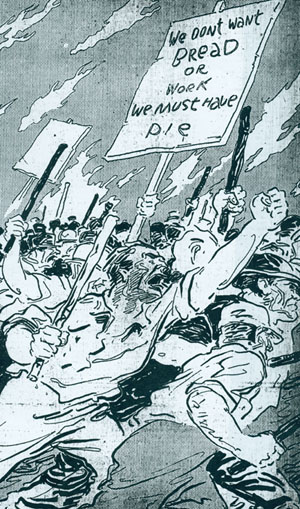
St. Louis Strikers shown as snarling mob.
Here is another great moment in American labor history that has been stripped from our collective memories.  If noted at all it rates as a footnote to the Great Railway Strike of 1877, that explosion of pent up working class wrath that rolled violently across the nation and scared the bejesus out of the massing oligarchs of a rapidly industrializing nation.  But it deserves more attention.  Much more.
The Railway Strike erupted on July 14 in Martinsburg, West Virginia.  Amid the lingering depression set off by the Panic of 1873, the Baltimore and Ohio Railroad cut wages for the second time in a year.  Railroad workers, many loosely organized in the Knights of Labor struck and refused to move freight at major traffic pinch-point demanding only that the second cut be restored.  The initial strike was orderly, but the governor called out the state militia, which refused to attack the strikers.  Then federal troops, including mobilized militia from neighboring states was called in.
In Baltimore mobs attacked troops headed for trains to West Virginia setting off pitched battles in the street and the burning of rail yards and rolling stock.  The strike spread like wildfire and with almost no organization first to Pennsylvania, where more battles were fought and then west across the industrialized Mid-West to the rail hub of Chicago by July 22 which was followed by days of rioting and violence.
The same day the strike reached East St. Louis, Illinois.  But something quite different happened there.  The St. Louis region on both sides of the Mississippi River was home to a large German immigrant population, many of the steeped in the traditions of the 1848 uprisings across Europe and in socialism.  Local Knights of Labor lodges were more highly organized than in most of the country and local craft unions had a strong history.  Perhaps most important was the presences of the Marxist Workingmen’s Party, about 1000 strong but with deep ties to the labor movement.
On the evening of July 22 local labor leaders and Workingmen’s Party members met to plan.  They elected an executive committee that would style itself as the directorate of the St. Louis Commune and issued General Order No. 1 calling for a halt to all rail traffic until demands for wage protections, an eight hour day and an end to child labor.
The following morning, on July 23 workers fanned out across East St. Louis and quickly seized the rail yards, docks, and warehouse facilities.  It was peaceful and well organized in contrast to the mob-like battles erupting the same day in Chicago.  Overwhelmed, and unable to provide police power to quell the strike, the mayor instead deputized the strikers to patrol the city and keep it calm on condition that property be protected.  The strikers readily agreed.
That evening members of the Party led about 500 workers across the Eads Bridge into St. Louis, Missouri which was not only a transportation hub but then the third largest manufacturing city in the country.  At a mass meeting in Lucas Square they called on their fellow workers to join them.  The reaction among the estimated 20,000 in attendance was near unanimous approval.  Local Knights lodges and craft unions joined in the strike spreading it to almost all industries in the city, including packing houses. 
When a Black worker representing the almost all black waterfront workers—loaders, warehousemen, and teamsters addressed the crowd he asked, “Will you stand to us regardless of color?”  The crowd roared its approval and support.
On July 24 parades of strikers up to 5000 strong made their way through the city peacefully calling out shop after shop.  By evening the commerce of the city was shut down, workers patrolled the largely quiet streets, and what has been called the nation’s first General Strike was on.
But strike leaders were spread thin on the west side of the river and spontaneous, although small scale violence erupted here and there, much of it on the tough River Front.  An emergency meeting of the Commune directorate was called for the evening of the 25, but broke up over divisions.  Black workers defended the right to use violence to complete the shutdown.  White leaders of the directorate issued what the blacks considered an insulting order to maintain discipline the meeting broke up with the black workers and some militant white supporter storming out.
On the evening of July 26 Commune leaders refused to speak to a mass rally called by the river men. 
Sensing a racial rift among the strikers Mayor Oversoltz organized a force of 700 hastily assembled police, “special deputies” and militia that evening and raided the strike headquarters at Schuler Hall with orders to shoot to kill anyone who resisted.  The Hall was sacked and most of the strike committee was arrested.
In the meantime 3000 Federal troops and militia units drawn mostly from southern Illinois and former Confederate Missouri strongholds who could be counted upon to be hostile to unionists, Germans, and Negros alike were mobilized along with 5000 more special deputies paid for by the railroad barons were mobilized.
They were loosed on the streets on the morning of July 27 taking advantage of the leadership vacuum created by smashing the commune leadership and racial divisions developing in the movement.
Fighting erupted across the city and lasted for two days.  At least 18 strikers or civilian onlookers were shot and killed outright, many more died later of injuries and hundreds were maimed.
Order was declared restored on the July 28 but troops continued to patrol the streets for weeks and union Workingmen’s party members and leaders were hunted down and arrested.
Hundreds were fired and black balled by the railroad.  Workers were forced to go back to work at slashed pay.  In many cases working hours were actually increased.  It was a bitter defeat that set the tone when the labor movement would begin to make a comeback a decade later.  All side recognized that it would be give no quarter class war.
Among the linger affects of the St. Louis Strike and the wider Great Railway Strike was congressional action to build large armories in most industrial centers from which well armed troops could more quickly quell insurrections.  In addition major military instillations like Fort Sheridan north of Chicago repositioned troops from the Indian Wars on the frontier to be ready for the next revolution.