Thursday, August 26, 2021

The New Militancy of the 1969 Women’s Strike for Equality


Bettty Freidan, the iconic founder of the second wave feminist movement, envisioned a march that would "get the attention of the press"  but had to fight dissent in the ranks.

In 1969 Betty Freidan thought it was a good idea to commemorate the 50th Anniversary of the adoption of the Nineteenth Amendment, which effectively gave American women the right to vote.  Freidan, the acknowledged founding mother of the modern Feminist Movement, was inspired by Alice Paul and the National Women’s Party who’s relentless and daring militancy pushed the long sought dream of suffrage to reality.  In turn she inspired the Women’s Marches that protested attacks on hard-fought for gains that drew hundreds of thousands to the National Mall in 2013.

Freidan began advocating and trying to organize “something big, something so big it will make national headlines” to galvanize the movement to new levels almost a year in advance.  She encountered a lot of resistance, even in the National Organization for Women (NOW), the country’s main feminist organization of which she was a founder.  Many members and leaders regarded a mass protest as too radical.  It also reflected tensions in the movement, barely 10 years old, between middle class white women and professionals and younger radicals comfortable with confrontation through experience in the anti-war movement and who were tending toward separatism.
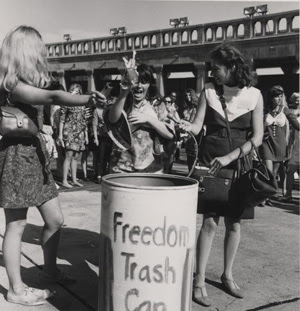
Older feminists thought the antics of young radicals like the burning of symbols of male domination outside the 1968 Miss American Pageant had discredited the movement.  The handful of women who participated were labled "bra burners" and the press portrayed the whole movement with the title.

In the eyes of some older activists these young Womens Libbers as they were mocked in the press, had already done damage to the movement with small, attention grabbing protests.  Most famous was the Bra Burning Protest held outside the Miss America Pageant in 1968.  The media had seized on that with a frenzy and Bra Burner had become synonymous with all feminists in the minds of much of the public.

While the NOW Board of Directors was slow to sign on, Friedan plunged ahead trying to plan and organize the event.  At first she used almost leaderless consciousness raising groups, a hallmark of ‘60’s feminism.  But sessions soon broke down in controversy between factions.  Even a month before the planned protest it was still mired almost to stalemate between the middle class “founders” and the young radicals.

                        A poster promoting the New York Women's Strike.

Eventually Friedan’s prestige among both groups and some careful compromising won out.  NOW endorsed the action and the Call went public.

The next hurdle was getting a permit from the City of New York for a planned march down Fifth Avenue, the sight of historic suffrage demonstrations before World War I.  The city flatly refused.  In response Friedan defiantly recast the protest as the Strike for Women’s Equality and vowed to go on with or without a permit.

Publicity surrounding the refusal galvanized support among activists of both factions.  Around the country NOW chapters and independent radical feminist groups planned actions in a score of cities.

In New York the Strike was set for Tuesday, August 26, 1970 at 5 pm to accommodate the thousands of women office workers who would pour out of Manhattan buildings at that hour.  Police attempted to confine the raucous protest to the sidewalks of Fifth Avenue.   NOW signs demanding equal pay for equal work, abortion access, and other mainstream issues, mixed with homemade signs both whimsical and angry.  Friedan and other leaders could only speak through bullhorns and were often drowned out by spontaneous chanting.  The crowd soon swelled to over 20,000 and the police could not keep them out of the streets.  Although few, if any, arrests were made, TV film footage broadcast later that night and the next day made it look like a near riot.

Meanwhile events in other cities were creative and often even more outrageous.

In Detroit, women staged a sit-in in a men’s restroom, protesting unequal facilities for men and women staffers. In Pittsburgh, women threw eggs at a radio host who dared them to show their liberation. Women in Washington, D.C. staged a march down Connecticut Avenue behind a banner reading “We Demand Equality”…[and] government workers organized a peaceful protest and staged a teach-in, which educated people about the injustices done to women, mindful that it was against the law for government workers to strike… in Minneapolis, women famously gathered and put on guerrilla theater, portraying key figures in the national abortion debate and classic stereotypical roles of women in American society; women were portrayed as mothers and wives, doing dishes, rearing children and doting obnoxiously on their husbands, all while wearing heels and an apron.—Wikipedia

Prestigious news commentators were not even handed in their coverage.  Eric Sevareid of CBS News compared the movement to an infectious disease and ended his report claiming that the women of the movement were nothing more than “a band of braless bubbleheads.”  Another CBS stalwart Howard K. Smith was equally harsh saying women had no grounds at all to protest.  Small wonder that within days of the event a CBS poll showed two-thirds of American women did not feel they were oppressed.

Younger militants turned out in great number when the march seemed under attack by New York authorities.  They included at least some minority women.

It first it looked like the older feminists had been right after all.  The demonstrations had “played into the hands” of opponents of equality.  Friedan did not think so.  She brazenly declared the event a success.  “It exceeded my wildest dreams. It’s now a political movement and the message is clear.”

It turned out after the initial fuss died down, she was right.  The appalling response by the mainstream media actually drove the warring factions of the movement together, if still somewhat uneasily.  Militancy was adopted by more and more mainstream women.  NOW and other organizations were geared up for more political action and unafraid of confrontation.  Within a decade most Americans had accepted much of what had been a “radical” agenda in 1969.

Despite its central part in the evolution of the Feminist Movement, the Women’s Strike for Equality is not well remembered today. 


Wednesday, August 25, 2021

Allan Pinkerton— Spy Master, The Original Private Eye, and Union Buster


Allan Pinkerton in 1861 as he gained fame a Lincoln's protector and secret agent.

Allan Pinkerton, America’s first detective and the founder of the security company that still bears his name was born on August 25, 1819 in Glasgow, Scotland.  Admired as a hero to some, he was despised by generations of workers as a union buster and scab herder. 

Pinkerton started as a class conscious working man.  The son of a duty disabled policeman, he apprenticed as a cooper and participated in the Chartist movement to obtain the franchise for working men and other political reforms.  Chartist “riots” were violently suppressed by troops in many cities. 

Newly married and deeply disappointed by the failure to achieve the vote, Pinkerton decided to immigrate to the Canada at the age of 23 in 1842.  He and his wife were shipwrecked off Nova Scotia and came ashore penniless with only the clothes on their back.  A friend tipped him off to a job at a Chicago brewery.  He worked at his trade there for five years before relocating to rural Dundee, Illinois nearly fifty miles northwest of the city. 

He apparently wanted to go into business providing oak wood from the abundant local woodlots to the brewery but reportedly accidentally stumbled on a ring of counterfeiters, which he reported to local authorities.  In those days when each bank issued their own paper notes, counterfeiting was a common crime.  Several well organized gangs found the remote farmsteads of recently settled Kane and McHenry counties—good places to set up operations far away from police but close enough to the city to get their bad paper quickly into circulation. 

Pinkerton began using disguises, false identities and other tricks to track down counterfeiting gangs.  He was appointed a part time deputy sheriff and later began to work on contract for the banks whose notes were being counterfeited.  Pinkerton thought he had found a niche and a home. 

But he also supported the Underground Railway which used the rural area as a transportation path for the same reasons as it was chosen by the crooks.  His known abolitionist sentiments led to a crushing electoral defeat in a run for local office. 

But his daring exploits chasing counterfeiters had been picked up in the popular press.  He packed up his new reputation and returned to Chicago where he hired himself out as a freelance detective.  Among his customers were the Treasury Department in the pursuit of more counterfeiters and the Cook County Sheriff, who hired him to locate two girls who had been kidnapped and taken to Michigan.  He found the girls and shot one of the captors, making headlines for his daring do. 

The Sheriff hired him as a full time detective—the first such officer in any Illinois police agency.  He also continued to take private clients on the side.

Pinkerton's "seeing eye" became one of America's first and most recognizable company logos.

In 1855 he formed his own private agency, the North-Western Police Agency, soon to become The Pinkerton National Detective Agency. Its famous logo was an All Seeing Eye with the motto “We never sleep”—thus the origin of the term private eye.  Pinkerton quickly built a large operation with many operatives who were trained in surveillance and under-cover operations.  He demanded his operatives keep detailed records of their cases and on all known criminals they encountered.  He kept the records, including descriptions, aliases, known associates, and modes of operation of hundreds of criminals.  He even became the first to use photographs to identify suspects.  No other private law enforcement agency and few public ones had anything like the manpower or sophistication of Pinkerton’s operations.

 Among the frequent customers of the new agency were the railroads, which is how Pinkerton came the attention of a railroad lawyer and politician, named Abraham Lincoln.  Pinkerton’s steadfast support of the Republican Party didn’t hurt either.  Lincoln tapped Pinkerton to assist his personal friend and bodyguard Ward Hill Lamon for security as he made his way from Illinois to Washington for his inauguration.  Pinkerton operatives uncovered a plot by Confederate sympathizers to kill Lincoln as he changed trains in Baltimore and allegedly foiled the attempt by sneaking the lanky Lincoln through town disguised as an old woman. 

Pinkerton, rear and Lincoln's friend and bodyguard Ward Hill Lamon with the goatee escorted President elect Lincoln on his perilous journey by train for the 1861 inauguration.

As the Civil War erupted, Lincoln learned to his chagrin that the Army had no real intelligence service.  He tapped Pinkerton to become the first head of the new Intelligence Service, forerunner of the U.S. Secret Service.  Pinkerton deployed his operatives behind the lines, often disguised as Confederate soldiers and employed various tipsters.  He personally went on some missions in enemy territory using the name Major E.J. Allen.  He was very close to another old acquaintance from the Illinois Central Railroad, General George McClellan. 

Unfortunately, Pinkerton consistently overestimated the size of opposing Confederate forces by as much two times their actual numbers.  That caused the cautious McClellan to avoid battle with the main Confederate forces when possible while demanding ever more men and arms for the President.  Military historians agree now that had McClellan moved his vastly larger and better equipped army more quickly and with greater determination to follow up on successes, the war could have been significantly shorter. 

Pinkerton on horseback in George McClellan's headquarters provided disastrous over-estimates of Confederate numbers and strength which caused the cautious commanding general from taking decisive action.

Eventually Lincoln grew tired of both McClellan’s dithering and Pinkerton’s exaggerations.  Pinkerton left the Service after 1862, but his agency continued to contract with the government for numerous intelligence operations through the rest of the war. 

In post war years Pinkerton’s agencies pursued gangs of bank and train robbers, most notoriously Missouri outlaws Frank and Jesse James.  The Pinkerton Agency got a public black eye when its men threw a bomb killing a child and blowing the arm off the James boys’ stepmother.  After an operative who got a job working on an adjacent farm was discovered and killed, Pinkerton withdrew from the case.  He considered it the biggest failure of his career. 

Pinkerton range detectives like these played a bloody roll in range wars between Western cattle barons and small ranchers and homesteaders accused of rustling cattle.

Soon rapid post war industrialization led to growing labor unrest.  Pinkerton, the former Chartist, had no trouble enlisting his men as strike breakers and spies against unions.  One of the most famous early examples was the infiltration of the Molly McGuires, a secret organization of Irish miners in the Pennsylvania anthracite coal fields by Irish-born operative James McParland.  Identities of Molly leaders and members were passed to local employers who employed vigilantes, who may or may not have included other Pinkerton men, to ambush and kill them and their families.  McParland’s testimony in court also led to the execution of six men and the destruction of the Molly McGuires. 

Pinkerton detective James McParland infiltrated the Molly Maguires in the Pennsylvania coal fields sending several to the gallows.  He had a long career with the agency and years later arranged for Big Bill Haywood and Charles Moyers of the Western Federation of Miners to be kidnapped from Colorado to stand trial in Idaho on bogus charges of planting a bomb that killed a former governor.

McParland was rewarded with rapid promotion through the company ranks and specialized in labor cases.  Twenty years later he kidnapped Big Bill Haywood, Charles Moyers and other leaders of the Western Federation of Miners from Colorado and took them on a sealed train to Idaho where they were put on trial for the bombing murder of a former governor. 

Pinkerton in a Harper's Weekly illustration shortly before his death.

Pinkerton died in Chicago on July 1, 1884 at the age of 64.  He fell on the pavement and bit his tongue.  It became infected and he died in agony.

 By that time a huge amount of his company’s business was anti-union activity.  Company agents were involved in the gun battle with striking steelworkers during the Homestead Strike of 1891, suppressing the Pullman Strike of 1894, and in the infamous Ludlow Massacre of 1914 to list only a few of the most infamous cases. 

The agency also was hired by foreign governments to suppress local radicals, most famously by Spain to work against nationalists in Cuba who included the abolition of slavery as one of their top goals.

Dashiell Hammett, the inventor of tough guy detective fiction based his character the Continental Op on his experience as a labor spy in Butte, Montana.  He may have been involved in investigations that lead to the lynching of legendary IWW organizer Frank Little.  The bitter experience made him a life-long radical.

Dashiell Hammett became a young Pinkerton operative before World War I and became so disillusioned by the anti-union work he was called on to do, including work that may have led up to the lynching of Industrial Workers of the Word (IWW) organizer Frank Little in Butte, Montana, that the famous creator of hard-boiled detective fiction dedicated much of the rest of his life to supporting radical causes. 

In the 1930’s a Senate Committee led by Wisconsin Progressive/Republican Robert M. La Follette, Jr. investigated the Pinkerton Agency for its systematic use of spies to infiltrate labor unions.  To this day Pinkerton is a curse word to unionists and the company is still used to protect scabs and harass picket lines. 

In 1999 the Pinkerton Agency and was acquired by the Swedish based international security firm Securitas AB.  It merged with its chief rival, the William J. Burns Detective Agency, in 2001.  Today it operates as an American subsidy of the Swedish firm under the name Pinkerton Consulting and Investigations.  And the work goes on.


Tuesday, August 24, 2021

Pete Rose Hustled Himself Out of Baseball

                            Charley Hustle making the wrong kind of headlines.

On August 24, 1989 Pete Rose aka Charlie Hustle was banned from baseball for life for gambling on Cincinnati Reds games when he was manager by an outraged Commissioner of Baseball Bart Giamatti.

Considered a shoo-in for election to the Baseball Hall of Fame on the first ballot, Rose probably doomed his chances for ever being included by for years steadfastly denying gambling on baseball despite mounting evidence, before sheepishly admitting guilt in his autobiography My Prison Without Bars. 

                                   Rose's rookie card still a hot commodity for collectors in mint condition.

Rose was a hometown product of Cincinnati, born to working class parents in 1941.  The switch hitting right hander’s dream came true when he was called to the Big Show in 1963. In his stellar 23 year career as a player, most of the time with the Reds, Rose hit for a .303 batting average, tallied 4,256 hits including 160 home runs and drove in a total of 1,394 runs.  He was famously aggressive on the base paths despite not being a fast runner and perfected a dangerous head-first slide. 

Among his many honors were Rookie of the Year in the National League in 1963, two Gold Gloves for his sparkling defensive play, three batting titles, 17 All Star Game appearances, and three World Championships with Cincinnati’s legendary Big Red Machine.  After playing for the Philadelphia Phillies and Montreal Expos from 1979 to ’84, controversial Reds owner Marge Schott brought Rose back as a player-manager to finish the ’84 season. 

Rose's signature head-first dive into base made him one of the most exciting players in baseball.

He played two more years in the combined role before retiring to concentrate on his bench duties.  He was undoubtedly the most popular player in Reds history and one of the most admired in baseball. 

But he was an inveterate gambler.  He claimed his regular bets with a major bookie did not include baseball, then after proof surfaced, that he did not bet on games he was part of.  When that claim, too, was disproven, he could only say that he bet for his team, not against it. 

Rose as Reds manager.

But gambling is the big no-no in Major League Base which was nearly killed by scandals in the 19th Century and again by the Black Sox scandal of 1919.  Baseball ignored a lot of misbehavior, including the nearly murderous attacks of Ty Cobb on fans, regular alcohol abuse by stars like Babe Ruth, and numerous instances of sexual peccadilloes.  It would not, however, forgive gambling. 

After his banishment Rose cut a pathetic figure.  Banned from even setting foot into a ball park, he made his living signing autographs and selling memorabilia.  Even that got him into trouble.  On April 20, 1990, Rose pleaded guilty to two charges of filing false income tax returns for not reporting income from selling autographs and memorabilia, and from horse racing winnings. He was sentenced to five months in the medium security Prison Camp at the United States Penitentiary in Marion, Illinois and fined $50,000. Released on January 7, 1991 after having paid $366,041 in back taxes and interest he was required to perform 1000 hours of community service. 

Rose would sign anything for a buck, including humiliating admissions.

Rose’s 2004 autobiography was an attempt to both bring in much needed income and rehabilitate his reputation, possibly leading to a lifting of the lifelong ban and eligibility for the Hall of Fame.  Despite the vocal support of many players and some sportswriters, the book failed on the later count.

The steroid scandals of the early 21st Century were used by supporters to argue that Rose, who never used performance enhancing drugs and who played hard his entire career, deserved consideration to be included in the Hall while disgraced players like Mark McGuire, Sammy Sosa, Barry Bonds, and Roger Clemens remain eligible. 

Rose flogging his autobiography, My Prison Without Bars.  The book flopped as a plea for sympathy and as a bid to regain eligibility for the Hall of Fame.

Baseball is officially un-moved by these arguments. After rumors that he was considering lifting the ban surfaced in 2010, Commissioner Bud Selig quickly denied the reports.  Selig’s successor has been no more sympathetic and many of the sportswriters who admired and championed him have retired.  Baseball has moved on.  It is doubtful Pete Rose will ever enter the Hall of Fame. 

Monday, August 23, 2021

Edgar Lee Masters—Illinois Poet and Restless Soul


                                 Edgar Lee Masters as a young man.

Edgar Lee Masters was the author of one of the greatest single volumes of American poetry ever—The Spoon River Anthology.  That book in which the denizens of a small 19th Century Illinois village graveyard tell their stories, is still a shock and an eye opener for anyone who bought into the Disney version of small town life as a kind of perfect idyll.

Masters was born on August 23, 1868 in Kansas where his father had briefly established a law practice.  When that failed the family moved back to his grandparents farm near Petersburg in Menard County, Illinois.  In 1880 the family moved again to nearby Lewistown where the boy attended high school and showed an interest in both writing and following his father’s shaky footsteps in the law.  He had his first publication in the Chicago Daily News—a Democratic challenger to the dominance and hegemony in the state of the Republican Chicago Tribune.

Masters' modest boyhood home in Petersburg has been preserved.

In the late 1880’s he attended Knox Academy, the prep school for Knox College but was forced to drop out when his family could no longer support him.  After that he read law at his father’s office.  His dad was the village Freethinker and thus something of an outcast.  The practice revolved around the margins of local life, petty civil cases for those who could not afford the lawyers who hobnobbed with the judges and bankers, criminal cases, divorces, anything that exposed the underside of the community.  It was an eye-opening experience.

After passing the Bar, young Masters hot footed it out of town to Chicago in 1893 where he hoped to advance both his legal and writing careers. He went into practice with Kickham Scanlan and began to publish poetry under the name Dexter Wallace.

In 1898 he married the daughter of a prominent lawyer and began a family that grew to three children including a daughter Marsha who grew up to be a poet and a son Hilary who became a novelist.  But the union grew stormy due to Master’s extramarital affairs.

                                Masters--the lawyer/poet on the cusp of fame.

In 1903 Masters went into partnership with Clarence Darrow, already noted as a top labor and defense attorney.  They were united in their Democratic politics, instinctive radicalism, Freethought, and admiration for the labor Democrat hero, Governor John Peter Altgeld.  As a junior partner in the firm, Masters handled mostly routine criminal and civil cases for the poor, often pro bono.

Despite an amicable beginning, the partnership foundered in 1908 and formally broke up in 1911 due to a business dispute with Darrow and a messy, scandalous marriage.    Despite the bitter personal falling out, he remained an admirer of Darrow.

Masters published two little noted volumes of poetry under pen names in 1898 and 1910.

During his hiatus from the active practice of law as his partnership with Darrow disintegrated he began work on writing and polishing poems inspired by his hometown.  In 1914 he began to publish these in Reedy’s Mirror out of St. Louis under another nom de plume, Webster Ford.  A year later the poems were collected and issued as The Spoon River Anthology with the assistance and encouragement of Harriet Monroe of Poetry Magazine to instant critical and popular acclaim.

                                    The first edition of Spoon River Anthology.                                

Suddenly the obscure lawyer was famous.  He gradually wound down the practice of law to concentrate on a literary career.  Although he was embittered in old age that none of his subsequent work got the attention of that classic, he produced prolifically and with great skill.  In all there were 19 more volumes of verse including a sequel The New Spoon River, 12 plays, 6 novels, and 7 biographies.  Among the subjects of his biographies were fellow Illinois poet Vachel Lindsay, Mark Twain, and Walt Whitman to each of whom he owed a debt of gratitude.

His 1931 bio Lincoln the Man was a highly controversial self-proclaimed de-mythologizing of the Prairie President.  In part it was a direct refutation of fellow Illinois poet Carl Sandburg’s lyrical and lionizing biographies.  His jealousy of Sandburg was well known, but he seems to have been most influenced a loyalty to the Democratic Party of the 19th Century which was already vanishing outside the Deep South.  He pictured Lincoln as a Whig tool of the banks and railroads from the beginning in service to concentrated wealth against the common man.  He was pictured as tyrant who rushed the country into an unwanted war to the applause of Eastern elites.  The book was a popular success in the South, but it virtually destroyed his own reputation with the liberal literary establishment, many previously admiring critics turning against his whole body of work.

Masters's feud with rival poet Sandburg of the reputation of Abraham Lincoln attracted national attention.  Sandburg triumphed and Masters's reputation was sullied.

He had quit the practice of law entirely by 1920 and moved to New York to concentrate on writing.  Masters finally divorced his first wife in 1923 years after abandoning the family.   In 1926 he married Ellen Coyne with whom he had another son, Hardin.

Although Masters won plaudits and honors including the Mark Twain Silver Medal in 1936, the Poetry Society of America medal in 1941, the Academy of American Poets Fellowship in 1942, and the Shelly Memorial Award in 1944 he never matched the fame and glory of his contemporary Carl Sandberg and often felt snubbed the Eastern and academic poetry elite.  He was not experimental enough to be ranked with the Imagists and modernists. 

However damaged Masters's reputation was at the time of his death, The Spoon River Anthology remained one of the most beloved volumes of American poetry and the writer was honored by U.S. postage stamp in 1970.

He died March 5, 1950, in a convalescent home near Philadelphia and was buried back home in Petersburg in the cemetery that inspired his greatest book.

Here are samples of Masters’ work.  First from The Spoon River Anthology:

Jim Brown was the trainer of a famous trotting horse, Dom Pedro.

Jim Brown

While I was handling Dom Pedro

I got at the thing that divides the race between men who are

For singing “Turkey in the straw” or “There is a fountain filled with blood”—

(Like Rile Potter used to sing it over at Concord);

For cards, or for Rev. Peet’s lecture on the holy land;

For skipping the light fantastic, or passing the plate;

For Pinafore, or a Sunday school cantata;

For men, or for money;

For the people or against them.

This was it:

Rev. Peet and the Social Purity Club,

Headed by Ben Pantier’s wife,

Went to the Village trustees,

And asked them to make me take Dom Pedro

From the barn of Wash McNeely, there at the edge of town,

To a barn outside of the corporation,

On the ground that it corrupted public morals.

Well, Ben Pantier and Fiddler Jones saved the day—

They thought it a slam on colts.


—Edgar Lee Masters


Masters was not so down on Lincoln in those days as reflected in one of the most famous pieces from the collection.  Ann Rutledge’s grave, not far from the poet’s, is now marked with this poem. 

Ann Rutledge


Out of me unworthy and unknown

The vibrations of deathless music;

“With malice toward none, with charity for all.”

Out of me the forgiveness of millions toward millions,

And the beneficient face of a nation

Shining with justice and truth.

I am Anne Rutledge who sleep beneath these weeds,

Beloved in life of Abraham Lincoln,

Wedded to him, not through union,

But through separation.

Bloom forever, O Republic,

From the dust of my bosom!


—Edgar Lee Masters


And finally, from a later collection a glimpse of the restless soul, the Freethinker taunted by a spiritual yearning he barely understood.

Inexorable Deities  

Deities!

Inexorable revealers,

Give me strength to endure

The gifts of the Muses,

Daughters of Memory.

When the sky is blue as Minerva’s eyes

Let me stand unshaken;

When the sea sings to the rising sun

Let me be unafraid;

When the meadow lark falls like a meteor

Through the light of afternoon,

An unloosened fountain of rapture,

Keep my heart from spilling

Its vital power;

When at the dawn

The dim souls of crocuses hear the calls

Of waking birds,

Give me to live but master the loveliness.

Keep my eyes unharmed from splendors

Unveiled by you,

And my ears at peace

Filled no less with the music

Of Passion and Pain, growth and change.

But O ye sacred and terrible powers,

Reckless of my mortality,

Strengthen me to behold a face,

To know the spirit of a beloved one

Yet to endure, yet to dare!


—Edgar Lee Masters