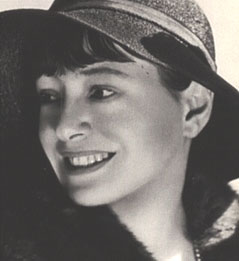
Dorothy
Parker is one of those writers now more famous for who she
was than what she wrote. She will
forever be etched in the public mind as the queen of the Algonquin Roundtable, that shifting group of Manhattan wits and sophisticate who daily gathered at an Algonquin Hotel table to exchange barbs
and bon mots. Through the Roaring Twenties and into the early years of the Depression the pithy sayings of these gin fueled repasts were breathless
repeated in gossip columns read as avidly in Peoria as on Park
Avenue.
Despite her own very
real accomplishments, Parker recognized this and even reveled in it. “Every day,” she said, “I get up, brush my
teeth, and sharpen my tongue.”
But Parker was a widely
respected magazine journalist, critic, and above all a poet. Her volumes of humorous verse were beloved
best sellers.
Parker was born on
August 22, 1893 on the Jersey Shore where
her middle class Manhattan parents kept a summer cabin. Her birth name was Rothschild—her father was of German
Jewish descent (not related to the banking family) and her mother was of Scottish ancestry. Her mother, Eliza died while staying at the same cabin just before her 5th
birthday setting off a troubled and unhappy childhood.
Young Dot, as she was
called, hated her father’s new wife and referred to her contemptuously as the
“the housekeeper.” She claimed her
father physically abused her. She was
openly glad when her step mother died in 1903.
Despite a Jewish father and a Protestant
birth mother, she was sent to the Convent
of the Blessed Sacrament School probably in hopes that the stern nuns would
train her wild rebelliousness. It didn’t
work. She was expelled when she was 14
for calling the Immaculate Conception “spontaneous
combustion.”
After that she was
shipped of for an indifferent education at a New Jersey finishing school mostly
to keep her out of her father’s hair.
She graduated at age 18 in 1911.
Two years later her father died leaving most of his estate to a
sister. Dorothy went to work playing
piano at a dancing school to earn a living.
In her spare time, she was writing verse.
She quickly established
a career as a writer after selling her first poem to Vanity Fair in 1914. Soon after she was hired as a staff writer at
a sister publication, Vogue then moved to a similar job at
Vanity Fair two years later.
In 1917 she met and
married stock broker Edwin Pond Parker
II. They were soon separated by his
service in World War I. Not that she minded much. Ambivalent about her Jewish identity,
especially because she hated her father, she later joked that she got married
to acquire a WASP name. After Parker’s return from the war, the
marriage was stormy and eventually ended in diverse in 1926.
Parker’s career really
took off when she took over theater reviews at Vanity Fair from the vacationing P.G. Woodhouse. Her
criticism was arch, acerbic, witty, and penetrating. Readers loved it. Skewered playwrights, producers, directors,
and actors felt differently.
Parker and fellow staff
members Robert Benchley and Robert E. Sherwood began to take a
daily largely liquid lunch at the Algonquin Hotel. They were soon joined by others and by 1919
folks were talking about the Roundtable.
Other early participants included Alexander
Wolcott, newspaperman/playwright Charlie
MacArthur, Harpo Marx, sportswriter Haywood
Broun and playwrights George F.
Kaufmann and Marc Connolly. Franklin Pierce Adams not only began
posting quips from the table in his popular column The Conning Tower, but
printed whole poems by Parker and other members helping to make their public
reputations.
Sometimes all of the
publicity the wits received backfired.
Theater producers outraged over several quotes by Parker ridiculing
their shows threatened to remove advertising from her employer. Vanity
Fair fired her. Benchley and Sherwood walked out in solidarity. By then they were all hot commodities and
could place poems, reviews and stories in all of the top magazines.
In 1925 Harold Ross founded the New
Yorker and brought Parker and Benchley on board as part of his Editorial Board. Parker now really came into her own. Her poems became a favorite feature and she
contributed sharp, well drawn short stories as well. Her caustic book reviews as the Constant Reader were very popular.
In 1926 her first
volume of poems, drawn from her contributions to the New Yorker, other
popular magazines and the Conning Tower
sold an amazing 47,000 copies and had generally glowing reviews. She followed with two more collections, Sunset Gun in 1928 and Death and Taxes in 1931.
Despite her success,
which included collaborating on plays with Kaufmann and Elmer Rice, Parker’s personal life was a shambles. Not only was she drinking heavily, but she
was subject to bouts of black depression and suicidal thoughts, which she
sometimes hinted at in her poems. Her
marriage was on the rocks and she was engaged in a series of sad, sometimes
disastrous love affairs. Affairs with
MacArthur, who would go on to marry actress Helen Hayes, Benchley, and Wolcott resulted in pregnancies and
abortions. After the first she made the
first of several suicide attempts.
Her love life and
disappointments became the fodder of her most famous short story, Big
Blonde published in The Bookman magazine. It won the prestigious O. Henry Award for Best
Short Story of 1929. She went on to
publish several story collections over the next decade.
Parker’s life changed
dramatically in 1927 as she became interested in the campaign to save anarchists Sacco and Vanzetti from
execution on dubious murder/bank robbery charges in Massachusetts. Previously largely
apolitical, she traveled to Boston to
protest and was arrested and fined $5 for picketing. The experience set of a commitment to leftist
causes, social justice, and civil rights that only grew and lasted the rest of
her life.
By the early 1930’s the
old gang at the Algonquin and newer members like Tallulah Bankhead and Edna
Ferber were drifting apart. The
group dynamics of members sleeping with each other or occasional other’s spouses
must have contributed. But so did the
increasing demands of successful careers and political tensions between the
more conservative members and the increasingly radicalized Parker.
One day in 1932 Ferber
showed up for lunch and found the regular table occupied by, “a party from
Kansas.” It was all over.
About that time Parker
began a relationship with a fellow New
Yorker contributor and sometimes actor Allan
Campbell. Like her, he was of Jewish
and Scottish heritage. He was also ten
years younger and an active bi-sexual.
The two were married in 1934 in Taos,
New Mexico on the way to Hollywood and
the lure of lucrative new careers as screenwriters.
They first caught on at
Paramount. He was put under a contract for $350
which included acting in bit parts, and she got $1000 a week. They soon, however, established themselves as
a successful screen writing duo
earning $2,000 to $5,000 a week free lancing a quality studios like MGM and Warner Bros. Most of the 15
films on which they collaborated were competent, journeyman efforts. But they earned an Academy Award nomination for the classic A Star is Born in 1937
with Janet Gaynor and Fredrick March. When Parker’s friend and fellow left wing
activist Lillian Hellman was called
away from The Little Foxes to work on another project, they were called
in two write additional dialogues for the Bette
Davis.
The marriage broke up
in divorce in 1938 but despite Parkers drinking and suicidal depressions, they
continued to work together until Campbell entered the service as a military intelligence
officer in World War II. As her contribution to the war effort she
worked with Wolcott and Viking Press
on a compact edition of her best stories and poems for soldiers serving overseas.
After the War Viking released it for American readers as The Compact Dorothy Parker. It has never since gone out of print.
After the war in 1947 Parker
won another Oscar nomination for her
contributions the Susan Hayward tearjerker
Smash-Up, the Story of a Woman. The story of a woman whose life was disintegrating in alcoholism must
have hit awfully close to the bone.
But Parker’s days in
Hollywood were number as the Red Scare infected the industry. For years she had been a leader of local
anti-Fascist crusades and organizations.
She had even reported on the Spanish
Civil War for The Masses and had helped re-locate defeated veterans of the
war to safety in Mexico. She was active on or chaired several
committees—most notably the Hollywood
Anti-Nazi League which grew to 4,000 members and was accused funneling
large sums of money to the Communist
Party.
Parker’s last Hollywood
job was The Fan, and adaptation of Oscar
Wilde’s Lady Windermere’s Fan for
Otto Preminger in 1949. After that she was hauled before a Congressional Committee, pled the Fifth Amendment, and blacklisted.
In the midst of all of
that, Parker re-married Campbell in 1950.
They separated, but did not divorce, in 1952 and Parker returned to New York to take up residency in the Volney Hotel. Advanced alcoholism prevented
her from returning to regular magazine work, although she submitted occasional
reviews. Mostly she made a small living
as celebrity guest or panelist on such radio programs as Information Please and Author,
Author. She wrote monologues for
old friends Tallulah Bankhead and Ilka
Chase.
Despite her drinking,
she remained as active as possible politically.
She was especially moved by the Civil
Rights Movement as it unfolded on the streets of the South.
In 1960 she reconciled
with Campbell and moved back to Los
Angeles where the couple worked fitfully on un-realized projects. In 1962 Campbell committed suicide. In worse emotional shape than ever, Parker
returned to the lonely life of a Volney Hotel drunk.
When she died of a
heart attack on June 7, 1967 Parker left her estate, including valuable literary
properties, to Martin Luther King, Jr.
to support him in his work. When he was
killed days later the estate ended up in the hands of the NAACP.
With no living relative
or willing friend to claim them Parker’s ashes stayed in a file cabinet in her
lawyer’s office for 17 years until the NAACP claimed them. They buried them under a marker on the grounds
of their Baltimore headquarters. The plaque reads:
Here lie the ashes of Dorothy
Parker (1893–1967) humorist, writer, critic. Defender of human and civil
rights. For her epitaph she suggested, “Excuse my dust”. This memorial garden
is dedicated to her noble spirit which celebrated the oneness of humankind and
to the bonds of everlasting friendship between black and Jewish people.
Dedicated by the National Association for the Advancement of Colored People.
October 28, 1988.
A
Pig’s Eye View of Literature
The Lives and Times of John Keats,
Percy Bysshe Shelley, and
George Gordon Noel, Lord Byron
Byron and Shelley and Keats
Were a trio of Lyrical treats.
The forehead of Shelley was cluttered with curls,
And Keats never was a descendant of earls,
And Byron walked out with a number of girls,
But it didn't impair the poetical feats
Of Byron and Shelley,
Of Byron and Shelley,
Of Byron and Shelley and Keats.
Autobiography
Oh, both my shoes are shiny new,
And pristine is my hat;
My dress is 1922....
My life is all like that.
Of
a Woman Dead, Young
If she had been beautiful, even,
Or wiser than women about her,
Or had moved with a certain defiance;
If she had had sons at her sides,
And she with her hands on their shoulders,
Sons, to make troubled the Gods-
But where was there wonder in her?
What had she, better or eviler,
Whose days were a pattering of peas
From the pod to the bowl in her lap?
That the pine tree is blasted by lightning,
And the bowlder split raw from the mountain,
And the river dried short in its rushing-
That I can know, and be humble.
But that They who have trodden the stars
Should turn from Their echoing highway
To trample a daisy, unnoticed
In a meadow of small, open flowers-
Where is Their triumph in that?
Where is Their pride, and Their vengeance?
–Dorothy Parker