Showing posts with label women. Show all posts

Tuesday, November 5, 2024

Election Day at Last--Civic Marathoners Ready to Collapse After the Finish

Newspeak House US Election Night Marathon · Luma 

In a nation deeply and bitterly divided Election Day angst and exhaustion are the order of the day.  Will it be a dumpster fire for democracy? 

It's finally Election Day.  Here in Northern Illinois and adjacent states like vital Wisconsin it is raw. raining on and off, and blustery giving it a suitable Sturm und Drang cast that matches the anxiety so many of us feel.  In conventional wisdom these conditions suppress voter turn out.  People getting off of work did not like to stand in miserable lines outside jammed polling places or drive on rain slick pavement in the dark.  Casual or not deeply connected voters were discouraged.  Suburban Democrats in Red collar counties were notoriously easily daunted because they had faint hope that they had any chance for representation in important down ballot local races.  Increasingly right wing Republicans from the Tea Party to the MAGA crowd would, as I have observed many times over the years, "crawl through glass" to elect their candidates.  Advantage GOP.

But mail-in and early voting has changed that.  Democrats have pushed early voting here since Barack Obama's first election and the percentage of their supporters opting for it has grown steadily giving them an increasing edge.  In the last election Trump and his minions vilified early voting and falsely charged it as an opportunity for election fraud.  Instead, he urged his supporters to turn out on election day to insure that early returns before early and mail in ballots were counted to show election night leads.  

Trump thought otherwise this time out.  Now he encouraged his most loyal supporters to vote early to match or offset the Democratic advantage.  The question is, did the reprogramming actually work?  Older White men, the Orange Menace's prime demographic, still seem to prefer traditional balloting.

(Side note--as a member of that cohort I have to ask, just what the hell is wrong with men?)

Of course Illinois is one of the safest Blue States in the nation and has strengthening that tendency since the 1960 razor thin victory of John F. Kennedy.  Suburban Cook County and metropolitan collar counties which once nearly balanced the huge Democratic advantage in Chicago and conservative rural and Down State areas.  but many of those areas have turned purple or even flipped Blue like former bastions Lake and Dupage counties.  Even here in McHenry County where the Republicans still dominate local offices,  Obama won in 2008,  Joe Biden came withing a hair, and local voters have gone for Democrats for state constitutional offices, and U.S. Senate.

Neighbors and even family members are deeply split this election.  Personal relationships are ruptured adding yet more stress.

The difference has been women whose drift away from the GOP has accelerated and finally become a panicked stampede after the Trump puppets on the Supreme Court overturn Roe v. Wade.

The national the Gender Gap is wider than ever and higher percentages of women actually cast ballots than men.

The pundits and talking heads still beat the band that the electorate is still split nearly in half and flickers either side of a dead heat in the critical six or seven battleground states that hold the key for an Electoral College victory and they have polls to prove it and keeping us all on jagged edge.

I think those polls under represent the rage and determination of women who have been the targets of intense voter turnout campaigns.  They will out-perform expectations.  So will blocks of voters with other key issues--youth voters and anti-gun violence advocates, climate change, LGBTQ+ rights and safety, election integrity and saving democracy, and minority rights.  Some "experts" wave their hand at the potential extra margins provided by these citizens claiming "liberals all stick together on a broad range of issues with the overlap of concerns limiting extra advantageTrue, as far as it goes, but at least some of those "single issue" voters are less motivated when they are not immanently threatened. Much depends on whose ox gets gored.  And all of these folks are likely under reported in the polls.

In addition, the drumbeat of traditional Republican conservatives like Liz Cheney, George Wills, and former Trump Cabinet members and national security heavies,  seems to be eroding Trump's base.  Dems recognized that when they began to assure Republican women that they could safely and secretly vote differently from their husbands.  Many will boycott the top of the ticket or vote for Harris without tipping their hands to voracious and possibly dangerous neighbors.  Another edge to Democrats.

I boldly predict the Harris-Waltz ticket will out-preform exceptions, win the popular vote, carry most swing states, and even bring others into play as the late Des Moines Register poll that show Harris up by 3% in that deep Red state suggests.  In Pennsylvania 400,000 Puerto Rican voters, easily enough to swing the state, are reported outraged by the "Floating Island of Garbage" comments at last week's Madison Square Garden hate fest.  On the other hand hundreds of thousands of Muslims in Michigan could boycott the top of the Democratic ticket over the War in Gaza.

Finally, many voters are sick to death after years of Trump psychodrama and just want it to end. 

The influx of Harris support will likely carry down ballot giving Democrats a good chance of retaining control of the Senate and even re-capturing the House.

Of course, my record of electoral prognostication is somewhat sketchy.

Here in McHenry County many Democrats will gather for this watch party at the historic Woodstock Opera House, but we won's know the final outcome of the Presidential election when the venue closes at 11 pm.

It could be days before the final results are known because of delays in counting mail in early ballots and likely Trump court challenges meant to once again undermine faith in election integrity and results evoking traumatic memories of four years ago.

There is nothing left for us to do but suck it up and be ready for a wild ride.


Wednesday, November 7, 2018

Election 2018—Much to Celebrate but Some Flies in the Ointment

Democrats celebrating gains in the House of Representatives.  Women, young people, and minorities propelled those wins.

It was a roller coaster night for Democrats, progressives, and those who hope to stop a slide into fascism.  But on the whole, there is much to celebrate.  I don’t mean to go into great detail, but here are some high and low lights and my take on them.
Despite the determined efforts of some TV pundits to pooh-pah a Blue Wave in the House and the significance gains Democrats did make—I’m looking at you Chuck Todd—it looks like Democrats not only take back the House, but will exceed most expectations after results of some tight races are called especially in California where a lumbering vote counting procedure can take weeks to announce final results.  Dems will probably end up with a net gain of nearly 40 seats which will prevent the defection of a handful of Blue Dog Democratic conservatives from advancing the Trump agenda in the House.
Even more impressive, Democrats topped Republicans by about 9% in all House votes cast in the nation.  Their gains would have been more impressive except for the heavily gerrymandered districts drawn by GOP legislatures.

But Democratic gains in a number of key races for governor and flipping some state legislative houses they now have a shot a drawing more equitable election maps after the 2020 census.  Despite a tough, narrow losses in Florida and Texas Senate races by rising Dem stars Andrew Gillum and Beto O’Roark and a still undecided Georgia race by Stacy Adams that is headed to court and a possible run-off election, Dems picket up 7 executive mansions previously held by Republicans including open seats in Maine, Michigan, Kansas, New Mexico, and Nevada and ousted two incumbent Governors, Wisconsin’s loathsome union buster Scott Walker, and Illinois’ disastrous Bruce Rauner.  Women won four of the open seats including a stunning victory by Laura Kelly in deep Red Kansas.
 
A lot of Democrats took the narrow loss of charismatic Texas progressive hard.  But the magnitude of his achievements in raising enromous amounts of cash from individual donors shunning PACs and special interests and in personally runing his direct-to-the -people campain appearing in every one of the Lone Star State's 200+ counties cannot be underestimated.  He redefined what  is possible in Texas and is a rising star for the progressive wing of the party.

In fact it was women who propelled Democratic victories across the country by not only showing up at the polls in record numbers but as fresh new candidates.  That included numbers of African Americans, Hispanics, two Muslims, two Native Americans, as well as some veterans.  The heavy shift of women, who out participate men in elections, is bad news for Republican who are widely viewed as the party of misogyny, because many former Republican women have probably left their old party for good.
Worse for the GOP, Millennials showed up to the polls in Droves and Democrats captured most of them.  Younger voters were particularly motivated by social issues including the protection of Gay and Transgender rights, gun regulation in the wake of school shootings and mass murders, equitable and fair immigration and asylum, a hope for relief from crushing student loan debt, and a general revulsion at racism, xenophobia, and anti-Semitism that has been fostered in the Republican base by Trump.  The wave of the Millennials already outnumbers aging Baby Boomers.

Young voters lining up to vote in Minnesotta.  Not only dide they show up to the polls in eyepoping numbers, they energied campaigns across the country.
In the wake of Trump’s success in Senate races in his base states, he has put his brand and stamp on the Republican Party.  Many so-called moderates in both houses—a half a generation ago most of them would have been considered hard conservatives themselves—have either retired or been ousted in House, replaced by Trump loyalists.  Trump has cut off appeal to Latin and Black voters, the LBGTQ community as well as women and young people.  His is the party of aging white men.  But whites will be a minority in the United States within twenty years and his base vote will slowly die off and fade away replaced by today’s young voters.  The future of the Republican Party is indeed bleak unless they can pull a rabbit out of hat.

A screen shot of NBC calling the Illinois governor race for J.B. Pritzker.
 If the Blue Wave did not impress Chuck Todd nationally, in Illinois it was a virtual tsunami.  Led by J.B. Pritzker his Lt. Governor running mate Juliana Stratton, plenty of cash to spread around, and fired-up armies of volunteers Democrats swept all statewide offices without breaking a sweat, picked up two suburban House Seats—Sean Casten in the 6th District and Lauren Underwood in the 14th--, increased their majorities in the state House and Senate, reached down to the county and local level boosting Democrats in Red suburban and Collar County races.  

Lauren Underwood celebrating her historic win in the drawn-for-Republican Illinois 14th Congressional Distict with supporters.
But Pritzker, who carried some baggage as a Billionaire who evaded property taxes by removing toilets from and empty mansion next door to his Gold Coast home, was actually outperformed by his down-ticket running mates including Kwame Raoul for Attorney General, Michael Frerichs for Treasurer, and Susana Mendoza for Comptroller.  Jesse White, the perennially popular Secretary of State won a sixth term with 69.4% of the vote topped the ticket.
Meanwhile McHenry County showed that it is still a tough nut to crack Republican stronghold with loyal voters showing up in droves on Election Day to counter strong Democratic turnout among early voters.  Yet the nut was at least cracked even if all the meat could not be extracted.
Sean Casten won his portion of the County although Lauren Underwood, despite a tremendous ground-game campaign and many visits here could not win her part.  She made up for that for that in Kane and DuPage Counties to win anyway. 
Jesse White was the only state candidate to carry McHenry, but he has won here before and is popular from regular appearances of his Jesse White Tumblers in local parades and festivals.
Democrats were blanked in State Senate and House races although Nancy Zettler came close in the 33rd House District with 48.73% of the vote.

Kelli Wegener was one of three Democrats who made it onto the McHenry County Board.
The real good news is that due to McHenry County’s quirky three member County Board system with no more than two seats open in off-year elections Democrats were able to pick up three seats bring a grand total to 4 out of 18 seats.  That will be the most Dems in living memory on the board.  Democrats Michael Vuuk in District 1, Suzzane Ness in District 2, and Kelli Wegener in District 3 all finished second three person races to win a Board seat.  Carlos Accosta in District 4 came within 187 votes in his race.

The Cheeto-in-Charge is gloating about his Red state Senate wins and will probably double down on the divisive rhetoric and hardly veiled racism that he believes won the day.  He has not yet grasp the peril that a Democratic House majority represents for him.
The bad news of Election night, of course, was the U.S. Senate where Trump’s relentless red meat rallies helped fire-up his base in an election map that heavily favored Republicans, They will increase their majority in the Senate by at least two despite Jacky Rossen flipping a seat Blue in Nevada.  Republicans turned out Democratic incumbents in Indiana, Missouri, and North Dakota.  Democrats staved off challengers in deep Red West Virginia and in Montana.  Races are still too close to call in Florida where incumbent Senator Bill Nelson is within .4% of current Governor Rick Scott and in Arizona where Democrat Kyrsten Simemea currently trails Martha McSally by .9%.  Both races will turn on absentee and provisional ballots and may result in re-counts.
Firm control of the Senate is most dangerous because it will give a free pass to boatloads of Trump hyper-reactionary judicial appointments, including one or two possible Supreme Court openings in the next four years.  Those lifetime appointments will warp the courts for decades and will be extremely dangerous for free speech, minorities, voting rights, reproductive rights, Gay and transgender rights, immigrants and asylum seekers, labor, general civil liberties, environmental regulation while being sympathetic to corporations and Christian pleas for exemption from many laws and regulations on the grounds of supposed freedom of conscience. 
Perhaps even more immediately dangerous, his Red state victories have confirmed to Trump that his instinct to use immigration as scare tactic, attacks on the press, and tacit approval White Nationalism and violence.  Chances are that he will double down on all of that.  He may even turn to his base for protection should the Mueller investigation get close to him, House Democrats unearth irrefutable evidence of criminal behavior in his personal or business affairs or prove collusion with the Russians.  He is not above raising the specter of civil war or even of pulling the trigger on one if cornered.
He will also continue to try to rule by executive fiat with growing confidence that a sympathetic court will not stop him.

The United States will undergo huge racial, ethnic, and age demographic changes in coming decades.  The Party of Old White Men is doomed.
The problem for Democrats is that at least until the demographic and generational changes discussed above fully kick in they are at a complete disadvantage in the Senate, which guarantees two Senators for each State serving six year terms.  Blame the Founders and the compromise between large and small states engineered by James Madison as the price of ratification of the Constitution.  Today the Southern, Border, and Western states carried by Trump in 2012 minus Florida, Texas, Missouri, and Arizona have a combined total 34 Senators despite having a total population less the California which has only two. 
We are hearing talk of a Constitutional Amendment base Senate representation on population.  But there are only three ways to accomplish that.  A new Constitutional Convention could be called, but that would open the entire document to revision perhaps putting the guarantees of the Bill of Rights in jeopardy.  No one outside the far-right fringes seriously supports a new Convention and they aren’t the folks likely to change the Senate.
Since small states will not to vote to reduce their influence in Congress there is no hope to reform Senate representation by Constitutional Amendment.
Both Congress and the States themselves can initiate a proposed amendment.  But Article 5 requires 3/4 of all the states to ratify an amendment for it to take effect.  It beggars the imagination that the many states with small populations would voluntarily vote to reduce their own influence in Congress. 
The Senate as we know it is here to stay whether we like it or not.  Even if Democrats win an overwhelming Presidential victory in 2020 and increase their majorities in the House they would likely still face a hostile Senate and definitely be restrained by a hostile court.
There are no easy paths in the continuing struggle ahead.  But continue to struggle we must.

Friday, January 22, 2016

Terrance V. Powderly—Accidently America’s First Great Union Leader

Terrance V. Powderly, Grand Master Workman of the Knights of Labor.


Terrance V. Powderly may have been the man with the tiniest spectacle lenses and most impressive moustache in American history.  He also became almost by accident the leader of this country’s first great national labor union.
That’s because the Noble and Holy Order of the Knights of Labor was founded in 1869 as a fraternal benevolent society and a lodge with the secret rituals and handshakes popularized by Masonry.  It was organized in Philadelphia by Uriah Smith Stephens, and James L. Wright and five other members of a local Taylor’s Union. It was not meant to itself become a labor union, but to provide social connections, moral uplift, general advocacy for reforms like an 8 hour day, and provide protection and benefits for injured members and surviving spouses and families. 
From the beginning the fledgling organization was unique in the breadth of those welcomed to belongall workers regardless of craft or skill, men and women, all ethnic and religious groups, and all races, except, as we will see later, Asians.  In a throwback to the days of guilds even master craftsmen and owners of small shops, farms, and manufacturing businesses could join if they still worked by the side of their employees.  This later group never represented more than a tiny fraction of the organization’s membership but deference to their sensibilities restrained action in its earlier years.
Two events contributed to the Knights beginning to take on the functions of a union.  First was the collapse in 1873 of an earlier attempt to form a national labor body, the National Labor Union.  Left behind were a hodge-podge of local unions, a few central labor councils in major cities, and a handful of craft unions struggling to establish national federations.  Without a national body to look toward for cooperation, and most importantly, solidarity during labor actions, many of these organizations elected to become Knights Assemblies.  Others maintained their seperate identity but encouraged or allowed their individual members to join the Knights.
By default, although the Knights officially discouraged strikes, Knights Assemblies and members were soon engaged in the full range of job actions.
Secondly was the ongoing near open warfare between coal mine operators and their largely Catholic and immigrant work forces in Pennsylvania.  Conditions were harsh, wages low, hours long, and there were regular mine disasters.  The infancy of the company town turned miners into virtual serfs.  Strikes, boycotts, and rebellions became common, all met with ruthless suppression.  Workers found that the ritual secrecy of the Knights, like that of the Irish fraternal organization the Loyal Order of Hibernians were the perfect cover to organize in secret.  By the mid 1870’s membership in the anthracite fields was exploding.
And that’s where Powderly first encountered the Knights.
Powderly was the 11th of 12 children of an Irish immigrant family born in Carbondale, Pennsylvania in the heart of the coal fields on January 22, 1849.  He was something of a sickly child losing the hearing in one ear to scarlet fever and nearly dying from the German measles.  His relative frailty probably spared him the fate of going to the mines at age 7 or 8 as a breaker boy.  Instead he was allowed to continue a rough sort of schooling until the ripe old age of 13 when he went to work for the Delaware and Hudson Railroad and the next year was promoted  to car inspector due to his intelligence. 
He was mature for his age and keenly interested in the world around him.  In his later memoirs he was able to recall in detail the Presidential Election of 1856 which elevated Pennsylvanian James Buchannan to the Executive Mansion.  He recalled his mother’s anguish over not being able to cast a vote and then and there became a lifelong supporter of women’s suffrage.
In the meantime he apprenticed as a machinist in the railroad shops and was working in the locomotive shops in Scranton by 1869.  He joined the Machinist and Blacksmiths Union in 1871, and he was elected president of a local in 1872.  From then on his life centered more and more on his dedication to the labor movement.  In 1873 he was fired for union activity and blackballed on the railroads.
Powderly drifted from job to job, but always kept up his connections to his union.  And although he never personally worked in the mines, he was keenly aware of the struggles in the major industry in his home region.
He signed a membership card in the Knights as early as 1874 but became active in his local Assembly in 1876.  He rose quickly, elected to the key position of Recording Secretary, which put him in communication with Assemblies all across the country.
Powderly was elected General Worthy Foreman of the Order at St. Louis in January 1879. Powderly became General Master Workman soon afterward.
Powderly had other interests.  He married in 1872 and began to raise a family and was active in local politics.  The same year He was elected Mayor of Scranton and was re-elected for two more two year terms which coincided with his rise in the Knights.  He was asked to run for Lieutenant Governor by the Greenback Labor Party in 1882, but declined the nomination.

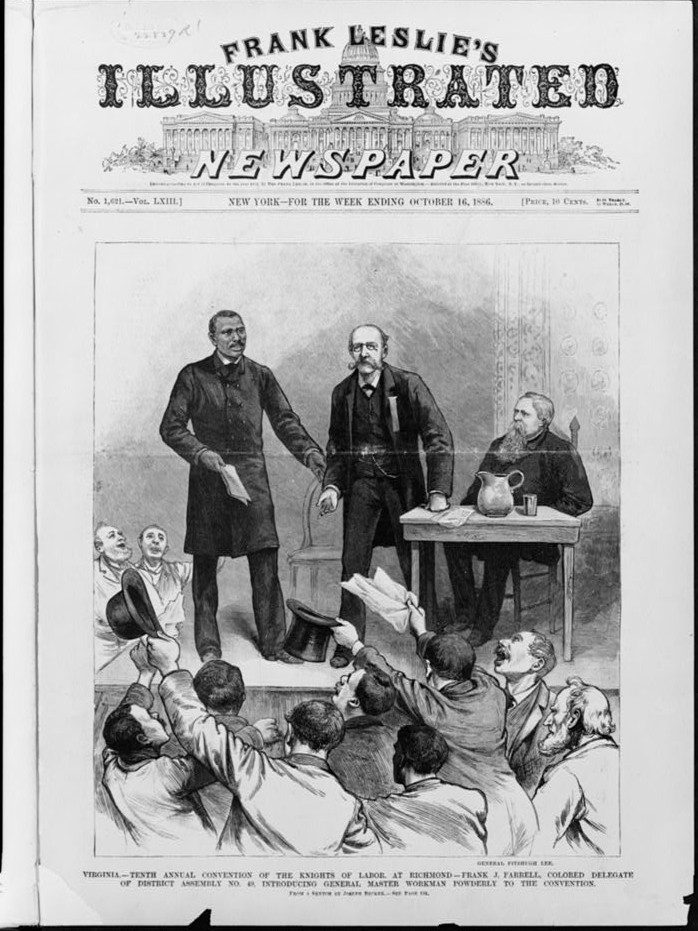
Powderly made headlines for his vocal advocacy of inclusion of Black workers, most other minorities, women, and unskilled laborers in the Knights.
When Powderly assumed office the Knights reported a national membership of 10,000.  Probably two or three times that number were in sympathy or in locals and assemblies not properly reporting to Headquarters, a common problem for the loosely organized Order with few employees.
But due to a combination of an explosion of national labor unrest and his own growing reputation, Powderly saw the Order grow to 700,000 then to 1 million members, including 10,000 women and 50,000 African Americans in 1886.
The Great American Railroad Strike of 1877 was responsible for a lot of that growth.  Although largely spontaneous and unorganized, the bloody riots exploded from the Baltimore and Ohio shops in Maryland and soon engulfed much of the nation with particularly hard fighting between strikers and authorities in the Knight’s cradle in Pennsylvania.  The Order was blamed by authorities for the strikes, and credited for them by workers across the country although the organization was not initially involved.
In fact Powderly was appalled by the violence and at first called on Knights members to remember their no-strike pledges and return to work. In fact in the west in places like St. Louis and New Orleans, where local Assemblies had time to organize responses before the violence struck, they were able to conduct disciplined actions with little of the mayhem and property damage in the east.
There remained a stumbling block to growth.  Although a large majority of members were, like Powderly, Catholics, the Church objected to the trapping of freemasonry and a secret society.  The Archbishop of Quebec had specifically forbidden membership.  American prelates seemed ready to follow suit.  Powderly worked closely with Archbishop James Gibbons of Baltimore who convinced the Pope not only not to condemn the Knights, but to broadly offer support for the right of unionization.  In return, Powderly led the Knights in dropping the Noble and Holy Order from their name and jettisoning secrecy and masonic style ritual in 1882.
Now, for better or worse, the Knights were a virtual union in everything but name.  Membership shot up faster than effective organization could accommodate them all. “In 1885 we had about 80,000 members in good standing,” Powderly wrote in his autobiography, “ in one year that number jumped up to 700,000 of which at least four hundred thousand came in from curiosity and caused more damage than good.”
One spur to growth was a successful strike in 1885 against the Wabash Railroad, part of the southwestern system controlled by railroad baron Jay Gould.  Despite his opposition to strikes, Powderly helped negotiate a favorable settlement, including a non-discrimination clause protecting Knights members from retribution.  It was the first significant national victory of any labor strike and sent the prestige of the organization and its leader through the roof.

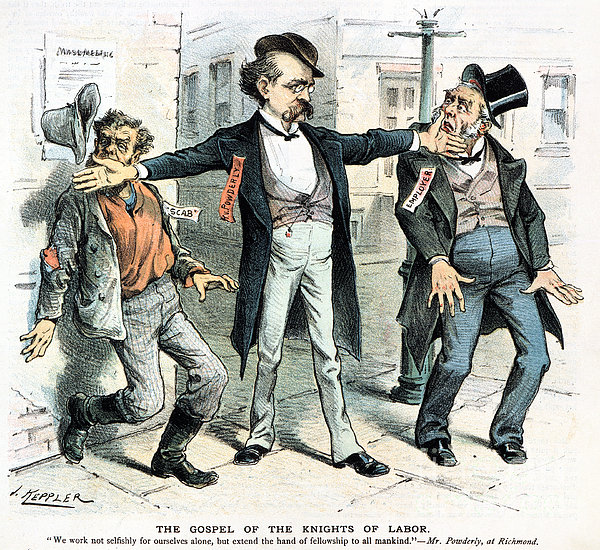
Pro-Knights cartoons and publications were at pains to paint Powderly and the Knights not as radicals, but as reasonable and fair reformers. 
Powderly was no radical.  He took a dim view of socialism and an even greater aversion to the anarchism that was taking root in parts of the labor movement.  He favored what might be called benign or cooperative republicanism (small “r”) with an emphasis on inclusion and fairness.  He advocated reforms like the eight hour day and elimination of child labor was well as wages that allowed working people to live with “simple dignity.”  His vision was egalitarian and inclusive of women and most minorities.
In general the Knights followed these precepts.  But they were not perfect.  Although Blacks were allowed to join, Powderly looked the other way when segregated Assemblies were established in the South. 
In the West, he went along with the virulent anti-Asian bias that erupted after the large scale introduction of coolie labor in railroad construction.  It was the almost universal opinion of White workers on the West Coast that Chinese labor drove down wages.  The Assemblies in Seattle urged the expulsion of all 10,000 Chinese in the city.  In Rock Spring, Wyoming local Knights organized a pogrom style riot in September of 1885 in which 28 Chinese miners were killed, 15 were injured, and 75 homes and business were burned.
Powderly condemned the violence but supported Oriental Exclusion immigration legislation.  He was not the only labor leader or radical to do so.  Even the California affiliate of the International Working People’s Association—the so called anarchist First International—endorsed exclusion.  Immigration issues became a major personal interest of Powderly and, as we will see, propelled a second career.
Two events in 1886 proved disastrously pivotal to the Knights.
First a second round of strikes against Gould’s Southwest System broke out early that year and spread even farther to more components of the system.  Violence broke out in several cities and soon there were the familiar pitched battles with authorities and company thugs.  Powderly desperately tried to reign in control of the strike while trying to negotiate a settlement.  This time Gould and his forces were adamant.  By March the strike petered out with no gains and local Assemblies in disarray.
Then in Chicago on May 1 strikes in support of one of Powderly’s favorite causes, the eight hour day engulfed the city.  These were in response to a nationwide call by the Knight’s rival craft union competitor which would soon become known as the American Federation of Labor (AFL).  Locally they were organized by member unions of the Central Labor Union and promoted by anarchists.  The eight hour strike coincided with several ongoing strikes in the city, including a major confrontation at the McCormick Reaper Works.
On May 2 police opened fire at picketers around the McCormick Works gate killing several.  The McCormick strikers included members of several craft unions and of the Knights, but was generally under the leadership of the craft unions.
Local anarchists, most of them German, organized a protest at the Haymarket on May 4.  A bomb was thrown by an unknown assailant as police moved in to attack the end of the peaceful rally.  The ensuing melee left several of workers and five cops dead.  The anarchists, some of whom were not in attendance or even involved in the meeting, were rounded up and arrested.  Eight were charged.  One committed suicide, seven were convicted and four hung.
Despite the fact that the Knights were only involved peripherally in the McCormick strike and the May 1 eight hour strike and not at all in the anarchist protest, the press laid the whole Haymarket affair largely the feet of Powderly and the Knights.
Nationwide suppression followed.  Worse over the next five years the Knights lost several badly organized but widely publicized strikes, shaking the confidence of workers.  The AFL began to emerge as a more effective alternative, although it excluded most unskilled workers and minorities.   Membership evaporated.
In addition the Knights were wracked with internal dissent and Powderly found his leadership increasingly under attack. By 1890 the Knights had shrunk to numbers similar to those when Powderly first took the reins. 
Powderly was defeated for re-election as Master Workman in 1893.  The organization’s decline only accelerated and by 1900 was essentially irrelevant except for a handful of local pockets of support.
Powderly studied law and was admitted to the bar in 1894.  He established a successful practice in Scranton and also dabbled in business.  Eventually he would even become part owner of a coal mining operation and other, largely unsuccessful industrial businesses.
He was making a name for himself as an expert in immigration.  He had come to the conclusion that not only was Asian immigration harmful to working people, but that the un-restricted flood of immigrants from Eastern and Southern Europe would destroy the standard of living of American workers.
Powderly in his second career as an immigration bureaucrat in Republican administrations for more than 20 years.  Shown in his Washington office, Powderly kept the tiny spectacles  and impressive mustache and acquired a toupee.  
Trying to court labor votes away from their traditional loyalty to Democrats or the emerging Populists, President William McKinley appointed to Powderly to an important post, U.S. Commissioner General of Immigration in 1897.  He enjoyed the continued support of Theodore Roosevelt who in 1902 made him Chief Information Officer for the U.S. Bureau of Immigration from 1907 to 1921.  In these positions he crafted the proposals that would result in the great curtailment of unrestricted immigration in the Immigration Act of 1924 which included an almost total ban on Asian immigration and a strict national quota system for Europe.
After his first wife died in 1901, Powderly married his long time secretary at the Knights.  Together they lived comfortably in Washington.  After a brief retirement Powderly died on June 24, 1924.  His wife survived him until 1940.
Seventeen years after his death, Powderly’s manuscript autobiography was discovered and published giving us one of the most detailed accounts of the formative years of the American labor movement.