Showing posts with label holidays. Show all posts

Thursday, October 22, 2020

Do the Same Old Holidays Bore You, Bucky? Try Wombat Day


Break out the Champaign and some tough roots, grass, and bark for the guest of honor!  It’s Wombat Day Down Under. It’s an ancient tradition stretching all the way back to 2005.  And so what if those asses in Canberra haven’t gotten around to making it a legal holiday with the Post Office closed, military parades, and bands playing Waltzing Mathilda, it’s good enough to raise a can of Foster’s and throw another shrimp on the barbie.

The occasion celebrates those cuddly short-legged, muscular marsupials native to Australia with pudgy snouts and short tails that resemble small, over-fed bears.  They are adaptable to Australia’s various often in hospitable environments from arid semi-desert to forests and mountain sides.  Not that anyone actually sees them much in the wild.  That’s because they are the world’s largest burrowing mammals—adults average about 40 inches long and can weigh between 35 and 70 pounds—and spend much of their lives in the their extensive burrow systems.  Being nocturnal they generally only come out to dine at night except for the rare darkly overcast, rainy day.

The late Steve Irwin showed off a wombat giving you an idea of their size.

The stout little beasts have powerful forelimbs with impressive claws for digging and large rodent-like incisors to gnaw through their tough diet choices.  Their natural predators were few—the dingo, now extinct Tasmanian devil, and, of course humans.  Over the last century feral dogs have heavily damaged the population.

Wombats are naturally both slow moving and shy, but can be aggressive when startled or threatened.  They have been known to charge humans who get near them and are large and heavy enough to knock down a grown man.  Their long, sharp claws can slash human flesh and bites can penetrate stout boots and thick socks.  On the other hand, humans, both Aborigines and early White settlers hunted them for food.  The settlers, with their fire arms and hunting dogs, quickly reduced the Wombat population and range over much of the southeastern part of the Continent.

Despite holding a day in their honor, Australians have a mighty ambivalent attitude toward the wombat.  The Aborigines did not seem to esteem them, despite relying on them as a protein source.  They did not imbue them with the spiritual powers and significance of other animals—kangaroos, snakes, crocodiles, sharks, etc.—in their Dreamtime mythologies and seldom depicted them in their rock art.  The origin story about them is hardly flattering—originating from a person named Warreen whose head had been flattened by a stone and tail amputated as punishment for selfishness.

When white settlers—most of them, you will recall, transported prisoners and their military guards—arrived, their opinion of the creatures was not much better.  At first because of the similarity of size and burrow habitations they were mistaken for a kind of badger, the large European weasel and omnivore totally unrelated the local marsupial.  Several Australian place names containing the name badger—Badger Creek, Victoria and Badger Corner, Tasmania  for instance—are really named for wombats. 

The English adopted the name from a corruption of the now extinct Darug Aboriginal language.  In 1798 John Price was exploring in what is now New South Wales with James Wilson who had lived with the Aborigines when he recorded in his diary:

We saw several sorts of dung of different animals, one of which Wilson called a Whom-batt, which is an animal about 20 inches high, with short legs and a thick body with a large head, round ears, and very small eyes; is very fat, and has much the appearance of a badger.

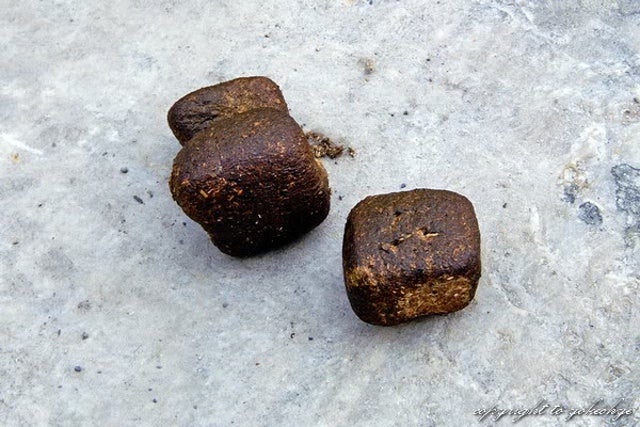
Those ain't bon bons--cubic wombat scat.  Now your day is complete.

That dung or scat is among the most tell-tale signs of the presence of wombats.   Because of their fibrous diet and highly efficient digestive process, wombats leave distinctive, compact cubical shaped pellets

It took much of the 19th Century to standardize the spelling of the animal.  Meanwhile they were being hunted for meat, sport, and because their burrowing was seen as a nuisance to farming and particularly sheep grazing.  The Europeans characterized the animals in their own folk stories as fat, lazy, and greedy.

By the early 20th Century all three species—the common wombat, Northern Hairy-nosed Wombat, and Southern Hairy-nosed Wombat—were all under pressure.  Wombats were classified as vermin in 1906, and a bounty was placed on them in 1925.  The results were entirely predictable.

The Northern Hairy-nosed Wombat is extremely endangered.  Only 138 were known to survive as of 2007 and their range confined to the Epping Forest National Park in Queensland where they are protected behind a predator proof fence.  Tenuous efforts have been made to re-establish another colony at the Richard Underwood Nature Refuge at Yarran Downs.  The species has become a symbol of Australian efforts to preserve endangered species.

But their Southern cousins and the now far-from Common Wombat are also under extreme pressure.  All species have been declared protected in all states but Victoria where the Department of Environment and Primary Industries still classifies them as a pest and allows both hunting and in some cases, poisoning.

Attempts by conservationists to manage a recovery of the population are hindered by the low fertility and reproductive rates of wombats.  Adult females produce only one offspring each breeding season after a gestation of 20-21 days.  They carry the joey in their well-developed pouches for seven months.  Alone among marsupials, the wombat pouch opens toward the animal’s rear.  This prevents the joey from being smothered by dirt as the mother expands her burrow during which her powerful front legs and claws toss dirt behind her.  The babies emerge as furry miniature adults.  They are weaned at 15 months and on their own and sexually active at a year and a half.

One of several wombat stamps issued by the Australian Post over recent decades.

The threatened and endangered status of wombats has evoked some degree of public sympathy and affection for the previously scorned critter.  They are sometimes used as a symbol for conservation efforts and have even appeared on Australian postage in recent years, something that their more glamorous cousins—Kangaroos, Koalas, Tasmanian Devils, and Platypuses achieved decades earlier.

Wombat prestige has also been boosted as they funny looking animals have become staples of Australian kiddy picture books, children’s literature, and children’s television.  One popular animated series features a wombat family.

This long running Aussie  children's program features a wombat puppet who has been paired with y several hosts and celebrity guests over the years.

Still the creatures lag behind those other iconic Aussie animals in public acceptance.  No Australian professional or college sports team has adopted the wombat as their mascot.

Perhaps that is why fans of the animal launched Wombat Day in 2005.  It seeks to honor the animal, but has more than a touch of tongue-in-cheek humor about it.  The only customs I could find associated with the celebration are viewing parties at zoos and animal preserves and baking and consuming homemade chocolate cakes or brownies made in the shape of a wombat.  Which leads me to suspect that the chocolate industry may be behind much of the annual promotion of the holiday.  Oh, they also consume a confection called Wine Gums.  Beats the hell out of me what they are.

A wombat Day cake.  Makes your mouth water, right?

October 22 was supposedly chosen because it is smack dab in the middle of the Southern Hemisphere spring planting season and there are said to be certain vague traditions linking wombats with fertility.  These claims are open to question.

Anyway, there you have it.  A new reason to celebrate.  And coming in the midst of the semi-lockdown of the Coronavirus pandemic leaves us all a bonkers this writer needs a cause to celebrate something.  Pass the Wombat Cake. 

Saturday, June 20, 2020

The Sun Shines Today on Summer Solstice


Note:  As with so much else the Coronavirus pandemic has put the kibosh on many Summer Solstice observations—Stonehenge is closed and the best the Brits can do is watch the mystical moment on the BBC.  Yet whatever we puny inhabitants of the Earth do or think, the astronomical event is inexorable.
Although the Summer Solstice, the longest day of the year in the Northern Hemisphere, has been marked and celebrated across cultures since pre-historic times, it is today celebrated mostly—understandably—in the most northern climes.  A day on or near the Solstice is still a widely celebrated public holidayMidsummer’s Day—in most of Scandinavia, the Baltic nations and in Quebec.  It is a widely observed unofficial celebration in Ireland and northern England and in several other countries.
At dusk on Midsummer's Eve young women neo-pagans launch miniature rafts with burning candles in Baltic areas like Estonia.
Of course in the Southern Hemisphere it is the Winter Solstice and celebrated with many of the traditions imported by Europeans for that occasion.
In the United States the event goes largely uncelebrated except by the growing communities of Wiccans, other neo-pagans, and ecological supporters of earth centered religion, including many Unitarian Universalists.  This is especially true in contrast to the Winter Solstice, which coincides with the Christmas/Yuletide holidays and a raft of other Festivals of Light from many cultures.  This is undoubtedly due to the yearning for the re-birth of light in the depths of a cold and dark time of year, historically associated with want and hunger as supplies from the last harvest and fall hunts wane.
By contrast, the Summer Solstice comes and goes at a time of warm, if not hot, weather in which long days have been enjoyed for weeks and will continue to be.  It is in the middle of the agricultural season, not spring planting or fall harvest so it has less of the aspect of a fertility celebration on one hand and a thanksgiving on the other.
Stonehenge is just the best known of many ancient monuments and constructions around the northern hemisphere that in some way mark the Summer Solstice, usually with a shaft of sunlight falling on an altar stone at either dawn or sunset or shining perfectly through a special aperture.  
In ancient times—perhaps even in the recently discovered “oldest temple in the world” found in eastern Turkey which pre-dates the agricultural revolution—the longest day of the year was such an important event that it was fixed by massive temples and monuments like those found in Egypt, Mesoamerica, and at Stonehenge where the dawning light of the solstice falls on a sacred altar or stone.  This was so widespread that there must have been a powerful, primeval urge.  It is clearly closely related to the wide-spread worship of the Sun or Sun gods.
Summer Solstice celebrations were among those targeted for eradication or appropriation by the early Church as its dominion spread over pagan realms.  An attempt was made to absorb the celebrations into St. John’s Day as Yule had been by Christmas, the Vernal Equinox by Easter, and the fall harvest festivals by All Souls and All Saints Day.  But except in certain localities, St. John’s Day never caught on as a major festival

Celebration of Midsummer waned in most places, although it survived as a folk festival in Celtic and Nordic areas. If those celebrations were imported to the New World, the Puritan divines who waged such a struggle wiping out vestiges of pagan celebrations like May Day, Halloween, and Christmas did not easily find them.  Perhaps it was because gatherings on that day did not have the tell-tale, Poll Dances, evocations and/or sacrifices to the dead, evergreens and holly, or other well defined trappings.
St. John's Day--the Feast of St. John the Baptist, celebrated on June 24 was intended to absorb pagan Midsummer traditions.  It is celebrated in many areas with more or less pagan rituals especially including bonfires and dances.  It is also an especially important day in Masonic ritual.
In this country the day is publicly celebrated in areas of heavy Swedish and Finnish immigration and is usually marked with a bonfire and picnic
Various neo-pagan groups celebrate in different ways and some of them are becoming more public about it.  New Age religious and spiritual groups also adapt or adopt some of the traditional neo-pagan celebrations.
Many Unitarian Universalists celebrate the Summer Solstice/Midsummer.  At Original Blessings, a lay led UU spiritual community in Brooklyn, New York, participants gathered inside in the dark seated around a flaming chalice.  Oh those wild and crazy UUs!
At any rate, the longest day of the year deserves some commemoration.   If you are celebrating today in any way, count me with you in spirit.

Sunday, June 14, 2020

My Flag, Your Flag, Our Flag?


Note:  We’ve been here before but this entry is lightly updated to account for current catastrophes especially the Black Lives Matter movement, Coronavirus pandemic crisis, and Trumpista bellicose faux patriotic posturing.

In case you hadn’t noticed today is officially Flag Day, a demi-holiday easily overlookedIt is celebrated by displaying the American Flag.  Veterans’ groups often organize solemn flag disposal ceremonies. 

No other country on earth makes quite the fetish of its flag as does the United States.  The word idolatry comes to mind.  At its worst it elevates the symbol—the Flag—over the substance—the democratic values espoused in the Declaration of Independence and protected by the Constitution.  It is an absolute truism that those who wrap themselves most in the Flag—and these day that is not just a figurative term—are the most disingenuous and dangerous.  Witness any Donald Trump performance.

Donald Trump practically swaddles himself in flags.  It's a tell--the more and bigger flags, the greater the lies and attacks on fundamental Constitutional and American values.
On the other hand—especially those who served in the Armed Forces or who were raised in a veteran’s household—have been taught to respect the Flag and “the nation for which it stands.”  I still hang the Flag on my house on patriotic holidays and always place my hat over my heart when it passes by in a parade.  It’s just the way I was raised.

Part of the national devotion to the Flag comes from an odd combination of cultural coincidence and calculated political strategy.  Our National Anthem, not officially adopted until 1931 but widely used on patriotic occasions for more than a century prior, may be the only national song about a flag. 

In the years after the Civil War the Grand Army of the Republic promoted flag waving as a triumphant poke-in-the-eye to defeated Confederates and as a test of patriotism in a way virtually unknown in the antebellum years.
Not widely displayed except at military posts, on Navy ships, and on some Federal buildings prior to the Civil War, the Grand Army of the Republic heavily promoted its use after the war in a spirit of triumphalism of the Union over the vanquished South.  For that reason display of the national flag was highly unpopular in the South until World War I.

The Pledge of Allegiance was penned by Francis Bellamy, a Baptist minister and socialist, for use during celebration the 400th anniversary of the supposed discovery of the New World by Christopher Columbus.  Quickly adopted by schools as part of the daily ritual of beginning classes, the Pledge does not swear allegiance to the government—an inclusive tip-of-the-hat to resentful former Rebels—or even to the Constitution, but to a symbol, the Flag.

Immigrant children were taught to salute the flag in public schools like this one in New York City where they would be punished for speaking their native languages.  Photo by Jacob Riis.

By the turn of the 20th Century the Flag was being used as a symbol of assimilation for the waves of emigrants swamping our shores—and as a test of their loyalty.  The most popular composers of the era—the March King John Philip Sousa and Broadway’s George M. Cohan made literal flag waving as popular as moon-June-spoon ballads.

During World War I, the Woodrow Wilson administration used flag imagery as part of their very sophisticated domestic propaganda operation designed to rouse support of the war effort and raise Liberty Loans.  After the war, the Flag was used to rally support for suppression of the labor movement, radicalism, Socialism, and Communism said to represent sinister alien ideologies.

Although the America First movement during the 1930's attracted some genuine anti-war sentiment, much of its leadership, including Charles Lindbergh, were pro-fascist.  Like other right-wing movements before and since they used the flag as "proof" of their patriotism.  Pictured is a mammoth  Madison Square Garden America First Rally in 1937.

Wilson proclaimed the first official Flag Day in 1916.  In 1949, with the country in the grips of yet another Red Scare, Congress made it an official Federal Holiday, although withholding the paid days off for Federal employees standard for other holidays.

June 14 is Flag Day because on this date in 1777 the Continental Congress passed the Flag Act which officially described a new national banner:

Resolved: That the flag of the United States be made of thirteen stripes, alternate red and white; that the union be thirteen stars, white in a blue field, representing a new Constellation.
The new official flag—not, by the way, likely first sewn by Philadelphia seamstress Betsy Ross—was based on the unofficial Grand Union flag used by General George Washington during the Siege of Boston.  That flag had the same thirteen alternating red and white stripes but had the British Union flag in its canton.  Of course, that was before Independence was declared in July of 1776.  It wouldn’t do to keep the reference to the British flag.

We will put it succinctly.  No, Betsy Ross did not sew the first American flag.

The Act was vague—it did not describe the arrangement of the stars in the field, how the stars should be shaped, or even how large the field should be.  Local flag makers working from the sketchy description produced many variations with five, six, and even twelve pointed stars; with stars of different sizes; and many variations of arrangement.  Also the shade of blue used for the field depended largely on what blue cloth the maker might have at hand. 
 The familiar thirteen stars in a circle was not only not standard, some historians doubt if it was used at all during the Revolutionary War.  Others believe that it might have been the flag used at the British surrender at Yorktown.

After Vermont and Kentucky were added to the Union two additional stars and two stripes were added.  It was this flag that was the Star Spangled Banner observed still flying over Ft. McHenry in Baltimore harbor after an all-night British naval bombardment in 1815.  It became apparent that with more new states, adding stripes would quickly become clumsy. In 1818, after five more states were added, Congress fixed the number of stripes at thirteen with an added star for each new state.

But it still did not specifically designate an arrangement for the stars.  During the Civil War flags with all manner of arrangements were used.  It was not until the creation of the 48 star flag in 1912 that a specific arrangement was established.  The current 50 star flag has been in use since July 4, 1960 after the admission of Hawaii to the Union.  This year will mark the 60th anniversary of that flag, which has been in service longer than any previous national banner.

For some Black Lives Matter protesters the flag is a symbol of white privialage and historic denial of the basic humanity of Black and other People of Color.
Today the flag is waved by forces on both sides of the great social and political divide even as the nation for which it stands seems to teeter perilously on the verge of a second civil war.  Both sides claim to love their country but have seemingly irreconcilable notions about what America is, what it means, and what it should become.


For some Trump supporters the Cheeto-in-charge is the flag.
I’ve got my flag today and I believe it stands for “Liberty and Justice for All.  What does your flag mean?


Thursday, October 22, 2015

Tired of the Same Old Boring Holidays? Try Wombat Day


Break out the Champaign and some tough roots, grass, and bark for the guest of honor!  It’s Wombat Day Down Under. It’s an ancient tradition stretching all the way back to 2005.  And so what if those asses in Canberra haven’t gotten around to making it a legal holiday with the Post Office closed, military parades, and bands playing Waltzing Mathilda, it’s good enough to raise a can of Foster’s and throw another shrimp on the barbie.
The occasion celebrates those cuddly short-legged, muscular marsupials native to Australia with pudgy snouts and short tails that resemble small, over-fed bears.  They are adaptable to Australia’s various often in hospitable environments from arid semi-desert to forests and mountain sides.  Not that anyone actually sees them much in the wild.  That’s because they are the world’s largest burrowing mammals—adults average about 40 inches long and can weigh between 35 and 70 pounds—and spend much of their lives in the their extensive burrow systems.  Being nocturnal they generally only come out to dine at night except for the rare darkly overcast, rainy day.
The stout little beasts have powerful forelimbs with impressive claws for digging and large rodent-like incisors to gnaw through their tough diet choices.  Their natural predators were few—the dingo, now extinct Tasmanian devil, and, of course humans.  Over the last century feral dogs have heavily damaged the population.
Wombats are naturally both slow moving and shy, but can be aggressive when startled or threatened.  They have been known to charge humans who get near them and are large and heavy enough to knock down a grown man.  Their long, sharp claws can slash human flesh and bites can penetrate stout boots and thick socks.  On the other hand, humans, both Aborigines and early White settlers hunted them for food.  The settlers, with their fire arms and hunting dogs, quickly reduced the Wombat population and range over much of the southeastern part of the Continent.
Despite holding a day in their honor, Australians have a might ambivalent attitude toward the wombat.  The Aborigines did not seem to esteem them, despite relying on them as a protein source.  They did not imbue them with the spiritual powers and significance of other animals—kangaroos, snakes, crocodiles, sharks, etc.—in their Dreamtime mythologies and seldom depicted them in their rock art.  The origin story about them is hardly flattering—originating from a person named Warreen whose head had been flattened by a stone and tail amputated as punishment for selfishness.
When white settlers—most of them, you will recall, transported prisoners and their military guards—arrived, their opinion of the creatures was not much better.  At first because of the similarity of size and burrow habitations they were mistaken for a kind of badger, the large European weasel and omnivore totally unrelated the local marsupial.  Several Australian place names containing the name badger—Badger Creek, Victoria and Badger Corner, Tasmania  for instance—are really named for wombats. 
The English adopted the name from a corruption of the now extinct Darug Aboriginal language.  In 1798 John Price was exploring in what is now New South Wales with James Wilson who had lived with the Aborigines when he recorded in his diary:
We saw several sorts of dung of different animals, one of which Wilson called a Whom-batt, which is an animal about 20 inches high, with short legs and a thick body with a large head, round ears, and very small eyes; is very fat, and has much the appearance of a badger.
Those ain't bon bons--cubic wombat scat.  Now your day is complete.
That dung or scat is among the most tell-tale signs of the presence of wombats.   Because of their fibrous diet and highly efficient digestive process, wombats leave distinctive, compact cubical shaped pellets. 
It took much of the 19th Century to standardize the spelling of the animal.  Meanwhile they were being hunted for meat, sport, and because their burrowing was seen as a nuisance to farming and particularly sheep grazing.  The Europeans characterized the animals in their own folk stories as fat, lazy, and greedy.
By the early 20th Century all three species—the common wombat, Northern Hairy-nosed Wombat, and Southern Hairy-nosed Wombat—were all under pressure.  Wombats were classified as vermin in 1906, and a bounty was placed on them in 1925.  The results were entirely predictable.
The Northern Hairy-nosed Wombat is extremely endangered.  Only 138 were known to survive as of 2007 and their range confined to the Epping Forest National Park in Queensland where they are protected behind a predator proof fence.  Tenuous efforts have been made to re-establish another colony at the Richard Underwood Nature Refuge at Yarran Downs.  The species has become a symbol of Australian efforts to preserve endangered species.
But their Southern cousins and the now far-from Common Wombat are also under extreme pressure.  All species have been declared protected in all states but Victoria where the Department of Environment and Primary Industries still classifies them as a pest and allows both hunting and in some cases, poisoning.

The late Steve Irwin shows of a wombat giving you an idea of their size.
Attempts by conservationists to manage a recovery of the population are hindered by the low fertility and reproductive rates of wombats.  Adult females produce only one offspring each breeding season after a gestation of 20-21 days.  They carry the joey in their well-developed pouches for seven months.  Alone among marsupials, the wombat pouch opens toward the animal’s rear.  This prevents the joey from being smothered by dirt as the mother expands her burrow during which her powerful front legs and claws toss dirt behind her.  The babies emerge as furry miniature adults.  They are weaned at 15 months and on their own and sexually active at a year and a half.
The threatened and endangered status of wombats has evoked some degree of public sympathy and affection for the previously scorned critter.  They are sometimes used as a symbol for conservation efforts and have even appeared on Australian postage in recent years, something that their more glamorous cousins—Kangaroos, Koalas, Tasmanian Devils, and Platypuses achieved decades earlier.
Wombat prestige has also been boosted as they funny looking animals have become staples of Australian kiddy picture books, children’s literature, and children’s television.  One popular animated series features a wombat family.
Still the creatures lag behind those other iconic Aussie animals in public acceptance.  No Australian professional or college sports team has adopted the wombat as their mascot.

A typical wombat chocolate cake, the primary delicacy of the holiday by a home baker.  Proffesional often make them much more elaborate, often like accurate three dimensional models of the animal.
Perhaps that is why fans of the animal launched Wombat Day in 2005.  It seeks to honor the animal, but has more than a touch of tongue-in-cheek humor about it.  The only customs I could find associated with the celebration are viewing parties at zoos and animal preserves and baking and consuming homemade chocolate cakes or brownies made in the shape of a wombat.  Which leads me to suspect that the chocolate industry may be behind much of the annual promotion of the holiday.  Oh, they also consume a confection called Wine Gums.  Beats the hell out of me what they are.
October 22 was supposedly chosen because it is smack dab in the middle of the Southern Hemisphere spring planting season and there are said to be certain vague traditions linking wombats with fertility.  These claims are open to question.
Anyway, there you have it.  A new reason to celebrate.  And coming the day after the Chicago Cubs exited the National League Championship Series after four straight losses, this writer needs a cause to celebrate something.  Pass the Wombat Cake.