Friday, January 28, 2022

Trying to Pick a Historical Blog Post for January 28

Faithful readers of this little blog often ask how I pick the topics for my historical entries, many of which seem to be obscure or exotic.  The process is simple, if haphazard. I consult a number of on-line history calendars, many of them specialized—labor, women, Black, music, baseball, etc. But almost every day I start at Wikipedia’s On This Day feature because it is exhaustive and amazingly diverse.

Glancing down today’s entries, a number caught my eye, some of which I have already used.  And some ignited my inner smart ass.

Take for instance, this one:  1393—King Charles VI of France was nearly killed when several dancers’ costumes caught fire during a masquerade ball.  Not enough information for a blog post, but I wanted to scream at the computer screen “And it didn’t do anything for the health of the dancers, either!”


The Diet of Worms was a critical turning point in the Protestant Revolution but makes for dull reading.

Or:  1521—The Diet of Worms began, lasting until May 25.  It was an important event in the Protestant Reformation but would make stupefyingly dull reading.  Yet I am tempted to write something just so I could use the joke, “The Diet of Worms lasted until May 25 when it was superseded by the Vegan Diet of Tofu.”  Thankfully, you were spared….


Henry VIII's son and heir, the boy King  Edward VI.

Then comes:  1547—Henry VIII died. His nine-year-old son, Edward VI became King, and the first Protestant ruler of England.  Ok, back when I first started a daily almanac feature as single paragraph shorts—how many readers yearn for me to return to such admirable brevity—I used this one.  The entry ran in toto: 


Nine year old Edward VI became King of England and Ireland on January 28, 1553 upon the death of his father, Henry VIII.  The frail boy’s short six year reign was marked by court intrigue and rule by “protectors” appointed by a Regency Council.  The first, Edward Seymour, Duke of Somerset, pursued a moderate policy against Catholics.  He was ousted and executed by John Dudley, Earl of Warwick and later Duke of Northumberland who oversaw the transformation of the Church of England into a Protestant body and persecuted Catholics.  The young King’s reign was also marked by two failed wars—one to force the Scots to betroth their young Queen Mary to her cousin Edward and thus unite the kingdoms, and another against perennial foe France.  Dudley compelled the tubercular young king to name his cousin Lady Jane Grey as his heir to prevent the accession of his Catholic half-sister Mary.  The scheme failed and Jane ruled for only nine days before Mary was set on the throne.  Despite all of the high drama swirling around him, Edward is best remembered today—at least on this side of the pond—for inspiring Mark Twain’s The Prince and the Pauper.

See?  Neat, quick, and to the point.  These days I would prattle on for pages until you would wish to put out of your misery by a Royal Headsman.

In the earliest years of the Wikipedia list, entries tended to be like this, all about kings, queens, emperors, Popes, and their trials and successions.  Or they were about long forgotten battles in obscure wars. 

How about a lexicographic factoid?:  1754—Horace Walpole coined the word serendipity in a letter to Horace Mann.  After noting that the second guy was not the educational reformer or founder of an insurance company, I would have been compelled to write something like, “It was entirely serendipitous that two guys named Horace actually knew one another.”

One of those obscure battles:  1846—The Battle of Aliwal, India, was won by British East India Company troops commanded by Sir Harry Smith. 


It was a good thing troopers at Fort Keogh were issued warm, heavy buffalo robe coats and hats.

Here’s one I liked so much I used twice!  1887—In a snowstorm at Fort Keogh, Montana, the world’s largest snowflakes were reported, 15 inches (38 cm) wide and 8 inches (20 cm) thick:


The winter of 1886-87 was the most brutal ever recorded over a wide swath of the West.  East of the Rocky Mountains from Indian Territory to Montana storm after storm dumped white stuff on the open range where much of the nation’s beef was raised.  The Great Blizzard of ’87, which lasted for ten days from January 9 to 19, was worst in Montana.  Sixteen inches of snow came down the first 16 hours amid driving winds and temperatures that dipped to -47˚.  And it just kept coming.

Cattle, already weakened by a summer drought and poor grass, floundered and died by the hundreds of thousands.  As ranchers began to try to dig out of drifts that covered their cabins and reached high lofts of their barns, they hoped things would get better.

But on January 29 at Fort Keogh near Miles City in southeastern Montana huge flakes began to fall.  And I mean huge.  Flakes were gathered and measured at 15 inches across and 8 inches thick weighing several ounces.  Men, horses, and cattle were actually injured by the falling flakes, the largest ever recorded anywhere.  The reports we so outlandish that they might have been dismissed as tall tales had they not been witnessed and attested to by a whole Army post.

More blizzards fallowed in February.  When the spring thaw finally came, coincidentally unleashing devastating floods, the corpses of millions of cattle littered the plains.  The industry was virtually wiped out and the old system of open range feeding never recovered.

Here’s one good for a post, heavy on the tongue in cheek:  1896—Walter Arnold of East Peckham, Kent becomes the first person to be convicted of speeding. He was fined 1 shilling, plus costs, for speeding at 8 mph (13 km/h), thus exceeding the speed limit of 2 mph (3.2 km/h).

And here are two for my inner rail and transportation lore geek:  1855—A locomotive on the Panama Canal Railway, ran from the Atlantic Ocean to the Pacific Ocean for the first time.  1917—Municipally-owned streetcars took to the streets of San Francisco.

Pop culture anyone?: 1956—Elvis Presley made his first US television appearance.  1958—The Lego company patented the design of its Lego bricks, still compatible with bricks produced today.

Been there, done that:  1965—The current design of the Flag of Canada was chosen by an act of Parliament.

Space Shuttle Challenger exploded live on television shortly after lift off kill an seven astronauts on board.

Here’s a heavy one:  1986—Space Shuttle program: STS-51-L mission—Space Shuttle Chalenger exploded after liftoff killing all seven astronauts on board.  I watched this one live with two year old daughter Maureen before taking her to day care and going to my second shift job as a school custodian.  Mark this for a future memoir piece.

You get the drift.  Lots to choose from.   And I haven’t even plumbed the long lists of births and deaths.  Of those I have used the French novelist Collette twice, mostly for the giddy thrill of being able to post a semi-nude photo of her dolled up as Cleopatra.


                        French actress/courtesan/novelist Colette as Cleopatra.

You can see that some days it takes nearly as long to pick a blog topic as to write an entry.

What do you think?  Which should I choose?  Or should I just post this tap dance and say to hell with it?


Thursday, January 27, 2022

Memories Dim as International Holocaust Remembrance Day is Observed


The grim reality is that 77 years after the world got confirmation of the breadth of the Holocaust anti-Semitism is on the rise in the United States and in Europe.  As the last survivors of the death camps and the Allied soldiers who liberated them dwindle the collective memory has dimmed.  Polls constantly show that younger people are at best foggy on the reality—many can’t place World War II within 50 years on a timeline, are unsure who the combatants were and on who was responsible for barely understood atrocities.  Holocaust denial is on the rise spread mainly by those who try to mask their own intentions to “complete the job.”  Right wing nationalism is making a comeback in Europe making substantial gains in several national parliaments and coming to power in Poland and other Eastern European Countries. 

Nazi paraphernalia and symbols were on display during the violent occupation of the U.S. Capitol last year by organized insurrectionists.  No one in the mob seemed a bit perturbed by this guy and his sweatshirt. 

In the U.S. White nationalism has broken out of the pariah fringe of society and is making a bid for respectability as it was given barely concealed wink and nod support from the former Resident himself.  Deadly mass shootings at the Tree of Life Synagogue in Pittsburgh and at a kosher grocery in New Jersey as well as a mass stabbing attack on a suburban New York home Hanukkah celebration were only some the most widely noted events.  Vandalism and attacks on synagogues, cemeteries, schools, and other Jewish institutions are on a sharp rise.  Anti-Semitic flyers and propaganda are being posted at colleges, universities, and high schools as well as in suburban communities.  The insurrectionist attack on the Capitol included individuals with swastika tattoos, a Camp Auschwitz sweatshirt in addition to members of anti-Semitic neo-fascist groups like the Oath Keepers and Proud Boys.  Even as White nationalist, racist, and anti-Semitic groups have lately been purged by Facebook, Twitter, and other platforms they find homes elsewhere and on the so-called Dark Web

Confounding attempts to counter these dangerous trends is the Israeli government’s campaign to tar every critic of its brutal and unrelenting attacks on Palestinians in Gaza, the occupied West Bank, and now in Jerusalem, Bethlehem, and other cities as anti-Semites.  The former Cheeto-in-Charge was happy to echo those charges and to support efforts to virtually outlaw calls for economic and cultural boycotts of the Jewish state.  Former Harry Potter actress Emma Watson recently became the latest victim smeared as anti-Sematic for daring to criticize Israeli oppression of Palestinians. She will not be the last.

The Hall of Names keeps the memories of individual Holocaust victims alive at Yad Vashem in Jerusalem. 

Today is International Holocaust Remembrance Day.  It will be observed—celebrated is certainly the wrong word here—in ways big and small, significant and trivial in many places across the world.  The commemoration comes on the anniversary of the liberation of Auschwitz-Birkenau death camps in Poland by the advancing Red Army on January 27, 1945.  American, British, Canadian, and other Allied Forces liberated other camps, but Auschwitz was the pinnacle of efficiency for the Nazi industrialization of mass murder.

On the sixtieth anniversary of the liberation the United Nations General Assembly held a special commemorative session.  The following November the General Assembly created the memorial day, which was first observed in 2006.

In November of 1944 as the Red Army advanced from the East and the Allies pressed on the Western Front, SS Chief Heinrich Himmler ordered the beginning to the eradication of evidence of the death camps in Poland.   Gassing operations were suspended and crematoria at Auschwitz were ordered destroyed or, in one case, converted into a bomb shelter.  As things got worse, Himmler ordered the evacuation of the camps in early January directing that “not a single prisoner from the concentration camps falls alive into the hands of the enemy.”

On January 17, 58,000 Auschwitz detainees were set on a death march west towards WodzisÅ‚aw ÅšlÄ…ski. Approximately 20,000 Auschwitz prisoners made it to Bergen-Belsen concentration camp in Germany, where they were liberated by the British in April 1945.

Some of the healthier inmates of Auschwitz after liberation by the Red Army.

But that left over 8,000 of the weakest and sickest abandoned with scant supplies.  The Red Army 322nd Rifle Division arrived 10 days later to find 7,500 barely alive and 600 corpses lying wherever they finally collapsed.  They also found much evidence of the greater crimes Himmler had hoped to hide—370,000 men’s suits, 837,000 women’s garments, and 7.7 tons of human hair. Coming in the midst of the Yalta Conference and other war news, the liberation received scant media attention at the time.  And the Soviets, who were at best ambivalent at the highest levels about what to do with the liberated Jews, did little to publicly celebrate their role in the liberation, at least at first.

It was only after survivors reached the West and eventually Israel as refugees, that Auschwitz emerged as a special, horrific symbol of the whole Holocaust.

Emaciated survivors at Buchenwald, a major extermination camp liberated by American troops.

The publication of the Diary of Ann Frank, Ellie Wiesel’s Night, and other memoirs by survivors, camp liberators, and on-the-scene journalists made deep public impressions in the West as did films like Stephen Spielberg’s Shindler’s List.  Evidence of the Holocaust has been carefully preserved at Israel’s Yad Vashem, the world central archive of Holocaust-related information and at Holocaust museums in many major cities.  Public acknowledgement of the Holocaust probably peaked internationally around the turn of the 21st Century and has been eroding since then.

The 75th anniversary was marked by a special meeting at the Fifth World Holocaust Forum at Yad Vashem in Jerusalem.  Over 50 international leaders including French President Emmanuel Macron, Russian President Vladimir Putin, Britain’s Prince Charles, and American Vice-President Mike Pence were on hand for the event.  They heard Netanyahu denounce critics of Israel as Anti-Semites and to beat the band for an international attack against Iran.   Other leaders, except Pence, generally distanced themselves from Netanyahu’s remarks and spoke in platitudes of varying degrees of sincerity about preventing any future genocide.

Holocaust Remembrance was muddied in 2020 year at the World Holocaust Forum when Israeli Prime Minister Benjamin Netanyahu used the occasion to justify violent oppression of Palestinians and his apartheid regime, to attack all critics of his policy as anti-Semites, and to rouse support for an attack on Iran.

Today there will be solemn remembrance gatherings at the sites of most of the World War II death camps and in cities around the world

Together we can truly pledge “Never Again!”  and mean it for Jews and for the modern targets of repression, oppression, apartheid like ghettoization, and even actual genocidal attacks including the Palestinians.


Wednesday, January 26, 2022

Nelson Rockefeller Checked Out in Flagrante Delicto

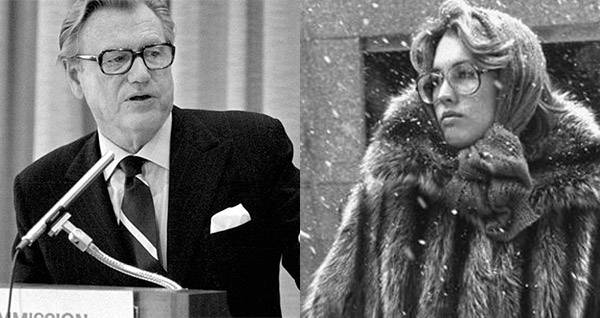
Former Vice President and New York Governor Nelson Rockefeller and 27-year-old Megan Marshak seen on the wintery streets of New York swathed in fur--not quite the usual attire of political aid and personal assistant.

I can’t help myself.  In retrospect it seems like such a quaint little scandal.  Charming really—the short naked final tumble of the recent Vice President of the United States and one of the wealthiest men in the country.  It seems almost like a May-December romcom with a dark twist ending.   Compare that with the multiple scandals and affairs of the last Resident of the United States—think Stormy Danniels, teen age beauty queens, and boastful pussy grabbing.

When Gerald Ford became President after Richard Nixon's resignation, Nelson Rockefeller was appointed as Vice President to fill out the vacancy in the office.  It was the crown of a long political career.

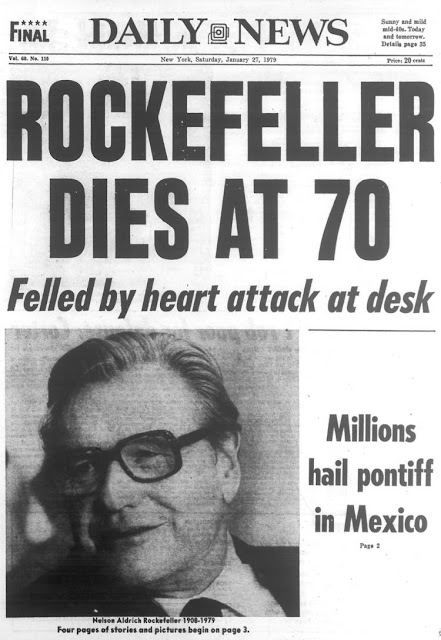
On January 26, 1979 Nelson Rockefeller, former Vice President of the United States, Governor of New York, Assistant Secretary of State, one of the richest men in America, patron of the arts, philanthropist, and Baptist collapsed with a massive heart attack at the age of 70. 

Unfortunately for him, he collapsed on 27-year-old Megan Marshak, an aide to the political powerhouse.  He was naked.  So was she.  She struggled to get the large, heavy man off her.  In doing so she may have pushed him off her bed and onto the floor.  Anyway, that’s where he was found by a responding ambulance crew. 

In the town house at 13 West 54th Street in New York City where Rockefeller theoretically kept a secondary office, but was really Marshak’s residence, the young woman went into a panic.  The affair between the two had been a very well-kept secret.  Rockefeller was very publicly married to his second wife, the former Margaretta “Happy” Murphy, herself a one-time aide when Rockefeller was governor of the Empire State.  Not knowing what else to do, Marshak phoned her close friend news reporter Ponchitta Pierce.

When Pierce arrived, she found Rockefeller unconscious but still breathing.  The two finally decided to call an ambulance after determining that they could not get the man dressed.  The ambulance arrived after a delay of around an hour.  Rockefeller died in the vehicle on the way to the hospital.  Opinion remains divided on whether, given the state of medicine at the time, he could have been saved if he received immediate attention.

                                The press initially ran the cover-up story, but it quickly unraveled.

Meanwhile the family scrambled into a protective mode.  The first press announcements said that Rockefeller was found collapsed at his desk at his main office in Rockefeller Center by a security guard.  That tale unraveled quickly.  The family acknowledged that he was with Marshak, but claimed they were working together in the second office.  The press quickly surmised that this was a ruse and began hinting, as broadly as possible in those more discrete days, that there might have been hanky-panky going on.

The widow Happy hastily arranged for her husband’s remains to be cremated.  But an official autopsy confirmed that Rockefeller died after a heart attack during or shortly after coitus. 

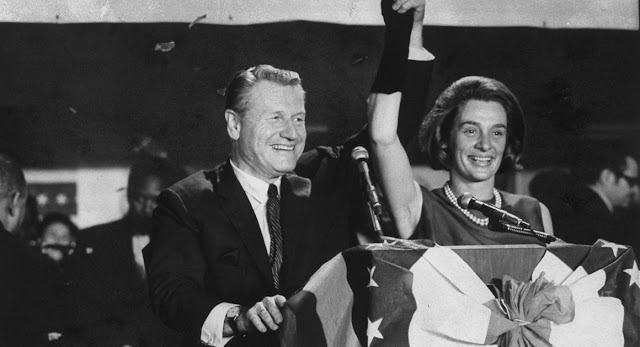
Rockefeller and his second wife Happy, another former aide.

The family and close friends gathered for a funeral on January 29 and the ashes were interred at the private Rockefeller family cemetery in Sleepy Hollow, New York.  On February 2 a public memorial was held at the famous Riverside Church attended by more than 2,200 people including President Jimmy Carter, former President Gerald R. Ford, more than 100 current or former members of Congress, as well as official representatives from more than 70 nations.   

Among those in attendance was Senator Barry Goldwater, whose insurgent campaign against Rockefeller and the hated Eastern Liberal Republican Establishment in 1964 denied Rocky his second shot at the Republican Party nomination for President—the one that was probably doomed by his hasty divorce from his first wife and equally hasty marriage to Happy, who had just dumped her own long-time spouse.

Conservatives could hardly contain their glee at Rockefeller’s demise and the embarrassing circumstances.  They considered it the death knell of liberal Republicanism.  And it pretty much was.  It took a while, but the species Rockefeller represented is now as extinct as the dodo.  Even today a Google search of Rockefeller’s death will turn up dozens of right wing web sites still gloating and many consigning their old foe to eternal damnation.  These folks never give up a grudge.

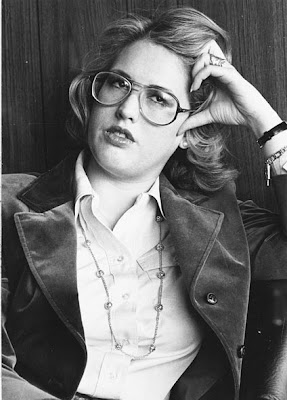
Megan Marshack looked very businesslike and professional in one of the few photos of her ever published.

As for the hapless young Megan Marshak, she holed up for weeks in the town house, never leaving, answering the phone, or granting any interviews.  When Rockefeller’s will was read, Marshak was left the deed to the now infamous townhouse.  She briefly dated macabre cartoonist Chas Addams who lived in the same building about a year after Rocky’s death.

Then she essentially vanished.  Only four published photographs, all taken before the death, are known to exist and that includes one of her at about age 12 and another that was high school mug shot.  Despite enormous press interest she was able to disappear.  In 1992 it was reported that she was living in New York and working quietly as a news writer and producer at WCBS-TV. In 2008 that pillar of journalism Parade Magazine reported that she had married and was living quietly in Southern California. 

Tuesday, January 25, 2022

The Troubled Present and Modest Beginnings of the Winter Olympics

Next week on February 4 the XXIV Olympic Winter Games will kick off with an elaborate, self-congratulatory Opening Ceremony at the Bird’s nest a/k/a the Beijing National Stadium.  The games will be held amid even more controversy and drama then have become customary for modern Olympiads.  In protest to rampant human rights violations in China, especially the repression of the Muslim Uyghurs—some charge genocide—in the country’s far northwest, suppression of Hong Kong protests in 2019 and ’20, and a general harsh suppression of speech, art, and even the mildest protests, the United States and many of its Western friends and allies announce diplomatic boycotts of the games meaning that no government dignitaries or officials will attend.

Just this week NBC and its related cable channels announced that they would not even be sending anchors or on-air reporters and commentators to the games despite having invested a fortune in broadcast rights and relying traditionally high ratings to boost viewership and ad revenue.  Major corporations have canceled or plan to cut back advertising during the games.  Anchors and commentators will be based in a New Jersey studio relying on international video feeds from China.  Presumably at least some producers and crews will be in China to facilitate interviews with athletes and some of the human interest pieces that have become a staple of the games.

NBC News will send reporters, but probably not anchor Lester Holt.  They will be prevented from much if any coverage outside of the venues and will not be able to cover human rights or environmental stories.

A protest in Sydney, Australia demanded a boycott of the Beijing Olympics over the Uyghur Genocide.

All of this is set against the background of the raging Coronavirus Pandemic and the exceptionally contagious Omicron variant.  China, of course, was the origin of the Covid-19 infection which it brought largely under control domestically with a campaign of vigorous disinfection and lock-downs often enforced brutally.  Authorities have been quick to respond of Omicron cases and outbreaks with similar measures, including shutting down entire cities, residential buildings, hotels, and workplaces often without even making provision for food, water, or bedding.  International visitors and everyone associated with Games are tested repeatedly.  No international audiences or family and friends of athletes will be allowed.  Some teams and individual athletes have pulled out of the games for fear of infection or because they refuse vaccination and/or testing.

China hopes to demonstrate that its authoritarian system is superior to Western democracies in dealing with Coronavirus crisis.  Despite these efforts at least 200 individuals associated with the games have tested positive and been placed in strict isolation.

The Games, which are supposed to promote international peace and understanding, also comes as Russia threatens an invasion of Ukraine, both traditional Olympic powerhouses.   An outbreak of war would certainly disrupt the Games.

But 98 years ago, the Winter Games had a far less troubled, if modest origin.  

                                Poster for the Winter Games retroactively designated as the first Winter Olympics.

On January 25, 1924 athletes from 16 nations gathered at the foot of Mont Blanc in Chamonix, and Haute-Savoie, France for an International Winter Sports Week.  The event was considered by its host, the French Olympic Committee, to be an informal extension of the Olympics Games held that summer in Paris.  It was in response to a clamor, particularly by Nordic countries for an international venue for amateur winter sports.

It was only after the conclusion of the successful games that the International Olympic Committee (IOC) decided to formally inaugurate the Winter Games at their meeting in 1925, that they retroactively proclaimed the Chamonix games the I Olympic Winter Games.  Thereafter the games would be held every four years in the same years as the Summer Games—interrupted by World War II—until 1994 when the current schedule of holding the game two years after the last Summer event was adopted.

The French event was not, however the first time some winter sports were part of Olympic games.  Figure Skating had been an Olympic event in both London and Antwerp, and Ice Hockey was contested in Antwerp on indoor rinks.  Obviously those events which had to be held outdoors could not be accommodated in a normal Olympic schedule.

Norway dominated Alpine events like the ski slalom. 

The first games were totally dominated by Nordic teams.  Norway won four Gold Medals and 17 total medals, Finland had four Golds and 11 total.  The United States only took a Gold in Speed Skating, a very distant Silver in Hockey, Silver in Lady’s Figure Skating, and a Bronze for Men’s Ski Jump.  But that was better than the hapless home team, despite fielding the second largest number of athletes.  The French won just three Bronze medals, one of them not actually awarded until 2006.

Curling had been presented during the games but was not considered an official sport.  In 2006, the IOC retroactively awarded medals to the 1924 curling teams after an appeal on behalf of the victorious British by a Glasgow newspaper.

An unofficial sport at the games, curlers were finally awarded medal for the competition in 2006.  Note the woman on this team--the only event in which women competed along side men.

The Curling medals were not the only ones awarded tardily.  When officials in 1974 discovered a mis-entered score in a ski jumping event, American Anders Haugen was elevated from fourth place to third and the 86 year old athlete finally received his Bronze.

The last medal presented during the competition was awarded to a sport that was not even contested during the games.  The French Olympic Committee presented a Gold Medal for alpinisme to Charles Granville Bruce, the leader of the expedition that tried but failed to climb Mount Everest in 1922.

The 1924 Gold Medal.  The last was not awarded until 2006.

Athletes at the games competed in 16 events in 9 sports—Bob Sled, Curling, Ice Hockey, Military Patrol, Figure Skating, Speed Skating, Cross Country Skiing, Nordic Combined Skiing, and Ski Jumping.

Norway's 13 year old Sonja Henie placed last in 1924  but was the darling of the games.  She went on to win Gold Medals in the next three Winter Games and a career in Hollywood movies.

In Figure Skating Sweden’s Gillis Grafström became the first—and last—individual to successfully defend a Gold Medal won at a previous Summer game, Antwerp in 1920.  He would go on to notch a third win in 1928 and a Silver in 1932.  On the distaff side 11 year old Sonja Henie skated for Norway.  She finished last but became the darling of the competition.  She would go on to win the next three consecutive Gold Medals, a career as one of the highest paid movies stars in Hollywood, and the first ice show queen.

Then there was Ice Hockey.  The Canadians, like Grafström defending Gold won at Antwerp, achieved the most devastating complete domination of an event in Olympic history, Summer or Winter.  They finished their qualifying round with 4 wins, and a total score of 110–3 against Switzerland, Czechoslovakia, Sweden, and Great Britain then breezed to a win topping the U.S.  This domination continued through most of early Olympic history.  The Canadians won six of the first seven Gold Medals.  Frankly, the whole country has had a swelled head and been a dick about this ever since.

The Canadian beating the shit out of the British in Ice Hockey.

All-in-all it was an exciting and successful week of completion.  Unlike the enormously expensive Summer games that year in Paris, the winter events even turned a modest profit.  They helped popularize winter sports in Europe and North America.  Not a bad debut.


Monday, January 24, 2022

Casablanca—One of America’s Favorite Movies Opened Nation-wide

Although it had an official premier at the Hollywood Theatre back on November 27, 1942 to make it eligible for the 1943 Academy Awards, Casablanca went into general release 79 years ago today on January 24.  That coincided with the last day of the Casablanca Conference with President Franklin D. Roosevelt and British Prime Minister Winston Churchill which mapped out the general strategy for the Western Front in Europe and was a little more than two months since the city was liberated by the British in Operation Torch.  Both events made the title instantly significant to war-time movie goers.

Although Casablanca misses the top ranks of most lists of the “greatest” films of all time, it never fails to score at or near the top of lists of favorites.  Never intended to be great art, it none the less is the epitome of how the crass movie-by-committee method of the Golden Age of the American studio system could often achieve it despite of itself.

Now a revered classic, the production was troubled and chaotic, and the film was only moderately successful in its first run.  But it swept the 1943 Oscars with eight nominations and three wins including Best Picture, Michael Curtiz for Best Director, and Best Screenplay for Julius J. Epstein, Philip G. Epstein, and Howard Koch.  Humphrey Bogart was nominated for his first romantic lead as the jaded café owner Rick and Claude Raines got a nod as Best Supporting Actor for his role as the Vichy French policeman Captain Louis Renault.  Somehow the luminous Ingrid Bergman was denied a nomination as Ilsa.  From then on, its reputation has only continued to grow.

Everybody comes to Ricks, including freedom fighting refugee Victor Lazlo and his wife Ilsa--a woman with a past.

Warner Bros. producer Hal Wallis bought Everybody Comes to Rick’s by Murray Burnett and Joan Alison, in January 1942 for $20,000, then a Hollywood record for an unproduced play.  He assigned the script to the twin Epstein brothers who made major changes in the story and characters.  Veteran writer Koch was brought in later.  In addition, several other un-credited writers contributed to the script including re-writes by Casey Robinson.  The script was in continuous revision throughout shooting.  Bergman later said she never knew who Ilsa would pick in the love triangle until handed a shooting script on the set of the final scene.  The films memorable final line “Louis, I think this is the beginning of a beautiful friendship,” was added weeks after principal shooting was completed.

Curtiz, a Hungarian Jew who had relatives still trapped in Hitler’s Europe, was tapped as director only after the first choice, Warner’s ace William Wyler, was unavailable. 

Several actors were considered for the roll of Rick.  Ronald Reagan was mentioned in early press stories on the film, but this was mostly just to keep his name in the papers.  Warner Bros. knew that he would enter the service before shooting began.  Bogart was a long-standing member of the Warner stock company best known for his tough guy and gangster rolls often in support of top studio stars James Cagney, Edward G. Robinson, and George Raft.  But the Maltese Falcon and High Sierra had recently moved him up to the top ranks of studio assets.  With some trepidation he was cast in the unconventional romantic lead.

Likewise, Ann Sheridan—who would have played the female lead as an American as envisioned in the original play—and European beauties Hedy Lamarr and Michèle Morgan were considered before Swedish born Ingrid Bergman was cast as Ilsa.  Austrian actor Paul Henreid fresh off a triumph as a suave leading man to Bette Davis in Now, Voyager, was cast as the noble Eastern European resistance hero Victor Laszlo, Ilsa’s husband.  Just as he feared, the stiff Laszlo typecast him and prevented him from becoming a major leading man.  The large cast also included Warner standbys Raines; Conrad Veidt, an anti-Nazi German who made a Hollywood career of playing Third Reich villains; and Sydney Greenstreet and Peter Lorre, both of whom had appeared with Bogart in The Maltese Falcon.

Rick and Ilsa in Paris,  "Here's looking at you, kid."

Max Steiner scored the film, but its most memorable musical moments were provided by Rick’s piano playing pal Sam, played by Dooley Wilson, and by the stirring singing Les Marseilles at a critical moment.  Wilson made an instant classic of As Time Goes By, a ballad of middling popularity by ‎Herman Hupfeld that had been floating around since 1931.

A rousing highlight of the film was the spontaneous singing of  Les Marseilles at Rick's as Nazi officers look on.

The melodramatic plot focused on a ridiculous MacGuffin. Letters of Transit were blank documents signed by a Vichy general that supposedly would allow the bearer to travel freely and were the magic documents needed by the refugees crowding Rick’s Café Américain in the French Moroccan city of Casablanca to get to neutral Portugal and from there perhaps to the safety of Britain or the U.S.  Two of these letters fall into the hands of proprietor Rick Blaine, a cynical American expatriate with a shady past just as his former lover, Ilsa, arrives with her husband Victor.  In flashback we learn of a near idyllic romance between Rick and Ilsa in Paris which ends when she disappears as German troops occupy the city.  She had never told him of her marriage or left any message as to why she did not meet him at the train station as planned to escape the city with him.

The rest of the film revolves around the search by Captain Renault, at the instance of the Nazi officer Major Stasser, for the valuable stolen letters of transit, and with the moral dilemmas of Rick and Ilsa.  In the end the French cop, the crusty American whose “shady past” turns out have been running guns to Ethiopia to be used against the invading Italians and fighting on the Republican side in the Spanish Civil War, and the wife torn between two loves each makes a sacrifice for the greater good.

Rick explains things to Ilsa at a fog shrouded airport.

Rick explained it to Ilsa in the fog at the airport:

Inside of us, we both know you belong with Victor. You’re part of his work, the thing that keeps him going. If that plane leaves the ground and you’re not with him, you’ll regret it. Maybe not today. Maybe not tomorrow, but soon and for the rest of your life… I’ve got a job to do, too. Where I’m going, you can’t follow. What I’ve got to do, you can’t be any part of. Ilsa, I’m no good at being noble, but it doesn’t take much to see that the problems of three little people don’t amount to a hill of beans in this crazy world. Someday you’ll understand that.”

Many years later writer Julius Epstein would say that the script contained, “more corn than in the states of Kansas and Iowa combined. But when corn works, there’s nothing better.”   It certainly worked in Casablanca!

In an unexpected twist the hero does not walk into the sunset with his great love but saunters into the fog with his erstwhile enemy on the way to join the Free French.